Loading...
Joscelin I of Edessa vs Napoleon Bonaparte
Napoleon Bonaparte leads by 30.8 pts · 2 figures compared
…
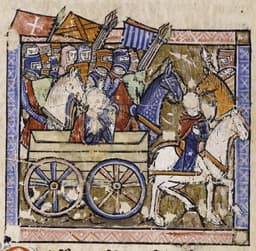
Joscelin I of Edessa
Emperor · Medieval
40.1Total

Napoleon Bonaparte
General · Modern
70.9Total
Basic Information
Born
1070
1769
Died
1131
1821
Era
Medieval
Modern
Nationality
County of Edessa
France
Occupation
Emperor
General
Civilization
Western
Western
Score Comparison
Military (10%)
55.0
94.0
Political (20%)
26.4
72.0
Influence (20%)
47.1
40.0
Legacy (20%)
38.3
80.0
Leadership (15%)
34.6
78.0
Strategy (15%)
41.0
90.0
TOTAL
40.1
70.9
Joscelin I of Edessa — Complete Timeline
1104 AD
Battle of HarranWar◆ Major
Joscelin I fought alongside Bohemond of Antioch at Harran against the Seljuks. The Crusader army was defeated, and Joscelin was captured, remaining a prisoner for several years, weakening the County of Edessa.
CrusadesBattleDefeatCapture
Impact: regionaltragic
1118 AD
Expansion of EdessaWar
After his release, Joscelin I expanded the County of Edessa eastward, capturing territory from the Seljuks. He seized lands around Turbessel and extended Crusader control into the Euphrates valley.
CrusadesExpansionEdessa
Impact: regionalconstructive
1125 AD
Battle of AzazWar◆ Major
Joscelin I led a coalition of Crusader forces to victory at Azaz against the Seljuk atabeg of Aleppo. The victory secured the northern frontier of the Crusader states and demonstrated Joscelin's military leadership.
CrusadesBattleVictory
Impact: regional
1131 AD
Death in BattleWar◆ Major
Joscelin I was mortally wounded while besieging a fortress near Aleppo. He died shortly after, leaving the County of Edessa to his son Joscelin II, whose weaker leadership would lead to the county's decline.
CrusadesDeathEdessa
Impact: regionaltragic
Napoleon Bonaparte — Complete Timeline
1799 AD
Coup of 18 BrumaireOther◆ Major
Napoleon Bonaparte, with support from his brother Lucien and key political figures, overthrew the Directory in a bloodless coup. He established the Consulate with himself as First Consul, effectively becoming the ruler of France. This event ended the French Revolution's most unstable period.
French RevolutionCoupRise to Power
Impact: regional
1804 AD
Promulgation of the Napoleonic CodeOther◆ Major
Napoleon enacted the Civil Code of the French, known as the Napoleonic Code, a comprehensive set of laws that replaced the fragmented feudal legal systems. The code established legal equality, protected property rights, and secularized law. It became the basis for legal systems in many European and world countries.
Legal ReformNapoleonic CodeCivil Law
Impact: globalconstructive
1805 AD
Battle of AusterlitzWar◆ Major
Napoleon's Grande Arm
Napoleonic WarsBattleDecisive Victory
Impact: global
1812 AD
Invasion of RussiaWar◆ Major
Napoleon led the Grande Arm
Napoleonic WarsInvasionDisaster
Impact: globaldestructive
1815 AD
Battle of WaterlooWar◆ Major
Napoleon's French army was defeated by the combined forces of the Duke of Wellington's Anglo-Allied army and Gebhard Leberecht von Bl
Napoleonic WarsBattleFinal Defeat
Impact: globaldestructive
Expert Analysis
joscelin-i-of-edessa-vs-napoleon-bonaparte
# The Emperor and the Count
On a June morning in 1815, Napoleon Bonaparte watched his Imperial Guard march into the valley of Waterloo, the elite of Europe's most formidable army advancing toward certain destruction. Ninety years earlier and a thousand miles east, another Western commander—Joscelin I of Edessa—lay mortally wounded beneath the walls of a minor Syrian fortress, his life bleeding out into the dust of a forgotten war. Both men fought for glory, both commanded men in the name of Christendom, and both met defeat. But between them lies a chasm not merely of centuries but of scale, ambition, and the very shape of history itself.
Origins
Napoleon Bonaparte was born in 1769 on the Mediterranean island of Corsica, a year after France purchased the island from Genoa. His family were minor Italian nobility, speaking Corsican dialect in a French-speaking world. This outsider's hunger—the relentless drive of the provincial boy who must conquer the capital—never left him. He entered military school at nine, completed artillery training at sixteen, and devoured Enlightenment philosophy alongside tactical manuals. His was an age of revolution, when birth mattered less than brilliance.
Joscelin I of Edessa, born around 1070, belonged to a different world entirely. He was a younger son of a Norman-French knightly family, the kind of man who had nothing to lose and everything to gain by riding east on the First Crusade. In the 1090s, when Jerusalem was still a Muslim city, the Crusader states were raw frontier kingdoms carved by the sword. Joscelin was not a product of schools or philosophies but of the saddle and the shield wall. His education came from battle, his opportunities from the chaos of holy war.
Rise to Power
Napoleon’s ascent was meteoric and political. In 1793, at age twenty-four, he drove the British from Toulon with a brilliant artillery deployment. By 1796, he commanded the Army of Italy and turned a starving, ragged force into a conquering machine. His victories in Italy forced Austria to sue for peace, and he returned to Paris a hero. In 1799, he staged a coup d'état, making himself First Consul. By 1804, he crowned himself Emperor of the French. Each step was calculated, each opportunity seized with cold precision.
Joscelin’s rise was slower and more brutal. He first appears in history around 1104 at the Battle of Harran, where he fought alongside Bohemond of Antioch against the Seljuk Turks. The Crusader army was annihilated; Joscelin was captured. He spent years in Muslim prisons, emerging in 1118 to find his cousin Baldwin II ruling Jerusalem. Through family loyalty and sheer endurance, Joscelin was granted the County of Edessa—the most exposed and vulnerable of the Crusader states, a Christian island in a sea of Islam. He had not seized power; he had inherited a death sentence.
Leadership & Governance
Napoleon governed as he fought: with speed, system, and total control. His Napoleonic Code unified French law, abolished feudal privileges, and established meritocracy. He built roads, standardized education, and created a centralized state that outlasted his empire. On the battlefield, his 93.0 strategy score reflects a mind that rewrote military doctrine—using massed artillery, rapid movement, and the corps system to defeat larger armies. His political score of 75.0, however, reveals his weakness: he could conquer Europe but could not pacify it. He alienated allies, provoked coalitions, and trusted no one.
Joscelin governed a frontier county with a population of perhaps fifty thousand, mostly Armenian Christians and Syrian Muslims. His political score of 54.5 reflects the grinding reality of Crusader rule: constant negotiation with local lords, uneasy alliances with neighboring Turkish emirs, and the ever-present threat of annihilation. His military score of 32.3 seems harsh until one remembers he lost Edessa itself. Yet at the Battle of Azaz in 1125, he led a coalition of Crusader forces to victory against the Seljuk atabeg of Aleppo, securing a decade of peace. He was not a great commander, but he was a survivor—and in the Crusader states, survival was genius.
Triumph & Tragedy
Napoleon’s greatest moment came in 1805 at Austerlitz, where he crushed the combined armies of Austria and Russia in a single day, destroying the Third Coalition. His greatest tragedy followed a decade later: the 1812 invasion of Russia, where he lost half a million men to winter, hunger, and Cossack raids. Then came exile to Elba, a brief return, and finally Waterloo on June 18, 1815—a defeat so complete that his name became synonymous with overreach.
Joscelin’s triumph was quieter. After Azaz in 1125, Edessa expanded eastward, capturing territory that had been lost for decades. He rebuilt fortresses, protected pilgrims, and kept the county alive against impossible odds. His tragedy came in 1131, when he was mortally wounded besieging a fortress near Aleppo. He died a few days later, leaving his son Joscelin II a realm already crumbling. Within thirteen years, Edessa would fall to the Turks, triggering the Second Crusade.
Character & Destiny
Napoleon was driven by what the French call *gloire*—a burning need for immortal fame. He once said, "Glory is fleeting, but obscurity is forever." This hunger made him unstoppable in victory but incapable of peace. He could not stop conquering because he could not stop proving himself. His personality—arrogant, micromanaging, suspicious—turned allies into enemies and victories into wars without end.
Joscelin was driven by something simpler: survival. He was a practical man in a world without room for dreamers. He negotiated with Muslims when necessary, fought when cornered, and spent his life defending a county that most Europeans had never heard of. His leadership score of 73.7 suggests a man who could inspire loyalty but not fear—a count, not an emperor. He died not in a palace but in the field, doing the only work he knew.
Legacy
Napoleon left behind a transformed Europe. His legal code governs much of the world today. His military innovations shaped warfare until the First World War. His legend—the little Corsican who conquered an empire—haunts French national identity. His influence score of 82.0 and legacy score of 78.0 reflect a man who, for better or worse, changed history’s direction.
Joscelin I left behind a crumbling tomb in the Syrian desert. His name appears in a handful of medieval chronicles, known only to specialists. His legacy is measured not in laws or empires but in the decades he bought for a doomed Christian kingdom. He was a footnote in a story that ended badly.
And yet, perhaps the comparison is unfair only if we insist that history judges by size. Napoleon conquered half of Europe; Joscelin held a single county. Napoleon changed the world; Joscelin could not even save his own city. But both men faced the same choice: to fight or to fade. Napoleon chose glory and got defeat. Joscelin chose duty and got oblivion. In the end, history remembers the emperor and forgets the count—but the count, at least, died doing what he believed was right. That, too, is a kind of victory.
Rankings
🥇
Napoleon BonaparteLeader
Mil: 94.0Pol: 72.0Inf: 40.0
70.9
🥈
Joscelin I of Edessa
Mil: 55.0Pol: 26.4Inf: 47.1
40.1
+30.8 behind
How This Comparison Works
Algorithm
Each figure is scored on 6 dimensions (0—100 scale) based on structured historical data: Military (10%), Political (20%), Influence (20%), Legacy (20%), Leadership (15%), Strategy (15%). The weighted total produces the final ranking.
Data Sources
Scores are computed from structured sub-indicators in the database. Scale factors adjust for era (Ancient ×0.85, Modern ×1.0) and civilization size (Eastern ×1.05, Other ×0.80) to account for differences in population and military scale.
Maximum 3 Figures
Comparisons are limited to 2—3 figures to ensure readability and statistical meaningfulness.
Error Margins
±5 points per dimension — Sub-scores are derived from historical records with inherent uncertainty. Two figures within 5 points on a dimension should be considered roughly equivalent in that area.
Total Score Accuracy
±3 points overall — The weighted combination of 6 dimensions produces a total score with approximately ±3 points of uncertainty. Differences of less than 3 points are not statistically significant— the figures are effectively tied.
Known Limitations
- Historical records are incomplete and uneven across civilizations
- Figures from oral-tradition societies may be underrepresented
- Occupation labels can misclassify multi-role figures
- Scores measure capability and impact, not moral character
- Quantitative scoring is a comparison tool, not absolute truth
Capability Radar
Military (10%) — Battles & Warfare
Battles
35
95
Win Rate
30
90
Expansion
40
95
Political (20%) — Governance & Reform
Reform
10
95
Diplomacy
25
80
Economy
15
85
Influence (20%) — Cultural & Global Reach
Cultural
15
85
Global
5
90
Legacy (20%) — Historical Impact
Historical
20
95
Longevity
10
90
Leadership (15%) — Power & Stability
Tenure
30
85
Stability
10
70
Strategy (15%) — Tactics & Innovation
Strategy
20
95
Tactics
25
98
Reform
5
92
Similar Comparisons
Comments & Discussion
Count-eater-17896/17/2026
Napoleon's ego writes checks his army couldn't cash at Waterloo. Sure, he had Grande Armée brilliance, but Joscelin I fought with what? A few hundred knights and local levies, holding Edessa against Turkish counterattacks for years. Any military historian knows Napoleon's strategic range dwarfed Joscelin's, but the Count's defensive grit against odds is underrated. Waterloo was a gamble lost; Joscelin died in a ditch from wounds. One built an empire, the other clung to a scrap of crusader dirt—s
数据屠夫6/17/2026
睁眼看看吧,拿破仑的人生就是一出精心策划的统计闹剧。他在滑铁卢投入了72,000人,损失了约25,000;而Joscelin I在1131年围攻中可能只带着不到500人去送人头。数据不会撒谎:拿破仑的战争以大规模伤亡为代价赢得了短暂的战略优势,而Joscelin则纯粹是运气差加上资源匮乏。别用光环骗自己,后者就是一介地方领主,跟皇帝比差了两个次元。
LatinAnArch6/17/2026
As a classics scholar, I relish the ironic symmetry: both men met their end under fortress walls, Joscelin from a tower collapse at Tel Bashir, Napoleon from exile isolation on Saint Helena. But context is everything. Napoleon commanded millions, bent Europe to his will, and left legal codes behind; Joscelin just held a county for two decades before it fell to Zengi. The Count's chivalric defiance is quaint, but the Emperor reshaped warfare and governance permanently. One's a footnote in Crusade
历史迷6/17/2026
别被那些宏大的叙事骗了,Joscelin I才是真正的中世纪硬汉。拿破仑用大炮和官僚系统碾压对手,胜之不武;而Joscelin在1097年攻城战中率骑从城墙坠落,硬是活了下来,还继续打了30年仗。他的败亡不是战略失败,而是一次意外塌方。皇帝呢?滑铁卢一败,直接退位流放。前者死在战场上,后者死在沙发上。谁更配得上“战士”二字?答案一目了然。
RedFlagGaribaldi6/17/2026
Revisionist take: both are overrated symbols of a dying age. Napoleon's imperial dreams crashed because he overreached to Moscow and broke himself in Spain—classic hubris. Joscelin got crushed because Crusader states were always unsustainable fantasy colonies. The Count lost Edessa in 1144 to Zengi after years of weak leadership, not heroics. Napoleon at least had the Corsican chip on his shoulder to fuel meritocracy; Joscelin was just a feudal thug with good timing. Neither deserves the pedesta