Loading...
This comparison has not been analyzed yet.
One-time AI generation (~1 minute). Scores and timeline are already available below.
Jose Marti vs Riek Machar
Jose Marti leads by 1.4 pts · 2 figures compared
…
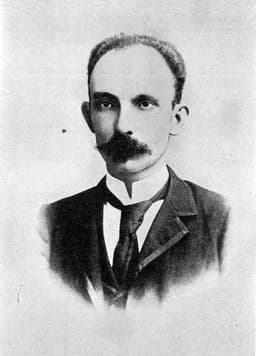
Jose Marti
Revolutionary · Modern
44.0Total

Riek Machar
Revolutionary · Modern
42.6Total
Basic Information
Born
1853
1953
Died
1895
—
Era
Modern
Modern
Nationality
Cuba
South Sudan
Occupation
Revolutionary
Revolutionary
Civilization
Western
Other
Score Comparison
Military (10%)
20.0
47.5
Political (20%)
33.6
35.1
Influence (20%)
59.0
47.1
Legacy (20%)
50.0
36.7
Leadership (15%)
40.9
51.9
Strategy (15%)
35.7
38.3
TOTAL
44.0
42.6
Jose Marti — Complete Timeline
1892 AD
Founding of the Cuban Revolutionary PartyPolitical Action
Marti founded the Cuban Revolutionary Party (PRC) in New York, uniting Cuban exiles. The party aimed to achieve Cuban independence from Spain through armed struggle and democratic governance.
Political OrganizationIndependence MovementExile
Impact: nationalprogressive
1895 AD
Battle of Dos RiosWar
Marti was killed in action at Dos Rios while fighting Spanish forces. His death made him a martyr for Cuban independence and galvanized the revolutionary movement, though it deprived the cause of its civilian leader.
BattleDeathMartyrdom
Impact: nationaltragic
Manifesto of MontecristiPolitical Action◆ Major
Marti and General Maximo Gomez signed the Manifesto of Montecristi, outlining the goals of the Cuban War of Independence. It called for racial equality, civilian control of the military, and a democratic republic.
ManifestoWar GoalsIndependence
Impact: nationalprogressive
Riek Machar — Complete Timeline
2005 AD
Appointed Vice President of South SudanPolitical Action◆ Major
Riek Machar was appointed Vice President of the Government of Southern Sudan under the Comprehensive Peace Agreement. He served alongside President Salva Kiir in the lead-up to independence.
Peace ProcessSouth SudanLeadership
Impact: national
2013 AD
Led the SPLM-IO RebellionWar◆ Major
After being accused of plotting a coup, Riek Machar fled to the bush and formed the Sudan People's Liberation Movement-in-Opposition (SPLM-IO). He led a rebellion against President Salva Kiir's government, sparking the South Sudanese Civil War.
RebellionCivil WarSouth Sudan
Impact: regionaldestructive
2020 AD
Returned as Vice President under Peace DealPolitical Action◆ Major
Riek Machar returned to Juba and was sworn in as First Vice President of South Sudan as part of the Revitalized Peace Agreement. The unity government aimed to end the civil war, but implementation remained fragile.
Peace AgreementUnity GovernmentSouth Sudan
Impact: nationalconstructive
This comparison has not been analyzed yet.
One-time AI generation (~1 minute). Scores and timeline are already available below.
Rankings
🥇
Jose MartiLeader
Mil: 20.0Pol: 33.6Inf: 59.0
44.0
🥈
Riek Machar
Mil: 47.5Pol: 35.1Inf: 47.1
42.6
+1.4 behind
How This Comparison Works
Algorithm
Each figure is scored on 6 dimensions (0—100 scale) based on structured historical data: Military (10%), Political (20%), Influence (20%), Legacy (20%), Leadership (15%), Strategy (15%). The weighted total produces the final ranking.
Data Sources
Scores are computed from structured sub-indicators in the database. Scale factors adjust for era (Ancient ×0.85, Modern ×1.0) and civilization size (Eastern ×1.05, Other ×0.80) to account for differences in population and military scale.
Maximum 3 Figures
Comparisons are limited to 2—3 figures to ensure readability and statistical meaningfulness.
Error Margins
±5 points per dimension — Sub-scores are derived from historical records with inherent uncertainty. Two figures within 5 points on a dimension should be considered roughly equivalent in that area.
Total Score Accuracy
±3 points overall — The weighted combination of 6 dimensions produces a total score with approximately ±3 points of uncertainty. Differences of less than 3 points are not statistically significant— the figures are effectively tied.
Known Limitations
- Historical records are incomplete and uneven across civilizations
- Figures from oral-tradition societies may be underrepresented
- Occupation labels can misclassify multi-role figures
- Scores measure capability and impact, not moral character
- Quantitative scoring is a comparison tool, not absolute truth
Capability Radar
Military (10%) — Battles & Warfare
Battles
15
35
Win Rate
10
30
Expansion
10
25
Political (20%) — Governance & Reform
Reform
40
30
Diplomacy
45
40
Economy
15
20
Influence (20%) — Cultural & Global Reach
Cultural
70
25
Global
55
25
Legacy (20%) — Historical Impact
Historical
65
30
Longevity
60
20
Leadership (15%) — Power & Stability
Tenure
20
55
Stability
10
10
Strategy (15%) — Tactics & Innovation
Strategy
25
35
Tactics
20
40
Reform
30
20
Similar Comparisons
Comments & Discussion
No comments yet. Be the first to share your thoughts!