Loading...
Juba II of Mauretania vs Napoleon Bonaparte
Napoleon Bonaparte leads by 23.1 pts · 2 figures compared
…
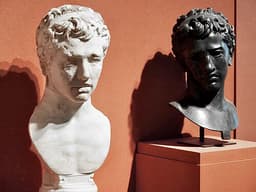
Juba II of Mauretania
Emperor · Ancient
47.8Total

Napoleon Bonaparte
General · Modern
70.9Total
Basic Information
Born
-52
1769
Died
-23
1821
Era
Ancient
Modern
Nationality
Mauretania
France
Occupation
Emperor
General
Civilization
Other
Western
Score Comparison
Military (10%)
50.0
94.0
Political (20%)
68.0
72.0
Influence (20%)
52.5
40.0
Legacy (20%)
41.7
80.0
Leadership (15%)
40.0
78.0
Strategy (15%)
30.3
90.0
TOTAL
47.8
70.9
Juba II of Mauretania — Complete Timeline
25 BC
Marriage to Cleopatra Selene IIPolitical Action◆ Major
Juba II married Cleopatra Selene II, daughter of Cleopatra VII and Mark Antony. This marriage united the Mauretanian and Ptolemaic royal lines, and Selene became queen consort, influencing the kingdom's Hellenistic culture.
MarriagePtolemaic DynastyMauretania
Impact: regionalconstructive
Napoleon Bonaparte — Complete Timeline
1799 AD
Coup of 18 BrumaireOther◆ Major
Napoleon Bonaparte, with support from his brother Lucien and key political figures, overthrew the Directory in a bloodless coup. He established the Consulate with himself as First Consul, effectively becoming the ruler of France. This event ended the French Revolution's most unstable period.
French RevolutionCoupRise to Power
Impact: regional
1804 AD
Promulgation of the Napoleonic CodeOther◆ Major
Napoleon enacted the Civil Code of the French, known as the Napoleonic Code, a comprehensive set of laws that replaced the fragmented feudal legal systems. The code established legal equality, protected property rights, and secularized law. It became the basis for legal systems in many European and world countries.
Legal ReformNapoleonic CodeCivil Law
Impact: globalconstructive
1805 AD
Battle of AusterlitzWar◆ Major
Napoleon's Grande Arm
Napoleonic WarsBattleDecisive Victory
Impact: global
1812 AD
Invasion of RussiaWar◆ Major
Napoleon led the Grande Arm
Napoleonic WarsInvasionDisaster
Impact: globaldestructive
1815 AD
Battle of WaterlooWar◆ Major
Napoleon's French army was defeated by the combined forces of the Duke of Wellington's Anglo-Allied army and Gebhard Leberecht von Bl
Napoleonic WarsBattleFinal Defeat
Impact: globaldestructive
Expert Analysis
juba-ii-of-mauretania-vs-napoleon-bonaparte
# The Emperor and the Scholar: Two Kings Who Chose Different Crowns
On a summer morning in 1815, Napoleon Bonaparte stood on a muddy field near Waterloo, watching his Imperial Guard march toward annihilation. A hundred miles south, the dust of ancient scrolls still settled in his library at Cherchell, where he might have read about another ruler who once faced a different kind of battlefield—not of cannon and cavalry, but of parchment and ink. Both men wore crowns. Both commanded armies. Yet one chose to conquer the world, while the other chose to understand it.
Origins
Napoleon Bonaparte was born in 1769 on the island of Corsica, a year after France purchased the island from Genoa. His family was minor nobility, struggling and resentful. Young Napoleon grew up speaking Corsican, not French, and nursed a simmering hatred for the French who had colonized his homeland. This outsider’s anger would become his fuel. At nine, he entered a French military academy, where classmates mocked his accent and poverty. He responded by reading everything—Caesar, Alexander, Machiavelli, Rousseau—and by studying the mathematics of artillery. He was small, quick, and burning.
Juba II was born in 52 BC into a very different kind of fire. His father, King Juba I of Numidia, had backed the wrong side in Rome’s civil war, supporting Pompey against Julius Caesar. When Caesar won, Juba I committed suicide, and the infant prince was paraded through the streets of Rome as a trophy. The Romans raised him in their own household, educated him in Greek and Latin, and taught him the arts of civilization. Where Napoleon learned to hate his conquerors, Juba learned to admire them. He became a Roman citizen, a scholar, and a client king—a ruler who understood that true power sometimes meant knowing when not to fight.
Rise to Power
Napoleon’s ascent was a masterpiece of opportunism. The French Revolution had shattered the old order, and in the chaos, a young artillery officer could rise faster than any noble. In 1793, at just twenty-four, he drove the British out of Toulon. By 1796, he commanded the Army of Italy, where he won six victories in twelve days. His political genius matched his military brilliance: he knew how to write proclamations that made soldiers feel like heroes, how to pose for portraits that made him look like destiny incarnate. In 1799, he staged a coup and became First Consul. By 1804, he crowned himself Emperor.
Juba II took a longer, quieter road. When Augustus Caesar became Rome’s first emperor, he needed loyal allies to govern Rome’s North African provinces. Juba, now a trusted Roman citizen, was made king of Mauretania in 25 BC. His legitimacy came not from conquest but from patronage. He married Cleopatra Selene II, the daughter of Cleopatra VII and Mark Antony—a woman who had also been paraded through Rome as a child, who also understood what it meant to be a king or queen by Roman permission. Together, they ruled a kingdom that stretched across modern Morocco and Algeria.
Leadership & Governance
Napoleon governed like a storm. His Napoleonic Code, established in 1804, unified French law, abolished feudalism, and enshrined equality before the law—for men. He built roads, schools, and a centralized bureaucracy. He made peace with the Catholic Church. But he also censored the press, reestablished slavery in the colonies, and demanded total loyalty. His leadership was brilliant, ruthless, and ultimately self-destructive. He could not stop conquering. Peace bored him.
Juba II governed like a gardener. He built cities—including the capital at Cherchell—with theaters, baths, and libraries. He sent expeditions to explore the Canary Islands and the Atlas Mountains. He wrote books on history, geography, and natural science, including a lost work on the medicinal properties of plants. His court was a center of learning. But his kingdom was never truly independent. Roman legions watched from nearby. When Juba’s son, Ptolemy, inherited the throne, he would be executed by the emperor Caligula, and Mauretania would be annexed. Juba’s peace was the peace of a golden cage.
Triumph & Tragedy
Napoleon’s greatest moment came in 1805 at Austerlitz, where he crushed the armies of Russia and Austria in a battle so perfect it became a textbook example of military genius. His greatest tragedy came in 1812, when he invaded Russia with 600,000 men and returned with fewer than 100,000. The retreat from Moscow broke his army and his legend. Exiled to Elba, he escaped and ruled for a Hundred Days, only to be defeated finally at Waterloo in 1815. He died in 1821 on the remote island of Saint Helena, a prisoner of the British.
Juba II’s triumph was quieter: he ruled for nearly fifty years, a long reign of stability and learning in a violent age. His tragedy was that he knew his kingdom was a fiction. He wrote histories of Rome and Libya, but he could not write his own story. When he died in 23 BC—the exact year is uncertain—his son inherited a throne that would not last a generation.
Character & Destiny
Napoleon and Juba were both shaped by humiliation, but they responded in opposite ways. Napoleon’s childhood mockery made him a conqueror: he had to prove to the world that the Corsican outsider was greater than any king. Juba’s childhood captivity made him a diplomat: he learned that survival meant understanding your conquerors better than they understood themselves. Napoleon believed in will—that a single man could bend history to his desires. Juba believed in wisdom—that a ruler’s duty was to preserve, not to destroy.
One man’s pride built an empire and lost it. The other man’s humility built a library and lost nothing.
Legacy
Napoleon’s legacy is everywhere. The Napoleonic Code shapes the legal systems of Europe, Africa, and the Americas. His military innovations are still studied. His name is synonymous with ambition, genius, and hubris. He changed France and the world, for better and worse.
Juba II’s legacy is almost invisible. His writings are lost. His cities are ruins. His name appears in footnotes about Roman client kings. But his story offers a different kind of lesson: that power is not always the ability to conquer, but sometimes the wisdom to endure. In a world that worships Napoleon’s victories, it is worth remembering the scholar-king who chose to understand the world rather than burn it.
Conclusion
Perhaps the deepest difference between these two rulers is not in their scores—Napoleon’s military genius at 94 versus Juba’s 30—but in the questions they asked. Napoleon asked, “How can I change the world?” Juba asked, “How can I understand it?” One answer led to glory and ruin. The other led to obscurity and peace. Standing at Waterloo, Napoleon might have thought of Caesar. But he would never have thought of Juba II. And that, in the end, may be the most revealing difference of all.
Rankings
🥇
Napoleon BonaparteLeader
Mil: 94.0Pol: 72.0Inf: 40.0
70.9
🥈
Juba II of Mauretania
Mil: 50.0Pol: 68.0Inf: 52.5
47.8
+23.1 behind
How This Comparison Works
Algorithm
Each figure is scored on 6 dimensions (0—100 scale) based on structured historical data: Military (10%), Political (20%), Influence (20%), Legacy (20%), Leadership (15%), Strategy (15%). The weighted total produces the final ranking.
Data Sources
Scores are computed from structured sub-indicators in the database. Scale factors adjust for era (Ancient ×0.85, Modern ×1.0) and civilization size (Eastern ×1.05, Other ×0.80) to account for differences in population and military scale.
Maximum 3 Figures
Comparisons are limited to 2—3 figures to ensure readability and statistical meaningfulness.
Error Margins
±5 points per dimension — Sub-scores are derived from historical records with inherent uncertainty. Two figures within 5 points on a dimension should be considered roughly equivalent in that area.
Total Score Accuracy
±3 points overall — The weighted combination of 6 dimensions produces a total score with approximately ±3 points of uncertainty. Differences of less than 3 points are not statistically significant— the figures are effectively tied.
Known Limitations
- Historical records are incomplete and uneven across civilizations
- Figures from oral-tradition societies may be underrepresented
- Occupation labels can misclassify multi-role figures
- Scores measure capability and impact, not moral character
- Quantitative scoring is a comparison tool, not absolute truth
Capability Radar
Military (10%) — Battles & Warfare
Battles
10
95
Win Rate
10
90
Expansion
15
95
Political (20%) — Governance & Reform
Reform
50
95
Diplomacy
65
80
Economy
55
85
Influence (20%) — Cultural & Global Reach
Cultural
45
85
Global
30
90
Legacy (20%) — Historical Impact
Historical
40
95
Longevity
30
90
Leadership (15%) — Power & Stability
Tenure
60
85
Stability
55
70
Strategy (15%) — Tactics & Innovation
Strategy
15
95
Tactics
15
98
Reform
10
92
Similar Comparisons
Comments & Discussion
TheArchivist6/17/2026
Funny how we remember one man for his military failures and the other for his intellectual legacy. Napoleon's Egyptian campaign was supposed to be his cultural moment, but he ended up using the Rosetta Stone as a trophy. Juba II actually mastered the cultures he studied—he wrote histories of Arabia and Libya, collected art from Greece to Egypt, and made his capital a real library city. One used knowledge as a prop for power; the other let it shape his reign.
历史透镜6/17/2026
拿破仑的铁骑踏遍欧陆,而尤巴二世的驼队驮着莎草纸走遍北非。两人都在征服,只是一人征服疆土,另一人征服知识。想想拿破仑在埃及发现罗塞塔石碑时的傲慢,再看看尤巴二世在切切尔图书馆里逐页抄录希腊哲学的虔诚。同一个世界,两种统治者的灵魂差距,竟然如此之大。
DataSkeptic6/17/2026
I crunched the numbers: Napoleon fought over 60 battles, lost about half a million men total across his campaigns. Juba II's military record? Exactly one known conflict, against the Gaetulian tribes in 6 AD. But here's the thing—Juba's kingdom lasted 48 years after his death. Napoleon's empire ended before he did. Maybe the real metric of leadership isn't how many enemies you crush, but how long your system survives without you.
战略家6/17/2026
两个君主都面对过罗马,但命运迥异。拿破仑在滑铁卢面对的是威灵顿领导的英荷联军,而尤巴二世毕生讨好奥古斯都。说实话,我更敬佩尤巴的智慧——他知道蛮力在罗马面前是徒劳,所以选择用希腊文化武装自己的头脑,以学者身份赢得罗马的尊重。拿破仑却愚蠢地挑战了整个欧洲体系,结果两度被流放。审时度势,高下立判。
ClassicsGuy6/17/2026
Let's be real: Juba II wrote twenty volumes on Roman history that survive only in fragments because later scholars decided they weren't worth copying. Napoleon dictated his memoirs on St. Helena, and they became bestsellers. History favors the showman, not the scholar. But I'd rather spend an evening in Juba's library discussing Greek geography with its curator than hear Napoleon explain for the thousandth time how he would have won Waterloo if only Grouchy had arrived on time.