Loading...
Juba II vs Napoleon Bonaparte
Napoleon Bonaparte leads by 21.0 pts · 2 figures compared
…
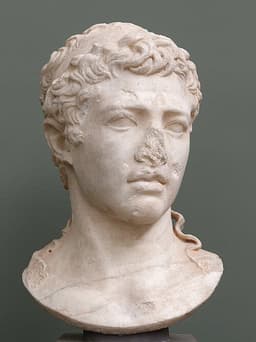
Juba II
Emperor · Ancient
49.9Total

Napoleon Bonaparte
General · Modern
70.9Total
Basic Information
Born
-48
1769
Died
23
1821
Era
Ancient
Modern
Nationality
Mauretania
France
Occupation
Emperor
General
Civilization
Other
Western
Score Comparison
Military (10%)
50.0
94.0
Political (20%)
46.6
72.0
Influence (20%)
52.5
40.0
Legacy (20%)
42.5
80.0
Leadership (15%)
74.0
78.0
Strategy (15%)
30.3
90.0
TOTAL
49.9
70.9
Juba II — Complete Timeline
25 BC
Marriage to Cleopatra Selene IIPolitical Action◆ Major
Juba II married Cleopatra Selene II, daughter of Cleopatra VII and Mark Antony. The marriage was arranged by Augustus to unite the client kingdoms of Mauretania and Numidia under a loyal couple, consolidating Roman influence in North Africa.
Marriage AllianceRoman Client KingdomNorth Africa
Impact: regionalconstructive
Reign as King of MauretaniaPolitical Action◆ Major
Augustus appointed Juba II as king of Mauretania, a Roman client kingdom. Juba ruled for nearly 50 years, promoting Romanization, urban development, and trade. He established the capital at Caesarea (modern Cherchell) and fostered cultural exchange.
KingshipRomanizationUrban Development
Impact: regionalconstructive
20 BC
Publication of Scholarly WorksCultural◆ Major
Juba II wrote numerous scholarly works in Greek on history, geography, natural history, and art. His writings, though mostly lost, were cited by later authors like Pliny the Elder and Plutarch. He was considered one of the most learned kings of antiquity.
ScholarshipGreek LiteratureNatural History
Impact: regionalconstructive
10 BC
Expedition to the Canary IslandsOther
Juba II sent an expedition to the Canary Islands, which he named after the large dogs (canes) found there. He described the islands in his writings, providing one of the earliest known accounts of the archipelago. This expedition expanded geographical knowledge.
ExplorationGeographyCanary Islands
Impact: regionalconstructive
Napoleon Bonaparte — Complete Timeline
1799 AD
Coup of 18 BrumaireOther◆ Major
Napoleon Bonaparte, with support from his brother Lucien and key political figures, overthrew the Directory in a bloodless coup. He established the Consulate with himself as First Consul, effectively becoming the ruler of France. This event ended the French Revolution's most unstable period.
French RevolutionCoupRise to Power
Impact: regional
1804 AD
Promulgation of the Napoleonic CodeOther◆ Major
Napoleon enacted the Civil Code of the French, known as the Napoleonic Code, a comprehensive set of laws that replaced the fragmented feudal legal systems. The code established legal equality, protected property rights, and secularized law. It became the basis for legal systems in many European and world countries.
Legal ReformNapoleonic CodeCivil Law
Impact: globalconstructive
1805 AD
Battle of AusterlitzWar◆ Major
Napoleon's Grande Arm
Napoleonic WarsBattleDecisive Victory
Impact: global
1812 AD
Invasion of RussiaWar◆ Major
Napoleon led the Grande Arm
Napoleonic WarsInvasionDisaster
Impact: globaldestructive
1815 AD
Battle of WaterlooWar◆ Major
Napoleon's French army was defeated by the combined forces of the Duke of Wellington's Anglo-Allied army and Gebhard Leberecht von Bl
Napoleonic WarsBattleFinal Defeat
Impact: globaldestructive
Expert Analysis
juba-ii-vs-napoleon-bonaparte
# The Conqueror and the Scholar-King
In the winter of 1815, Napoleon Bonaparte stood on the deck of a British warship, watching the coast of France dissolve into the gray Atlantic. He was a prisoner now, bound for a rocky island in the South Atlantic where he would die six years later, at age fifty-one. Nearly eighteen centuries earlier, another king had sailed from the same region of the world—not into exile, but toward a kingdom he would rule for half a century. Juba II, a Numidian prince raised in Rome, had crossed the Mediterranean to govern Mauretania, a client state of the empire that had conquered his father. One man had tried to conquer Europe and failed; the other had accepted Roman domination and flourished. What made the difference? The answer lies not merely in their circumstances, but in the deepest currents of their character and their age.
Origins
Napoleon was born in 1769 on the island of Corsica, a year after France purchased the island from Genoa. His family belonged to the minor nobility—impoverished, ambitious, and resentful of French rule. From childhood, he carried a sense of being an outsider, a provincial among the Parisian elite. The French Revolution, which erupted when he was twenty, shattered the old order and opened paths that birth alone could never have granted. He seized them with ferocious energy.
Juba II was born in 48 BC, the son of King Juba I of Numidia, a North African kingdom that had sided with Pompey against Julius Caesar. When Caesar triumphed, Juba I committed suicide, and his infant son was paraded through Rome in a golden cage as a trophy of war. The boy was then raised in the household of Caesar’s heir, Octavian—the future Emperor Augustus. Juba learned Latin and Greek, absorbed Roman law and philosophy, and grew into a scholar. He was not an outsider; he was a hostage who became an insider, a man who understood that survival meant mastering the culture of his captors.
Rise to Power
Napoleon’s ascent was meteoric. At twenty-four, he drove the British out of Toulon; at twenty-six, he crushed a royalist uprising in Paris with a “whiff of grapeshot”; at twenty-seven, he led a brilliant campaign in Italy, forcing Austria to sue for peace. Each victory fed the next. By 1799, at age thirty, he was First Consul of France; by 1804, Emperor. His rise was a story of will, genius, and the chaos of revolution—a chaos he both exploited and tamed.
Juba’s rise was quieter, but no less remarkable. In 25 BC, Augustus appointed him king of Mauretania, a vast territory stretching across modern Morocco and Algeria. The appointment was a calculated act of Roman policy: place a loyal, educated client on the throne, and let him govern in Rome’s interest. Juba accepted. He had no army to speak of, no revolutionary fervor, no dream of independence. What he had was patience, intelligence, and the understanding that his kingdom’s survival depended on pleasing Augustus.
Leadership & Governance
Napoleon ruled through conquest and reform. His military genius was staggering—he fought more than sixty battles and lost only seven, a record that still awes historians. His strategy, captured in the maxim “I may lose a battle, but I shall never lose a minute,” relied on speed, deception, and the decisive concentration of force. But his political wisdom was more fragile. He centralized the French state, created the Napoleonic Code, and modernized education and administration. Yet he also crowned himself emperor, placed his brothers on European thrones, and provoked endless wars that bled France dry.
Juba ruled through accommodation and culture. He built a capital at Caesarea (modern Cherchell, Algeria), adorned with Roman-style temples, theaters, and libraries. He issued coins bearing his image alongside that of Augustus, a constant reminder of his allegiance. He promoted agriculture, trade, and the spread of Roman customs. His most lasting act was scholarly: he wrote dozens of books on history, geography, natural history, and art, all in Greek. He sent an expedition to the Canary Islands in 10 BC, naming them for the large dogs (canes) found there—a name that survives to this day. His military record, by contrast, was negligible; his strategy score of 30.0 reflects a king who never needed to fight.
Triumph & Tragedy
Napoleon’s greatest moment was the Battle of Austerlitz in 1805, where he destroyed a combined Russian and Austrian army, cementing his reputation as the greatest commander of his age. His greatest tragedy was the invasion of Russia in 1812. He marched six hundred thousand men into the vastness of the eastern steppes; fewer than forty thousand returned. The disaster broke his aura of invincibility and set the stage for his abdication in 1814, his return in 1815, and his final defeat at Waterloo.
Juba’s triumph was subtler: he ruled Mauretania for nearly fifty years, died in his bed in 23 AD, and left a kingdom that remained stable and prosperous under Roman suzerainty. His tragedy was that almost none of his writings survive—only fragments quoted by later authors. He was a scholar-king whose scholarship was lost to time, remembered more for his marriage to Cleopatra Selene II, daughter of Cleopatra VII and Mark Antony, than for his own intellectual labors.
Character & Destiny
Napoleon was driven by a relentless hunger for glory. “I live only for posterity,” he once said. “Death is nothing, but to live defeated and without glory is to die every day.” This ambition made him a conqueror, but it also made him incapable of compromise. He could not stop, could not consolidate, could not accept that even genius has limits. His destiny was to rise higher than any man of his era—and to fall harder.
Juba was driven by a different force: the will to survive and adapt. He had learned in childhood that resistance meant death. So he chose collaboration, scholarship, and the slow work of building a kingdom within the empire’s shadow. His destiny was not glory but endurance. He left no legend of conquest, but he left a stable realm and a body of knowledge that, though lost, once enriched the intellectual life of the ancient world.
Legacy
Napoleon’s legacy is immense and contradictory. He spread the ideals of the French Revolution—legal equality, secular government, meritocracy—across Europe, but he also revived monarchy and waged wars of aggression. The Napoleonic Code still influences legal systems worldwide. His military innovations shaped modern warfare. He is remembered as both a liberator and a tyrant, a genius and a cautionary tale.
Juba’s legacy is quieter. He is remembered by historians as a model client king, a bridge between Roman and African cultures, and a scholar whose work illuminated the natural world of his time. His name survives in the Canary Islands and in the pages of Pliny the Elder, who drew on his writings. He is not a household name, but he represents something rare: a ruler who used knowledge, not force, to secure his place in history.
Conclusion
Standing on that British ship in 1815, Napoleon could look back on a life of unparalleled ambition and catastrophic defeat. Juba II, looking out from his palace in Caesarea, could see a kingdom at peace, a library of his own works, and the knowledge that he had played the hand he was dealt with quiet mastery. One man tried to remake the world in his image and failed. The other accepted the world as it was and made it his own. Which was wiser? The answer, perhaps, depends on whether one values the blaze of a falling star or the steady light of a lamp that burns for half a century.
Rankings
🥇
Napoleon BonaparteLeader
Mil: 94.0Pol: 72.0Inf: 40.0
70.9
🥈
Juba II
Mil: 50.0Pol: 46.6Inf: 52.5
49.9
+21.0 behind
How This Comparison Works
Algorithm
Each figure is scored on 6 dimensions (0—100 scale) based on structured historical data: Military (10%), Political (20%), Influence (20%), Legacy (20%), Leadership (15%), Strategy (15%). The weighted total produces the final ranking.
Data Sources
Scores are computed from structured sub-indicators in the database. Scale factors adjust for era (Ancient ×0.85, Modern ×1.0) and civilization size (Eastern ×1.05, Other ×0.80) to account for differences in population and military scale.
Maximum 3 Figures
Comparisons are limited to 2—3 figures to ensure readability and statistical meaningfulness.
Error Margins
±5 points per dimension — Sub-scores are derived from historical records with inherent uncertainty. Two figures within 5 points on a dimension should be considered roughly equivalent in that area.
Total Score Accuracy
±3 points overall — The weighted combination of 6 dimensions produces a total score with approximately ±3 points of uncertainty. Differences of less than 3 points are not statistically significant— the figures are effectively tied.
Known Limitations
- Historical records are incomplete and uneven across civilizations
- Figures from oral-tradition societies may be underrepresented
- Occupation labels can misclassify multi-role figures
- Scores measure capability and impact, not moral character
- Quantitative scoring is a comparison tool, not absolute truth
Capability Radar
Military (10%) — Battles & Warfare
Battles
15
95
Win Rate
10
90
Expansion
10
95
Political (20%) — Governance & Reform
Reform
30
95
Diplomacy
60
80
Economy
40
85
Influence (20%) — Cultural & Global Reach
Cultural
45
85
Global
30
90
Legacy (20%) — Historical Impact
Historical
40
95
Longevity
35
90
Leadership (15%) — Power & Stability
Tenure
55
85
Stability
50
70
Strategy (15%) — Tactics & Innovation
Strategy
15
95
Tactics
20
98
Reform
5
92
Similar Comparisons
Comments & Discussion
CorsicanCannonball6/17/2026
Military historian here: let's be clear — comparing Juba II to Napoleon is like comparing a well-behaved library mouse to a hurricane. Napoleon turned Corsican rage into the Grand Armée, rewriting warfare with mass conscription and corps d'armée. Juba II inherited a cushy client kingdom because Rome liked his education. Sure, he wrote books on botany, but he never levied an army or fought a real campaign. Napoleon had the balls and tactical genius to nearly conquer Europe. Don't romanticize the
毒舌哲学家6/17/2026
你们这群人就是喜欢把失败者美化成悲剧英雄。拿破仑在滑铁卢输得底裤都不剩,然后被流放圣赫勒拿岛,到死都要跟英国看守吵架。反观朱巴二世,人家小日子过得多滋润?写写书,搞搞科学,当文化人,还活得比拿破仑久多了。说白了,拿破仑就是一根筋想征服,结果把自己玩没了;朱巴二世懂得适时躺平,这才是真智慧。别拿那种中二病当英雄。|
PhilosopherKiller6/17/2026
Stop the press — Juba II was a Stoic king who actually *read* books, not just burned them or banned them. He wrote about history, geography, and theater, and his court in Caesarea was a real intellectual hub. Napoleon, by contrast, was a thin-skinned tyrant who marched millions to death for his ego. Let’s be honest: one man built a library, the other built a grave. I know which legacy I’d rather have. Juba II is the quiet victor here.|
古罗马卷王迷弟6/17/2026
我旗帜鲜明站朱巴二世!你们根本不懂他多屌:他从小在罗马长大,跟凯撒的养子屋大维是好兄弟,学的是希腊罗马经典,写的是《非洲史》《阿非利加志》这种硬核专著。你以为他只是个傀儡国王?错!他在自己的王国搞城市化、推广希腊文化、甚至支持公共剧场,实打实的文明建设者。拿破仑就是个暴发户,靠打仗抢了点荣誉,最后还不是孤岛吃土。治世比乱世难多了,兄弟。|
SkepticalOfHype6/17/2026
Before we crown either, let's step back. The comparison itself is warped by selection bias — we're cherry-picking an obscure African scholar-king and a European military titan. Why not pair Napoleon with Caesar? Or Juba II with Marcus Aurelius? This feels like a TED Talk trying too hard to be clever. In reality, both men were products of very different power structures. Napoleon built a military machine, Juba II built stability. Neither is objectively "better." Let's quit the false dichotomies.