Loading...
Junius Richard Jayewardene vs Napoleon Bonaparte
Napoleon Bonaparte leads by 9.9 pts · 2 figures compared
…
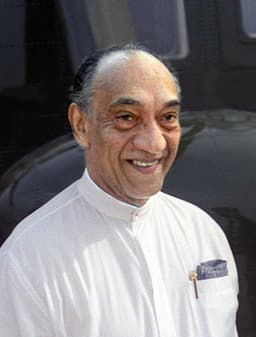
Junius Richard Jayewardene
Politician · Modern
61.0Total

Napoleon Bonaparte
General · Modern
70.9Total
Basic Information
Born
1906
1769
Died
1996
1821
Era
Modern
Modern
Nationality
Sri Lanka
France
Occupation
Politician
General
Civilization
Indian
Western
Score Comparison
Military (10%)
43.0
94.0
Political (20%)
72.0
72.0
Influence (20%)
59.0
40.0
Legacy (20%)
54.0
80.0
Leadership (15%)
78.0
78.0
Strategy (15%)
60.0
90.0
TOTAL
61.0
70.9
Junius Richard Jayewardene — Complete Timeline
1971 AD
Suppressed the 1971 JVP InsurrectionWar◆ Major
As Prime Minister, Jayewardene oversaw the military response to the Janatha Vimukthi Peramuna (JVP) uprising. The government declared a state of emergency, deployed the army, and crushed the insurrection within months, resulting in thousands of deaths and mass arrests.
JVP UprisingState RepressionEmergency Rule
Impact: nationaldestructive
1977 AD
Opened the Economy to Free Market ReformsReform◆ Major
After winning the 1977 general election, Jayewardene's UNP government implemented sweeping economic liberalization. They removed import controls, devalued the rupee, promoted foreign investment, and established the Greater Colombo Economic Commission to create export processing zones.
Economic LiberalizationOpen EconomyFree Market
Impact: nationalprogressive
1978 AD
Introduced Executive PresidencyReform
Jayewardene's government passed the 1978 Constitution, replacing the Westminster-style parliamentary system with an executive presidency. He became the first Executive President of Sri Lanka, concentrating significant power in the presidency, including control over the cabinet and judiciary.
Constitutional ReformExecutive PresidencyPower Centralization
Impact: national
1983 AD
Declared the 1983 Black July PogromPolitical Action
Following the LTTE ambush that killed 13 soldiers, Jayewardene's government did not deploy the military to stop anti-Tamil riots. Over several days, Sinhalese mobs killed thousands of Tamils in Colombo and elsewhere, destroying property. The pogrom radicalized the Tamil separatist movement.
Black JulyAnti-Tamil RiotsCivil War Escalation
Impact: nationaltragic
1987 AD
Signed the Indo-Sri Lanka AccordPolitical Action◆ Major
Jayewardene signed the Indo-Sri Lanka Peace Accord with Indian Prime Minister Rajiv Gandhi. The accord aimed to end the Sri Lankan Civil War by devolving power to Tamil provinces and deploying the Indian Peace Keeping Force (IPKF) to disarm the LTTE.
Peace AccordIndian InterventionCivil War
Impact: regional
Napoleon Bonaparte — Complete Timeline
1799 AD
Coup of 18 BrumaireOther◆ Major
Napoleon Bonaparte, with support from his brother Lucien and key political figures, overthrew the Directory in a bloodless coup. He established the Consulate with himself as First Consul, effectively becoming the ruler of France. This event ended the French Revolution's most unstable period.
French RevolutionCoupRise to Power
Impact: regional
1804 AD
Promulgation of the Napoleonic CodeOther◆ Major
Napoleon enacted the Civil Code of the French, known as the Napoleonic Code, a comprehensive set of laws that replaced the fragmented feudal legal systems. The code established legal equality, protected property rights, and secularized law. It became the basis for legal systems in many European and world countries.
Legal ReformNapoleonic CodeCivil Law
Impact: globalconstructive
1805 AD
Battle of AusterlitzWar◆ Major
Napoleon's Grande Arm
Napoleonic WarsBattleDecisive Victory
Impact: global
1812 AD
Invasion of RussiaWar◆ Major
Napoleon led the Grande Arm
Napoleonic WarsInvasionDisaster
Impact: globaldestructive
1815 AD
Battle of WaterlooWar◆ Major
Napoleon's French army was defeated by the combined forces of the Duke of Wellington's Anglo-Allied army and Gebhard Leberecht von Bl
Napoleonic WarsBattleFinal Defeat
Impact: globaldestructive
Expert Analysis
junius-richard-jayewardene-vs-napoleon-bonaparte
# The Emperor and the President: Two Paths to Power, Two Legacies of Ruin
On a June morning in 1815, Napoleon Bonaparte stood on a muddy field near Waterloo, watching his Imperial Guard march into cannon fire for the last time. A century and a half later, on a July night in 1983, Junius Richard Jayewardene sat in a Colombo mansion, choosing not to send troops as Colombo burned in the worst ethnic violence the island had ever seen. Both men held absolute power. Both believed they were reshaping history. But one conquered continents with cavalry charges, the other dismantled a democracy with a signature. What separates a general who redrew the map of Europe from a politician who redrew the constitution of a small island nation? The answer lies not in their ambition—which burned equally bright—but in the worlds they inherited and the choices they made when history demanded a response.
Origins
Napoleon Bonaparte was born in 1769 on Corsica, a Mediterranean island that had just been sold to France by Genoa. His family was minor nobility, poor and resentful of French rule. He spoke Italian before French, and his schoolmates mocked his accent. This outsider status forged a relentless drive—he would prove himself to France by conquering it, then prove himself to the world by conquering Europe. The French Revolution, which erupted when he was twenty, tore down the old order and created a vacuum that a brilliant young artillery officer could fill. Napoleon’s era was one of chaos and opportunity, where a man with talent and ambition could rise from nothing to emperor.
Junius Richard Jayewardene was born in 1906 in Colombo, Ceylon, into a wealthy, Anglicized family of lawyers and politicians. His father was a Supreme Court judge, his uncle a leader of the independence movement. Where Napoleon fought to enter the elite, Jayewardene was born inside it. He studied at Royal College, then at Ceylon Law College, and entered politics as a young man in the 1930s, inheriting a stable British colonial administration that was slowly transitioning toward self-rule. His era was one of negotiation, not revolution; of committee rooms, not battlefields. The contrast is fundamental: Napoleon had to shatter a world to build his own; Jayewardene had to preserve one that was already crumbling.
Rise to Power
Napoleon’s ascent was meteoric and violent. At twenty-four, he drove British forces from Toulon; at twenty-six, he suppressed a royalist uprising in Paris with a "whiff of grapeshot"; at twenty-seven, he led a ragged army into Italy and defeated the Austrians in a series of lightning campaigns. By thirty, he was First Consul of France. By thirty-five, he crowned himself Emperor. Each step was a gamble, each victory a foundation for the next. His rise was a military conquest of the state itself.
Jayewardene’s path was slow, patient, and political. He entered the State Council in 1943, became Finance Minister in 1948, and spent decades in opposition. He lost elections, waited, and waited again. In 1970, his United National Party was crushed at the polls; he spent seven years in the wilderness. Then, in 1977, at the age of seventy-one, he won a landslide victory. His rise was not a storm but a tide, rising inch by inch over forty years. Where Napoleon seized power, Jayewardene inherited it.
Leadership & Governance
Napoleon ruled like a general on campaign. He centralized the state, created the Napoleonic Code—a legal framework that still underpins much of Europe—and reformed education, banking, and administration. He was a genius of organization, able to dictate orders to multiple armies while planning the next day’s battle. But his governance was an extension of war: every reform served the machine of conquest. He could not stop fighting because fighting was what he was.
Jayewardene governed like a lawyer rewriting a contract. In 1978, he introduced the executive presidency, concentrating power in his own hands. Then he opened the economy to free market reforms, dismantling decades of socialist controls. Foreign investment poured in, Colombo’s skyline rose, and for a few years, Sri Lanka seemed to be booming. But his governance was an extension of negotiation: every reform served the consolidation of his own power. He could not stop centralizing because control was what he was.
The difference is stark: Napoleon’s reforms aimed to make France strong enough to conquer the world; Jayewardene’s reforms aimed to make Sri Lanka stable enough to survive its own divisions. Napoleon thought in continents; Jayewardene thought in constituencies.
Triumph & Tragedy
Napoleon’s greatest moment was Austerlitz in 1805, where he destroyed the combined armies of Austria and Russia. His worst was the invasion of Russia in 1812, where he lost half a million men to winter and starvation. The tragedy was that his genius for war could not be translated into a lasting peace. He won every battle but lost the war against geography, logistics, and the relentless arithmetic of attrition.
Jayewardene’s greatest moment was the economic liberalization of 1977, which transformed Sri Lanka from a stagnant socialist backwater into a dynamic, open economy. His worst was Black July in 1983, when anti-Tamil riots killed perhaps three thousand people and triggered the civil war that would ravage the country for three decades. The tragedy was that his political genius could not be translated into national unity. He won every election but lost the war against ethnic hatred, fear, and the relentless arithmetic of reprisal.
Character & Destiny
Napoleon was restless, brilliant, and incapable of rest. He once said, "Power is my mistress." He needed conquest the way a fire needs oxygen. His character drove him to overreach: he could not stop at the Pyrenees, or the Rhine, or the Niemen. He had to push until he broke, and he did.
Jayewardene was calculating, patient, and incapable of trust. He once said, "I am the only person who can save this country." He needed control the way a drowning man needs air. His character drove him to centralize: he could not share power with parliament, or the judiciary, or the Tamil minority. He had to hold everything until it shattered, and it did.
Both men were shaped by their worlds. Napoleon’s world was a battlefield where the bold survived; Jayewardene’s was a courtroom where the cunning prevailed. But both shared a fatal flaw: they believed their own genius was enough to overcome the limits of reality.
Legacy
Napoleon left a code of laws, a myth of glory, and a continent reshaped by war. He is remembered as a military genius and a tyrant, a liberator and a conqueror. His legacy is debated in every European history classroom, and his shadow falls across two centuries.
Jayewardene left an executive presidency, an open economy, and a country torn apart by civil war. He is remembered as a reformer and a polarizer, a modernizer and a divider. His legacy is debated in every Sri Lankan household, and his shadow falls across a nation still struggling to heal.
Conclusion
What separates Napoleon from Jayewardene is not the scale of their ambition but the nature of their destruction. Napoleon burned through armies and empires; Jayewardene burned through trust and institutions. One fell at Waterloo, the other died in his bed. But both left behind a question that haunts every leader who believes they alone can save their nation: Was the price worth it? The answer, for both, is the silence of the graves.
Rankings
🥇
Napoleon BonaparteLeader
Mil: 94.0Pol: 72.0Inf: 40.0
70.9
🥈
Junius Richard Jayewardene
Mil: 43.0Pol: 72.0Inf: 59.0
61.0
+9.9 behind
How This Comparison Works
Algorithm
Each figure is scored on 6 dimensions (0—100 scale) based on structured historical data: Military (10%), Political (20%), Influence (20%), Legacy (20%), Leadership (15%), Strategy (15%). The weighted total produces the final ranking.
Data Sources
Scores are computed from structured sub-indicators in the database. Scale factors adjust for era (Ancient ×0.85, Modern ×1.0) and civilization size (Eastern ×1.05, Other ×0.80) to account for differences in population and military scale.
Maximum 3 Figures
Comparisons are limited to 2—3 figures to ensure readability and statistical meaningfulness.
Error Margins
±5 points per dimension — Sub-scores are derived from historical records with inherent uncertainty. Two figures within 5 points on a dimension should be considered roughly equivalent in that area.
Total Score Accuracy
±3 points overall — The weighted combination of 6 dimensions produces a total score with approximately ±3 points of uncertainty. Differences of less than 3 points are not statistically significant— the figures are effectively tied.
Known Limitations
- Historical records are incomplete and uneven across civilizations
- Figures from oral-tradition societies may be underrepresented
- Occupation labels can misclassify multi-role figures
- Scores measure capability and impact, not moral character
- Quantitative scoring is a comparison tool, not absolute truth
Capability Radar
Military (10%) — Battles & Warfare
Battles
42
95
Win Rate
47
90
Expansion
50
95
Political (20%) — Governance & Reform
Reform
80
95
Diplomacy
70
80
Economy
75
85
Influence (20%) — Cultural & Global Reach
Cultural
40
85
Global
55
90
Legacy (20%) — Historical Impact
Historical
65
95
Longevity
50
90
Leadership (15%) — Power & Stability
Tenure
85
85
Stability
60
70
Strategy (15%) — Tactics & Innovation
Strategy
54
95
Tactics
53
98
Reform
57
92
Similar Comparisons
Comments & Discussion
CorsicaConqueror6/17/2026
Comparing Napoleon to Jayewardene is like comparing a forest fire to a smoldering pile of trash. Napoleon crushed absolutism and spread legal reform across Europe—the Napoleonic Code still shapes civil law today. Jayewardene? He took a functioning democracy and systematically dismantled it, stacking the courts and triggering a civil war that killed 100,000. One built an empire; the other just built his own statue while his country burned.
数据拆解师6/17/2026
拿战马和签字笔比?别搞笑了。拿破仑在1800-1815年参与60多场战役,动员400万士兵,伤亡数据有精确图表可查。而贾亚瓦德纳呢?他1983年的黑色七月事件造成3000人死亡,但斯里兰卡内战总死亡人数膨胀到10万——这效率堪比慢性自杀。数据不会说谎:一个用大炮炸出帝国,一个用宪法磨出人间地狱。
MemoireMaestro6/17/2026
Context matters, you amateurs. Napoleon inherited a revolutionary powder keg where a 26-year-old could become general by merit. Jayewardene inherited a postcolonial island with deep ethnic fractures. But here's the rub: Napoleon's ambition produced Waterloo—a battle studied for centuries. Jayewardene's produced the 1978 Constitution—a document that concentrated power so brazenly, it made Sri Lanka's 1980s a cautionary tale for every democracy scholar. Legacy is measured in centuries, not body co
历史修正炮6/17/2026
少拿拿破仑给这斯里兰卡政客贴金。拿破仑至少是个战争天才,1796年意大利战役用3.8万人打败11.5万奥军,战术至今被军校研究。贾亚瓦德纳连军队都调不动,1987年印度维和部队进驻时他连屁都不敢放。要说共同点,两人都死于流放或孤立——但拿破仑在圣赫勒拿岛写回忆录,贾亚瓦德纳只留下一个破碎的种族隔离国家。高下立判。
TacticalTurtle6/17/2026
The real scandal? Jayewardene had a 1983 parliamentary supermajority and chose violence over negotiation. Napoleon at least knew when to retreat—tactical withdrawal from Moscow, strategic exile on Elba. Jayewardene's "success" was the 1977 landslide that gave him 140/168 seats; his "failure" was using that mandate to ignite civil war. A military mind reads terrain; a political mind reads power. Jayewardene misread both, and his island's been bleeding ever since. Napoleonic my foot.