Loading...
Justin I vs Napoleon Bonaparte
Napoleon Bonaparte leads by 29.1 pts · 2 figures compared
…
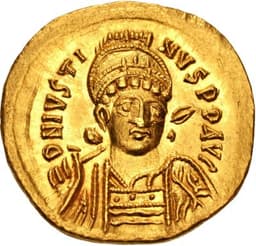
Justin I
Emperor · Ancient
41.8Total

Napoleon Bonaparte
General · Modern
70.9Total
Basic Information
Born
450
1769
Died
527
1821
Era
Ancient
Modern
Nationality
Byzantine Empire
France
Occupation
Emperor
General
Civilization
Western
Western
Score Comparison
Military (10%)
25.9
94.0
Political (20%)
39.4
72.0
Influence (20%)
46.3
40.0
Legacy (20%)
37.5
80.0
Leadership (15%)
65.7
78.0
Strategy (15%)
25.0
90.0
TOTAL
41.8
70.9
Justin I — Complete Timeline
518 AD
Became Emperor of ByzantiumPolitical Action◆ Major
Upon the death of Emperor Anastasius I, Justin, the commander of the imperial guard, was elected emperor by the army and the Senate. His rise from a peasant background to the throne marked a significant change in the imperial administration.
AccessionByzantine EmpirePolitical Change
Impact: national
519 AD
Ended the Acacian SchismPolitical Action◆ Major
Justin, under the influence of his nephew Justinian, reconciled with the Papacy by accepting the Council of Chalcedon. This ended the Acacian Schism that had divided the Eastern and Western churches for 35 years.
Religious PolicyChurch UnityByzantine Empire
Impact: regionalconstructive
527 AD
Appointed Justinian as co-emperorPolitical Action◆ Major
As his health declined, Justin elevated his nephew Justinian to the rank of co-emperor. This ensured a smooth succession and allowed Justinian to assume full power upon Justin's death later that year.
SuccessionByzantine EmpireJustinian
Impact: national
Napoleon Bonaparte — Complete Timeline
1799 AD
Coup of 18 BrumaireOther◆ Major
Napoleon Bonaparte, with support from his brother Lucien and key political figures, overthrew the Directory in a bloodless coup. He established the Consulate with himself as First Consul, effectively becoming the ruler of France. This event ended the French Revolution's most unstable period.
French RevolutionCoupRise to Power
Impact: regional
1804 AD
Promulgation of the Napoleonic CodeOther◆ Major
Napoleon enacted the Civil Code of the French, known as the Napoleonic Code, a comprehensive set of laws that replaced the fragmented feudal legal systems. The code established legal equality, protected property rights, and secularized law. It became the basis for legal systems in many European and world countries.
Legal ReformNapoleonic CodeCivil Law
Impact: globalconstructive
1805 AD
Battle of AusterlitzWar◆ Major
Napoleon's Grande Arm
Napoleonic WarsBattleDecisive Victory
Impact: global
1812 AD
Invasion of RussiaWar◆ Major
Napoleon led the Grande Arm
Napoleonic WarsInvasionDisaster
Impact: globaldestructive
1815 AD
Battle of WaterlooWar◆ Major
Napoleon's French army was defeated by the combined forces of the Duke of Wellington's Anglo-Allied army and Gebhard Leberecht von Bl
Napoleonic WarsBattleFinal Defeat
Impact: globaldestructive
Expert Analysis
justin-i-vs-napoleon-bonaparte
# The Emperor and the Corporal: Two Paths to Power
On a spring morning in 1814, Napoleon Bonaparte stood in the courtyard of the Palace of Fontainebleau, bidding farewell to his Old Guard. The men who had followed him from the sands of Egypt to the frozen plains of Russia wept openly as their emperor, the master of Europe, prepared for exile. Twelve centuries earlier, another man had stood at a similar precipice—Justin, a peasant from the Balkan highlands, had watched the imperial guards of Constantinople choose him as their emperor, a man who could barely sign his own name. Both rose from obscurity to supreme power, but their journeys could not have been more different, nor their endings more starkly contrasted.
Origins
Napoleon Bonaparte was born in 1769 on the island of Corsica, a recently acquired French territory. His family belonged to the minor nobility, but they were poor and Italian-speaking in a French world. This awkward position—too noble for the peasantry, too foreign for the French elite—forged in him a hunger for recognition that would never be satisfied. He was sent to military school in mainland France, where classmates mocked his accent and his poverty. The Revolution of 1789 would become his ladder.
Justin I, born in 450, came from even humbler beginnings. He was a peasant from the province of Dardania, in the Balkans, who walked to Constantinople with nothing but the clothes on his back. The Byzantine Empire, then the wealthiest state in Christendom, offered no path for a illiterate farmer's son—except one: the army. Justin enlisted in the imperial guard, a force of elite soldiers who protected the emperor. For decades, he served faithfully, rising through the ranks through sheer physical prowess and reliability, not brilliance. By 518, he had become the commander of this guard, the *excubitores*.
Rise to Power
Napoleon's ascent was a rocket. In 1793, at age twenty-four, he drove the British fleet from Toulon and was promoted to brigadier general. By 1796, he commanded the French army in Italy, where he won a dozen battles in a single year. His political genius matched his military skill: in 1799, he overthrew the French government in a coup, becoming First Consul. Five years later, he crowned himself Emperor of the French. His path was one of relentless ambition, calculated risk, and the exploitation of chaos.
Justin's rise was a slow, steady march. In 518, the Emperor Anastasius died without an heir. The palace was a web of factions—the Greens and Blues, the Orthodox and Monophysites, the senators and eunuchs. As the powerful squabbled, the army acted. The excubitores, loyal to their commander, proclaimed Justin emperor. He was sixty-eight years old, a man who had never commanded an army in battle, who could not read or write. His entire qualification was that he was there, trusted, and uncontroversial. On July 9, 518, the senate ratified the choice. The peasant became emperor.
Leadership & Governance
Napoleon governed like a storm. He reformed French law into the Napoleonic Code, a rational system that swept away feudal privileges and established equality before the law. He built roads, standardized education, and centralized the state. But he also waged war constantly—his military score of 94 and strategy score of 93 reflect a man who saw conquest as the purpose of power. By 1812, his empire stretched from Spain to Poland, but he had no off-switch. His political score of 75 shows a leader who could build institutions but could not build peace.
Justin governed like a caretaker. His military score of 26.7 and strategy score of 35.4 reveal a man who never led troops in battle. Instead, he relied on his nephew, Justinian, a brilliant, educated young man who had received the education Justin never had. Under Justin's reign, the most significant achievement was political: in 519, he ended the Acacian Schism, a thirty-five-year rift between the churches of Rome and Constantinople. He accepted the Council of Chalcedon, reuniting the Eastern and Western churches. It was a diplomatic masterstroke, guided by Justinian, that stabilized the empire's religious unity. Justin's political score of 72 reflects a man who knew his limits and delegated to those who didn't.
Triumph & Tragedy
Napoleon's greatest triumph was Austerlitz in 1805, where he destroyed the armies of Austria and Russia in a single day. His greatest tragedy was the invasion of Russia in 1812: 600,000 men marched east; fewer than 100,000 returned. He was exiled to Elba in 1814, escaped in 1815, and was finally defeated at Waterloo on June 18, 1815. He died in exile on Saint Helena in 1821, at age fifty-one.
Justin's greatest triumph was the peaceful transition of power. In 527, as his health declined, he appointed Justinian as co-emperor. This ensured a smooth succession—a rarity in Byzantine history, where coups and civil wars were common. Justin died later that year, at age seventy-seven, having ruled for nine years without a single major rebellion. There was no tragedy, only the quiet end of a life that had exceeded every expectation.
Character & Destiny
Napoleon was driven by an insatiable need to prove himself. "I am not a man like other men," he once said. "The laws of morality do not apply to me." This belief in his own exceptionalism led him to overreach constantly. He could not stop because stopping would mean admitting that he was, after all, just a man. His personality—brilliant, arrogant, restless—shaped his destiny: a comet that burned brightly and then vanished.
Justin was driven by humility. He knew he was not a great man, and he acted accordingly. He surrounded himself with capable advisors, especially Justinian, and did not interfere in matters beyond his understanding. "I am a simple soldier," he might have said, and meant it. His personality—steady, unambitious, realistic—shaped his destiny: a bridge between two eras, a peasant who held the empire steady for his nephew to transform.
Legacy
Napoleon's legacy is enormous. The Napoleonic Code influences legal systems across Europe and the Americas. His military campaigns are studied in every war college. His name is synonymous with ambition, genius, and hubris. But his legacy score of 78 reflects the ambiguity: he brought reform and war, progress and destruction.
Justin's legacy is modest. He is remembered primarily as the uncle of Justinian, the man who built the Hagia Sophia and reconquered Italy. But Justin made Justinian possible. Without his peaceful reign, without the religious unity he restored, without the stable succession he ensured, the golden age of Justinian might never have occurred. His legacy score of 52.2 understates his importance—he was the foundation upon which greatness was built.
Conclusion
Napoleon and Justin represent two poles of leadership. Napoleon seized history by the throat and tried to bend it to his will; Justin let history carry him, guiding it only gently. One ended in exile, the other in a palace. One is remembered for his brilliance, the other for his humility. Perhaps the lesson is not that one path is better than the other, but that both can succeed—and both can fail. The difference lies in knowing which path suits the times. Napoleon's era demanded a conqueror; Justin's era demanded a steward. Both answered the call, and both, in their own ways, changed the world.
Rankings
🥇
Napoleon BonaparteLeader
Mil: 94.0Pol: 72.0Inf: 40.0
70.9
🥈
Justin I
Mil: 25.9Pol: 39.4Inf: 46.3
41.8
+29.1 behind
How This Comparison Works
Algorithm
Each figure is scored on 6 dimensions (0—100 scale) based on structured historical data: Military (10%), Political (20%), Influence (20%), Legacy (20%), Leadership (15%), Strategy (15%). The weighted total produces the final ranking.
Data Sources
Scores are computed from structured sub-indicators in the database. Scale factors adjust for era (Ancient ×0.85, Modern ×1.0) and civilization size (Eastern ×1.05, Other ×0.80) to account for differences in population and military scale.
Maximum 3 Figures
Comparisons are limited to 2—3 figures to ensure readability and statistical meaningfulness.
Error Margins
±5 points per dimension — Sub-scores are derived from historical records with inherent uncertainty. Two figures within 5 points on a dimension should be considered roughly equivalent in that area.
Total Score Accuracy
±3 points overall — The weighted combination of 6 dimensions produces a total score with approximately ±3 points of uncertainty. Differences of less than 3 points are not statistically significant— the figures are effectively tied.
Known Limitations
- Historical records are incomplete and uneven across civilizations
- Figures from oral-tradition societies may be underrepresented
- Occupation labels can misclassify multi-role figures
- Scores measure capability and impact, not moral character
- Quantitative scoring is a comparison tool, not absolute truth
Capability Radar
Military (10%) — Battles & Warfare
Battles
10
95
Win Rate
10
90
Expansion
10
95
Political (20%) — Governance & Reform
Reform
35
95
Diplomacy
40
80
Economy
30
85
Influence (20%) — Cultural & Global Reach
Cultural
20
85
Global
15
90
Legacy (20%) — Historical Impact
Historical
25
95
Longevity
20
90
Leadership (15%) — Power & Stability
Tenure
40
85
Stability
45
70
Strategy (15%) — Tactics & Innovation
Strategy
10
95
Tactics
10
98
Reform
15
92
Similar Comparisons
Comments & Discussion
AUSTERLITZ_ANALYST6/17/2026
Give me a break comparing these two. Napoleon was a strategic genius who rewrote the rulebook of warfare; Justin I was basically the Byzantine version of a lucky temp worker who stumbled into the purple. Waterloo was a masterpiece of miscalculation, sure, but Napoleon conquered Italy at 26. Justin couldn't even sign his name—his signature was a stencil. The only thing they share is starting from "meh" beginnings. Napoleon earned his throne with blood and brilliance; Justin got his because the gu
君士坦丁堡的看门人6/17/2026
拿波拿巴和查士丁尼?滑天下之大稽。一个是征服欧洲的科西嘉矮子,一个是靠跪舔禁卫军上位的乡村文盲。拿破仑至少会打仗——看看他在奥斯特里茨怎么玩死俄奥联军。查士丁尼呢?连自己执政官的法令都看不懂,全靠侄子查士丁尼一世当隐形摄政王。这俩差距比拜占庭城墙还厚。别拿泥腿子的运气侮辱军事天才。
DATA_DETECTIVE6/17/2026
The comparison is a statistical farce. Napoleon commanded an army of 600,000 to invade Russia and lost 95% of it. Justin I ruled uneventfully for nine years and died in bed. By raw success metrics—survival, stability, succession quality—Justin absolutely crushes it. Napoleon's conquests collapsed within a decade; Justin's nephew Justinian became history's greatest Byzantine emperor. Sometimes the best ruler is the one who knows when to manage a bureaucracy, not rewrite the map in blood.
地中海抄写员6/17/2026
数据不说谎:拿破仑打55场仗输8场,但帝国只撑了10年倒台。查士丁尼打0场仗,但平稳执政9年。光看“存活率”和“传承度”,这农民完胜。别忘了——查士丁尼一世奠基了圣索菲亚大教堂,编撰了罗马法大全。拿破仑留下了滑铁卢和一座破坟墓。谁的遗产更值钱?你摸摸良心说。