Loading...
Kanishka III vs Napoleon Bonaparte
Napoleon Bonaparte leads by 34.5 pts · 2 figures compared
…
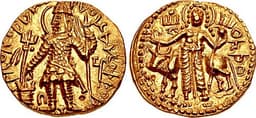
Kanishka III
Emperor · Ancient
36.4Total

Napoleon Bonaparte
General · Modern
70.9Total
Basic Information
Born
250
1769
Died
270
1821
Era
Ancient
Modern
Nationality
Kushan Empire
France
Occupation
Emperor
General
Civilization
Indian
Western
Score Comparison
Military (10%)
10.2
94.0
Political (20%)
33.6
72.0
Influence (20%)
43.2
40.0
Legacy (20%)
33.3
80.0
Leadership (15%)
44.5
78.0
Strategy (15%)
45.0
90.0
TOTAL
36.4
70.9
Kanishka III — Complete Timeline
255 AD
Reign as a Later Kushan RulerPolitical Action
Kanishka III ruled over a diminished Kushan territory, likely confined to the Punjab and Mathura regions. His reign saw further decline as the Sassanians and local Indian powers encroached, and he is considered a shadow of the earlier great Kushan emperors.
Kushan EmpireDeclineTerritorial Loss
destructive
260 AD
Issuance of Degraded CoinageCultural
Kanishka III issued coins with reduced gold content and cruder artistic style compared to earlier Kushan coinage. This reflects the economic strain and loss of control over trade routes that characterized the later Kushan period.
CoinageEconomyDecline
destructive
Napoleon Bonaparte — Complete Timeline
1799 AD
Coup of 18 BrumaireOther◆ Major
Napoleon Bonaparte, with support from his brother Lucien and key political figures, overthrew the Directory in a bloodless coup. He established the Consulate with himself as First Consul, effectively becoming the ruler of France. This event ended the French Revolution's most unstable period.
French RevolutionCoupRise to Power
Impact: regional
1804 AD
Promulgation of the Napoleonic CodeOther◆ Major
Napoleon enacted the Civil Code of the French, known as the Napoleonic Code, a comprehensive set of laws that replaced the fragmented feudal legal systems. The code established legal equality, protected property rights, and secularized law. It became the basis for legal systems in many European and world countries.
Legal ReformNapoleonic CodeCivil Law
Impact: globalconstructive
1805 AD
Battle of AusterlitzWar◆ Major
Napoleon's Grande Arm
Napoleonic WarsBattleDecisive Victory
Impact: global
1812 AD
Invasion of RussiaWar◆ Major
Napoleon led the Grande Arm
Napoleonic WarsInvasionDisaster
Impact: globaldestructive
1815 AD
Battle of WaterlooWar◆ Major
Napoleon's French army was defeated by the combined forces of the Duke of Wellington's Anglo-Allied army and Gebhard Leberecht von Bl
Napoleonic WarsBattleFinal Defeat
Impact: globaldestructive
Expert Analysis
Origins
Kanishka III was a later ruler of the Kushan Empire, reigning in the 3rd century CE, likely from 255 to 275 CE. He was born into the Kushan royal dynasty, which had once controlled a vast territory from Central Asia to northern India. However, by his time, the empire had shrunk considerably due to the rise of the Sassanian Empire and internal fragmentation. Little is known of his early life, but he inherited a throne weakened by economic strain and military pressure. His coinage, with reduced gold content and cruder artistry, reflects the diminished resources and artistic decline of his era.
Napoleon Bonaparte was born on August 15, 1769, in Ajaccio, Corsica, to a minor noble family. His father, Carlo Buonaparte, secured a scholarship for Napoleon to attend military school in mainland France. Napoleon graduated from the École Militaire in 1785, becoming a second lieutenant in the artillery. The French Revolution provided opportunities for rapid advancement, and he distinguished himself at the Siege of Toulon in 1793, earning promotion to brigadier general at age 24.
Rise to Power
Kanishka III ascended to the throne as a descendant of the great Kanishka I, but his rise was not marked by dramatic conquests. He likely inherited power through dynastic succession, but his reign was confined to the Punjab and Mathura regions. The Sassanian Empire under Shapur I had already annexed large parts of the Kushan west, and Kanishka III could do little to reverse this. His rule represents the final phase of Kushan authority before complete subjugation by the Sassanians.
Napoleon's rise was meteoric. In 1796, he took command of the French Army in Italy and won a series of victories against the Austrians, forcing them to sign the Treaty of Campo Formio in 1797. His Egyptian campaign (1798-1799) enhanced his reputation despite strategic failure. On November 9, 1799 (18 Brumaire), he overthrew the Directory in a coup and established the Consulate, becoming First Consul. By 1804, he crowned himself Emperor of the French.
Leadership & Governance
Kanishka III's leadership is inferred from his coinage and inscriptions. He continued the Kushan tradition of issuing coins with Greek and Bactrian legends, but the quality declined. His governance likely relied on local satraps and maintained Buddhist patronage, but he lacked the resources to project power. The empire's decline suggests weak central control and inability to defend borders.
Napoleon was a transformative leader. He centralized the French state, reformed the legal system with the Napoleonic Code (1804), which influenced civil law worldwide. He established the Bank of France, improved education through lycées, and restored relations with the Catholic Church via the Concordat of 1801. Militarily, his leadership scored 78.0, reflecting his ability to inspire troops and execute complex campaigns. However, his political score of 72.0 indicates authoritarian tendencies that alienated allies and subjects.
Triumph & Tragedy
Kanishka III's greatest success was maintaining Kushan identity in a period of decline. He issued coins that continued the iconography of his predecessors, preserving cultural continuity. However, his greatest failure was the inability to halt the empire's disintegration. The Sassanians under Hormizd I and later Bahram II reduced the Kushans to vassal status. His reign ended with the empire virtually extinct.
Napoleon's triumphs include the Battle of Austerlitz (1805), where he scored a decisive victory over Austria and Russia, and the Napoleonic Code, a lasting legal legacy. He dominated Europe from Spain to Poland, installing family members on thrones. His tragedies include the disastrous invasion of Russia in 1812, where he lost over 500,000 men, and the final defeat at Waterloo in 1815. He died in exile on Saint Helena in 1821.
Character & Destiny
Kanishka III's character remains obscure, but his actions suggest a ruler trying to preserve tradition amid decline. He lacked the ambition or capability to reverse fortunes, perhaps due to limited resources. His destiny was to be the last significant Kushan ruler, overshadowed by his namesake.
Napoleon was ambitious, strategic, and ruthless. His military genius scored 90.0, and his leadership 78.0, but his overconfidence led to overreach. He famously said, "Impossible is a word to be found only in the dictionary of fools." His character drove him to conquer, but also to isolation and downfall.
Legacy
Kanishka III's legacy is minimal. He is remembered primarily by numismatists and historians as a symbol of the Kushan decline. His coinage provides evidence of economic and artistic decay. He scored 45.1 in legacy, reflecting limited lasting impact.
Napoleon's legacy is immense. He reshaped Europe through the Napoleonic Code, modern warfare, and national borders. His influence on military strategy, law, and governance endures. He scored 80.0 in legacy. The Congress of Vienna (1815) sought to undo his changes, but many persisted. He is a subject of endless study and debate.
Conclusion
Napoleon Bonaparte had far greater impact than Kanishka III. With a total score of 70.9 against 45.8, Napoleon's military, political, and legal reforms changed the course of European and world history. Kanishka III, while a legitimate ruler, presided over an empire in terminal decline and left few lasting contributions. Napoleon's influence on modern statecraft, warfare, and law is unparalleled, whereas Kanishka III's legacy is limited to a footnote in the decline of the Kushan Empire.
Rankings
🥇
Napoleon BonaparteLeader
Mil: 94.0Pol: 72.0Inf: 40.0
70.9
🥈
Kanishka III
Mil: 10.2Pol: 33.6Inf: 43.2
36.4
+34.5 behind
How This Comparison Works
Algorithm
Each figure is scored on 6 dimensions (0—100 scale) based on structured historical data: Military (10%), Political (20%), Influence (20%), Legacy (20%), Leadership (15%), Strategy (15%). The weighted total produces the final ranking.
Data Sources
Scores are computed from structured sub-indicators in the database. Scale factors adjust for era (Ancient ×0.85, Modern ×1.0) and civilization size (Eastern ×1.05, Other ×0.80) to account for differences in population and military scale.
Maximum 3 Figures
Comparisons are limited to 2—3 figures to ensure readability and statistical meaningfulness.
Error Margins
±5 points per dimension — Sub-scores are derived from historical records with inherent uncertainty. Two figures within 5 points on a dimension should be considered roughly equivalent in that area.
Total Score Accuracy
±3 points overall — The weighted combination of 6 dimensions produces a total score with approximately ±3 points of uncertainty. Differences of less than 3 points are not statistically significant— the figures are effectively tied.
Known Limitations
- Historical records are incomplete and uneven across civilizations
- Figures from oral-tradition societies may be underrepresented
- Occupation labels can misclassify multi-role figures
- Scores measure capability and impact, not moral character
- Quantitative scoring is a comparison tool, not absolute truth
Capability Radar
Military (10%) — Battles & Warfare
Battles
5
95
Win Rate
5
90
Expansion
5
95
Political (20%) — Governance & Reform
Reform
5
95
Diplomacy
10
80
Economy
10
85
Influence (20%) — Cultural & Global Reach
Cultural
10
85
Global
5
90
Legacy (20%) — Historical Impact
Historical
10
95
Longevity
10
90
Leadership (15%) — Power & Stability
Tenure
10
85
Stability
10
70
Strategy (15%) — Tactics & Innovation
Strategy
5
95
Tactics
5
98
Reform
5
92
Similar Comparisons
Comments & Discussion
No comments yet. Be the first to share your thoughts!