Loading...
Kedus Harbe vs Napoleon Bonaparte
Napoleon Bonaparte leads by 31.4 pts · 2 figures compared
…
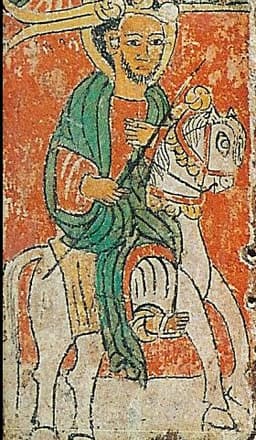
Kedus Harbe
Emperor · Medieval
39.5Total

Napoleon Bonaparte
General · Modern
70.9Total
Basic Information
Born
1100
1769
Died
1150
1821
Era
Medieval
Modern
Nationality
Ethiopia
France
Occupation
Emperor
General
Civilization
Other
Western
Score Comparison
Military (10%)
21.2
94.0
Political (20%)
26.4
72.0
Influence (20%)
50.2
40.0
Legacy (20%)
40.8
80.0
Leadership (15%)
45.0
78.0
Strategy (15%)
39.6
90.0
TOTAL
39.5
70.9
Kedus Harbe — Complete Timeline
1120 AD
Commissioned church constructionCultural
Kedus Harbe oversaw the building of multiple churches in the Zagwe domain, continuing the dynasty's tradition of rock-hewn architecture. His patronage of the Ethiopian Orthodox Church strengthened religious institutions and promoted Christian worship.
Church buildingReligious patronageZagwe period
Impact: regionalconstructive
Napoleon Bonaparte — Complete Timeline
1799 AD
Coup of 18 BrumaireOther◆ Major
Napoleon Bonaparte, with support from his brother Lucien and key political figures, overthrew the Directory in a bloodless coup. He established the Consulate with himself as First Consul, effectively becoming the ruler of France. This event ended the French Revolution's most unstable period.
French RevolutionCoupRise to Power
Impact: regional
1804 AD
Promulgation of the Napoleonic CodeOther◆ Major
Napoleon enacted the Civil Code of the French, known as the Napoleonic Code, a comprehensive set of laws that replaced the fragmented feudal legal systems. The code established legal equality, protected property rights, and secularized law. It became the basis for legal systems in many European and world countries.
Legal ReformNapoleonic CodeCivil Law
Impact: globalconstructive
1805 AD
Battle of AusterlitzWar◆ Major
Napoleon's Grande Arm
Napoleonic WarsBattleDecisive Victory
Impact: global
1812 AD
Invasion of RussiaWar◆ Major
Napoleon led the Grande Arm
Napoleonic WarsInvasionDisaster
Impact: globaldestructive
1815 AD
Battle of WaterlooWar◆ Major
Napoleon's French army was defeated by the combined forces of the Duke of Wellington's Anglo-Allied army and Gebhard Leberecht von Bl
Napoleonic WarsBattleFinal Defeat
Impact: globaldestructive
Expert Analysis
kedus-harbe-vs-napoleon-bonaparte
# The Emperor and the King: Two Paths to Immortality
In the winter of 1812, Napoleon Bonaparte watched his Grand Army burn the Kremlin before retreating through the snows of Russia—a defeat that would seal his fate. Seven centuries earlier, in the highlands of Ethiopia, Kedus Harbe stood before a cliff face in Lasta, ordering his masons to carve a church from solid rock—a victory of faith that would outlast any empire. These two rulers, born worlds apart in time and place, both sought to leave their mark on history. One conquered continents, the other carved mountains. One is remembered by millions, the other by few. Why did their paths diverge so dramatically?
Origins
Napoleon Bonaparte was born in 1769 on the Mediterranean island of Corsica, a territory only recently acquired by France. His family belonged to the minor nobility, but their status was precarious. Young Napoleon was a short, intense boy who spoke French with an Italian accent—an outsider among the elite military academies he attended. France in the 1780s was a powder keg of revolutionary ideas, and Napoleon absorbed them like gunpowder. His world was one of rapid change, where a man of talent could rise faster than any noble birth.
Kedus Harbe, by contrast, was born around 1100 into the Zagwe dynasty of Ethiopia, a Christian kingdom isolated in the Horn of Africa. The Zagwe had seized power from the Solomonic line, and legitimacy was a constant question. Harbe’s Ethiopia was a medieval world of feudal lords, Coptic monks, and a faith that had survived centuries of isolation. His education was not in artillery manuals but in scripture and church ritual. The mountains that surrounded him were not barriers to be crossed but sanctuaries to be hallowed.
Rise to Power
Napoleon’s ascent was a masterpiece of opportunism. In 1793, at age 24, he drove the British from Toulon with a brilliant artillery barrage. By 1796, he commanded the Army of Italy, where he defeated larger Austrian forces through speed and deception. The Directory, France’s corrupt government, saw him as a useful tool. Napoleon saw them as a stepping stone. In 1799, he staged a coup and made himself First Consul. By 1804, he crowned himself Emperor in Notre Dame, taking the crown from the Pope’s hands and placing it on his own head—a gesture that said everything about his ambition.
Kedus Harbe’s rise was quieter. He inherited a kingdom, not conquered it. The Zagwe throne passed through family lines, and Harbe was likely a son or nephew of King Lalibela, the dynasty’s most famous ruler. His power rested not on military glory but on religious piety and the support of the Ethiopian Orthodox Church. In 1120, he commissioned the construction of rock-hewn churches—not as a political statement, but as an act of devotion. The masons did not march to war; they chiseled chapels from living stone.
Leadership & Governance
Napoleon ruled through force and law. His Napoleonic Code, enacted in 1804, standardized French law across Europe, abolishing feudalism and establishing equality before the law—at least for men. He created a centralized bureaucracy, reformed education, and built roads and canals. But his governance was also a dictatorship: he censored newspapers, suppressed dissent, and made peace with the Catholic Church only to control it. His military genius was unmatched: at Austerlitz in 1805, he crushed the armies of Austria and Russia in a single day. But he governed like a general, always seeking the next battle.
Kedus Harbe ruled through faith and stone. His churches were not fortresses but prayers made permanent. The Zagwe kings were remembered not for battles won but for buildings carved. Harbe continued his dynasty’s tradition, but on a smaller scale than Lalibela. His leadership was spiritual, not strategic. He did not expand his borders or reform his kingdom’s laws. He built churches, collected relics, and prayed. In a world where legitimacy came from God, this was governance enough.
Triumph & Tragedy
Napoleon’s greatest triumph was his empire at its height in 1810, stretching from Spain to Poland. He had redrawn the map of Europe, installed his brothers on thrones, and humbled the great powers. His greatest tragedy came in 1812, when he invaded Russia with 600,000 men and returned with fewer than 100,000. The disaster broke his aura of invincibility. By 1814, Paris was occupied, and he was exiled to Elba. He returned in 1815 for a final gamble, but at Waterloo, his old magic failed him. He died in 1821 on the remote island of Saint Helena, a prisoner of the British.
Kedus Harbe’s triumphs were quieter. His churches still stand in the Ethiopian highlands, carved into the earth, sheltering worshippers for nine centuries. His tragedy was obscurity. He ruled during a golden age of Ethiopian rock-hewn architecture, but his name is known only to scholars and priests. He was overshadowed by his predecessor Lalibela, whose churches became a pilgrimage site and a UNESCO World Heritage site. Harbe built, but he did not build enough to be remembered.
Character & Destiny
Napoleon was driven by an insatiable hunger for glory. “I live only for posterity,” he once said, and he meant it. His personality was a whirlwind of ambition, intelligence, and arrogance. He believed he could shape history with his will alone. And for a time, he did. But his character also contained the seeds of his downfall: he could not stop, could not compromise, could not accept limits. His destiny was to conquer the world, and then lose it.
Kedus Harbe was shaped by humility—not personal weakness, but the humility of a ruler who saw himself as a servant of God. His churches were not monuments to himself but to his faith. He did not seek to be remembered; he sought to be righteous. His destiny was to be forgotten by the world but remembered by his God. In the Ethiopian Orthodox tradition, he is “Kedus”—a saint. That was his ambition, and he achieved it.
Legacy
Napoleon’s legacy is written in law, politics, and war. The Napoleonic Code influenced legal systems from Europe to Latin America. He inspired nationalism across the continent and changed how wars were fought. His name is synonymous with military genius and overreaching ambition. Today, he is studied in every military academy and debated in every history department. He scored 94 in military genius, 93 in strategy—among the highest in history.
Kedus Harbe’s legacy is carved in stone. His churches are part of Ethiopia’s living heritage, still used for worship. But his scores are modest: 58.9 in military, 45 in politics, 51.4 in legacy. He did not change the world; he preserved a tradition. In a global sense, he is a footnote. In a spiritual sense, he is a saint.
Conclusion
What separates the emperor from the king is not talent but scale. Napoleon wanted to reshape the world in his image, and he nearly succeeded. Kedus Harbe wanted to honor God in his corner of the earth, and he did. One built an empire that collapsed in a generation; the other built churches that have stood for nine centuries. History remembers the conqueror, but faith remembers the saint. Perhaps the true measure of a ruler is not how much they changed the world, but how well they served their own. Napoleon served his ambition. Kedus Harbe served his God. Both left their mark—one in fire and blood, the other in stone and prayer. Which legacy is greater depends on what you value: the roar of the cannon or the silence of the sanctuary.
Rankings
🥇
Napoleon BonaparteLeader
Mil: 94.0Pol: 72.0Inf: 40.0
70.9
🥈
Kedus Harbe
Mil: 21.2Pol: 26.4Inf: 50.2
39.5
+31.4 behind
How This Comparison Works
Algorithm
Each figure is scored on 6 dimensions (0—100 scale) based on structured historical data: Military (10%), Political (20%), Influence (20%), Legacy (20%), Leadership (15%), Strategy (15%). The weighted total produces the final ranking.
Data Sources
Scores are computed from structured sub-indicators in the database. Scale factors adjust for era (Ancient ×0.85, Modern ×1.0) and civilization size (Eastern ×1.05, Other ×0.80) to account for differences in population and military scale.
Maximum 3 Figures
Comparisons are limited to 2—3 figures to ensure readability and statistical meaningfulness.
Error Margins
±5 points per dimension — Sub-scores are derived from historical records with inherent uncertainty. Two figures within 5 points on a dimension should be considered roughly equivalent in that area.
Total Score Accuracy
±3 points overall — The weighted combination of 6 dimensions produces a total score with approximately ±3 points of uncertainty. Differences of less than 3 points are not statistically significant— the figures are effectively tied.
Known Limitations
- Historical records are incomplete and uneven across civilizations
- Figures from oral-tradition societies may be underrepresented
- Occupation labels can misclassify multi-role figures
- Scores measure capability and impact, not moral character
- Quantitative scoring is a comparison tool, not absolute truth
Capability Radar
Military (10%) — Battles & Warfare
Battles
10
95
Win Rate
10
90
Expansion
10
95
Political (20%) — Governance & Reform
Reform
20
95
Diplomacy
20
80
Economy
20
85
Influence (20%) — Cultural & Global Reach
Cultural
30
85
Global
10
90
Legacy (20%) — Historical Impact
Historical
25
95
Longevity
20
90
Leadership (15%) — Power & Stability
Tenure
30
85
Stability
25
70
Strategy (15%) — Tactics & Innovation
Strategy
10
95
Tactics
10
98
Reform
5
92
Similar Comparisons
Comments & Discussion
CannonFodderCritic6/17/2026
Call me a skeptic, but comparing a military genius who redrew Europe's map to a medieval Ethiopian king who built churches is like comparing a storm to a whisper. Napoleon mobilized 600,000 men for Russia; Kedus Harbe likely couldn't field a tenth of that. The "faith" argument is just romanticism for obscurity—we remember Napoleon because he shaped global history, not because he carved rocks. One changed laws, the other changed local architecture.
历史测绘员6/17/2026
说实话,这对比太牵强了。拿破仑有详细的战役记录、法律条文和日记,我们能精确分析他的每一步决策。而Kedus Harbe呢?我们连他的出生年份都得靠推测。你拿凿岩机跟大炮比?别傻了,历史记忆的深度取决于记录的质量,不是浪漫的想象。石雕教堂再美,也改变不了我们几乎不了解他的政治或军事成就这一事实。
SacredGeometryNerd6/17/2026
You're all missing the point. Kedus Harbe's rock-hewn churches weren't just buildings—they were theological land-art. Lalibela's 11 monolithic churches required carving DOWNWARD into volcanic tuff, creating entire spaces from negative volume. That's not architecture, that's spatial alchemy. Napoleon built an empire from ash; Harbe carved eternity from stone. Which legacy literally still stands? Exactly. Faith outlasts fire and steel.
王朝轮回论6/17/2026
拿破仑的失败是必然的,因为他只懂征服不懂扎根。Kedus Harbe聪明得多——在埃塞俄比亚高原上,权力不是靠军队数量,而是靠神圣血统和教会支持。他让每座教堂成为信仰的堡垒,比拿破仑的莱比锡战役更持久。拿破仑1805年称帝,1815年就倒了;而Zagwe王朝整整统治了三百多年,直到1270年。谁的策略更实际?用长远眼光看,结果一目了然。
R4tionalMind6/17/2026
I'll take the contrarian view: Napoleon's influence is vastly overrated in this context. His campaigns ultimately failed, his code only applied in Europe, and St. Helena proved his mortality. Kedus Harbe's churches survived invasion, religious shifts, and centuries of upheaval—they're still active pilgrimage sites today. The question isn't "who was more famous," it's "who achieved their actual goal." Harbe wanted eternal spiritual legacy. Napoleon wanted eternal temporal power. Only one succeede