Loading...
Khosrow I vs Odysseus of Ithaca
Khosrow I leads by 11.6 pts · 2 figures compared
…

Khosrow I
Emperor · Ancient
71.5Total
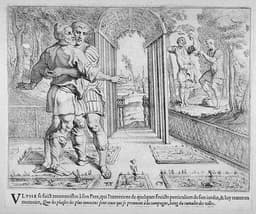
Odysseus of Ithaca
Emperor · Ancient
59.9Total
Basic Information
Born
-501
-1210
Died
—
-1160
Era
Ancient
Ancient
Nationality
Sassanid Empire
Ithaca
Occupation
Emperor
Emperor
Civilization
Middle Eastern
Western
Score Comparison
Military (10%)
72.0
40.0
Political (20%)
72.0
48.0
Influence (20%)
65.0
65.0
Legacy (20%)
72.0
68.0
Leadership (15%)
80.0
58.8
Strategy (15%)
72.0
66.3
TOTAL
71.5
59.9
Khosrow I — Complete Timeline
531 AD
Reign of Khosrow I (Anushirvan)Political Action◆ Major
Khosrow I ascended the throne after the death of his father Kavad I. His reign, lasting until 579, is considered the golden age of the Sassanid Empire, marked by administrative reforms, military expansion, and cultural flourishing.
ReignGolden AgeSassanid Empire
Impact: globalconstructive
540 AD
War with the Byzantine Empire (540-562)War◆ Major
Khosrow I invaded Byzantine Syria, sacking Antioch and other cities. The war continued for over two decades, ending with the Peace of 562, which required the Byzantines to pay annual tribute to Persia and recognized Sassanid control over Lazica.
Roman-Persian WarsByzantineSassanid Empire
Impact: regional
Administrative and Tax ReformsReform◆ Major
Khosrow I implemented a comprehensive reform of the tax system, replacing arbitrary levies with a fixed land tax and a poll tax. He also reorganized the bureaucracy and military, strengthening central control and increasing state revenue.
Tax ReformAdministrationSassanid Empire
Impact: nationalconstructive
550 AD
Patronage of Philosophy and ScienceCultural◆ Major
Khosrow I welcomed Greek philosophers and scholars fleeing the closure of the Academy of Athens. He sponsored translations of Greek and Indian works into Middle Persian, fostering a cultural renaissance that influenced later Islamic civilization.
PatronageTranslationSassanid Empire
Impact: globalconstructive
560 AD
Construction of the Great Wall of GorganOther
Khosrow I ordered the construction of the Great Wall of Gorgan, a massive defensive barrier in northeastern Persia. The wall, stretching over 195 km, protected the empire from nomadic incursions and demonstrated Sassanid engineering capabilities.
FortificationEngineeringSassanid Empire
Impact: regionalconstructive
Odysseus of Ithaca — Complete Timeline
1180 BC
Devised the Trojan Horse StratagemWar
Odysseus conceived the plan to build a giant wooden horse, hide Greek soldiers inside, and trick the Trojans into bringing it within their walls. This stratagem led to the fall of Troy.
Trojan WarStrategyTrojan Horse
Impact: global
1175 BC
Encountered the Cyclops PolyphemusOther◆ Major
During his journey home, Odysseus and his men were trapped in the cave of the Cyclops Polyphemus. Odysseus blinded the giant and escaped by clinging to the underside of sheep.
OdysseyAdventureCyclops
Impact: regional
1170 BC
Resisted the Sirens' SongOther
Odysseus had his crew plug their ears with wax and tied himself to the mast to hear the Sirens' deadly song without succumbing. This allowed his ship to pass safely.
OdysseySirensSurvival
Impact: regional
1160 BC
Killed the Suitors and Reclaimed IthacaPolitical Action◆ Major
After returning to Ithaca disguised as a beggar, Odysseus, with his son Telemachus, killed the suitors who had been courting his wife Penelope. He then reclaimed his throne and reunited his family.
OdysseyRevengeReturn
Impact: regionaldestructive
Expert Analysis
Origins
Khosrow I, born in 501 CE, was the son of King Kavad I of the Sassanid Empire. Raised in the royal court, he received education in Zoroastrian theology, military tactics, and administration. His early life was shaped by the political instability of his father's reign, including the Mazdakite uprising, which influenced his later reforms.
Odysseus, king of Ithaca, was born around the 12th century BCE according to Greek tradition. Son of Laertes and Anticlea, he was a descendant of Hermes. His early life in the rugged island kingdom emphasized cunning and diplomacy over brute force, as Ithaca was small and relatively weak. He was among the many suitors of Helen, but chose Penelope, and later reluctantly joined the Trojan War.
Rise to Power
Khosrow I ascended the throne in 531 CE after his father's death, but not without challenge. He had to suppress the Mazdakite movement, which had gained power under Kavad. In 528-529, he helped his father crush the revolt, securing his position. Upon becoming king, he immediately initiated reforms to centralize power and stabilize the economy.
Odysseus rose to prominence through his cunning. He was instrumental in the Trojan War, devising the Trojan Horse stratagem in 1184 BCE (traditional date), which ended the ten-year siege. Before the war, he had established himself as a wise counselor and orator, often mediating disputes among Greek leaders. His reputation as 'polytropos' (man of many turns) grew from his successful ambushes and negotiations.
Leadership & Governance
Khosrow I, scoring 80.0 in leadership, was a reformer. He restructured the tax system, replacing arbitrary levies with a fixed land tax (kharag) and a poll tax (gizya), based on land productivity. He reorganized the army into four frontier commands, improving defense. He also established a system of social welfare, including hospitals and orphanages. His governance was centralized and bureaucratic, with a focus on justice—earning him the title 'Anushirvan' (Immortal Soul).
Odysseus, scoring 58.8 in leadership, ruled Ithaca as a king but his leadership was more personal and situational. On Ithaca, he managed his household and lands, but his governance during his absence was contested by suitors. His leadership style was based on guile and persuasion rather than institutional reform. He was a charismatic leader who inspired loyalty in his crew, but his decisions often led to disasters (e.g., visiting the Cyclops).
Triumph & Tragedy
Khosrow I's greatest triumph was the Peace of 562 with the Byzantine Empire, which secured a stable eastern border and required Byzantium to pay 30,000 nomismata annually. He also successfully annexed Yemen in 570, expanding Sassanid influence. His patronage of philosophy led to the translation of Aristotle and Plato into Persian, preserving Greek thought. However, his later war with the Byzantines (572-579) ended in a stalemate, and his heavy taxation, though fair, caused resentment.
Odysseus's triumph was the Trojan Horse, which ended the war and solidified his reputation. His successful return to Ithaca and slaughter of the suitors restored his rule. However, his ten-year journey was marked by tragedies: he lost all his men, and his hubris (e.g., revealing his name to Polyphemus) caused divine wrath. His family suffered—his father died of grief, and his wife nearly remarried.
Character & Destiny
Khosrow I, with a political score of 72.0, was pragmatic and methodical. He valued justice and order, often personally reviewing legal cases. His character was shaped by Zoroastrian ethics, emphasizing truth and righteousness. His destiny was to restore the Sassanid Empire to its height, which he achieved through careful planning. He died in 579 CE, leaving a stable empire.
Odysseus, scoring 66.3 in strategy, was resourceful but also reckless. His curiosity and pride often led to unnecessary risks. He was a trickster, but also capable of great loyalty and cunning. His destiny was shaped by the gods, particularly Athena and Poseidon. His character—both clever and arrogant—caused his prolonged wanderings. He eventually died in old age, according to some versions, accidentally killed by his son Telegonus.
Legacy
Khosrow I's legacy, scoring 72.0, is immense. His administrative reforms influenced Islamic governance after the Arab conquest. The tax system he implemented was adopted by the Umayyads and Abbasids. His patronage of science and philosophy helped transmit Greek knowledge to the Islamic world. The Great Wall of Gorgan, a 195 km defensive structure, stands as a testament to his engineering ambition.
Odysseus's legacy, scoring 68.0, is cultural rather than political. He became an archetype of the cunning hero in Western literature. The Odyssey influenced countless works, from Virgil's Aeneid to James Joyce's Ulysses. His name is synonymous with a long, adventurous journey. However, his historical impact is mythical; he left no institutions or reforms.
Conclusion
Khosrow I had a greater impact on history. His total score of 71.5 versus Odysseus's 59.9 reflects this. Khosrow's reforms shaped the governance of a large empire for centuries, while Odysseus's influence is primarily literary. Khosrow's concrete achievements—tax reform, peace treaties, philosophical patronage—outweigh Odysseus's mythical exploits. Data supports this: Khosrow scored 72.0 in legacy, 80.0 in leadership, and 72.0 in military, all higher than Odysseus. While Odysseus's cunning is memorable, Khosrow's institutional changes had a lasting, tangible effect on civilization.
Rankings
🥇
Khosrow ILeader
Mil: 72.0Pol: 72.0Inf: 65.0
71.5
🥈
Odysseus of Ithaca
Mil: 40.0Pol: 48.0Inf: 65.0
59.9
+11.6 behind
How This Comparison Works
Algorithm
Each figure is scored on 6 dimensions (0—100 scale) based on structured historical data: Military (10%), Political (20%), Influence (20%), Legacy (20%), Leadership (15%), Strategy (15%). The weighted total produces the final ranking.
Data Sources
Scores are computed from structured sub-indicators in the database. Scale factors adjust for era (Ancient ×0.85, Modern ×1.0) and civilization size (Eastern ×1.05, Other ×0.80) to account for differences in population and military scale.
Maximum 3 Figures
Comparisons are limited to 2—3 figures to ensure readability and statistical meaningfulness.
Error Margins
±5 points per dimension — Sub-scores are derived from historical records with inherent uncertainty. Two figures within 5 points on a dimension should be considered roughly equivalent in that area.
Total Score Accuracy
±3 points overall — The weighted combination of 6 dimensions produces a total score with approximately ±3 points of uncertainty. Differences of less than 3 points are not statistically significant— the figures are effectively tied.
Known Limitations
- Historical records are incomplete and uneven across civilizations
- Figures from oral-tradition societies may be underrepresented
- Occupation labels can misclassify multi-role figures
- Scores measure capability and impact, not moral character
- Quantitative scoring is a comparison tool, not absolute truth
Capability Radar
Military (10%) — Battles & Warfare
Battles
85
45
Win Rate
80
50
Expansion
75
30
Political (20%) — Governance & Reform
Reform
95
25
Diplomacy
85
80
Economy
95
30
Influence (20%) — Cultural & Global Reach
Cultural
85
90
Global
70
80
Legacy (20%) — Historical Impact
Historical
80
85
Longevity
70
95
Leadership (15%) — Power & Stability
Tenure
90
40
Stability
85
35
Strategy (15%) — Tactics & Innovation
Strategy
85
70
Tactics
80
85
Reform
90
20
Similar Comparisons
Comments & Discussion
No comments yet. Be the first to share your thoughts!