Loading...
Kim Jong-il vs Napoleon Bonaparte
Napoleon Bonaparte leads by 21.8 pts · 2 figures compared
…
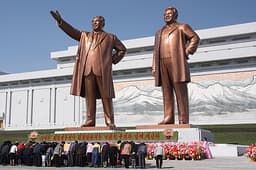
Kim Jong-il
Politician · Modern
49.1Total

Napoleon Bonaparte
General · Modern
70.9Total
Basic Information
Born
1941
1769
Died
—
1821
Era
Modern
Modern
Nationality
North Korea
France
Occupation
Politician
General
Civilization
Eastern
Western
Score Comparison
Military (10%)
36.6
94.0
Political (20%)
26.4
72.0
Influence (20%)
56.4
40.0
Legacy (20%)
45.0
80.0
Leadership (15%)
72.0
78.0
Strategy (15%)
53.8
90.0
TOTAL
49.1
70.9
Kim Jong-il — Complete Timeline
1994 AD
Assumption of Leadership after Kim Il-sung's DeathPolitical Action◆ Major
Kim Jong-il officially assumed supreme leadership of North Korea following the death of his father Kim Il-sung. He inherited a totalitarian state with a struggling economy and a nuclear weapons program.
SuccessionNorth KoreaLeadership
Impact: global
1995 AD
Arduous March FamineOther◆ Major
North Korea suffered a severe famine, known as the Arduous March, caused by floods, economic mismanagement, and the collapse of Soviet aid. Hundreds of thousands died, while the regime prioritized military spending over relief.
FamineHumanitarian CrisisNorth Korea
Impact: nationaltragic
2000 AD
Sunshine Policy Engagement with South KoreaPolitical Action◆ Major
Kim Jong-il participated in the first inter-Korean summit with South Korean President Kim Dae-jung in Pyongyang. The summit led to the June 15th Joint Declaration, promoting reconciliation and economic cooperation.
SummitReconciliationSouth Korea
Impact: regionalconstructive
2006 AD
First North Korean Nuclear TestWar
Under Kim Jong-il's leadership, North Korea conducted its first underground nuclear test, claiming success. This event escalated international tensions and led to UN sanctions, marking North Korea's entry as a nuclear-armed state.
Nuclear TestProliferationSanctions
Impact: globaldestructive
2011 AD
Death and Succession by Kim Jong-unPolitical Action◆ Major
Kim Jong-il died of a heart attack, and his youngest son Kim Jong-un was quickly declared the successor. This continued the Kim dynasty's hereditary rule, with Kim Jong-un assuming leadership of the Workers' Party and military.
DeathSuccessionKim Dynasty
Impact: global
Napoleon Bonaparte — Complete Timeline
1799 AD
Coup of 18 BrumaireOther◆ Major
Napoleon Bonaparte, with support from his brother Lucien and key political figures, overthrew the Directory in a bloodless coup. He established the Consulate with himself as First Consul, effectively becoming the ruler of France. This event ended the French Revolution's most unstable period.
French RevolutionCoupRise to Power
Impact: regional
1804 AD
Promulgation of the Napoleonic CodeOther◆ Major
Napoleon enacted the Civil Code of the French, known as the Napoleonic Code, a comprehensive set of laws that replaced the fragmented feudal legal systems. The code established legal equality, protected property rights, and secularized law. It became the basis for legal systems in many European and world countries.
Legal ReformNapoleonic CodeCivil Law
Impact: globalconstructive
1805 AD
Battle of AusterlitzWar◆ Major
Napoleon's Grande Arm
Napoleonic WarsBattleDecisive Victory
Impact: global
1812 AD
Invasion of RussiaWar◆ Major
Napoleon led the Grande Arm
Napoleonic WarsInvasionDisaster
Impact: globaldestructive
1815 AD
Battle of WaterlooWar◆ Major
Napoleon's French army was defeated by the combined forces of the Duke of Wellington's Anglo-Allied army and Gebhard Leberecht von Bl
Napoleonic WarsBattleFinal Defeat
Impact: globaldestructive
Expert Analysis
kim-jong-il-vs-napoleon-bonaparte
# The Emperor and the Hermit: Napoleon and Kim Jong-il
On a June morning in 1815, Napoleon Bonaparte surveyed the muddy fields of Waterloo, his Grande Armée poised for what would be his final gamble. Across the centuries and continents, in a starkly different scene, Kim Jong-il sat in a darkened Pyongyang screening room, watching foreign films he had ordered smuggled past his own borders. One man sought to conquer the world; the other, to seal it shut. How did two leaders, both wielding absolute power, arrive at such opposite destinies—one remembered as a titan of history, the other as a ghost of tyranny?
Origins
Napoleon was born in 1769 on Corsica, an island recently annexed by France, into a minor noble family with more pride than wealth. The French Revolution that erupted when he was twenty shattered the old order, offering a young artillery officer a ladder to glory. He absorbed Enlightenment ideals while mastering the brutal calculus of war. Corsica’s rugged independence and France’s revolutionary ferment forged a man who believed in merit, not birthright—yet also in his own destiny.
Kim Jong-il was born in 1941 in a Soviet military camp, his father Kim Il-sung a guerrilla leader backed by Moscow. He grew up in a North Korea that was less a country than a cult, where his father’s image hung in every home. The Japanese occupation, the Korean War, and the Stalinist statecraft of his father taught him that survival meant absolute control. If Napoleon learned to seize opportunity, Kim learned to eliminate it.
Rise to Power
Napoleon’s ascent was a blur of cannon fire and ink. At twenty-four, he drove the British from Toulon. At twenty-six, he crushed a royalist uprising in Paris with a “whiff of grapeshot.” By thirty, he had conquered Italy and Egypt, not merely with bayonets but with proclamations that cast himself as a liberator. His 1799 coup made him First Consul; by 1804, he crowned himself Emperor in Notre Dame, taking the crown from the Pope’s hands. Every step was earned through audacity and blood.
Kim Jong-il’s rise was silent, scripted, and decades long. He was groomed from childhood as the “Dear Leader,” appointed to party posts in his twenties while his father lived. By the 1980s, he managed propaganda and security, crafting his own myth: that he was born on a sacred mountain under a double rainbow. When Kim Il-sung died in 1994, Kim Jong-il simply stepped into power—no election, no coup, only a seamless inheritance. His path required no genius, only patience and the absence of rivals.
Leadership & Governance
Napoleon governed with a sword in one hand and a law code in the other. His Napoleonic Code standardized French law, abolished feudal privileges, and spread across Europe. He built schools, roads, and banks; he negotiated with the Pope and crushed dissent equally. On the battlefield, his 93-point military genius was unmatched. He won at Austerlitz in 1805, at Jena in 1806, and redrew the map of Europe. But his ambition outpaced strategy: the 1812 invasion of Russia cost half a million men, and his refusal to compromise led to his first abdication in 1814.
Kim Jong-il governed through isolation and fear. He inherited a Stalinist economy already crumbling; the Arduous March famine of 1995–1998 killed perhaps 10% of the population while he hoarded luxury goods and films. He never fought a war—his 27-point military score reflects a leader who built nuclear weapons but never risked using them. Instead, he perfected blackmail: trading threats for aid, testing a nuclear device in 2006 to force the world to negotiate. His political score of 48 reflects a system where “politics” meant purges, not policy.
Triumph & Tragedy
Napoleon’s greatest triumph was Austerlitz, where he lured a larger Austro-Russian army into a trap and shattered it. His tragedy was not Waterloo alone—it was the hubris that led him to invade Russia, then to refuse peace terms, then to return from exile in 1815 only to lose everything. His final years on Saint Helena were a slow death by defeat and cancer, dictating memoirs that would reshape his legacy.
Kim Jong-il’s triumph was survival itself. He kept his regime alive through famine, international sanctions, and the collapse of the Soviet Union. His tragedy was that his “success” was a hollow shell: a starving population, a bankrupt economy, and a son, Kim Jong-un, who inherited a nuclear weapon but no legitimacy. When Kim Jong-il died of a heart attack in 2011, his regime did not fall—but it had never truly lived.
Character & Destiny
Napoleon was driven by an insatiable need for glory. “I live only for posterity,” he said, and he meant it. His personality—brilliant, ruthless, charismatic—shaped every decision. He could charm a diplomat or terrify a general; he could write a love letter and a battle plan on the same day. That same personality made it impossible for him to stop, to consolidate, to accept limits. His destiny was to overreach.
Kim Jong-il was driven by fear. He inherited a system that required total control, and he perfected it. His personality—paranoid, theatrical, isolated—turned North Korea into a stage where he played the starring role. He never visited most of his country, never held a press conference, never risked genuine power. His destiny was to entomb his nation in a prison of his own making.
Legacy
Napoleon’s legacy is written in law codes, national borders, and military academies. His 78-point legacy score reflects a man who reshaped Europe even in defeat. The Napoleonic Code influences legal systems from France to Louisiana. He democratized merit and centralized bureaucracy; he is studied, debated, and remembered as both liberator and tyrant.
Kim Jong-il’s legacy is a nuclear state and a suffering people. His 63-point legacy is that of a dead end: his achievements—the bomb, the cult, the succession—all served only to perpetuate a system that cannot sustain itself. He is remembered not as a leader but as a warning, a figure whose name evokes famine, not glory.
Conclusion
Napoleon and Kim Jong-il both wielded absolute power, but their differences reveal the chasm between ambition and survival. Napoleon sought to change the world and nearly succeeded; Kim Jong-il sought to freeze it and nearly destroyed his own people. One died in exile, mourned by a continent; the other died in his bed, mourned by no one who could speak freely. In the end, the measure of a leader is not how many bow before them, but what they leave behind when the bowing stops.
Rankings
🥇
Napoleon BonaparteLeader
Mil: 94.0Pol: 72.0Inf: 40.0
70.9
🥈
Kim Jong-il
Mil: 36.6Pol: 26.4Inf: 56.4
49.1
+21.8 behind
How This Comparison Works
Algorithm
Each figure is scored on 6 dimensions (0—100 scale) based on structured historical data: Military (10%), Political (20%), Influence (20%), Legacy (20%), Leadership (15%), Strategy (15%). The weighted total produces the final ranking.
Data Sources
Scores are computed from structured sub-indicators in the database. Scale factors adjust for era (Ancient ×0.85, Modern ×1.0) and civilization size (Eastern ×1.05, Other ×0.80) to account for differences in population and military scale.
Maximum 3 Figures
Comparisons are limited to 2—3 figures to ensure readability and statistical meaningfulness.
Error Margins
±5 points per dimension — Sub-scores are derived from historical records with inherent uncertainty. Two figures within 5 points on a dimension should be considered roughly equivalent in that area.
Total Score Accuracy
±3 points overall — The weighted combination of 6 dimensions produces a total score with approximately ±3 points of uncertainty. Differences of less than 3 points are not statistically significant— the figures are effectively tied.
Known Limitations
- Historical records are incomplete and uneven across civilizations
- Figures from oral-tradition societies may be underrepresented
- Occupation labels can misclassify multi-role figures
- Scores measure capability and impact, not moral character
- Quantitative scoring is a comparison tool, not absolute truth
Capability Radar
Military (10%) — Battles & Warfare
Battles
5
95
Win Rate
5
90
Expansion
5
95
Political (20%) — Governance & Reform
Reform
10
95
Diplomacy
20
80
Economy
5
85
Influence (20%) — Cultural & Global Reach
Cultural
30
85
Global
40
90
Legacy (20%) — Historical Impact
Historical
40
95
Longevity
30
90
Leadership (15%) — Power & Stability
Tenure
85
85
Stability
40
70
Strategy (15%) — Tactics & Innovation
Strategy
10
95
Tactics
10
98
Reform
15
92
Similar Comparisons
Comments & Discussion
Hussar Historian6/17/2026
The true measure of these two men isn’t their body count—it’s that Napoleon lost his empire in one rainy afternoon at Waterloo after conquering most of Europe, while Kim Jong-il never fought a single battle yet ruled for 17 years. One gambled everything on decisive action; the other understood that in tyranny, doing nothing is the safest strategy. Napoleon’s ambition was his genius and his doom.
史诗考据党6/17/2026
仔细对比两人的统治细节会发现根本性错位:拿破仑在1796年意大利战役中25天打了6场胜仗,而金正日在1984年单是观看外国电影就耗费了全年三分之一的工作时间。一个用刺刀丈量世界,另一个用荧屏隔离现实。拿破仑失败于战场,金正日失败于历史——前者留下了法典,后者只留下了饥荒。
Data Skeptic Dave6/17/2026
Let’s talk numbers they’d both hate: Napoleon’s Grande Armée of 1812 had 600,000 men; Kim Jong-il presided over a country where GDP per capita was below $1,000. The French fought 60+ battles across a continent; Kim’s military might never once crossed its own border. One controlled an industrial superpower, the other a starving hermit kingdom. Napoleon is analyzed at West Point; Kim Jong-il is a footnote in intelligence files.
匿名反思者6/17/2026
必须指出这种对比本身的伪善:我们津津乐道拿破仑的浪漫征战,却将金正日钉在“独裁”十字架上。可拿破仑在埃及屠杀战俘、在海地恢复奴隶制时,难道不也是“暴君”?区别在于,胜利者把失败者的故事写成黑色喜剧。拿破仑的野心写在史书上,金正日的恐惧刻在朝鲜人的骨髓里——两种暴政,只是西方历史选择了自己的小丑与英雄。
Classics & Campaigns6/17/2026
Napoleon’s appeal rests on a myth of social ascent: a Corsican artilleryman who became Emperor through talent. Kim Jong-il’s rule rests on a myth of descent: a god-king born into power. Both are fictions—Napoleon’s meritocracy was built on nepotism and cronies, Kim’s on bloodline propaganda. Yet one fiction inspired reforms and legal codes; the other inspired starvation and prison camps. That’s the difference between a revolutionary who changed the world and a petty tyrant who changed nothing bu