Loading...
King David vs Napoleon Bonaparte
King David leads by 4.4 pts · 2 figures compared
…
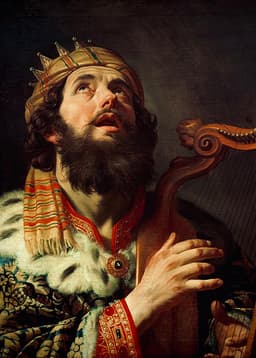
King David
Emperor · Ancient
75.3Total

Napoleon Bonaparte
General · Modern
70.9Total
Basic Information
Born
-1010
1769
Died
-970
1821
Era
Ancient
Modern
Nationality
Israel
France
Occupation
Emperor
General
Civilization
Middle Eastern
Western
Score Comparison
Military (10%)
72.0
94.0
Political (20%)
72.0
72.0
Influence (20%)
88.0
40.0
Legacy (20%)
70.0
80.0
Leadership (15%)
72.0
78.0
Strategy (15%)
70.0
90.0
TOTAL
75.3
70.9
King David — Complete Timeline
1010 BC
Anointed as King of JudahPolitical Action◆ Major
After Saul's death, David was anointed king over the tribe of Judah at Hebron. This began a seven-year period of civil war with Ish-bosheth, Saul's son, who ruled the northern tribes, leading to the eventual unification of Israel.
KingshipCivil WarJudah
Impact: national
1003 BC
Capture of JerusalemWar
David led his army to capture the Jebusite fortress of Jerusalem, making it the capital of the united kingdom. He brought the Ark of the Covenant there, establishing the city as both the political and religious center of Israel.
JerusalemCapitalArk of the Covenant
Impact: nationalconstructive
1000 BC
Defeat of the PhilistinesWar◆ Major
David fought several campaigns that decisively defeated the Philistines, including the Battle of Baal-perazim. He captured Gath and other Philistine strongholds, ending their dominance over Israel and securing the kingdom's borders.
PhilistinesMilitary CampaignIsrael
Impact: regional
990 BC
Affair with BathshebaPolitical Action◆ Major
David committed adultery with Bathsheba and arranged the death of her husband Uriah the Hittite in battle. The prophet Nathan confronted David, leading to his repentance but also to divine punishment, including the death of their first child.
ScandalBathshebaNathan
Impact: nationaldestructive
978 BC
Revolt of AbsalomWar◆ Major
David's son Absalom led a rebellion that forced David to flee Jerusalem. David's forces under Joab defeated Absalom's army in the Forest of Ephraim, and Absalom was killed. David returned to Jerusalem but the kingdom was weakened.
RebellionCivil WarAbsalom
Impact: nationaltragic
Napoleon Bonaparte — Complete Timeline
1799 AD
Coup of 18 BrumaireOther◆ Major
Napoleon Bonaparte, with support from his brother Lucien and key political figures, overthrew the Directory in a bloodless coup. He established the Consulate with himself as First Consul, effectively becoming the ruler of France. This event ended the French Revolution's most unstable period.
French RevolutionCoupRise to Power
Impact: regional
1804 AD
Promulgation of the Napoleonic CodeOther◆ Major
Napoleon enacted the Civil Code of the French, known as the Napoleonic Code, a comprehensive set of laws that replaced the fragmented feudal legal systems. The code established legal equality, protected property rights, and secularized law. It became the basis for legal systems in many European and world countries.
Legal ReformNapoleonic CodeCivil Law
Impact: globalconstructive
1805 AD
Battle of AusterlitzWar◆ Major
Napoleon's Grande Arm
Napoleonic WarsBattleDecisive Victory
Impact: global
1812 AD
Invasion of RussiaWar◆ Major
Napoleon led the Grande Arm
Napoleonic WarsInvasionDisaster
Impact: globaldestructive
1815 AD
Battle of WaterlooWar◆ Major
Napoleon's French army was defeated by the combined forces of the Duke of Wellington's Anglo-Allied army and Gebhard Leberecht von Bl
Napoleonic WarsBattleFinal Defeat
Impact: globaldestructive
Expert Analysis
king-david-vs-napoleon-bonaparte
### The Conqueror and the Shepherd King
In the spring of 1815, Napoleon Bonaparte stood before his Grande Armée, the eagles of his empire gleaming under a pale European sun. He had escaped exile, seized power once more, and now faced the final roll of the dice at Waterloo. Fifteen centuries earlier and a thousand miles to the east, another king—a ruddy-faced shepherd boy named David—stood before a giant on a battlefield in the Valley of Elah, a sling in his hand and a stone in his pocket. One would reshape a continent through iron law and cannon fire; the other would forge a nation through poetry, faith, and blood. What drove these two men, separated by millennia, to such different fates? The answer lies not in their triumphs alone, but in the soil from which they grew.
### Origins
Napoleon was born in 1769 on the rugged island of Corsica, a place that had become French only months before his birth. His family belonged to the minor nobility, proud and poor. From the start, he was an outsider—a Corsican who would remake France, a short man who would tower over history. His era was the late Enlightenment, a time of revolutionary upheaval when old thrones were crumbling and new ideas—liberty, merit, nationalism—were in the air. He devoured books on military tactics and the lives of Caesar and Alexander, but he never lost the hard edge of a man who had to claw his way up.
King David, by contrast, was born around 1010 BCE, probably in the small town of Bethlehem. His father Jesse was a farmer, and David was the youngest of eight sons, a boy sent to tend sheep while his brothers went to war. His world was the ancient Near East, a patchwork of warring tribes and petty kingdoms dominated by the Philistines, who possessed iron weapons and chariots. David’s upbringing was not about statecraft or Enlightenment philosophy; it was about the raw, intimate struggle of a shepherd protecting his flock from lions and bears. His first lessons in leadership were learned alone, under a desert sky, with only a sling and his faith in a God he called Yahweh.
### Rise to Power
Napoleon’s ascent was a masterpiece of timing and ambition. The French Revolution had shattered the old order, creating a vacuum for talent. In 1793, at just 24, he distinguished himself at the Siege of Toulon, where his artillery tactics drove out the British. By 1795, he had saved the revolutionary government from a royalist mob with a “whiff of grapeshot.” Then came the Italian campaign of 1796-1797, where he turned a ragged army into a conquering force, winning battle after battle against the Austrians. Each victory was a stepping stone. By 1799, he was First Consul; by 1804, Emperor of the French.
David’s rise was slower and more personal. He was anointed king by the prophet Samuel while still a boy, but the throne was not his for decades. He first entered the public stage by killing Goliath around 1025 BCE, a moment that made him a hero in Israel but also a target of King Saul’s jealousy. For years, David lived as a fugitive, hiding in caves and gathering a band of outlaws. He was a rebel leader before he was a king, and he learned loyalty and betrayal in the most intimate way—by being hunted by the very man he had served. Only after Saul’s death in battle did David become king of Judah in 1010 BCE, and then, after a seven-year civil war, king of all Israel.
### Leadership & Governance
Napoleon ruled through sheer force of will and intellect. He was a military genius of the first order, with a strategic score of 93, but he was also a political reformer. His Napoleonic Code, implemented in 1804, swept away feudal privileges and established a uniform legal system based on merit, property rights, and secular authority. He centralized the state, built schools, and stabilized the currency. Yet his governance was autocratic; he tolerated no dissent and crowned himself emperor, betraying the revolution’s ideals.
David governed differently. He was a warrior-king with a military score of 66, but his greatest feat was political: the unification of Israel’s fractious tribes. His capture of Jerusalem in 1003 BCE was a masterstroke—he took a neutral city and made it his capital, a symbol of unity. He brought the Ark of the Covenant there, making the city both political and religious center. David’s leadership was personal and flawed; he ruled by charisma and covenant, not codified law. He was a poet who wrote psalms, a man who could dance before the Ark and weep over a fallen enemy.
### Triumph & Tragedy
Napoleon’s greatest triumph was the Battle of Austerlitz in 1805, where he crushed the combined armies of Austria and Russia, a victory so perfect it became a textbook example of military deception. His empire stretched from Spain to Poland. But his tragedy was hubris. The invasion of Russia in 1812 cost him half a million men; the disastrous retreat in winter shattered his invincible aura. Exiled to Elba, he returned for the Hundred Days, only to be defeated at Waterloo in 1815. He died in lonely exile on Saint Helena in 1821.
David’s triumph was the consolidation of a kingdom that would endure for centuries. He defeated the Philistines decisively, securing Israel’s borders. But his tragedy was personal. His affair with Bathsheba around 990 BCE led to the murder of her husband, Uriah, and the prophet Nathan’s condemnation. The consequences rippled through his family: his son Amnon raped his daughter Tamar, another son Absalom murdered Amnon and then led a rebellion in 978 BCE that forced David to flee his own capital. David returned, but his heart was broken. He died an old man, having seen his kingdom descend into civil war.
### Character & Destiny
Napoleon was a creature of his era—a product of the Enlightenment’s faith in reason and the Revolution’s worship of ambition. He believed he could remake the world through sheer will, and for a time, he did. But he lacked the humility to know when to stop. His personality was forged in the crucible of Corsican resentment and French chaos; he saw history as a chessboard and himself as the only player.
David was a man of faith and contradiction. He was a warrior who wrote psalms of peace, a king who committed murder and then wept in repentance. His personality was shaped by the shepherd’s solitude and the prophet’s judgment; he knew he was chosen by God, but he also knew he was deeply flawed. This tension—between divine favor and human frailty—defined his decisions. He could forgive his enemies (he spared Saul twice) but could not control his own household.
### Legacy
Napoleon left behind a transformed Europe. The Napoleonic Code influenced legal systems from France to Louisiana. He spread nationalism, secularism, and the concept of meritocracy, but also the memory of a conqueror who drowned a continent in blood. Today, he is remembered as both a genius and a tyrant—a man who, in the words of the historian Andrew Roberts, “built an empire on the back of a revolution.”
David left behind a dynasty and a faith. He established Jerusalem as the eternal capital of the Jewish people, and his lineage, according to Christian and Jewish tradition, would produce the Messiah. He is remembered not as a perfect king, but as a man after God’s own heart—a flawed hero whose story of sin and repentance has resonated for three thousand years.
### Conclusion
One man conquered the world and lost it; the other conquered a small land and gave it eternity. Napoleon’s legacy is written in laws and battlefields; David’s is written in scriptures and prayers. Both were ambitious, both were flawed, and both reshaped their worlds. But the difference is this: Napoleon sought to remake the world in his own image, and the world broke him. David sought to serve a purpose greater than himself, and his kingdom—though it crumbled—still lives in the hearts of billions. In the end, the shepherd king may have understood something the Corsican emperor never did: that true power is not in the force of arms, but in the story you leave behind.
Rankings
🥇
King DavidLeader
Mil: 72.0Pol: 72.0Inf: 88.0
75.3
🥈
Napoleon Bonaparte
Mil: 94.0Pol: 72.0Inf: 40.0
70.9
+4.4 behind
How This Comparison Works
Algorithm
Each figure is scored on 6 dimensions (0—100 scale) based on structured historical data: Military (10%), Political (20%), Influence (20%), Legacy (20%), Leadership (15%), Strategy (15%). The weighted total produces the final ranking.
Data Sources
Scores are computed from structured sub-indicators in the database. Scale factors adjust for era (Ancient ×0.85, Modern ×1.0) and civilization size (Eastern ×1.05, Other ×0.80) to account for differences in population and military scale.
Maximum 3 Figures
Comparisons are limited to 2—3 figures to ensure readability and statistical meaningfulness.
Error Margins
±5 points per dimension — Sub-scores are derived from historical records with inherent uncertainty. Two figures within 5 points on a dimension should be considered roughly equivalent in that area.
Total Score Accuracy
±3 points overall — The weighted combination of 6 dimensions produces a total score with approximately ±3 points of uncertainty. Differences of less than 3 points are not statistically significant— the figures are effectively tied.
Known Limitations
- Historical records are incomplete and uneven across civilizations
- Figures from oral-tradition societies may be underrepresented
- Occupation labels can misclassify multi-role figures
- Scores measure capability and impact, not moral character
- Quantitative scoring is a comparison tool, not absolute truth
Capability Radar
Military (10%) — Battles & Warfare
Battles
75
95
Win Rate
85
90
Expansion
80
95
Political (20%) — Governance & Reform
Reform
80
95
Diplomacy
75
80
Economy
70
85
Influence (20%) — Cultural & Global Reach
Cultural
95
85
Global
90
90
Legacy (20%) — Historical Impact
Historical
95
95
Longevity
95
90
Leadership (15%) — Power & Stability
Tenure
85
85
Stability
65
70
Strategy (15%) — Tactics & Innovation
Strategy
85
95
Tactics
80
98
Reform
70
92
Similar Comparisons
Comments & Discussion
No comments yet. Be the first to share your thoughts!