Loading...
King Kang of Zhou vs Napoleon Bonaparte
Napoleon Bonaparte leads by 14.2 pts · 2 figures compared
…
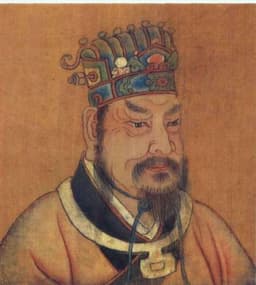
King Kang of Zhou
Emperor · Ancient
56.7Total

Napoleon Bonaparte
General · Modern
70.9Total
Basic Information
Born
-1040
1769
Died
-996
1821
Era
Ancient
Modern
Nationality
Zhou China
France
Occupation
Emperor
General
Civilization
Eastern
Western
Score Comparison
Military (10%)
74.7
94.0
Political (20%)
45.0
72.0
Influence (20%)
56.4
40.0
Legacy (20%)
48.3
80.0
Leadership (15%)
72.0
78.0
Strategy (15%)
55.0
90.0
TOTAL
56.7
70.9
King Kang of Zhou — Complete Timeline
1000 BC
Campaigns Against the DongyiWar◆ Major
King Kang launched military expeditions against the Dongyi peoples in the east. These campaigns expanded Zhou territory and secured the eastern frontiers, bringing new regions under Zhou control.
Military ExpansionDongyiZhou Dynasty
Impact: regional
Consolidation of the Zhou Legal CodeReform
King Kang continued the work of the Duke of Zhou in codifying laws and punishments. This legal framework reinforced the social hierarchy and the authority of the Zhou king over the feudal lords.
Legal ReformZhou DynastyGovernance
Impact: nationalconstructive
Golden Age of Western ZhouCultural◆ Major
The reigns of King Cheng and King Kang were later idealized as a golden age of peace and prosperity. The period saw stable governance, cultural flourishing, and the consolidation of Zhou rituals and institutions.
Golden AgeCultural FlourishingZhou Dynasty
Impact: nationalconstructive
Napoleon Bonaparte — Complete Timeline
1799 AD
Coup of 18 BrumaireOther◆ Major
Napoleon Bonaparte, with support from his brother Lucien and key political figures, overthrew the Directory in a bloodless coup. He established the Consulate with himself as First Consul, effectively becoming the ruler of France. This event ended the French Revolution's most unstable period.
French RevolutionCoupRise to Power
Impact: regional
1804 AD
Promulgation of the Napoleonic CodeOther◆ Major
Napoleon enacted the Civil Code of the French, known as the Napoleonic Code, a comprehensive set of laws that replaced the fragmented feudal legal systems. The code established legal equality, protected property rights, and secularized law. It became the basis for legal systems in many European and world countries.
Legal ReformNapoleonic CodeCivil Law
Impact: globalconstructive
1805 AD
Battle of AusterlitzWar◆ Major
Napoleon's Grande Arm
Napoleonic WarsBattleDecisive Victory
Impact: global
1812 AD
Invasion of RussiaWar◆ Major
Napoleon led the Grande Arm
Napoleonic WarsInvasionDisaster
Impact: globaldestructive
1815 AD
Battle of WaterlooWar◆ Major
Napoleon's French army was defeated by the combined forces of the Duke of Wellington's Anglo-Allied army and Gebhard Leberecht von Bl
Napoleonic WarsBattleFinal Defeat
Impact: globaldestructive
Expert Analysis
king-kang-of-zhou-vs-napoleon-bonaparte
The Conqueror and the Peacemaker
On a June morning in 1815, Napoleon Bonaparte watched his Imperial Guard march toward the ridge of Mont-Saint-Jean, their drums beating the charge. He had staked everything on this battle, on the iron courage of his veterans. Across the Channel of time, some 2,800 years earlier, another ruler sat in his ancestral hall in the Zhou capital of Hao, receiving tribute from emissaries of the eastern tribes. King Kang of Zhou had never fought a battle like Waterloo. He had never needed to. One man’s life was a story of meteoric rise and catastrophic fall; the other’s was a quiet consolidation that became the stuff of legend. What drove these two leaders—one the embodiment of restless ambition, the other the architect of stable order—to such different ends?
Origins
Napoleon Bonaparte was born in 1769 on the island of Corsica, a place that had only recently become French. His family was minor nobility, but they were poor, and young Napoleon was a solitary, intense boy who devoured books on military history and philosophy. He came of age in the chaos of the French Revolution, a world where old hierarchies were shattered and a brilliant young artillery officer could rise to command armies. The era taught him that fortune favored the bold, and that the only law that mattered was the law of victory.
King Kang of Zhou, by contrast, was born into a world already ordered. His father, King Cheng, had ruled during the consolidation of the Zhou dynasty after its conquest of the Shang. Kang’s grandfather was the legendary King Wu, and his great-uncle was the Duke of Zhou, the regent who had codified the principles of governance. Kang inherited a system, not a revolution. His era was ancient China’s Bronze Age, a world of ritual bronzes, oracle bones, and a feudal order where the king’s authority flowed from heaven’s mandate. He was trained not for personal glory but for the stewardship of a lineage.
Rise to Power
Napoleon’s path to power was a series of audacious gambles. In 1793, at age 24, he drove the British fleet from Toulon and was made a brigadier general. In 1796, he took command of the ragged Army of Italy and turned it into an instrument of conquest, winning a dozen battles in a single campaign. By 1799, he had returned from Egypt, overthrown the Directory in the Coup of 18 Brumaire, and made himself First Consul. In 1804, he crowned himself Emperor of the French. Each step was a leap into the unknown, and each leap paid off—until they didn’t.
King Kang rose to power by birthright. He became king around 1040 BC, likely as a young man, inheriting a realm that his father and grandfather had won and his great-uncle had organized. There was no coup, no dramatic battlefield promotion. His rise was quiet, almost invisible to history. What mattered was what he did with the throne.
Leadership & Governance
As a ruler, Napoleon was a whirlwind. He reorganized French law into the Napoleonic Code, a system that enshrined equality before the law, protected property rights, and secularized the state. It was a genuinely revolutionary achievement, and it spread across Europe wherever his armies marched. He built roads, founded banks, and reformed education. But his governance was inseparable from his wars. He needed conquest to fund his reforms, and he needed victories to justify his rule. The same ambition that drove him to reform also drove him to invade Russia in 1812, a decision that cost him half a million men.
King Kang governed through continuity. He continued the work of the Duke of Zhou in codifying laws and punishments, reinforcing a legal code that emphasized hierarchy and mutual obligation. The key event of his reign was the *Campaigns Against the Dongyi* around 1000 BC, where he launched military expeditions against eastern tribes. But these were not wars of annihilation. They were campaigns of expansion and pacification, designed to bring new territories under the Zhou feudal system. The result was stability, not glory. The reigns of King Cheng and King Kang were later idealized as a golden age of peace and prosperity—a time when the king’s virtue, not his sword, held the realm together.
Triumph & Tragedy
Napoleon’s greatest triumph was Austerlitz in 1805, where he crushed the combined armies of Austria and Russia, a victory so complete it ended the Holy Roman Empire. His greatest tragedy was the retreat from Moscow in 1812, where the Russian winter destroyed his Grand Army. He was exiled to Elba, returned for the Hundred Days, and met his final defeat at Waterloo in 1815. He died in 1821 on Saint Helena, a prisoner, dictating his memoirs.
King Kang’s triumphs and tragedies are harder to measure. His greatest achievement was not a single battle but a reign of forty-four years without civil war or rebellion. His tragedy is that we know so little of him. No dramatic exile, no final defeat—just the slow erosion of Zhou power in the centuries after his death. His golden age gave way to the chaos of the Spring and Autumn period, but that was not his doing.
Character & Destiny
Napoleon was a man of immense will, immense intelligence, and immense insecurity. He could not stop. He once said, “Power is my mistress.” He believed that a man’s destiny was something to be seized, forced, bent to his will. This made him a genius on the battlefield and a disaster in the long term. He could not delegate, could not compromise, could not accept limits. His character drove him to conquer Europe—and to lose it all.
King Kang’s character is almost invisible to history, but we can infer it from his actions. He was a man who accepted limits. He did not try to conquer the world. He did not need to prove his genius. He ruled within the framework his ancestors had built, and he passed it on intact. His destiny was to be remembered as a symbol of good governance, not as a legend of individual brilliance.
Legacy
Napoleon’s legacy is everywhere. The Napoleonic Code shapes the legal systems of continental Europe. His military campaigns are studied in war colleges. His name is synonymous with ambition, genius, and hubris. He is a cautionary tale and a model of reform, all at once.
King Kang’s legacy is quieter but no less real. He is remembered in Chinese history as part of the “Cheng-Kang Golden Age,” a benchmark for what a well-ordered state could be. His reign helped define the Confucian ideal of the virtuous ruler who governs by example, not by force. He is not a household name in the West, but his influence on Chinese political thought is profound.
Conclusion
Napoleon and King Kang represent two poles of leadership: the restless genius who reshapes the world in his image, and the steady steward who preserves the world he inherits. Napoleon’s story is a firework—brilliant, dazzling, and brief. King Kang’s is a candle—steady, quiet, and long-burning. Both are necessary. Both are human. And both remind us that the greatest leaders are not always the ones who conquer the most, but the ones who leave behind a world that can endure without them.
Rankings
🥇
Napoleon BonaparteLeader
Mil: 94.0Pol: 72.0Inf: 40.0
70.9
🥈
King Kang of Zhou
Mil: 74.7Pol: 45.0Inf: 56.4
56.7
+14.2 behind
How This Comparison Works
Algorithm
Each figure is scored on 6 dimensions (0—100 scale) based on structured historical data: Military (10%), Political (20%), Influence (20%), Legacy (20%), Leadership (15%), Strategy (15%). The weighted total produces the final ranking.
Data Sources
Scores are computed from structured sub-indicators in the database. Scale factors adjust for era (Ancient ×0.85, Modern ×1.0) and civilization size (Eastern ×1.05, Other ×0.80) to account for differences in population and military scale.
Maximum 3 Figures
Comparisons are limited to 2—3 figures to ensure readability and statistical meaningfulness.
Error Margins
±5 points per dimension — Sub-scores are derived from historical records with inherent uncertainty. Two figures within 5 points on a dimension should be considered roughly equivalent in that area.
Total Score Accuracy
±3 points overall — The weighted combination of 6 dimensions produces a total score with approximately ±3 points of uncertainty. Differences of less than 3 points are not statistically significant— the figures are effectively tied.
Known Limitations
- Historical records are incomplete and uneven across civilizations
- Figures from oral-tradition societies may be underrepresented
- Occupation labels can misclassify multi-role figures
- Scores measure capability and impact, not moral character
- Quantitative scoring is a comparison tool, not absolute truth
Capability Radar
Military (10%) — Battles & Warfare
Battles
65
95
Win Rate
70
90
Expansion
75
95
Political (20%) — Governance & Reform
Reform
60
95
Diplomacy
65
80
Economy
70
85
Influence (20%) — Cultural & Global Reach
Cultural
55
85
Global
45
90
Legacy (20%) — Historical Impact
Historical
60
95
Longevity
50
90
Leadership (15%) — Power & Stability
Tenure
70
85
Stability
75
70
Strategy (15%) — Tactics & Innovation
Strategy
70
95
Tactics
60
98
Reform
55
92
Similar Comparisons
Comments & Discussion
Conqueror's Shadow6/17/2026
King Kang consolidated a dynasty his ancestors fought for—Napoleon built his own from scratch only to watch it crumble. Kang never commanded a single great battle, yet his reign stabilized China for three centuries. That's not ambition versus stability; that's good timing versus better advertising. Give me Kang's eight hundred years of peace over Napoleon's fifteen years of glory any day.
数据怀疑者6/17/2026
拿破仑自称“我即革命”,可他手下死了上百万人,法国人口增长停滞了二十年。周康王呢?成康之治四十多年没用过刑罚,因为没人犯罪。哪个统治成本更值得?数据不说谎:拿破仑的每一寸领土都是用国债和寡妇换来的,康王用零军事预算换来了真正的太平盛世。
The Old Guard6/17/2026
Napoleon faced Wellington at Waterloo with a flank march that had worked a hundred times before. King Kang faced... nothing. He inherited a system, sat on a throne, and called it "government." Try putting Kang in command of the Army of Italy at 26, crossing the Alps with only a map and a will to survive. Napoleon earned his empire every day; Kang just happened to be born with the right surname.
古典考据派6/17/2026
别被“成康之治”的虚名骗了。司马迁《史记》明确记载,康王征伐鬼方一次就俘获一万三千人,这是和平吗?这是用周礼包装的血腥扩张。对比之下,拿破仑至少在法典里写下了平等原则,康王做的只是把青铜礼器做得更大。你要我选择,我选那个让佃农也能当元帅的时代。
Chronicler48206/17/2026
Empires aren't built on poetry and tea ceremonies. King Kang's Zhou might have lasted longer, but it never left China. Napoleon's France changed the map of Europe, inspired nationalism from Cairo to Warsaw, and invented modern warfare. A dynasty that doesn't push boundaries is just a tribe that got lucky with geography. I'll take the little corporal who scared the whole world over a bureaucrat who never left his palace.