Loading...
Kujula Kadphises vs Napoleon Bonaparte
Napoleon Bonaparte leads by 15.7 pts · 2 figures compared
…
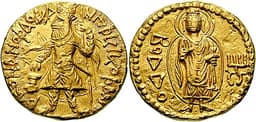
Kujula Kadphises
Emperor · Ancient
55.2Total

Napoleon Bonaparte
General · Modern
70.9Total
Basic Information
Born
20
1769
Died
80
1821
Era
Ancient
Modern
Nationality
Kushan Empire
France
Occupation
Emperor
General
Civilization
Indian
Western
Score Comparison
Military (10%)
52.5
94.0
Political (20%)
68.0
72.0
Influence (20%)
55.7
40.0
Legacy (20%)
50.0
80.0
Leadership (15%)
48.8
78.0
Strategy (15%)
60.0
90.0
TOTAL
55.2
70.9
Kujula Kadphises — Complete Timeline
30 AD
Unification of the Yuezhi TribesPolitical Action◆ Major
Kujula Kadphises united the five Yuezhi tribes of Bactria into a single confederation. This unification laid the foundation for the Kushan Empire, which would become a major power in Central Asia and India.
UnificationYuezhiKushan Empire
Impact: regionalconstructive
40 AD
Issuance of First Kushan CoinsCultural
Kujula Kadphises issued the first Kushan coins, imitating Roman and Greek designs. These coins featured his portrait and the title 'Kushan' in Greek script, establishing a numismatic tradition for the empire.
CoinageNumismaticsKushan
Impact: regionalconstructive
50 AD
Conquest of the Kabul ValleyWar◆ Major
Kujula Kadphises led Kushan forces to conquer the Kabul Valley from the Indo-Parthians. This expanded Kushan territory into the Indian subcontinent and established control over key trade routes.
ConquestKabul ValleyExpansion
Impact: regional
Napoleon Bonaparte — Complete Timeline
1799 AD
Coup of 18 BrumaireOther◆ Major
Napoleon Bonaparte, with support from his brother Lucien and key political figures, overthrew the Directory in a bloodless coup. He established the Consulate with himself as First Consul, effectively becoming the ruler of France. This event ended the French Revolution's most unstable period.
French RevolutionCoupRise to Power
Impact: regional
1804 AD
Promulgation of the Napoleonic CodeOther◆ Major
Napoleon enacted the Civil Code of the French, known as the Napoleonic Code, a comprehensive set of laws that replaced the fragmented feudal legal systems. The code established legal equality, protected property rights, and secularized law. It became the basis for legal systems in many European and world countries.
Legal ReformNapoleonic CodeCivil Law
Impact: globalconstructive
1805 AD
Battle of AusterlitzWar◆ Major
Napoleon's Grande Arm
Napoleonic WarsBattleDecisive Victory
Impact: global
1812 AD
Invasion of RussiaWar◆ Major
Napoleon led the Grande Arm
Napoleonic WarsInvasionDisaster
Impact: globaldestructive
1815 AD
Battle of WaterlooWar◆ Major
Napoleon's French army was defeated by the combined forces of the Duke of Wellington's Anglo-Allied army and Gebhard Leberecht von Bl
Napoleonic WarsBattleFinal Defeat
Impact: globaldestructive
Expert Analysis
kujula-kadphises-vs-napoleon-bonaparte
# The Emperor and the Unifier: Two Paths to Power
In the winter of 1805, Napoleon Bonaparte stood before his Grande Armée at Austerlitz, about to deliver the most stunning military victory of his age. Eighteen centuries earlier and thousands of miles away, Kujula Kadphises, a chieftain of the Yuezhi nomads, gazed across the dusty plains of Bactria, pondering how to bind five warring tribes into a single empire. One man would reshape Europe through fire and law; the other would plant the seeds of a dynasty that would bridge East and West. What drove these two figures—so different in time, place, and temperament—to pursue such similar ambitions, and why did their paths diverge so dramatically?
Origins
Napoleon was born in 1769 on the Mediterranean island of Corsica, a land recently annexed by France. His family belonged to the minor nobility, but they were neither wealthy nor powerful. The young Bonaparte grew up speaking Italian-accented French, an outsider in a nation that would one day worship him. The Enlightenment was in full bloom, and the French Revolution—a cataclysm that would upend monarchy and class—was just around the corner. His era was one of chaos and opportunity, where a brilliant artillery officer could become emperor.
Kujula Kadphises, born around 20 AD, emerged from the Yuezhi, a confederation of nomadic tribes that had migrated from the borders of China into Central Asia. The Yuezhi had been displaced by the Xiongnu, and by the first century AD, they had settled in Bactria, a region of fertile valleys and ancient trade routes. Kujula’s world was one of tribal loyalties, shifting alliances, and the shadow of empires like Rome and Parthia. He had no revolution to ride—only the slow, grinding need to survive and dominate.
Rise to Power
Napoleon’s ascent was meteoric. He first distinguished himself at the Siege of Toulon in 1793, where, as a young captain, he devised the plan that drove British forces from the port. By 1796, he was commanding the Army of Italy, where his lightning campaigns forced Austria to sue for peace. Each victory fed his reputation; each political crisis in Paris opened a door. In 1799, he staged a coup d’état, becoming First Consul, and by 1804, he crowned himself Emperor of the French. His path was one of relentless ambition, fueled by a genius for both war and self-promotion.
Kujula’s rise was slower, like the carving of a mountain. In 30 AD, he achieved what his predecessors could not: he unified the five Yuezhi tribes into a single confederation. This was not a battle won in a day but a patient work of diplomacy, marriage alliances, and subtle coercion. The tribes had long fought among themselves; Kujula gave them a common purpose. By 50 AD, he led them into the Kabul Valley, conquering it from the Indo-Parthians and expanding Kushan territory into the crossroads of Central Asia and India. His power came not from a single stroke but from years of building trust and fear among men who had known only division.
Leadership & Governance
Napoleon ruled through what the historian calls “the cult of the leader.” He was a military genius—his scores of 94 in military and 93 in strategy reflect a man who could read a battlefield like a poem. At Austerlitz in 1805, he lured the Austro-Russian army into a trap, crushing them with a feigned retreat. Yet his political score of 75 hints at a flaw: he centralized power so completely that his empire depended on his own survival. He reformed France through the Napoleonic Code, standardizing laws and abolishing feudal privileges, but he also silenced dissent and crowned himself emperor. His political wisdom was real but brittle.
Kujula, by contrast, governed with a lighter hand. His political score of 72 and leadership of 78 suggest a ruler who understood that an empire of nomads and settled peoples required flexibility. He issued the first Kushan coins around 40 AD, imitating Roman and Greek designs—a brilliant stroke of soft power that signaled legitimacy and connected his realm to the wider world. He did not impose a single culture but allowed local traditions to persist, creating a hybrid civilization that would later flourish under his successors. His military score of 21.9 is low, but this may reflect a leader who valued consolidation over conquest; he expanded territory through careful campaigns, not Napoleonic blitzkriegs.
Triumph & Tragedy
Napoleon’s greatest moment was Austerlitz, where he shattered the Third Coalition and cemented his dominance over Europe. His tragedy was the invasion of Russia in 1812, where hubris and logistics destroyed his Grand Armée. He was exiled to Elba, returned for a Hundred Days, and finally defeated at Waterloo in 1815. His fall was as spectacular as his rise—a man who could not stop, whose ambition consumed everything he built.
Kujula’s triumph was the founding of the Kushan Empire itself, a dynasty that would last for centuries and foster the spread of Buddhism along the Silk Road. His tragedy is that we know so little of his end. He died around 80 AD, likely of old age, and his empire passed to his son, Vima Takto. There was no dramatic exile, no final battle—only the quiet continuation of a legacy he had planted.
Character & Destiny
Napoleon was driven by a restless hunger for glory. “Impossible is a word to be found only in the dictionary of fools,” he once said. His personality was magnetic, his ambition limitless, but his need for control made him unable to delegate or compromise. He shaped his own destiny, but that destiny was a trap.
Kujula was a unifier, not a conqueror. His character was patient, pragmatic, and adaptive. He worked within the constraints of his world—nomadic traditions, limited resources, the need for consensus. His destiny was to build something that would outlast him, not to die in a blaze of glory.
Legacy
Napoleon’s legacy is a paradox. He spread the ideals of the French Revolution—equality before the law, meritocracy, secular governance—across Europe, yet he also revived monarchy and empire. His Napoleonic Code influences legal systems worldwide, but his wars killed millions. He is remembered as both a hero and a tyrant, a figure of unmatched ambition and tragic flaw.
Kujula’s legacy is quieter but more enduring. The Kushan Empire became a bridge between Rome, Persia, China, and India, facilitating trade and the exchange of ideas. His coins, with their Greek and Roman motifs, testify to a ruler who understood that power is not only won by the sword but also by the symbol. He is remembered as a founder, not a destroyer—a man who gave his people an identity that would last for centuries.
Conclusion
Napoleon and Kujula both rose from modest origins to build empires, but their stories reveal the different shapes of ambition. Napoleon’s fire burned bright and fast, consuming everything in its path until it had nothing left to burn. Kujula’s flame was a steady lamp, lighting a path that others could follow. One changed the world in a flash; the other changed it slowly, like water shaping stone. In the end, both remind us that history belongs not only to the conqueror who shouts the loudest but also to the unifier who builds a foundation that others can stand upon.
Rankings
🥇
Napoleon BonaparteLeader
Mil: 94.0Pol: 72.0Inf: 40.0
70.9
🥈
Kujula Kadphises
Mil: 52.5Pol: 68.0Inf: 55.7
55.2
+15.7 behind
How This Comparison Works
Algorithm
Each figure is scored on 6 dimensions (0—100 scale) based on structured historical data: Military (10%), Political (20%), Influence (20%), Legacy (20%), Leadership (15%), Strategy (15%). The weighted total produces the final ranking.
Data Sources
Scores are computed from structured sub-indicators in the database. Scale factors adjust for era (Ancient ×0.85, Modern ×1.0) and civilization size (Eastern ×1.05, Other ×0.80) to account for differences in population and military scale.
Maximum 3 Figures
Comparisons are limited to 2—3 figures to ensure readability and statistical meaningfulness.
Error Margins
±5 points per dimension — Sub-scores are derived from historical records with inherent uncertainty. Two figures within 5 points on a dimension should be considered roughly equivalent in that area.
Total Score Accuracy
±3 points overall — The weighted combination of 6 dimensions produces a total score with approximately ±3 points of uncertainty. Differences of less than 3 points are not statistically significant— the figures are effectively tied.
Known Limitations
- Historical records are incomplete and uneven across civilizations
- Figures from oral-tradition societies may be underrepresented
- Occupation labels can misclassify multi-role figures
- Scores measure capability and impact, not moral character
- Quantitative scoring is a comparison tool, not absolute truth
Capability Radar
Military (10%) — Battles & Warfare
Battles
45
95
Win Rate
50
90
Expansion
60
95
Political (20%) — Governance & Reform
Reform
40
95
Diplomacy
50
80
Economy
45
85
Influence (20%) — Cultural & Global Reach
Cultural
50
85
Global
45
90
Legacy (20%) — Historical Impact
Historical
55
95
Longevity
60
90
Leadership (15%) — Power & Stability
Tenure
55
85
Stability
50
70
Strategy (15%) — Tactics & Innovation
Strategy
55
95
Tactics
40
98
Reform
30
92
Similar Comparisons
Comments & Discussion
No comments yet. Be the first to share your thoughts!