Loading...
Le Loi vs Yang Jian
Yang Jian leads by 4.5 pts · 2 figures compared
…
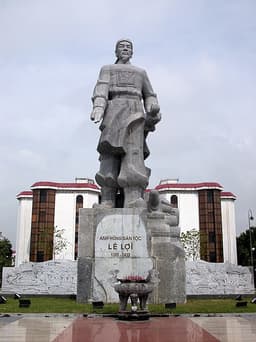
Le Loi
Emperor · Medieval
68.2Total

Yang Jian
Emperor · Medieval
72.7Total
Basic Information
Born
1385
541
Died
1433
604
Era
Medieval
Medieval
Nationality
Vietnam
China
Occupation
Emperor
Emperor
Civilization
Eastern
Eastern
Score Comparison
Military (10%)
74.7
76.0
Political (20%)
60.0
62.7
Influence (20%)
68.0
65.0
Legacy (20%)
68.0
80.0
Leadership (15%)
72.0
79.8
Strategy (15%)
69.1
75.0
TOTAL
68.2
72.7
Le Loi — Complete Timeline
1418 AD
Lam Son Uprising BeginsWar
Le Loi launched the Lam Son uprising against Ming Chinese occupation of Dai Viet. He gathered a small force in the Lam Son region of Thanh Hoa province, beginning a decade-long guerrilla war.
Ming OccupationVietnamese IndependenceGuerrilla War
Impact: national
1426 AD
Siege of Dong QuanWar◆ Major
Le Loi's forces besieged the Ming-held citadel of Dong Quan (Hanoi). The siege cut off Ming supply lines and forced the Chinese to negotiate, leading to the eventual withdrawal of Ming forces.
SiegeMing OccupationDai Viet
Impact: national
1427 AD
Battle of Chi Lang PassWar◆ Major
Le Loi's forces ambushed and defeated a large Ming relief army at Chi Lang Pass. This decisive victory forced the Ming court to recognize Dai Viet's independence and withdraw its remaining troops.
BattleMing OccupationIndependence
Impact: regional
1428 AD
Founding of the Later Le DynastyPolitical Action
Le Loi ascended the throne as Emperor Le Thai To, founding the Later Le dynasty. He established a new capital at Dong Kinh (Hanoi) and implemented policies to rebuild the war-torn country.
Later Le DynastyVietnamese HistoryReconstruction
Impact: regionalconstructive
Yang Jian — Complete Timeline
577 AD
Conquest of Northern ZhouWar◆ Major
Yang Jian, as regent of Northern Zhou, led a campaign to conquer the rival Northern Qi state. He defeated the Northern Qi army and annexed its territory, unifying northern China under Northern Zhou rule.
Northern ZhouNorthern QiConquestUnification
Impact: regionalconstructive
581 AD
Overthrow of Northern ZhouPolitical Action
Yang Jian forced Emperor Jing of Northern Zhou to abdicate and proclaimed himself emperor, founding the Sui Dynasty. This ended the Northern Zhou and began the Sui Dynasty, which would later reunify all of China.
Sui DynastyNorthern ZhouAbdicationDynastic Change
Impact: nationaldestructive
582 AD
Implementation of Equal-Field SystemReform◆ Major
Yang Jian implemented the equal-field system (juntian) across the Sui Empire, redistributing land to peasants and reducing the power of aristocratic families. This reform increased agricultural productivity and tax revenue, strengthening the central government.
Sui DynastyLand ReformAgricultureCentralization
Impact: nationalprogressive
589 AD
Conquest of Chen DynastyWar
Yang Jian launched a massive invasion of the Chen Dynasty in southern China. His forces captured the Chen capital Jiankang (Nanjing), ending the Chen Dynasty and reunifying China after nearly 300 years of division since the fall of the Han.
Sui DynastyChen DynastyReunificationConquest
Impact: globalconstructive
Expert Analysis
Origins
Le Loi was born in 1385 in the Lam Son region of Thanh Hoa province, Dai Viet (modern Vietnam). He came from a wealthy landowning family with a tradition of local leadership. His early life coincided with the oppressive Ming occupation of Vietnam (1407-1427), which shaped his nationalist resolve. Yang Jian was born in 541 in the northern Chinese state of Western Wei, into a powerful aristocratic family. His father, Yang Zhong, was a general, and Yang Jian himself entered the military and political elite, eventually serving as regent for the Northern Zhou dynasty. Both men emerged from turbulent times: Le Loi from a conquered nation, Yang Jian from a divided China.
Rise to Power
Le Loi's rise began in 1418 when he launched the Lam Son uprising against Ming occupation. Initially with only a small band of followers, he gradually built a resistance movement. Key turning points included the Siege of Dong Quan (1426-1427), where his forces cut off Ming supply lines, and the Battle of Chi Lang Pass (1427), where his general Le Sat ambushed and destroyed a Ming relief army of over 100,000 troops. These victories forced the Ming court to negotiate, leading to the recognition of Dai Viet's independence in 1428. Yang Jian's rise was more rapid and political. In 580, after the death of Emperor Xuan of Northern Zhou, Yang Jian as regent seized power. He defeated rival generals and in 581 forced the young Emperor Jing to abdicate, proclaiming himself emperor of the Sui dynasty. In 589, he conquered the Chen dynasty in the south, reunifying China after nearly 300 years of division since the fall of the Han dynasty.
Leadership & Governance
Le Loi's leadership was characterized by guerrilla warfare and strategic patience. He scored 72.0 in leadership and 69.1 in strategy. He decentralized command, allowing local leaders like Nguyen Trai to operate independently. After becoming emperor, he implemented policies to rebuild the war-torn country: land redistribution, tax relief, and promotion of Confucian education. He moved the capital to Dong Kinh (Hanoi). Yang Jian scored higher in leadership (79.8) and strategy (75.0). He was a centralized reformer: he implemented the equal-field system (juntian) to redistribute land to peasants, reducing aristocratic power; he established a three-tier administrative system; and he codified laws. His governance was efficient but harsh, with strict punishments for corruption. Both men focused on post-war recovery, but Yang Jian's reforms were more systematic and enduring.
Triumph & Tragedy
Le Loi's greatest triumph was expelling the Ming and securing Vietnamese independence after 20 years of occupation. His founding of the Later Le dynasty, which lasted over 350 years, is a monumental achievement. However, his tragedy lies in the brevity of his reign (1428-1433) and the internal challenges his successors faced. He died relatively young (age 48) and his successors struggled with factional conflicts. Yang Jian's triumph was the reunification of China and the creation of a strong central administration. His equal-field system and legal code influenced later dynasties. But his tragedy was his harsh rule and the brutal treatment of his rivals. He was also paranoid in his later years, purging officials and even his own son. His dynasty, the Sui, lasted only 37 years, collapsing soon after his death due to massive public works projects and military campaigns that exhausted the state.
Character & Destiny
Le Loi was a patient and pragmatic leader. He was known for his humility and ability to inspire loyalty among his followers. His character was shaped by the struggle for national liberation, making him a symbol of resilience. Yang Jian was ambitious, ruthless, and meticulous. He was a master of political intrigue and administrative reform, but his paranoia and harshness alienated many. Historical assessments often contrast Le Loi's nationalist idealism with Yang Jian's pragmatic centralism. Le Loi's destiny was to become a national hero of Vietnam, while Yang Jian's destiny was to be a transitional figure who paved the way for the Tang dynasty.
Legacy
Le Loi's legacy is immense in Vietnam. He is revered as a national hero who liberated the country from Chinese rule. The Later Le dynasty he founded became one of Vietnam's longest-lasting dynasties, and his military strategies are studied. He scores 68.0 in legacy. Yang Jian's legacy is more complex. He reunified China and his administrative reforms were adopted by the Tang dynasty, which succeeded him. The equal-field system and the three-tier administration became foundations of Chinese governance. He scores 80.0 in legacy, reflecting his lasting impact on Chinese political structure. However, his dynasty's quick collapse often overshadows his achievements.
Conclusion
Yang Jian had a greater overall impact on history, reflected in his total score of 72.7 versus Le Loi's 68.2. While Le Loi's liberation of Vietnam was crucial for Vietnamese national identity, Yang Jian's reunification of China and his administrative reforms influenced a much larger population and set the stage for the golden age of the Tang dynasty. Yang Jian's political and leadership scores (62.7 and 79.8) surpass Le Loi's (60.0 and 72.0), and his legacy score (80.0) is significantly higher. However, Le Loi's military and strategic achievements (74.7 and 69.1) are comparable to Yang Jian's (76.0 and 75.0), but the scale of Yang Jian's conquest—unifying all of China—gives him the edge. In summary, Yang Jian's impact on world history is greater due to the magnitude of his unification and reforms.
Rankings
🥇
Yang JianLeader
Mil: 76.0Pol: 62.7Inf: 65.0
72.7
🥈
Le Loi
Mil: 74.7Pol: 60.0Inf: 68.0
68.2
+4.5 behind
How This Comparison Works
Algorithm
Each figure is scored on 6 dimensions (0—100 scale) based on structured historical data: Military (10%), Political (20%), Influence (20%), Legacy (20%), Leadership (15%), Strategy (15%). The weighted total produces the final ranking.
Data Sources
Scores are computed from structured sub-indicators in the database. Scale factors adjust for era (Ancient ×0.85, Modern ×1.0) and civilization size (Eastern ×1.05, Other ×0.80) to account for differences in population and military scale.
Maximum 3 Figures
Comparisons are limited to 2—3 figures to ensure readability and statistical meaningfulness.
Error Margins
±5 points per dimension — Sub-scores are derived from historical records with inherent uncertainty. Two figures within 5 points on a dimension should be considered roughly equivalent in that area.
Total Score Accuracy
±3 points overall — The weighted combination of 6 dimensions produces a total score with approximately ±3 points of uncertainty. Differences of less than 3 points are not statistically significant— the figures are effectively tied.
Known Limitations
- Historical records are incomplete and uneven across civilizations
- Figures from oral-tradition societies may be underrepresented
- Occupation labels can misclassify multi-role figures
- Scores measure capability and impact, not moral character
- Quantitative scoring is a comparison tool, not absolute truth
Capability Radar
Military (10%) — Battles & Warfare
Battles
75
75
Win Rate
80
80
Expansion
65
85
Political (20%) — Governance & Reform
Reform
70
90
Diplomacy
75
75
Economy
65
85
Influence (20%) — Cultural & Global Reach
Cultural
80
75
Global
55
70
Legacy (20%) — Historical Impact
Historical
85
85
Longevity
75
80
Leadership (15%) — Power & Stability
Tenure
60
70
Stability
70
80
Strategy (15%) — Tactics & Innovation
Strategy
82
85
Tactics
78
70
Reform
70
90
Similar Comparisons
Comments & Discussion
No comments yet. Be the first to share your thoughts!