Loading...
Leon Gambetta vs Napoleon Bonaparte
Napoleon Bonaparte leads by 9.7 pts · 2 figures compared
…
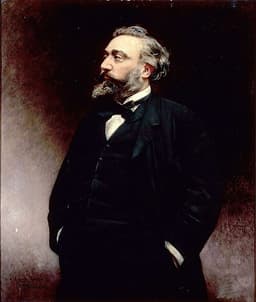
Leon Gambetta
Politician · Modern
61.2Total

Napoleon Bonaparte
General · Modern
70.9Total
Basic Information
Born
1838
1769
Died
1882
1821
Era
Modern
Modern
Nationality
France
France
Occupation
Politician
General
Civilization
Western
Western
Score Comparison
Military (10%)
50.0
94.0
Political (20%)
70.0
72.0
Influence (20%)
62.0
40.0
Legacy (20%)
56.0
80.0
Leadership (15%)
79.8
78.0
Strategy (15%)
42.6
90.0
TOTAL
61.2
70.9
Leon Gambetta — Complete Timeline
1870 AD
Proclamation of the Third Republic (1870)Political Action
After the fall of Napoleon III at Sedan, Gambetta proclaimed the Third Republic from the H
Third RepublicRegime Change
Impact: nationalconstructive
Escape from Paris by Balloon (1870)Political Action◆ Major
During the Siege of Paris, Gambetta escaped the city in a hot air balloon to organize resistance in the provinces. He raised new armies and continued the war effort against Prussia.
Franco-Prussian WarResistance
Impact: nationalconstructive
Minister of the Interior (1870-1871)Political Action◆ Major
Gambetta served as Minister of the Interior in the Government of National Defense. He directed the war effort and attempted to continue fighting after the fall of Paris.
Franco-Prussian WarGovernment
Impact: national
1871 AD
Founding of the Republican Union (1871)Political Action◆ Major
Gambetta founded the Republican Union party, which advocated for a secular, democratic republic. The party became a major force in the National Assembly.
Political PartyRepublicanism
Impact: nationalconstructive
1879 AD
President of the Chamber of Deputies (1879-1882)Political Action◆ Major
Gambetta was elected President of the Chamber of Deputies, a powerful position in the Third Republic. He used it to advance republican reforms.
Third RepublicParliament
Impact: national
1881 AD
Prime Minister of France (1881-1882)Political Action◆ Major
Gambetta became Prime Minister, forming the 'Grand Ministry' of republican unity. His government lasted only 73 days due to opposition to his proposed constitutional reforms.
Third RepublicPrime Minister
Impact: national
Napoleon Bonaparte — Complete Timeline
1799 AD
Coup of 18 BrumaireOther◆ Major
Napoleon Bonaparte, with support from his brother Lucien and key political figures, overthrew the Directory in a bloodless coup. He established the Consulate with himself as First Consul, effectively becoming the ruler of France. This event ended the French Revolution's most unstable period.
French RevolutionCoupRise to Power
Impact: regional
1804 AD
Promulgation of the Napoleonic CodeOther◆ Major
Napoleon enacted the Civil Code of the French, known as the Napoleonic Code, a comprehensive set of laws that replaced the fragmented feudal legal systems. The code established legal equality, protected property rights, and secularized law. It became the basis for legal systems in many European and world countries.
Legal ReformNapoleonic CodeCivil Law
Impact: globalconstructive
1805 AD
Battle of AusterlitzWar◆ Major
Napoleon's Grande Arm
Napoleonic WarsBattleDecisive Victory
Impact: global
1812 AD
Invasion of RussiaWar◆ Major
Napoleon led the Grande Arm
Napoleonic WarsInvasionDisaster
Impact: globaldestructive
1815 AD
Battle of WaterlooWar◆ Major
Napoleon's French army was defeated by the combined forces of the Duke of Wellington's Anglo-Allied army and Gebhard Leberecht von Bl
Napoleonic WarsBattleFinal Defeat
Impact: globaldestructive
Expert Analysis
leon-gambetta-vs-napoleon-bonaparte
# The General and the Orator
On a September afternoon in 1870, as Prussian armies tightened their grip around Paris, a middle-aged politician with a thick provincial accent climbed into a wicker basket beneath a hydrogen balloon. Leon Gambetta, the son of an Italian grocer, rose above the besieged capital and floated into history. Forty-five years earlier, another Frenchman had died in exile on a remote Atlantic island, his grand ambitions reduced to ashes. Napoleon Bonaparte had conquered Europe with cannon and cavalry; Gambetta would try to save France with words and will. Both men sought to shape a nation’s destiny—one through the sword, the other through the ballot box—and their divergent paths illuminate the chasm between military glory and republican resilience.
Origins
Napoleon was born in 1769 on Corsica, an island recently annexed by France, into a minor noble family of Italian descent. His father, Carlo, was a lawyer and diplomat who maneuvered within the French colonial administration, while his mother, Letizia, instilled in him a fierce sense of pride and discipline. The Corsican landscape—rugged, isolated, and simmering with resentment against French rule—shaped a boy who felt both part of France and apart from it. He studied at military academies in Brienne and Paris, where his classmates mocked his accent and poverty. That outsider’s hunger would drive him relentlessly.
Gambetta, born in 1838 in Cahors, came from humbler stock. His father ran a small grocery store; his mother was a devout Catholic. The family had no military tradition, no aristocratic pretensions. Young Leon was a brilliant student, winning scholarships that carried him to the law faculty in Paris. Where Napoleon’s world was one of fortresses and battlefields, Gambetta’s was one of debating societies and republican clubs. The France of his youth was already industrializing, already wrestling with the legacies of revolution. He absorbed the ideals of 1789 not as a conqueror but as a reformer.
Rise to Power
Napoleon’s ascent was meteoric. At 24, he drove the British out of Toulon with a daring artillery plan. At 26, he suppressed a royalist uprising in Paris with what he called “a whiff of grapeshot.” By 30, he had conquered Italy and Egypt, covering himself in glory while the corrupt Directory fumbled at home. The coup of 18 Brumaire in 1799 was almost anticlimactic: a nation exhausted by chaos welcomed a strongman. His path was paved with victories—Austerlitz in 1805, Jena in 1806, Friedland in 1807—each battle a stepping stone to empire.
Gambetta’s rise was slower, more parliamentary. He entered politics in 1869, winning a seat in the Legislative Body as a fiery opponent of Napoleon III’s authoritarian regime. His gift was oratory: he could hold a chamber spellbound for hours, his voice rising and falling with righteous indignation. When the Franco-Prussian War erupted in 1870 and Napoleon III was captured at Sedan, Gambetta seized the moment. From the balcony of the Hôtel de Ville, he proclaimed the Third Republic. He was 32 years old, and France lay prostrate.
Leadership & Governance
As emperor, Napoleon governed with a blend of military discipline and enlightened reform. The Napoleonic Code, enacted in 1804, standardized French law across a fragmented continent, guaranteeing property rights and legal equality—though not for women. He centralized the bureaucracy, created the Bank of France, and established lycées to train future elites. But his governance was inseparable from conquest. Each new victory brought territory, tribute, and subjects who resented French rule. He never built lasting institutions of consent; his empire rested on his own genius and his armies’ bayonets.
Gambetta never commanded an army. His military score of 37.5 reflects a man who organized resistance but never led a charge. As Minister of the Interior in the Government of National Defense, he directed the war effort from Tours, raising new armies and attempting to break the Prussian siege. It was a hopeless task—the Prussians were too strong—but his energy was formidable. After the war, he turned to building a republic. He founded the Republican Union party in 1871, advocating for secular education, democratic institutions, and the separation of church and state. When he became President of the Chamber of Deputies in 1879, he wielded influence through persuasion, not decree. His brief 73-day premiership in 1881-1882 collapsed under the weight of republican infighting.
Triumph & Tragedy
Napoleon’s greatest moment came on December 2, 1805, when he destroyed the combined armies of Austria and Russia at Austerlitz. It was a masterpiece of strategy—feinting weakness on his right, crushing the enemy center, and pursuing a shattered foe. His political score of 75.0 and strategy score of 93.0 reflect a commander who could read a battlefield like a chessboard. But his tragedy was hubris. The invasion of Russia in 1812 cost half a million men. The defeat at Waterloo in 1815 ended his Hundred Days and sent him to St. Helena, where he died in 1821, a prisoner of the British.
Gambetta’s triumph was quieter but more enduring. He gave France a republic that survived. His tragedy was personal: he died in 1882 at just 44, worn out by overwork and a botched surgery. He never saw the full fruits of his labor—the secular schools, the stable democracy, the defeat of monarchist revivals. Yet his legacy outlasted Napoleon’s empire. The Third Republic endured until 1940, longer than the First Empire’s 10 years.
Character & Destiny
Napoleon was a creature of will. “Impossible is a word to be found only in the dictionary of fools,” he once said. He trusted his own judgment above all, demanded absolute loyalty, and crushed dissent without hesitation. His personality was magnetic, his energy boundless—but his inability to share power or accept limits doomed him. He could not stop conquering, even when conquest became self-destructive.
Gambetta was a creature of conviction. “Politics is the art of the possible,” he believed. He was pragmatic, building coalitions, compromising when necessary, but never abandoning his core republican faith. Where Napoleon inspired fear, Gambetta inspired loyalty. Where Napoleon centralized, Gambetta delegated. His personality was warm, his oratory passionate, his health fragile. He died not in exile but in his own bed, mourned by a nation.
Legacy
Napoleon left a contradictory legacy. His military innovations influenced warfare for a century; his legal code still shapes civil law across Europe and beyond; his myth inspired dictators from Louis-Napoleon to Hitler. But his conquests also brought death, destruction, and the bitter memory of occupation. His legacy score of 78.0 reflects a man who remade the world but left it more divided.
Gambetta left a quieter legacy. He is remembered as the founder of the Third Republic, the man who gave France a stable democracy when monarchy seemed inevitable. His influence score of 76.2 and political score of 72.0 capture a statesman who built institutions, not empires. He is not a household name like Napoleon, but his work endures in every French schoolroom, every secular law, every republican election.
Conclusion
Two Frenchmen, two visions. Napoleon sought to conquer France’s enemies; Gambetta sought to build France’s republic. One died in defeat, the other in triumph. Yet both answered the same question: what does it mean to lead a nation? For Napoleon, leadership meant bending the world to one’s will. For Gambetta, it meant shaping a world that could outlast one’s will. The general’s empire crumbled; the orator’s republic endured. In the end, perhaps the grocer’s son taught the Corsican’s heir a lesson: that lasting power is not taken at the point of a sword, but built in the hearts of citizens.
Rankings
🥇
Napoleon BonaparteLeader
Mil: 94.0Pol: 72.0Inf: 40.0
70.9
🥈
Leon Gambetta
Mil: 50.0Pol: 70.0Inf: 62.0
61.2
+9.7 behind
How This Comparison Works
Algorithm
Each figure is scored on 6 dimensions (0—100 scale) based on structured historical data: Military (10%), Political (20%), Influence (20%), Legacy (20%), Leadership (15%), Strategy (15%). The weighted total produces the final ranking.
Data Sources
Scores are computed from structured sub-indicators in the database. Scale factors adjust for era (Ancient ×0.85, Modern ×1.0) and civilization size (Eastern ×1.05, Other ×0.80) to account for differences in population and military scale.
Maximum 3 Figures
Comparisons are limited to 2—3 figures to ensure readability and statistical meaningfulness.
Error Margins
±5 points per dimension — Sub-scores are derived from historical records with inherent uncertainty. Two figures within 5 points on a dimension should be considered roughly equivalent in that area.
Total Score Accuracy
±3 points overall — The weighted combination of 6 dimensions produces a total score with approximately ±3 points of uncertainty. Differences of less than 3 points are not statistically significant— the figures are effectively tied.
Known Limitations
- Historical records are incomplete and uneven across civilizations
- Figures from oral-tradition societies may be underrepresented
- Occupation labels can misclassify multi-role figures
- Scores measure capability and impact, not moral character
- Quantitative scoring is a comparison tool, not absolute truth
Capability Radar
Military (10%) — Battles & Warfare
Battles
28
95
Win Rate
31
90
Expansion
32
95
Political (20%) — Governance & Reform
Reform
70
95
Diplomacy
65
80
Economy
55
85
Influence (20%) — Cultural & Global Reach
Cultural
45
85
Global
55
90
Legacy (20%) — Historical Impact
Historical
60
95
Longevity
50
90
Leadership (15%) — Power & Stability
Tenure
60
85
Stability
50
70
Strategy (15%) — Tactics & Innovation
Strategy
35
95
Tactics
43
98
Reform
46
92
Similar Comparisons
Comments & Discussion
CANNON-COUNTER6/17/2026
Napoleon's "genius" was just good PR. Sure, Austerlitz dazzled, but his logistics collapsed in Russia because he couldn't adapt to mud and cold—textbook overreach. Gambetta's balloon escape? That took raw guts, not cavalry flair. One man gambled armies for ego; the other gambled altitude for a nation. I'd take an orator who outran a siege over a general who lost half a million men any day.
数据拆台手6/17/2026
拿破仑的人口账本烂透了——法国男人死光在战场,寡妇满街跑,他倒好,死在圣赫勒拿还写回忆录洗白。冈贝塔呢?1870年巴黎围城,他乘气球跑路组织反抗,用的全是民选力量。数据上,拿破仑的战争让法国损失近百万壮丁,冈贝塔的法兰西第三共和国却撑了70年。数字会说话:独裁者烧钱,共和派存人。
CARTHAGO-NOVA6/17/2026
Let's not romanticize Gambetta's "people's will"—he was just as ruthless as Napoleon, but with a borrowed lexicon from Classical Rome. When he declared *"la République est le gouvernement qui nous divise le moins"*, he was channeling Cicero, not the masses. Both men were tyrants in their own way: Napoleon on horseback, Gambetta behind the podium. Power corrupts, whether you wear epaulettes or a frock coat. History buffs miss the irony: Gambetta's balloon bought him time, but his republic built c
民国老教授6/17/2026
别被气球神话骗了:冈贝塔不过是个口才好的投机者。1871年巴黎公社起义时,他躲得远远的,让军队镇压工人;拿破仑至少敢站在炮火跟前。一个是革命沙龙里的阴谋家,一个是战场上的孤注一掷。法兰西需要的是恺撒,而不是一个会让法国输掉阿尔萨斯-洛林的律师。所谓“共和韧性”,不过是精英换了个面具继续统治。
GENERAL-GAMBIT6/17/2026
You're all missing the strategic nexus: both failed to grasp industrial warfare's demands. Napoleon's grande armée collapsed because he couldn't manage supply lines for 600,000 men; Gambetta's aerial escape was a stunt that masked his inability to reform weapon procurement—France lost with chassepots against Prussian breechloaders. The real lesson? Charisma just delays defeat; logistics win wars. My money's on the Corsican, though—at least he died in his boots, not in exile.