Loading...
Leonel Brizola vs Napoleon Bonaparte
Napoleon Bonaparte leads by 21.3 pts · 2 figures compared
…
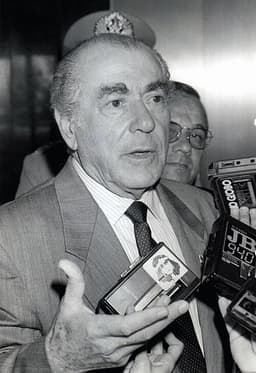
Leonel Brizola
Politician · Modern
49.6Total

Napoleon Bonaparte
General · Modern
70.9Total
Basic Information
Born
1922
1769
Died
—
1821
Era
Modern
Modern
Nationality
Brazil
France
Occupation
Politician
General
Civilization
Western
Western
Score Comparison
Military (10%)
36.6
94.0
Political (20%)
53.8
72.0
Influence (20%)
58.0
40.0
Legacy (20%)
48.3
80.0
Leadership (15%)
40.0
78.0
Strategy (15%)
53.3
90.0
TOTAL
49.6
70.9
Leonel Brizola — Complete Timeline
1958 AD
Elected Governor of Rio Grande do SulPolitical Action◆ Major
Brizola was elected governor of Rio Grande do Sul as a member of the Brazilian Labor Party (PTB). His administration implemented progressive reforms, including land expropriations and expansion of public education.
GovernorshipReformLabor Party
Impact: regionalconstructive
1961 AD
Led the 'Legality Campaign' to Defend Goulart's PresidencyPolitical Action◆ Major
When military ministers tried to block Jo
Political CrisisLegalityResistance
Impact: nationalconstructive
1964 AD
Exiled After the 1964 CoupPolitical Action◆ Major
After the military coup, Brizola was forced into exile, first in Uruguay and later in other countries. He continued to organize opposition to the dictatorship from abroad, advocating for armed resistance.
ExileOppositionMilitary Dictatorship
Impact: nationaltragic
1979 AD
Returned to Brazil and Founded the Democratic Labor Party (PDT)Political Action◆ Major
Brizola returned from exile under the amnesty law and founded the PDT, a left-wing party that revived the legacy of Get
Political PartyLaborismDemocratization
Impact: nationalconstructive
1982 AD
Elected Governor of Rio de JaneiroPolitical Action◆ Major
Brizola was elected governor of Rio de Janeiro in the first direct gubernatorial elections since the coup. His administration focused on education, housing, and public health, but was also marked by fiscal problems and political conflicts.
GovernorshipDemocracySocial Policy
Impact: regionalconstructive
Napoleon Bonaparte — Complete Timeline
1799 AD
Coup of 18 BrumaireOther◆ Major
Napoleon Bonaparte, with support from his brother Lucien and key political figures, overthrew the Directory in a bloodless coup. He established the Consulate with himself as First Consul, effectively becoming the ruler of France. This event ended the French Revolution's most unstable period.
French RevolutionCoupRise to Power
Impact: regional
1804 AD
Promulgation of the Napoleonic CodeOther◆ Major
Napoleon enacted the Civil Code of the French, known as the Napoleonic Code, a comprehensive set of laws that replaced the fragmented feudal legal systems. The code established legal equality, protected property rights, and secularized law. It became the basis for legal systems in many European and world countries.
Legal ReformNapoleonic CodeCivil Law
Impact: globalconstructive
1805 AD
Battle of AusterlitzWar◆ Major
Napoleon's Grande Arm
Napoleonic WarsBattleDecisive Victory
Impact: global
1812 AD
Invasion of RussiaWar◆ Major
Napoleon led the Grande Arm
Napoleonic WarsInvasionDisaster
Impact: globaldestructive
1815 AD
Battle of WaterlooWar◆ Major
Napoleon's French army was defeated by the combined forces of the Duke of Wellington's Anglo-Allied army and Gebhard Leberecht von Bl
Napoleonic WarsBattleFinal Defeat
Impact: globaldestructive
Expert Analysis
leonel-brizola-vs-napoleon-bonaparte
# The Corsican and the Gaúcho: Two Men Who Reshaped Their Worlds
On a June morning in 1815, Napoleon Bonaparte stood on a muddy field near Waterloo, watching his Imperial Guard march into the maw of British cannon fire. One hundred and forty-nine years later, in August 1964, Leonel Brizola sat in a cramped Montevideo apartment, listening to Brazilian radio stations that no longer dared speak his name. Both men had once commanded the hopes of millions. Both had been driven from power by forces they could not defeat. Yet their paths to that exile—and the worlds they left behind—could hardly have been more different.
Origins
Napoleon was born in 1769 on Corsica, an island that had become French property only months before his birth. His family belonged to the minor nobility, scraping by on modest incomes while his father collaborated with the French occupiers. Young Napoleon grew up speaking Corsican Italian, mocked by his French classmates for his accent and his island manners. The French Revolution, which erupted when he was twenty, shattered the old hierarchies and opened a path for talent that the ancien régime would never have allowed.
Leonel Brizola was born in 1922 in Carazinho, a small town in Brazil's southernmost state, Rio Grande do Sul. His father was a poor farmer who died when Brizola was young, leaving the family in desperate straits. Brizola worked as a shoeshine boy, a telegraph messenger, and a street vendor before scraping together enough money to study engineering. Where Napoleon's rise was powered by the collapse of a monarchy, Brizola's was fueled by the populist currents sweeping Latin America in the 1930s and 1940s—the era of Getúlio Vargas, who created the Brazilian Labor Party that would become Brizola's political home.
The difference in their eras shaped everything. Napoleon came of age when a single ambitious man could redraw the map of Europe with an army of muskets and bayonets. Brizola entered politics in an age of mass media, organized labor, and institutionalized parties—where power flowed not from battlefield victories but from coalitions, unions, and the ballot box.
Rise to Power
Napoleon's ascent was meteoric. In 1793, at just twenty-four, he drove British forces from the port of Toulon, earning promotion to brigadier general. By 1796, he commanded the French army in Italy, where his lightning campaigns humiliated the Austrians and made him a national hero. In 1799, he seized power in a coup d'état, becoming First Consul. Five years later, he crowned himself Emperor of the French. He had gone from obscure Corsican artillery officer to master of Europe in barely a decade—a rise built entirely on military genius.
Brizola's path was slower, steadier, and political. In 1958, he was elected governor of Rio Grande do Sul, a state known for its cattle ranches and its tradition of armed rebellion. His administration focused on land reform, public education, and infrastructure—policies that won him fierce loyalty among the poor and bitter hatred among the landed elite. When President Jânio Quadros resigned in 1961, military ministers tried to block Vice President João Goulart—Brizola's brother-in-law—from taking office. Brizola launched the "Legality Campaign," mobilizing radio broadcasts and armed civilians to defend Goulart's constitutional right to rule. He succeeded, but the crisis revealed how fragile Brazil's democracy had become.
Leadership & Governance
As emperor, Napoleon was a whirlwind of activity. He reorganized French administration, centralized the state, and created the Napoleonic Code—a legal framework that abolished feudal privileges, established equality before the law, and protected property rights. His military campaigns were masterpieces of speed and deception: he crushed the Prussians at Jena in 1806, outmaneuvered the Austrians at Wagram in 1809, and invaded Russia in 1812 with the largest army Europe had ever seen. Yet his governance was deeply autocratic. He suppressed dissent, censored the press, and placed his relatives on thrones across the continent. His political score of 75.0 reflects a ruler who was efficient but not democratic.
Brizola governed very differently. As governor of Rio de Janeiro from 1982, after returning from exile and founding the Democratic Labor Party, he focused on public works and social programs. He built schools, paved roads, and created the "Integrated Centers for Public Education" (CIEPs)—full-day schools designed to keep poor children off the streets and in classrooms. His leadership style was charismatic, confrontational, and deeply personal. He spoke directly to crowds in the language of the common man, denouncing elites and foreign powers with equal fury. His military score of 24.7 is laughably low compared to Napoleon's 94.0, but his political score of 72.0 reflects a man who understood the machinery of democracy—even when that machinery was being dismantled around him.
Triumph & Tragedy
Napoleon's greatest triumph was also the seed of his destruction. In 1805, he defeated the combined armies of Austria and Russia at Austerlitz, a battle so perfect that military academies still study it. He was at the height of his power, master of Europe from the Pyrenees to the Polish plains. But hubris led him to invade Russia in 1812. The Russian winter, the scorched-earth tactics, and the vast distances destroyed his Grande Armée. By 1814, the allies had captured Paris and exiled him to Elba. He returned in 1815 for the Hundred Days, only to meet final defeat at Waterloo. His legacy score of 78.0 acknowledges that his reforms outlasted his empire, but his failures were catastrophic.
Brizola's tragedy was different. In 1964, the Brazilian military—backed by the United States—overthrew President Goulart in a coup. Brizola, who had been preparing for armed resistance, was forced into exile. He spent fifteen years in Uruguay, Portugal, and the United States, watching from abroad as a dictatorship crushed the labor movement he had helped build. When he returned in 1979 under an amnesty law, Brazil had changed. The left-wing parties he founded never achieved the mass mobilization of his earlier years. He died in 2004, a respected but diminished figure, his dream of a socialist Brazil unrealized.
Character & Destiny
Napoleon was driven by an insatiable ambition. "I am not a man," he once said, "but a thing." He saw himself as an instrument of history, destined to reshape the world. His personality was magnetic, his energy inexhaustible, but his arrogance was fatal. He could not stop, could not share power, could not accept limits. That same drive that conquered Europe also destroyed him.
Brizola was driven by a different fire: loyalty to the poor and rage at injustice. He was stubborn, sometimes reckless, and prone to grand gestures that alienated moderates. But his character was forged in the crucible of Brazilian inequality. He never wavered in his belief that ordinary people deserved dignity, education, and a voice. Where Napoleon sought glory, Brizola sought justice—and both found that history does not always reward what we seek.
Legacy
Napoleon's legacy is written across the map of Europe. The Napoleonic Code influenced legal systems from France to Egypt to Louisiana. He modernized administration, promoted meritocracy, and spread revolutionary ideals—even as he betrayed them. His name still evokes awe, controversy, and endless fascination.
Brizola's legacy is narrower but no less real. The CIEP schools he built in Rio de Janeiro educated generations of poor children. The Democratic Labor Party he founded still exists, a voice for Brazilian workers. He is remembered as a symbol of resistance to dictatorship, a man who stood up when others bowed down. His total score of 64.0 cannot capture the moral weight of that stand.
Conclusion
Napoleon and Brizola never met, never corresponded, never knew each other's names. Yet their lives ask the same question: What does it mean to lead? Napoleon answered with conquest, Brizola with conviction. One reshaped continents; the other tried to reshape a nation. Both failed in their grandest ambitions—Napoleon died on a remote Atlantic island, Brizola died a politician out of season. But both succeeded in leaving the world slightly different than they found it. That, perhaps, is the only measure that matters.
Rankings
🥇
Napoleon BonaparteLeader
Mil: 94.0Pol: 72.0Inf: 40.0
70.9
🥈
Leonel Brizola
Mil: 36.6Pol: 53.8Inf: 58.0
49.6
+21.3 behind
How This Comparison Works
Algorithm
Each figure is scored on 6 dimensions (0—100 scale) based on structured historical data: Military (10%), Political (20%), Influence (20%), Legacy (20%), Leadership (15%), Strategy (15%). The weighted total produces the final ranking.
Data Sources
Scores are computed from structured sub-indicators in the database. Scale factors adjust for era (Ancient ×0.85, Modern ×1.0) and civilization size (Eastern ×1.05, Other ×0.80) to account for differences in population and military scale.
Maximum 3 Figures
Comparisons are limited to 2—3 figures to ensure readability and statistical meaningfulness.
Error Margins
±5 points per dimension — Sub-scores are derived from historical records with inherent uncertainty. Two figures within 5 points on a dimension should be considered roughly equivalent in that area.
Total Score Accuracy
±3 points overall — The weighted combination of 6 dimensions produces a total score with approximately ±3 points of uncertainty. Differences of less than 3 points are not statistically significant— the figures are effectively tied.
Known Limitations
- Historical records are incomplete and uneven across civilizations
- Figures from oral-tradition societies may be underrepresented
- Occupation labels can misclassify multi-role figures
- Scores measure capability and impact, not moral character
- Quantitative scoring is a comparison tool, not absolute truth
Capability Radar
Military (10%) — Battles & Warfare
Battles
5
95
Win Rate
5
90
Expansion
5
95
Political (20%) — Governance & Reform
Reform
65
95
Diplomacy
60
80
Economy
50
85
Influence (20%) — Cultural & Global Reach
Cultural
45
85
Global
35
90
Legacy (20%) — Historical Impact
Historical
50
95
Longevity
40
90
Leadership (15%) — Power & Stability
Tenure
55
85
Stability
40
70
Strategy (15%) — Tactics & Innovation
Strategy
10
95
Tactics
10
98
Reform
5
92
Similar Comparisons
Comments & Discussion
CANNON COUNTER6/17/2026
Comparing Napoleon's 1815 Waterloo chess match to Brizola's 1964 radio whispers is like contrasting a thunderstorm with a tapped wire. One lost 50,000 men in a single day reshaping Europe's borders; the other lost a continent's largest democracy to a coup where his name vanished from the air. Brizola's real tragedy? His 1961 "Legalidade" campaign mobilized armed citizens to secure Goulart's presidency—proving he could fight, just not with cannon.
铁血辩手6/17/2026
拿战水壶大战巴西草鞋?拿破仑从科西嘉口音逆袭到《民法典》植入欧洲骨髓,布利佐拉14岁擦鞋拼到国民议会,但战略差远了。拿破仑滑铁卢前夜还能喝令格鲁希元帅支援,布利佐拉1964年眼睁睁看军队倒戈。细节决定成败:前者带着2000门火炮征服欧洲,后者连自己的收音机频道都保不住。
DATA WRANGLER6/17/2026
Tell me about the 1964 ratio: 0 coups defeated vs. 20+ battles orchestrated? Brizola's 1961 "Cadeia da Legalidade" network of 100+ radio stations created a communication marvel—but his exile in Uruguay saw zero military success. Napoleon raised armies from scratch, conquered 70 major battles. The real divergence isn't exile style, it's scale of impact: one reshaped European law, the other let Brazil's 21-year dictatorship bloom.
古典学者6/17/2026
英雄史诗的差距在于叙事结构。拿破仑的流放是《奥德赛》式的悲剧英雄——厄尔巴岛归来再战滑铁卢,最后圣赫勒拿岛写回忆录教育后代。Brizola的蒙得维的亚公寓更像《圣经·诗篇》的流亡者:默默忍耐,等祖国再度召唤。两人都留下了“共和神话”,但拿破仑的军队碑文刻在凯旋门,Brizola的反叛之声沉在巴西农村的短波收音机里。
REVISIONIST CRITIC6/17/2026
Quit romanticizing exile. Napoleon's 1815 campaign was a desperate gamble that killed 125,000 men in just the Waterloo campaign—for a man who'd already abdicated once. Brizola's 1964 "failed" resistance? He built a grassroots network that would later fuel the 1984 Diretas Já movement. One leader burned Europe for personal glory; the other planted seeds that democratized a continent's sleeping giant.