Loading...
This comparison has not been analyzed yet.
One-time AI generation (~1 minute). Scores and timeline are already available below.
Leopold II of Austria vs Oscar I
Leopold II of Austria leads by 5.8 pts · 2 figures compared
…

Leopold II of Austria
Emperor · Modern
55.5Total
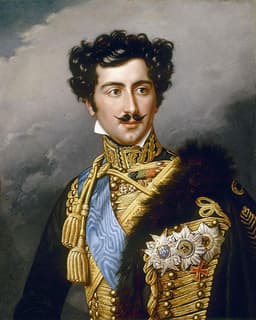
Oscar I
Emperor · Modern
49.7Total
Basic Information
Born
1747
1799
Died
1792
1859
Era
Modern
Modern
Nationality
Austria
Sweden
Occupation
Emperor
Emperor
Civilization
Western
Western
Score Comparison
Military (10%)
50.0
21.2
Political (20%)
72.0
72.0
Influence (20%)
55.7
51.8
Legacy (20%)
46.7
40.0
Leadership (15%)
68.0
72.0
Strategy (15%)
38.6
30.3
TOTAL
55.5
49.7
Leopold II of Austria — Complete Timeline
1790 AD
Suppression of the Belgian RevoltWar◆ Major
Leopold II sent Austrian troops to suppress the United Belgian States, which had declared independence from Habsburg rule in 1789. The revolt was crushed by December 1790, re-establishing Austrian control over the Southern Netherlands.
BelgiumRevoltHabsburg
Impact: regionaldestructive
Reversal of Joseph II's ReformsReform◆ Major
Upon becoming emperor, Leopold II reversed many of his brother Joseph II's radical reforms to pacify the nobility and clergy. He restored the privileges of the Estates and repealed the Edict of Toleration in some areas, stabilizing the Habsburg monarchy after years of unrest.
Counter-ReformStabilizationNobility
Impact: regional
1791 AD
Declaration of PillnitzPolitical Action◆ Major
Leopold II and King Frederick William II of Prussia issued the Declaration of Pillnitz, stating that the situation of the French royal family was a matter of common interest to all European sovereigns. This declaration was interpreted as a threat of intervention against the French Revolution.
French RevolutionMonarchyIntervention
Impact: global
Treaty of SistovaPolitical Action
Leopold II ended the Austro-Turkish War with the Treaty of Sistova, which restored the pre-war status quo. Austria gained only the small town of Or
Ottoman EmpirePeace TreatyStatus Quo
Impact: regional
Oscar I — Complete Timeline
1840 AD
Liberal reforms of the penal codeReform◆ Major
Oscar I oversaw a major reform of the Swedish penal code, abolishing the death penalty for most crimes and reducing the use of corporal punishment. This was part of a broader liberalization of Swedish law, influenced by Enlightenment principles and aimed at modernizing the justice system.
SwedenLawReformPenal Code
Impact: nationalprogressive
Introduction of freedom of the pressReform◆ Major
Oscar I introduced a new press law that significantly expanded freedom of the press in Sweden. This allowed for greater public debate and criticism of the government, marking a shift towards a more open and liberal society, though it was still subject to some restrictions.
SwedenPress FreedomLiberalismReform
Impact: nationalprogressive
1854 AD
First Swedish railway concessionOther◆ Major
Oscar I granted the first concession for the construction of a railway in Sweden, connecting Stockholm to Gothenburg. This initiated the development of Sweden's railway network, which was crucial for economic integration and industrial growth in the following decades.
SwedenRailwayInfrastructureIndustrialization
Impact: nationalconstructive
1858 AD
Repeal of the Conventicle ActReform◆ Major
Oscar I repealed the Conventicle Act, which had prohibited religious gatherings outside the state church. This allowed for greater religious freedom and the establishment of free churches, a significant step towards religious toleration in Sweden.
SwedenReligionFreedomReform
Impact: nationalprogressive
This comparison has not been analyzed yet.
One-time AI generation (~1 minute). Scores and timeline are already available below.
Rankings
🥇
Leopold II of AustriaLeader
Mil: 50.0Pol: 72.0Inf: 55.7
55.5
🥈
Oscar I
Mil: 21.2Pol: 72.0Inf: 51.8
49.7
+5.8 behind
How This Comparison Works
Algorithm
Each figure is scored on 6 dimensions (0—100 scale) based on structured historical data: Military (10%), Political (20%), Influence (20%), Legacy (20%), Leadership (15%), Strategy (15%). The weighted total produces the final ranking.
Data Sources
Scores are computed from structured sub-indicators in the database. Scale factors adjust for era (Ancient ×0.85, Modern ×1.0) and civilization size (Eastern ×1.05, Other ×0.80) to account for differences in population and military scale.
Maximum 3 Figures
Comparisons are limited to 2—3 figures to ensure readability and statistical meaningfulness.
Error Margins
±5 points per dimension — Sub-scores are derived from historical records with inherent uncertainty. Two figures within 5 points on a dimension should be considered roughly equivalent in that area.
Total Score Accuracy
±3 points overall — The weighted combination of 6 dimensions produces a total score with approximately ±3 points of uncertainty. Differences of less than 3 points are not statistically significant— the figures are effectively tied.
Known Limitations
- Historical records are incomplete and uneven across civilizations
- Figures from oral-tradition societies may be underrepresented
- Occupation labels can misclassify multi-role figures
- Scores measure capability and impact, not moral character
- Quantitative scoring is a comparison tool, not absolute truth
Capability Radar
Military (10%) — Battles & Warfare
Battles
20
10
Win Rate
25
10
Expansion
15
10
Political (20%) — Governance & Reform
Reform
55
70
Diplomacy
70
60
Economy
50
60
Influence (20%) — Cultural & Global Reach
Cultural
40
30
Global
35
20
Legacy (20%) — Historical Impact
Historical
50
30
Longevity
40
20
Leadership (15%) — Power & Stability
Tenure
60
60
Stability
45
65
Strategy (15%) — Tactics & Innovation
Strategy
25
10
Tactics
20
10
Reform
30
20
Similar Comparisons
Comments & Discussion
No comments yet. Be the first to share your thoughts!