Loading...
Li Dazhao vs Napoleon Bonaparte
Napoleon Bonaparte leads by 27.5 pts · 2 figures compared
…
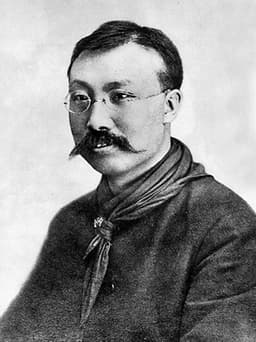
Li Dazhao
Politician · Modern
43.4Total

Napoleon Bonaparte
General · Modern
70.9Total
Basic Information
Born
1889
1769
Died
1927
1821
Era
Modern
Modern
Nationality
China
France
Occupation
Politician
General
Civilization
Eastern
Western
Score Comparison
Military (10%)
10.9
94.0
Political (20%)
39.4
72.0
Influence (20%)
61.0
40.0
Legacy (20%)
52.0
80.0
Leadership (15%)
31.2
78.0
Strategy (15%)
34.4
90.0
TOTAL
43.4
70.9
Li Dazhao — Complete Timeline
1921 AD
Co-founding of the Chinese Communist PartyPolitical Action
Li Dazhao, a professor at Peking University and early Marxist thinker, was a key founder of the Chinese Communist Party. He recruited many early members and helped establish the party's intellectual foundations through his writings.
Chinese Communist PartyFoundingMarxism
Impact: globalconstructive
1927 AD
Execution by Zhang ZuolinPolitical Action◆ Major
Li Dazhao was arrested by the warlord Zhang Zuolin's forces in Beijing during a raid on the Soviet embassy. He was executed by hanging, becoming a martyr for the Communist cause. His death galvanized opposition to the warlord government.
Chinese Communist PartyExecutionMartyr
Impact: nationaltragic
Napoleon Bonaparte — Complete Timeline
1799 AD
Coup of 18 BrumaireOther◆ Major
Napoleon Bonaparte, with support from his brother Lucien and key political figures, overthrew the Directory in a bloodless coup. He established the Consulate with himself as First Consul, effectively becoming the ruler of France. This event ended the French Revolution's most unstable period.
French RevolutionCoupRise to Power
Impact: regional
1804 AD
Promulgation of the Napoleonic CodeOther◆ Major
Napoleon enacted the Civil Code of the French, known as the Napoleonic Code, a comprehensive set of laws that replaced the fragmented feudal legal systems. The code established legal equality, protected property rights, and secularized law. It became the basis for legal systems in many European and world countries.
Legal ReformNapoleonic CodeCivil Law
Impact: globalconstructive
1805 AD
Battle of AusterlitzWar◆ Major
Napoleon's Grande Arm
Napoleonic WarsBattleDecisive Victory
Impact: global
1812 AD
Invasion of RussiaWar◆ Major
Napoleon led the Grande Arm
Napoleonic WarsInvasionDisaster
Impact: globaldestructive
1815 AD
Battle of WaterlooWar◆ Major
Napoleon's French army was defeated by the combined forces of the Duke of Wellington's Anglo-Allied army and Gebhard Leberecht von Bl
Napoleonic WarsBattleFinal Defeat
Impact: globaldestructive
Expert Analysis
li-dazhao-vs-napoleon-bonaparte
# The Conqueror and the Kindler: Napoleon and Li Dazhao
In the spring of 1927, as Li Dazhao walked calmly toward the gallows in a Beijing prison, he could not have known that halfway across the world, the legacy of another man—one who had died a century earlier—was being debated in the chambers of power. Napoleon Bonaparte had once stood at the pinnacle of European domination, his name synonymous with conquest. Li Dazhao, by contrast, faced execution with no army, no empire, only a stack of radical pamphlets and a vision for a China yet to be born. What drove two such different men to shape history from such different poles of power? The answer lies not in their shared ambition, but in the worlds that shaped them.
Origins
Napoleon was born in 1769 on the Mediterranean island of Corsica, a place of rugged independence that had only recently been annexed by France. His family was minor nobility, but his education at French military schools instilled in him the Enlightenment ideals of meritocracy and order. The French Revolution of 1789 shattered the old regime, and Napoleon—ambitious, brilliant, and ruthless—saw opportunity in chaos. Corsica taught him that power comes from action, not birthright.
Li Dazhao, born in 1889 in Hebei province, came of age in a China reeling from humiliation. The Qing Dynasty was collapsing under the weight of foreign incursions and internal decay. As a young scholar, he studied at Peking University, where he encountered Western ideas—democracy, science, and later, Marxism. Where Napoleon saw a Europe ripe for conquest, Li saw a China in desperate need of salvation. His era was not one of empire-building, but of intellectual awakening.
Rise to Power
Napoleon’s ascent was meteoric. By 1796, at age 26, he commanded the French army in Italy, where his lightning campaigns stunned Europe. His victory at the Battle of Austerlitz in 1805—often called his masterpiece—cemented his reputation as a military genius, scoring 93 in strategy and 94 in military prowess. He didn’t wait for power; he seized it, crowning himself Emperor of the French in 1804. His path was one of conquest: each battle a stepping stone, each treaty a new province.
Li Dazhao’s rise was quieter, but no less transformative. In 1917, as Russia’s Bolsheviks seized power, Li began lecturing on Marxism at Peking University, his words spreading through China’s restless youth. In 1921, he co-founded the Chinese Communist Party, a small group of intellectuals meeting in a Shanghai schoolhouse. His power was not of armies but of ideas. He was not a general but a kindler of revolution, lighting a fire that would take decades to burn.
Leadership & Governance
Napoleon ruled with iron efficiency. He centralized the French state, reformed education, and most famously, codified the Napoleonic Code—a legal system that enshrined equality before the law, but also curtailed women’s rights and free speech. His leadership score of 80 reflects a man who inspired fierce loyalty but demanded absolute obedience. As a military commander, he was peerless: his campaigns are still studied for their boldness and logistical brilliance. Yet his political wisdom was flawed—he could conquer but not consolidate, as his disastrous invasion of Russia in 1812 proved.
Li Dazhao never governed. His leadership was intellectual and moral. As a professor, he shaped a generation of revolutionaries, including a young Mao Zedong. His political score of 50.1 reflects the limitations of his influence—he was executed before he could see his ideas take root. But his strategy score of 59.6 hints at a man who understood that revolution required patience, that Marxism must adapt to Chinese conditions. He wrote not decrees but essays, urging peasants and workers to rise.
Triumph & Tragedy
Napoleon’s greatest moment was Austerlitz, where he destroyed a larger Russian and Austrian army, forcing the Holy Roman Empire to dissolve. His tragedy came at Waterloo in 1815, when a combination of British and Prussian forces shattered his army. He died in exile on Saint Helena, a prisoner of his own ambition. His fall was as dramatic as his rise—a cautionary tale of overreach.
Li Dazhao’s triumph was the founding of the CCP, a seed that would grow into the world’s largest political party. His tragedy was his execution in 1927, at age 38, by the warlord Zhang Zuolin. He died not on a battlefield but in a prison yard, his body swinging from a noose. Yet his death galvanized the Communist movement, turning him into a martyr. Where Napoleon’s tragedy was personal, Li’s was sacrificial.
Character & Destiny
Napoleon was driven by an insatiable hunger for glory. “I love power as a musician loves his violin,” he once said. His character—arrogant, brilliant, impulsive—shaped his destiny. He believed he could impose order on Europe through force, but his contempt for diplomacy and his inability to compromise led to his downfall. His total score of 82.4 reflects a man who achieved greatness but squandered it.
Li Dazhao was driven by a quiet, unyielding conviction. He was a scholar who became a revolutionary, a man who wrote, “The future of the world is not in the hands of the powerful, but in the hands of the awakened.” His character—patient, idealistic, selfless—shaped a destiny he would not live to see. His total score of 55.7 is modest, but it measures not his impact, but his time: he died before his seeds could bloom.
Legacy
Napoleon left behind a transformed Europe. The Napoleonic Code influenced legal systems worldwide, and his conquests spread nationalism, which would eventually undo his empire. He is remembered as a titan of ambition, a subject of endless fascination and debate.
Li Dazhao left behind a revolution. The CCP he helped found would, in 1949, create the People’s Republic of China. He is remembered as a founding father, his image revered in textbooks and his teachings studied by party cadres. Where Napoleon’s legacy is one of power, Li’s is one of purpose.
Conclusion
Napoleon and Li Dazhao never met, never could have. One was a conqueror who sought to remake the world through force; the other was a kindler who sought to remake it through ideas. Napoleon’s story is one of triumph and hubris, a man who reached for the stars and fell to earth. Li’s story is one of sacrifice and patience, a man who planted seeds in the dark, trusting that the light would come. Both shaped history—but in ways that remind us that power takes many forms, and that the quietest revolutions often leave the deepest marks.
Rankings
🥇
Napoleon BonaparteLeader
Mil: 94.0Pol: 72.0Inf: 40.0
70.9
🥈
Li Dazhao
Mil: 10.9Pol: 39.4Inf: 61.0
43.4
+27.5 behind
How This Comparison Works
Algorithm
Each figure is scored on 6 dimensions (0—100 scale) based on structured historical data: Military (10%), Political (20%), Influence (20%), Legacy (20%), Leadership (15%), Strategy (15%). The weighted total produces the final ranking.
Data Sources
Scores are computed from structured sub-indicators in the database. Scale factors adjust for era (Ancient ×0.85, Modern ×1.0) and civilization size (Eastern ×1.05, Other ×0.80) to account for differences in population and military scale.
Maximum 3 Figures
Comparisons are limited to 2—3 figures to ensure readability and statistical meaningfulness.
Error Margins
±5 points per dimension — Sub-scores are derived from historical records with inherent uncertainty. Two figures within 5 points on a dimension should be considered roughly equivalent in that area.
Total Score Accuracy
±3 points overall — The weighted combination of 6 dimensions produces a total score with approximately ±3 points of uncertainty. Differences of less than 3 points are not statistically significant— the figures are effectively tied.
Known Limitations
- Historical records are incomplete and uneven across civilizations
- Figures from oral-tradition societies may be underrepresented
- Occupation labels can misclassify multi-role figures
- Scores measure capability and impact, not moral character
- Quantitative scoring is a comparison tool, not absolute truth
Capability Radar
Military (10%) — Battles & Warfare
Battles
13
95
Win Rate
18
90
Expansion
23
95
Political (20%) — Governance & Reform
Reform
60
95
Diplomacy
20
80
Economy
10
85
Influence (20%) — Cultural & Global Reach
Cultural
55
85
Global
50
90
Legacy (20%) — Historical Impact
Historical
70
95
Longevity
65
90
Leadership (15%) — Power & Stability
Tenure
10
85
Stability
5
70
Strategy (15%) — Tactics & Innovation
Strategy
21
95
Tactics
26
98
Reform
32
92
Similar Comparisons
Comments & Discussion
No comments yet. Be the first to share your thoughts!