Loading...
Li Xuan vs Napoleon Bonaparte
Napoleon Bonaparte leads by 30.0 pts · 2 figures compared
…
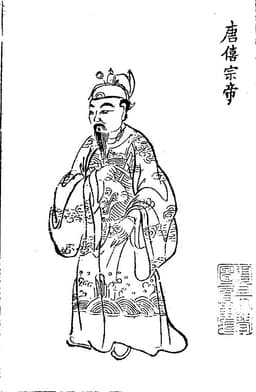
Li Xuan
Emperor · Medieval
40.9Total

Napoleon Bonaparte
General · Modern
70.9Total
Basic Information
Born
862
1769
Died
888
1821
Era
Medieval
Modern
Nationality
China
France
Occupation
Emperor
General
Civilization
Eastern
Western
Score Comparison
Military (10%)
50.0
94.0
Political (20%)
35.0
72.0
Influence (20%)
46.3
40.0
Legacy (20%)
37.5
80.0
Leadership (15%)
39.0
78.0
Strategy (15%)
38.6
90.0
TOTAL
40.9
70.9
Li Xuan — Complete Timeline
880 AD
Fled Chang'an to ChengduPolitical Action
When Huang Chao's rebel army approached the Tang capital Chang'an, Li Xuan (Tang Xizong) abandoned the city and fled to Chengdu in Sichuan. This flight left the capital undefended and marked the collapse of central authority during the Huang Chao Rebellion.
FlightHuang Chao RebellionCapital Lost
Impact: nationaltragic
885 AD
Recalled to Chang'an After Huang Chao's DefeatPolitical Action◆ Major
After Huang Chao was defeated by the Shatuo Turk Li Keyong and other warlords, Li Xuan returned to Chang'an. However, the city was in ruins and the Tang court was now dependent on regional military governors, further weakening imperial power.
ReturnWarlord EraTang Decline
Impact: national
Napoleon Bonaparte — Complete Timeline
1799 AD
Coup of 18 BrumaireOther◆ Major
Napoleon Bonaparte, with support from his brother Lucien and key political figures, overthrew the Directory in a bloodless coup. He established the Consulate with himself as First Consul, effectively becoming the ruler of France. This event ended the French Revolution's most unstable period.
French RevolutionCoupRise to Power
Impact: regional
1804 AD
Promulgation of the Napoleonic CodeOther◆ Major
Napoleon enacted the Civil Code of the French, known as the Napoleonic Code, a comprehensive set of laws that replaced the fragmented feudal legal systems. The code established legal equality, protected property rights, and secularized law. It became the basis for legal systems in many European and world countries.
Legal ReformNapoleonic CodeCivil Law
Impact: globalconstructive
1805 AD
Battle of AusterlitzWar◆ Major
Napoleon's Grande Arm
Napoleonic WarsBattleDecisive Victory
Impact: global
1812 AD
Invasion of RussiaWar◆ Major
Napoleon led the Grande Arm
Napoleonic WarsInvasionDisaster
Impact: globaldestructive
1815 AD
Battle of WaterlooWar◆ Major
Napoleon's French army was defeated by the combined forces of the Duke of Wellington's Anglo-Allied army and Gebhard Leberecht von Bl
Napoleonic WarsBattleFinal Defeat
Impact: globaldestructive
Expert Analysis
li-xuan-vs-napoleon-bonaparte
# The Emperor Who Fled and the General Who Conquered
In the spring of 880, two men stood at opposite ends of fortune. In Chang’an, the 18-year-old Emperor Li Xuan, known to history as Tang Xizong, heard the drumming of rebel hooves approaching the capital. He ordered his carriage packed and fled west to Chengdu, leaving behind a dynasty that had ruled China for nearly three centuries. Half a world away, a 11-year-old Corsican boy named Napoleone Buonaparte was just beginning his military education in mainland France, destined to become the man who would remold Europe in his image. One was born to rule and lost everything; the other was born into obscurity and conquered a continent. Their stories, separated by a millennium and a civilization, reveal how character, circumstance, and the cruel logic of history determine whether a leader becomes a legend or a footnote.
Origins
Napoleon Bonaparte came into the world on August 15, 1769, in Ajaccio, Corsica, an island that France had purchased from Genoa just a year earlier. His family was minor nobility, poor but proud. His father, Carlo Buonaparte, was a lawyer who managed to secure a scholarship for young Napoleon to attend the Brienne Military Academy in mainland France. There, the short, intense Corsican boy faced relentless mockery from aristocratic classmates for his accent and provincial origins. He responded by burying himself in books—military history, mathematics, the works of Rousseau and Plutarch. The French Revolution, erupting when he was twenty, was his great opening: it swept away the old aristocratic order and allowed talent, not birth, to command armies.
Li Xuan was born in 862, the fifth son of Emperor Yizong of Tang. He inherited the throne at age 11 in 873, not because of merit but because of blood. The Tang dynasty, once the greatest empire on earth, had been decaying for decades. The imperial court was a snake pit of eunuch power struggles, corrupt officials, and regional military governors who acted as independent warlords. Young Li Xuan was raised in luxury, surrounded by sycophants, shielded from the brutal realities of his crumbling realm. Where Napoleon had to fight for every scrap of recognition, Li Xuan had everything handed to him—except the ability to hold it.
Rise to Power
Napoleon’s ascent was a masterclass in opportunism. In 1793, at age 24, he commanded the artillery that recaptured the port of Toulon from British forces, earning promotion to brigadier general. In 1795, he saved the revolutionary government from a royalist uprising with a “whiff of grapeshot”—cannon fire into the Parisian mob. By 1796, he was given command of the French army in Italy, where he transformed a ragged, starving force into a conquering juggernaut, winning battle after battle against the Austrians. His Italian campaign of 1796–1797 was a dazzling display of speed, deception, and tactical genius. When he returned to France, he was a national hero.
Li Xuan’s rise required no effort—he was simply the next emperor. But his real power was an illusion. The eunuchs who controlled the palace had placed him on the throne precisely because they believed he would be pliable. The real authority rested with the eunuch Tian Lingzi, who became Li Xuan’s chief advisor and effectively ruled in his name. When the great rebellion of Huang Chao erupted in 874, sweeping across eastern China, the Tang court was paralyzed. The emperor did not lead armies; he issued decrees that no one obeyed. By 880, when Huang Chao’s forces approached Chang’an, Li Xuan’s only option was flight.
Leadership & Governance
Napoleon’s leadership was built on a paradox: he was an absolute ruler who governed through merit. As First Consul from 1799 and Emperor from 1804, he centralized the state but also reformed it. The Napoleonic Code, enacted in 1804, standardized French law, abolished feudal privileges, and established principles of equality before the law—though it also restricted women’s rights. He created the Bank of France, stabilized the currency, and built a system of lycées (state-run secondary schools) to train future bureaucrats. His military leadership was legendary: at Austerlitz in 1805, he destroyed a larger Austro-Russian army through brilliant deception and timing. He understood that morale, speed, and the ability to concentrate force at the decisive point were worth more than numbers.
Li Xuan governed through absence. After fleeing to Chengdu in 880, he spent five years in relative safety while Huang Chao’s rebels sacked Chang’an, massacred the aristocracy, and proclaimed a new dynasty. The emperor’s authority was sustained only by the efforts of warlords like Li Keyong, a Shatuo Turk chieftain who eventually defeated Huang Chao in 884. When Li Xuan finally returned to Chang’an in 885, he found the capital looted, the treasury empty, and his own generals more powerful than ever. He had no army of his own, no loyal bureaucracy, no reform program. He was a figurehead in a land of warlords.
Triumph & Tragedy
Napoleon’s greatest triumph was the Empire at its height in 1810–1812: France stretched from Spain to Poland, allied with Russia and Austria, and dominated the European continent. The Napoleonic Code spread across Europe, dismantling feudalism and planting the seeds of modern legal systems. His tragedy was the invasion of Russia in 1812. He marched 600,000 men into the vastness of Russia, won the Battle of Borodino, captured Moscow—and then watched his army starve and freeze during the retreat. Only about 100,000 returned. The disaster shattered his aura of invincibility and led to his first abdication in 1814.
Li Xuan’s triumph was simply surviving. He lived to see Huang Chao defeated, and he returned to his capital—a rare achievement for a late Tang emperor. His tragedy was deeper: he presided over the disintegration of a dynasty that had endured for 289 years. After his return, the warlords fought among themselves, and the emperor could only watch. In 887, one of his own generals, Zhu Wen, turned against him and forced him to flee again. Li Xuan died in 888, aged 26, perhaps poisoned, perhaps of illness. The Tang dynasty staggered on for another 19 years, but it was already dead in all but name.
Character & Destiny
Napoleon was possessed by an insatiable hunger for glory and control. “I am not a man but a thing,” he once said. “I have no private feelings.” He drove himself and his armies to the breaking point, believing that willpower could overcome any obstacle. This same relentless drive that won him an empire also destroyed it: he could not stop, could not compromise, could not share power. His exile to Elba in 1814 and final defeat at Waterloo in 1815 were the direct consequences of his refusal to accept limits.
Li Xuan was a passive figure in an active tragedy. He did not create the forces that destroyed his dynasty; he simply failed to resist them. His character was shaped by the eunuch-controlled court that raised him, which valued obedience over initiative. He was not stupid—he was simply never given the chance to develop the ruthless pragmatism that survival required. Where Napoleon seized history by the throat, Li Xuan let history sweep him away.
Legacy
Napoleon left behind a transformed Europe. The Napoleonic Code remains the basis of civil law in France and many other countries. His military campaigns are studied at war colleges worldwide. His name became synonymous with ambition, genius, and hubris. He is remembered as both a liberator who spread revolutionary ideals and a tyrant who drowned them in blood.
Li Xuan left behind a shattered dynasty and a cautionary tale. He is remembered, if at all, as the emperor who lost the Tang. His reign marks the point of no return in Chinese history, when the unified empire fragmented into the chaos of the Five Dynasties and Ten Kingdoms period. He is a footnote in the long story of China’s rise and fall, a reminder that even the greatest dynasties can collapse when leadership fails.
Conclusion
One man conquered the world; the other could not hold his own capital. But their differences are not simply a matter of ability. Napoleon lived in an era of revolution, when old structures were collapsing and new ones could be built. Li Xuan lived in an era of decay, when the old structure was too rotten to repair but still too heavy to replace. Napoleon could create his own opportunities; Li Xuan could only react to crises he did not cause. In the end, both were consumed by forces larger than themselves. Napoleon’s tragedy was that he could not stop conquering; Li Xuan’s tragedy was that he never learned to fight. History judges them accordingly—but it also judges the times that made them.
Rankings
🥇
Napoleon BonaparteLeader
Mil: 94.0Pol: 72.0Inf: 40.0
70.9
🥈
Li Xuan
Mil: 50.0Pol: 35.0Inf: 46.3
40.9
+30.0 behind
How This Comparison Works
Algorithm
Each figure is scored on 6 dimensions (0—100 scale) based on structured historical data: Military (10%), Political (20%), Influence (20%), Legacy (20%), Leadership (15%), Strategy (15%). The weighted total produces the final ranking.
Data Sources
Scores are computed from structured sub-indicators in the database. Scale factors adjust for era (Ancient ×0.85, Modern ×1.0) and civilization size (Eastern ×1.05, Other ×0.80) to account for differences in population and military scale.
Maximum 3 Figures
Comparisons are limited to 2—3 figures to ensure readability and statistical meaningfulness.
Error Margins
±5 points per dimension — Sub-scores are derived from historical records with inherent uncertainty. Two figures within 5 points on a dimension should be considered roughly equivalent in that area.
Total Score Accuracy
±3 points overall — The weighted combination of 6 dimensions produces a total score with approximately ±3 points of uncertainty. Differences of less than 3 points are not statistically significant— the figures are effectively tied.
Known Limitations
- Historical records are incomplete and uneven across civilizations
- Figures from oral-tradition societies may be underrepresented
- Occupation labels can misclassify multi-role figures
- Scores measure capability and impact, not moral character
- Quantitative scoring is a comparison tool, not absolute truth
Capability Radar
Military (10%) — Battles & Warfare
Battles
5
95
Win Rate
5
90
Expansion
0
95
Political (20%) — Governance & Reform
Reform
5
95
Diplomacy
5
80
Economy
5
85
Influence (20%) — Cultural & Global Reach
Cultural
10
85
Global
5
90
Legacy (20%) — Historical Impact
Historical
15
95
Longevity
10
90
Leadership (15%) — Power & Stability
Tenure
20
85
Stability
5
70
Strategy (15%) — Tactics & Innovation
Strategy
5
95
Tactics
5
98
Reform
0
92
Similar Comparisons
Comments & Discussion
NICKNAME: The Ten Thousand Yea6/17/2026
"Li Xuan was a teenager running from a rebellion that had already won. Napoleon at 11 was a scholarship kid fighting for respect in a room full of nobles. The Tang emperor had every resource but zero will; the Corsican had nothing but will. Li Xuan lost his kingdom to a grain-salt smuggler (Huang Chao). Napoleon lost his to the entire continent of Europe ganging up on him. That’s not equal-opportunity failure."
天外飞将6/17/2026
“把唐僖宗跟拿破仑比?你咋不比比秦皇跟凯撒呢?一个是祖坟冒青烟躺赢了九年的娃娃,另一个是白手起家把整个欧洲揍趴下的猛人。僖宗跑成都的时候带着妃子和大臣,拿破仑从厄尔巴岛跑回巴黎的时候只有一千老兵。逃亡和复辟,天壤之别。”
Correction from Corsica6/17/2026
"You want a fair comparison? Pick Li Shimin versus Napoleon—both generals, both empire-builders. Li Xuan is the wrong Tang emperor. His grandpa Xuanzong also fled to Sichuan during the An Lushan rebellion, but Xuanzong made a comeback and kept the dynasty alive. Xuan? He just watched it disintegrate while playing polo. Napoleon lost at Waterloo; Li Xuan lost at… breathing."
数据的审判官6/17/2026
"数据不会撒谎:拿破仑打了60多场战役,只输了七八场。唐僖宗在位15年,黄巢打进长安只用了一年。拿破仑的法典还在养活着半个欧洲的律师,僖宗留下的只有藩镇割据和朱温篡唐。你说这两人能被拿来比较,除非你把‘皇帝’当成唯一的共同点,那我也能说崇祯跟拿破仑差不多——反正都败了,对不?"
The Polostick Philosopher6/17/2026
"Every time I see this meme pairing, I wince. It’s like comparing a chess master to a guy who flipped the board halfway through the game. Li Xuan was famous for his love of polo and cockfighting—while rebels marched on his capital. Napoleon would have had those rebel leaders executed, made his favorite polo player a general, and still conquered Italy before breakfast. Context matters: one was a child, the other became a titan. Let’s stop romanticizing incompetence."