Loading...
Li Xuan vs Narasimha Raya II
Li Xuan leads by 2.7 pts · 2 figures compared
…
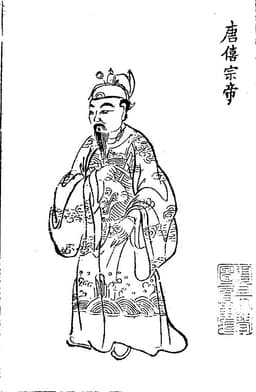
Li Xuan
Emperor · Medieval
40.9Total

Narasimha Raya II
Emperor · Medieval
38.2Total
Basic Information
Born
862
1491
Died
888
1505
Era
Medieval
Medieval
Nationality
China
India
Occupation
Emperor
Emperor
Civilization
Eastern
Indian
Score Comparison
Military (10%)
50.0
21.2
Political (20%)
35.0
32.1
Influence (20%)
46.3
47.1
Legacy (20%)
37.5
36.7
Leadership (15%)
39.0
44.5
Strategy (15%)
38.6
36.8
TOTAL
40.9
38.2
Li Xuan — Complete Timeline
880 AD
Fled Chang'an to ChengduPolitical Action
When Huang Chao's rebel army approached the Tang capital Chang'an, Li Xuan (Tang Xizong) abandoned the city and fled to Chengdu in Sichuan. This flight left the capital undefended and marked the collapse of central authority during the Huang Chao Rebellion.
FlightHuang Chao RebellionCapital Lost
Impact: nationaltragic
885 AD
Recalled to Chang'an After Huang Chao's DefeatPolitical Action◆ Major
After Huang Chao was defeated by the Shatuo Turk Li Keyong and other warlords, Li Xuan returned to Chang'an. However, the city was in ruins and the Tang court was now dependent on regional military governors, further weakening imperial power.
ReturnWarlord EraTang Decline
Impact: national
Narasimha Raya II — Complete Timeline
1491 AD
Regency for the Young EmperorPolitical Action
Upon the death of Saluva Narasimha, Narasimha Raya II became regent for the infant emperor, ruling in his name. He effectively controlled the empire for 14 years, maintaining stability and continuing the policies of his predecessor.
RegencyGovernancePolitical
Impact: national
1505 AD
Assassination of Narasimha Raya IIPolitical Action
Narasimha Raya II, the Saluva regent, was assassinated by his own general, Vira Narasimha, who then seized the throne. The assassination ended the Saluva dynasty and paved the way for the Tuluva dynasty's rise.
AssassinationDynasty ChangePolitical
Impact: nationaldestructive
Expert Analysis
Origins
Li Xuan, born in 862, was the fifth son of Emperor Yizong of Tang. His mother, a consort, died early, and he was raised in the palace. He received a traditional Confucian education but was known for his love of games and hunting, showing little interest in governance. His reign name, Tang Xizong, began in 873 after his father's death, but the empire was already weakened by factional strife and regional military governors (jiedushi).
Narasimha Raya II, born around 1460, was a prince of the Saluva dynasty of the Vijayanagara Empire. His father, Saluva Narasimha, had founded the dynasty after overthrowing the Sangama rulers. Narasimha Raya II was groomed for military and administrative roles but was overshadowed by his father's dominance. He ascended to regency after his father's death in 1491, ruling for the infant emperor, a child of the previous dynasty.
Rise to Power
Li Xuan ascended the throne at age 11 in 873, but real power rested with eunuchs and officials. In 875, the Huang Chao rebellion erupted, devastating the empire. By 880, Huang Chao's forces approached Chang'an, and Li Xuan, advised by eunuchs, fled to Chengdu in 881, abandoning the capital. His flight marked a loss of legitimacy and control. He remained in exile until 885, when Huang Chao was defeated by the Shatuo Turk Li Keyong and other warlords. Li Xuan returned to a ruined Chang'an, but his authority was nominal, as regional warlords held real power.
Narasimha Raya II rose to prominence as regent for the young emperor after his father's death in 1491. He effectively controlled the Vijayanagara Empire, managing its administration and military. However, his rule was contested by rival generals, particularly Vira Narasimha, a powerful military commander. In 1505, Vira Narasimha assassinated Narasimha Raya II during a coup, ending the Saluva dynasty and seizing the throne. Narasimha Raya II's rise was brief, lasting only 14 years.
Leadership & Governance
Li Xuan's leadership was passive and reactive. He failed to mount a coherent defense against Huang Chao, relying on mercenaries like Li Keyong. His governance was marked by eunuch manipulation and fiscal irresponsibility, including debasing the currency. He issued no significant reforms and left provincial governors to their own devices. His flight to Chengdu demonstrated a lack of resolve, and his return did not restore order. He died in 888, leaving the Tang dynasty in terminal decline.
Narasimha Raya II governed as a regent, maintaining the administrative machinery of the Vijayanagara Empire. He continued his father's policies of temple patronage and land grants to Brahmins. However, he faced military threats from the Bahmani Sultanate to the north and internal rebellions. He failed to secure his position against Vira Narasimha, who exploited his weak military standing. Narasimha Raya II's governance was competent but not transformative, and his assassination revealed his vulnerability.
Triumph & Tragedy
Li Xuan's greatest success was surviving the Huang Chao rebellion, albeit at great cost. He managed to return to Chang'an and maintain the Tang dynasty for a few more years. His tragedy was the complete loss of imperial authority; after his flight, the central government never recovered. He is remembered as a weak ruler who presided over the empire's disintegration.
Narasimha Raya II's triumph was maintaining the Saluva dynasty's control over Vijayanagara for 14 years, preventing immediate collapse. His tragedy was his assassination, which ended the dynasty and plunged the empire into civil war. He failed to consolidate power or build a loyal base, leading to his downfall.
Character & Destiny
Li Xuan was indolent and pleasure-seeking, avoiding hard decisions. His character led to the abandonment of the capital and the erosion of Tang prestige. Historians describe him as incompetent and irresponsible. His destiny was to be a footnote in the Tang's decline, with a legacy of failure.
Narasimha Raya II was cautious and perhaps overly trusting. He did not eliminate rivals like Vira Narasimha, which sealed his fate. His character was that of a caretaker ruler, not a consolidator. His destiny was to be overthrown, a victim of the violent politics of Vijayanagara.
Legacy
Li Xuan's legacy is that of a failed emperor. His flight to Chengdu became a symbol of Tang weakness. The dynasty limped on for a few more decades but was effectively dead after his reign. He scored 37.5 in legacy, reflecting his minimal positive impact.
Narasimha Raya II's legacy is tied to the Saluva dynasty's brief rule. His assassination paved the way for the Tuluva dynasty under Vira Narasimha, which would later produce Krishnadevaraya, the greatest Vijayanagara ruler. His legacy score of 36.7 is slightly lower, as his reign was a transition.
Conclusion
Li Xuan and Narasimha Raya II both ruled during periods of decline, but Li Xuan's impact on the Tang dynasty's collapse was more significant. Despite his low scores (total 40.9 vs 38.2), Li Xuan's actions directly led to the loss of imperial authority, whereas Narasimha Raya II's assassination only affected the dynasty, not the empire's long-term trajectory. Li Xuan had greater overall impact because his failures accelerated the fall of a major empire, while Narasimha Raya II's death merely changed the ruling family. Thus, Li Xuan emerges as the more consequential figure, even if both were weak rulers.
Rankings
🥇
Li XuanLeader
Mil: 50.0Pol: 35.0Inf: 46.3
40.9
🥈
Narasimha Raya II
Mil: 21.2Pol: 32.1Inf: 47.1
38.2
+2.7 behind
How This Comparison Works
Algorithm
Each figure is scored on 6 dimensions (0—100 scale) based on structured historical data: Military (10%), Political (20%), Influence (20%), Legacy (20%), Leadership (15%), Strategy (15%). The weighted total produces the final ranking.
Data Sources
Scores are computed from structured sub-indicators in the database. Scale factors adjust for era (Ancient ×0.85, Modern ×1.0) and civilization size (Eastern ×1.05, Other ×0.80) to account for differences in population and military scale.
Maximum 3 Figures
Comparisons are limited to 2—3 figures to ensure readability and statistical meaningfulness.
Error Margins
±5 points per dimension — Sub-scores are derived from historical records with inherent uncertainty. Two figures within 5 points on a dimension should be considered roughly equivalent in that area.
Total Score Accuracy
±3 points overall — The weighted combination of 6 dimensions produces a total score with approximately ±3 points of uncertainty. Differences of less than 3 points are not statistically significant— the figures are effectively tied.
Known Limitations
- Historical records are incomplete and uneven across civilizations
- Figures from oral-tradition societies may be underrepresented
- Occupation labels can misclassify multi-role figures
- Scores measure capability and impact, not moral character
- Quantitative scoring is a comparison tool, not absolute truth
Capability Radar
Military (10%) — Battles & Warfare
Battles
5
10
Win Rate
5
10
Expansion
0
10
Political (20%) — Governance & Reform
Reform
5
10
Diplomacy
5
10
Economy
5
10
Influence (20%) — Cultural & Global Reach
Cultural
10
10
Global
5
10
Legacy (20%) — Historical Impact
Historical
15
10
Longevity
10
10
Leadership (15%) — Power & Stability
Tenure
20
10
Stability
5
10
Strategy (15%) — Tactics & Innovation
Strategy
5
10
Tactics
5
10
Reform
0
10
Similar Comparisons
Comments & Discussion
No comments yet. Be the first to share your thoughts!