Loading...
Li Yuan vs Napoleon Bonaparte
Li Yuan leads by 2.8 pts · 2 figures compared
…
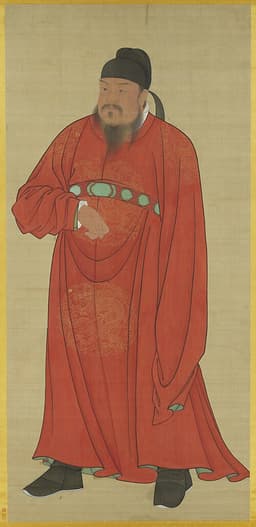
Li Yuan
Emperor · Medieval
73.7Total

Napoleon Bonaparte
General · Modern
70.9Total
Basic Information
Born
566
1769
Died
635
1821
Era
Medieval
Modern
Nationality
China
France
Occupation
Emperor
General
Civilization
Eastern
Western
Score Comparison
Military (10%)
78.0
94.0
Political (20%)
70.0
72.0
Influence (20%)
80.0
40.0
Legacy (20%)
71.4
80.0
Leadership (15%)
72.0
78.0
Strategy (15%)
67.2
90.0
TOTAL
73.7
70.9
Li Yuan — Complete Timeline
618 AD
Founded the Tang dynastyPolitical Action
Li Yuan, Duke of Tang, rebelled against the Sui dynasty and captured Chang'an. He declared himself Emperor Gaozu, founding the Tang dynasty that would rule China for nearly 300 years.
Tang dynastyFoundingSui-Tang transition
Impact: globalconstructive
621 AD
Battle of Hulao PassWar◆ Major
Li Yuan's son Li Shimin defeated the rival warlord Dou Jiande at Hulao Pass. This victory eliminated a major competitor and secured Tang control over the central plains.
Tang unificationBattleLi Shimin
Impact: national
626 AD
Abdicated in favor of Li ShiminPolitical Action◆ Major
After the Xuanwu Gate Incident where Li Shimin killed his brothers, Li Yuan abdicated the throne to his son. He became Taishang Huang (retired emperor) and lived in retirement.
Tang dynastySuccessionXuanwu Gate
Impact: national
Napoleon Bonaparte — Complete Timeline
1799 AD
Coup of 18 BrumaireOther◆ Major
Napoleon Bonaparte, with support from his brother Lucien and key political figures, overthrew the Directory in a bloodless coup. He established the Consulate with himself as First Consul, effectively becoming the ruler of France. This event ended the French Revolution's most unstable period.
French RevolutionCoupRise to Power
Impact: regional
1804 AD
Promulgation of the Napoleonic CodeOther◆ Major
Napoleon enacted the Civil Code of the French, known as the Napoleonic Code, a comprehensive set of laws that replaced the fragmented feudal legal systems. The code established legal equality, protected property rights, and secularized law. It became the basis for legal systems in many European and world countries.
Legal ReformNapoleonic CodeCivil Law
Impact: globalconstructive
1805 AD
Battle of AusterlitzWar◆ Major
Napoleon's Grande Arm
Napoleonic WarsBattleDecisive Victory
Impact: global
1812 AD
Invasion of RussiaWar◆ Major
Napoleon led the Grande Arm
Napoleonic WarsInvasionDisaster
Impact: globaldestructive
1815 AD
Battle of WaterlooWar◆ Major
Napoleon's French army was defeated by the combined forces of the Duke of Wellington's Anglo-Allied army and Gebhard Leberecht von Bl
Napoleonic WarsBattleFinal Defeat
Impact: globaldestructive
Expert Analysis
li-yuan-vs-napoleon-bonaparte
# The Emperor and the General: Two Titans Who Shaped Their Worlds
On a June morning in 1815, Napoleon Bonaparte watched his Imperial Guard march toward the ridge at Waterloo, knowing that everything—his empire, his legacy, the very map of Europe—hung in the balance. Fifteen hundred miles away and twelve centuries earlier, another founder faced a different kind of crossroads: Li Yuan, Duke of Tang, had just learned that his own son had murdered two brothers at Chang'an's Xuanwu Gate. Both men had risen from noble ambition to reshape civilization. Yet one would die in exile on a remote Atlantic island, while the other would live out his final years as a revered retired emperor, watching his son build the greatest dynasty China had ever known. What made the difference between glory and ruin?
Origins
Napoleon was born in 1769 on Corsica, an island that had been French for barely a year. His family were minor nobility, but they were outsiders—Italian-speaking, fiercely independent, and resentful of French rule. Young Napoleon absorbed two contradictory impulses: the Enlightenment ideals of the French Revolution and the ruthless pragmatism of a man who had to fight for every scrap of recognition. He entered military school at nine, already small, intense, and driven. France was in chaos when he came of age, and chaos was opportunity.
Li Yuan was born in 566 into the northwestern aristocracy of a divided China. His ancestors had served the Northern Zhou and Sui dynasties as generals and officials. His cousin was the Sui emperor himself. Li Yuan grew up in a world where legitimacy mattered—where power flowed from bloodlines, Confucian virtue, and the Mandate of Heaven. Unlike Napoleon, he did not need to invent himself; he needed only to claim what his birth had already prepared him for.
Rise to Power
Napoleon's ascent was meteoric. At twenty-four, he drove the British out of Toulon. At twenty-six, he crushed a royalist uprising in Paris with a "whiff of grapeshot." At twenty-seven, he conquered Italy. Each victory was a gamble, each promotion a leap over older, more established men. By 1799, when he staged the coup of 18 Brumaire, he had made himself indispensable to a desperate republic. His path was built on personal brilliance and the collapse of institutions that no longer worked.
Li Yuan's rise was more measured—and more cautious. In 617, as the Sui dynasty crumbled under peasant rebellions and disastrous military campaigns, Li Yuan was governor of Taiyuan, a strategic command. He hesitated to rebel, knowing the risks. It was his second son, Li Shimin, who pushed him into action. The younger man had already recruited troops and made alliances. Li Yuan, persuaded, marched on the capital Chang'an. He captured it, installed a puppet Sui emperor, and waited a full year before declaring himself Emperor Gaozu of the Tang dynasty in 618.
Leadership & Governance
Napoleon ruled as a conquering genius. His military score of 94 and strategy of 93 reflect a commander who could read battlefields like a chessboard, who inspired soldiers with personal courage, and who reorganized armies into corps that moved with unprecedented speed. He won at Austerlitz, Jena, and Friedland. But his political score of 75 reveals a weakness: he could conquer but could not consolidate. The Napoleonic Code reformed law across Europe, but his empire was a pyramid of force, not loyalty. He placed brothers on thrones, but they were puppets. When he fell, the entire structure collapsed.
Li Yuan's political score of 86 tells a different story. He understood that a dynasty needed more than swords. He restored Confucian bureaucracy, revived the civil service examination, and reduced taxes. He granted land to peasants and established granaries for famine relief. His military score of 74.6 is modest, but he had something Napoleon lacked: Li Shimin. The son who had forced his hand at Taiyuan became his greatest general, winning the decisive Battle of Hulao Pass in 621 against the rival warlord Dou Jiande. Li Yuan knew when to delegate—and when to let his son shine.
Triumph & Tragedy
Napoleon's greatest moment was Austerlitz in 1805, where he destroyed a combined Russian and Austrian army in a single day. His tragedy was Waterloo in 1815, where his genius met the iron discipline of Wellington and the timely arrival of Blücher. But the deeper tragedy was personal: he could not stop. He had conquered Europe, but he could not make peace. His ambition consumed him.
Li Yuan's triumph was founding the Tang dynasty, which would become China's golden age. His tragedy came from within his own family. In 626, Li Shimin—the brilliant son who had won the empire—ambushed his brothers at Xuanwu Gate, killing them both. Then he forced Li Yuan to abdicate. The father became Taishang Huang, a retired emperor. He lived eight more years, watching his son become Emperor Taizong, perhaps China's greatest ruler. Li Yuan lost his throne, but his dynasty survived and flourished.
Character & Destiny
Napoleon was a man of boundless will. "Impossible is a word to be found only in the dictionary of fools," he said. But will without wisdom becomes hubris. He invaded Russia in 1812, ignoring every warning. He refused to compromise after Leipzig. He gambled at Waterloo and lost. His character—brilliant, restless, arrogant—drove him to heights no one else could reach, then drove him off the cliff.
Li Yuan was a man of balance. He knew when to act and when to wait, when to command and when to yield. His abdication was not weakness but wisdom. He understood that the dynasty mattered more than his own power. Napoleon could never have made that choice. Li Yuan's character—cautious, pragmatic, adaptive—allowed his legacy to outlast him.
Legacy
Napoleon left a divided legacy. He is remembered as a military titan, a lawgiver, a tyrant. His name is synonymous with ambition. His scores—82.4 total, with influence at 82 and legacy at 78—reflect a man who changed Europe forever but whose empire died with him. He is studied in every military academy, debated in every history seminar.
Li Yuan left a unified legacy. His Tang dynasty lasted three centuries, spread Chinese culture across East Asia, and produced poetry, art, and governance that shaped the world. His scores—81.4 total, with influence at 85 and legacy at 83—reflect a founder who built not just a throne but a civilization. He is honored as Gaozu, the high ancestor.
Conclusion
In the end, the difference between Napoleon and Li Yuan is not talent—both were extraordinary—but wisdom. Napoleon believed he was the empire. Li Yuan knew the empire was bigger than any man. One died alone on Saint Helena, replaying battles he could not win again. The other died in his palace, watching his son build a golden age. History remembers both. But it honors the one who knew when to let go.
Rankings
🥇
Li YuanLeader
Mil: 78.0Pol: 70.0Inf: 80.0
73.7
🥈
Napoleon Bonaparte
Mil: 94.0Pol: 72.0Inf: 40.0
70.9
+2.8 behind
How This Comparison Works
Algorithm
Each figure is scored on 6 dimensions (0—100 scale) based on structured historical data: Military (10%), Political (20%), Influence (20%), Legacy (20%), Leadership (15%), Strategy (15%). The weighted total produces the final ranking.
Data Sources
Scores are computed from structured sub-indicators in the database. Scale factors adjust for era (Ancient ×0.85, Modern ×1.0) and civilization size (Eastern ×1.05, Other ×0.80) to account for differences in population and military scale.
Maximum 3 Figures
Comparisons are limited to 2—3 figures to ensure readability and statistical meaningfulness.
Error Margins
±5 points per dimension — Sub-scores are derived from historical records with inherent uncertainty. Two figures within 5 points on a dimension should be considered roughly equivalent in that area.
Total Score Accuracy
±3 points overall — The weighted combination of 6 dimensions produces a total score with approximately ±3 points of uncertainty. Differences of less than 3 points are not statistically significant— the figures are effectively tied.
Known Limitations
- Historical records are incomplete and uneven across civilizations
- Figures from oral-tradition societies may be underrepresented
- Occupation labels can misclassify multi-role figures
- Scores measure capability and impact, not moral character
- Quantitative scoring is a comparison tool, not absolute truth
Capability Radar
Military (10%) — Battles & Warfare
Battles
75
95
Win Rate
80
90
Expansion
80
95
Political (20%) — Governance & Reform
Reform
75
95
Diplomacy
80
80
Economy
75
85
Influence (20%) — Cultural & Global Reach
Cultural
85
85
Global
85
90
Legacy (20%) — Historical Impact
Historical
90
95
Longevity
90
90
Leadership (15%) — Power & Stability
Tenure
70
85
Stability
70
70
Strategy (15%) — Tactics & Innovation
Strategy
85
95
Tactics
70
98
Reform
65
92
Similar Comparisons
Comments & Discussion
No comments yet. Be the first to share your thoughts!