Loading...
Liu Yu vs Qin Shi Huang
Qin Shi Huang leads by 23.8 pts · 2 figures compared
…

Liu Yu
Emperor · Ancient
61.4Total
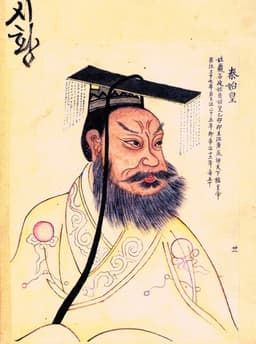
Qin Shi Huang
Emperor · Ancient
85.2Total
Basic Information
Born
363
-259
Died
422
-210
Era
Ancient
Ancient
Nationality
China
China
Occupation
Emperor
Emperor
Civilization
Eastern
Eastern
Score Comparison
Military (10%)
78.5
80.0
Political (20%)
62.7
90.0
Influence (20%)
54.9
85.0
Legacy (20%)
52.0
90.0
Leadership (15%)
68.0
78.0
Strategy (15%)
72.0
82.0
TOTAL
61.4
85.2
Liu Yu — Complete Timeline
399 AD
Suppression of Sun En's RebellionWar◆ Major
Liu Yu led forces to suppress the rebellion of Sun En, a Daoist leader who threatened the Jin capital. His victory earned him military prestige and control over key armies, setting the stage for his rise to power.
Jin DynastyRebellionSun EnMilitary Campaign
Impact: nationalconstructive
410 AD
Conquest of Southern YanWar◆ Major
Liu Yu led a campaign to conquer the Southern Yan state in Shandong. He defeated the Southern Yan army and captured its capital Guanggu, annexing the territory into Jin and eliminating a rival state.
Jin DynastySouthern YanConquestShandong
Impact: regionalconstructive
420 AD
Overthrow of the Eastern JinPolitical Action
Liu Yu forced Emperor Gong of Jin to abdicate and proclaimed himself emperor, founding the Liu Song Dynasty. This ended the Eastern Jin Dynasty and began the Liu Song period, the first of the Southern Dynasties.
Liu SongJin DynastyAbdicationDynastic Change
Impact: nationaldestructive
Qin Shi Huang — Complete Timeline
246 BC
Construction of the Mausoleum and Terracotta ArmyOther◆ Major
Qin Shi Huang commissioned a vast mausoleum complex near Xi'an, guarded by thousands of life-sized terracotta soldiers, horses, and chariots. The project employed hundreds of thousands of workers and reflected his obsession with immortality and imperial power.
Impact: global
230 BC
Conquest of the Six Warring StatesWar
From 230 to 221 BCE, Ying Zheng led the Qin state in a series of campaigns that conquered the Han, Zhao, Wei, Chu, Yan, and Qi states. This unified China under a single ruler for the first time, ending the Warring States period.
Impact: global
221 BC
Standardization of Writing, Currency, and MeasurementsReform◆ Major
Qin Shi Huang ordered the standardization of Chinese script, currency, and weights and measures across the unified empire. This facilitated administration, trade, and cultural integration, laying a foundation for future dynasties.
Impact: globalconstructive
Proclamation of the Qin DynastyPolitical Action
After conquering the last independent state, Ying Zheng declared himself Shi Huangdi (First Emperor), founding the Qin Dynasty. He adopted a new title to signify his supreme authority and initiated centralized imperial rule.
Impact: global
214 BC
Initiation of the Great Wall ConstructionOther◆ Major
Qin Shi Huang ordered the connection and extension of existing northern fortifications to create a unified defensive wall against nomadic Xiongnu raids. This project involved massive conscripted labor and became the precursor to the later Great Wall.
Impact: regional
213 BC
Burning of Books and Burying of ScholarsPolitical Action◆ Major
On the advice of Li Si, Qin Shi Huang ordered the burning of historical records and philosophical texts not aligned with Legalist doctrine. He also had 460 Confucian scholars buried alive to suppress dissent and consolidate ideological control.
Impact: nationaldestructive
Expert Analysis
liu-yu-vs-qin-shi-huang
# The First Emperor and the Last General: Qin Shi Huang and Liu Yu
In the winter of 221 BC, a man who had been born a prince of a border state stood atop a conquered capital and declared himself the First Emperor of all China. Eight hundred miles away and six centuries later, another man—born a beggar’s son in a crumbling empire—would seize the same throne, not as a conqueror of kingdoms but as the last desperate hope of a dynasty that had already failed. Both men reshaped China. One created an empire that would echo for two millennia. The other founded a dynasty that lasted barely sixty years. The difference between them is not merely a matter of time. It is a question of what it means to build, and what it means to survive.
Origins
Qin Shi Huang was born into power, but not into security. The state of Qin, perched on the western frontier of the Zhou dynasty’s crumbling order, was a land of harsh laws and relentless warfare. His father, King Zhuangxiang, died when the boy was thirteen, leaving Ying Zheng to inherit a throne surrounded by enemies and advisors who doubted him. The young king grew up in a world where mercy was weakness and trust was a trap. By the time he reached manhood, he had already learned the essential lesson of his era: that unity could only be forged through absolute control.
Liu Yu’s origins could not have been more different. He was born in 363 AD, in the twilight of the Eastern Jin dynasty, a time when the imperial court had fled south of the Yangtze River and northern China had fallen to barbarian invaders. His family was so poor that his mother died when he was an infant, and his father nearly abandoned him. Liu Yu grew up in the mud of Jiankang’s backstreets, working as a woodcutter and a gambler, learning to fight with his fists before he ever held a sword. Where Qin Shi Huang inherited an army, Liu Yu had to claw his way into one.
Rise to Power
Qin Shi Huang’s path to power was a matter of strategy, not survival. At twenty-two, he purged his regent, Lü Buwei, and took personal command of the Qin state. For the next nine years, he and his brilliant minister Li Si methodically dismantled the six rival kingdoms—Han, Zhao, Wei, Chu, Yan, and Qi—one by one. The conquest was clinical: spies, bribes, sieges, and massacres. By 221 BC, every throne in China belonged to him.
Liu Yu’s rise was far more chaotic. In 399 AD, the Daoist leader Sun En launched a rebellion that nearly destroyed the Jin dynasty. Liu Yu, then a minor officer, led a desperate counterattack that saved the capital. Over the next two decades, he fought not only foreign enemies but also rival generals, corrupt eunuchs, and the Jin court itself—a snake pit of intrigue that made Qin’s warring states look straightforward. His conquest of the Southern Yan kingdom in 410 AD was a masterpiece of endurance: he marched his army across barren terrain, cut off his own supply lines to force a decisive battle, and captured the Yan emperor in his own capital. But unlike Qin Shi Huang, Liu Yu never conquered all of China. The north remained lost to barbarian tribes, and his empire was forever a southern rump state.
Leadership & Governance
Qin Shi Huang governed as he conquered: by decree. He standardized writing, currency, and measurements across his empire, forcing the old kingdoms to speak the same language and count the same coins. He connected the northern walls into what would become the Great Wall, and he built a network of roads and canals that tied his realm together. But he also burned books that contradicted his ideology and buried scholars alive for criticizing his rule. His philosophy was Legalism—the belief that law, not virtue, held society together—and he enforced it with the cruelty of a man who believed that order was the only alternative to chaos.
Liu Yu governed as a soldier, not a reformer. He kept the Jin dynasty’s bureaucratic structure largely intact, rewarding his generals with land and titles rather than redesigning the state. His reign was too short—barely two years as emperor before his death in 422 AD—to leave a deep administrative mark. He was a brilliant battlefield commander but a mediocre ruler, more concerned with loyalty than with law. Where Qin Shi Huang tried to remake the world, Liu Yu tried only to hold it together.
Triumph & Tragedy
Qin Shi Huang’s greatest triumph was the unification itself—a feat so audacious that it has defined China ever since. His tragedy was that he could not trust anyone, not even his own heirs. He died in 210 BC while on a tour of his empire, and his advisors conspired to place a weak son on the throne. Within three years, the Qin dynasty collapsed in rebellion, and the First Emperor’s dream of eternal rule turned to ash.
Liu Yu’s triumph was survival itself. He took a dying dynasty and gave it a new name, the Liu Song, and a new lease on life. His tragedy was that he had no time to build. He died at fifty-nine, exhausted by a lifetime of war, and his descendants plunged the dynasty into a cycle of murder and intrigue that destroyed it within a generation. His greatest victory—the conquest of Southern Yan—was a footnote compared to what Qin Shi Huang had achieved.
Character & Destiny
Qin Shi Huang was a megalomaniac who believed he was the Son of Heaven on Earth. He built a mausoleum guarded by an army of terracotta soldiers, sought the elixir of immortality, and called himself “Shi Huangdi”—the First Emperor, a title meant to last ten thousand generations. His arrogance was his strength and his undoing: it drove him to unify China, but it also blinded him to the fragility of his creation.
Liu Yu was a pragmatist who never forgot that he had started as a woodcutter. He wore simple clothes, ate plain food, and trusted only his old comrades from the battlefield. He was haunted by the knowledge that his dynasty was built on sand—that the northern barbarians could invade at any moment, that his own generals might betray him, that the Jin court’s corruption had not died with the dynasty. His humility made him a better soldier, but it also limited his vision. He could save a dynasty, but he could not build an empire.
Legacy
Qin Shi Huang’s legacy is the Chinese empire itself. The standardized script, the unified currency, the roads, the walls—these became the bones of every subsequent dynasty. Even his tyranny served a purpose: later rulers learned from his mistakes, tempering Legalist severity with Confucian mercy. He is remembered as a monster and a founder, a tyrant who gave China its shape.
Liu Yu’s legacy is more modest. The Liu Song dynasty was the first of the Southern Dynasties, a series of short-lived states that preserved Chinese civilization during the dark centuries of barbarian rule. He is remembered as a great general and a flawed emperor, a man who did what he could with what he had. But his dynasty fell, and the north remained lost for another century. He did not change China. He only kept it alive.
Conclusion
In the end, the difference between Qin Shi Huang and Liu Yu is not a matter of talent or ambition. Both were brilliant commanders. Both were ruthless politicians. Both seized a throne that seemed impossible. But Qin Shi Huang inherited a state that was already the strongest in China, and he had thirty-six years to build his empire. Liu Yu inherited a dynasty that was already dying, and he had two years to rule. One man created a world. The other saved a fragment of one. History remembers the creator, not the caretaker—but both are necessary. Without Liu Yu, there might have been no Chinese civilization left for future emperors to reunite. Without Qin Shi Huang, there might have been nothing to reunite at all.
Rankings
🥇
Qin Shi HuangLeader
Mil: 80.0Pol: 90.0Inf: 85.0
85.2
🥈
Liu Yu
Mil: 78.5Pol: 62.7Inf: 54.9
61.4
+23.8 behind
How This Comparison Works
Algorithm
Each figure is scored on 6 dimensions (0—100 scale) based on structured historical data: Military (10%), Political (20%), Influence (20%), Legacy (20%), Leadership (15%), Strategy (15%). The weighted total produces the final ranking.
Data Sources
Scores are computed from structured sub-indicators in the database. Scale factors adjust for era (Ancient ×0.85, Modern ×1.0) and civilization size (Eastern ×1.05, Other ×0.80) to account for differences in population and military scale.
Maximum 3 Figures
Comparisons are limited to 2—3 figures to ensure readability and statistical meaningfulness.
Error Margins
±5 points per dimension — Sub-scores are derived from historical records with inherent uncertainty. Two figures within 5 points on a dimension should be considered roughly equivalent in that area.
Total Score Accuracy
±3 points overall — The weighted combination of 6 dimensions produces a total score with approximately ±3 points of uncertainty. Differences of less than 3 points are not statistically significant— the figures are effectively tied.
Known Limitations
- Historical records are incomplete and uneven across civilizations
- Figures from oral-tradition societies may be underrepresented
- Occupation labels can misclassify multi-role figures
- Scores measure capability and impact, not moral character
- Quantitative scoring is a comparison tool, not absolute truth
Capability Radar
Military (10%) — Battles & Warfare
Battles
85
85
Win Rate
90
90
Expansion
80
90
Political (20%) — Governance & Reform
Reform
65
95
Diplomacy
60
75
Economy
60
90
Influence (20%) — Cultural & Global Reach
Cultural
50
95
Global
40
85
Legacy (20%) — Historical Impact
Historical
65
95
Longevity
55
95
Leadership (15%) — Power & Stability
Tenure
70
70
Stability
55
65
Strategy (15%) — Tactics & Innovation
Strategy
85
85
Tactics
88
80
Reform
75
95
Similar Comparisons
Comments & Discussion
TheIronChancellor6/17/2026
Qin Shi Huang didn't just unify China—he engineered it. Standardizing writing, currency, and axle widths wasn't bureaucracy; it was a logistical revolution that made empire possible. Liu Yu? He was a competent general who happened to be in the right place when the Jin dynasty collapsed. His Liu Song dynasty lasted 59 years. Qin's systems lasted 2,000. There's no comparison. One built the machine; the other just turned the crank.
数理判官6/17/2026
我讨厌这种“英雄史观”的对比。你们拿一个统一七国的皇帝跟一个篡位将军比,却忘了算概率。当时天下分裂几百年,统一是必然趋势,换个人也可能做到。刘裕却是从乞丐爬到皇帝,逆袭概率比中彩票还低。单论个人成就,刘裕更难得。秦始皇不过是生在赢家通吃的时代。
LegionsAndLaws6/17/2026
Military historian here: Qin Shi Huang conquered through overwhelming force and terror—400,000 Zhao soldiers buried alive at Changping. That's not strategy; that's genocide as policy. Liu Yu fought 27 major campaigns, including the brilliant naval defeat of the Later Qin. He understood maneuver, supply lines, and morale. Which emperor would I rather follow into battle? The one who didn't need mass graves to win.
考据狂人6/17/2026
别忽略关键细节:刘裕的刘宋政权只传了七代就灭亡,而秦始皇的秦朝二代而亡——短命程度旗鼓相当。但刘裕是“寒人掌机要”的代表,打破了门阀士族垄断,这在九品中正制时代是革命性的。秦始皇坑儒焚书是文化断根,刘裕起码没烧过一本书。论对历史进程的贡献,前者是开创者,后者是破坏者——但破坏也分级别。
RedClayRebel6/17/2026
Sure, Qin Shi Huang built the Great Wall and the Terracotta Army, but he also taxed peasants into suicide and forced laborers to die building his tomb. Liu Yu fed his army by farming alongside them during campaigns. He once canceled tax collection for a year after a famine. One emperor treated people as tools; the other remembered he'd been a beggar. I know which kind of leader I'd trust with my life.