Loading...
Lothair I vs Napoleon Bonaparte
Napoleon Bonaparte leads by 22.7 pts · 2 figures compared
…
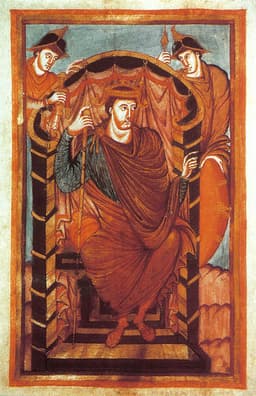
Lothair I
Emperor · Medieval
48.2Total

Napoleon Bonaparte
General · Modern
70.9Total
Basic Information
Born
795
1769
Died
855
1821
Era
Medieval
Modern
Nationality
Frankish Empire
France
Occupation
Emperor
General
Civilization
Western
Western
Score Comparison
Military (10%)
55.0
94.0
Political (20%)
37.9
72.0
Influence (20%)
50.2
40.0
Legacy (20%)
42.5
80.0
Leadership (15%)
62.2
78.0
Strategy (15%)
45.0
90.0
TOTAL
48.2
70.9
Lothair I — Complete Timeline
823 AD
Imperial Coronation by Pope Paschal IPolitical Action◆ Major
Lothair I was crowned co-emperor by Pope Paschal I in Rome, receiving the imperial title from his father Louis the Pious. This coronation affirmed Lothair's status as the senior heir and future ruler of the Carolingian Empire, though it later led to conflict with his brothers.
CarolingianCoronationEmpire
Impact: regionalconstructive
830 AD
Rebellion Against Louis the PiousPolitical Action◆ Major
Lothair I led a rebellion of nobles against his father, Emperor Louis the Pious, resulting in Louis's temporary deposition. Lothair seized power but was later forced to restore his father after the intervention of his brothers. This event deepened family divisions.
CarolingianRebellionLouis the Pious
Impact: regionaldestructive
841 AD
Battle of FontenoyWar◆ Major
Lothair I's forces were defeated by the combined armies of his brothers Louis the German and Charles the Bald at Fontenoy-en-Puisaye. The battle was a bloody civil war that weakened the Carolingian dynasty and led directly to the negotiations for the Treaty of Verdun.
CarolingianBattleCivil War
Impact: regionaldestructive
843 AD
Treaty of VerdunPolitical Action
Lothair I, along with his brothers Louis the German and Charles the Bald, signed the Treaty of Verdun, dividing the Carolingian Empire into three kingdoms. Lothair received Middle Francia, including the imperial title and the cities of Aachen and Rome.
CarolingianTreatyDivision
Impact: global
855 AD
Abdication and Retirement to Prüm AbbeyPolitical Action◆ Major
Lothair I abdicated the throne and divided Middle Francia among his three sons: Louis II (Italy and imperial title), Lothair II (Lotharingia), and Charles (Provence). He then retired to Pr
CarolingianAbdicationDivision
Impact: regional
Napoleon Bonaparte — Complete Timeline
1799 AD
Coup of 18 BrumaireOther◆ Major
Napoleon Bonaparte, with support from his brother Lucien and key political figures, overthrew the Directory in a bloodless coup. He established the Consulate with himself as First Consul, effectively becoming the ruler of France. This event ended the French Revolution's most unstable period.
French RevolutionCoupRise to Power
Impact: regional
1804 AD
Promulgation of the Napoleonic CodeOther◆ Major
Napoleon enacted the Civil Code of the French, known as the Napoleonic Code, a comprehensive set of laws that replaced the fragmented feudal legal systems. The code established legal equality, protected property rights, and secularized law. It became the basis for legal systems in many European and world countries.
Legal ReformNapoleonic CodeCivil Law
Impact: globalconstructive
1805 AD
Battle of AusterlitzWar◆ Major
Napoleon's Grande Arm
Napoleonic WarsBattleDecisive Victory
Impact: global
1812 AD
Invasion of RussiaWar◆ Major
Napoleon led the Grande Arm
Napoleonic WarsInvasionDisaster
Impact: globaldestructive
1815 AD
Battle of WaterlooWar◆ Major
Napoleon's French army was defeated by the combined forces of the Duke of Wellington's Anglo-Allied army and Gebhard Leberecht von Bl
Napoleonic WarsBattleFinal Defeat
Impact: globaldestructive
Expert Analysis
lothair-i-vs-napoleon-bonaparte
The Emperor and the Inheritor
On a June morning in 1815, Napoleon Bonaparte watched the rain-soaked fields of Waterloo and prepared for the battle that would seal his fate. Thirty-five years earlier, in 795, a very different kind of ruler had been born into the Carolingian world—Lothair I, a man who would inherit an empire rather than conquer one. These two figures, separated by a millennium, embody the starkest contrast in Western history: the self-made titan versus the born heir. Napoleon, the Corsican artillery officer who crowned himself emperor, and Lothair, the grandson of Charlemagne who received his crown from a pope, both ruled vast territories. Yet one reshaped Europe forever, while the other is remembered, if at all, as the man who presided over its fragmentation.
Origins
Napoleon Bonaparte entered the world in 1769 on the island of Corsica, a place only recently ceded to France. His family was minor nobility, but their status was precarious, their language Italian, their loyalties divided. This outsider's perspective—neither fully French nor wholly independent—forged a restless ambition. The French Revolution, which erupted when he was twenty, shattered the old order and opened paths that birth alone could never have granted.
Lothair I, by contrast, was born in 795 into the most powerful dynasty in Europe. His grandfather was Charlemagne, the legendary emperor who had united much of the West. His father, Louis the Pious, inherited this empire intact. Lothair never had to fight for his place; it was given to him, along with the expectation that he would preserve what others had built. The contrast could not be sharper: one man had everything to prove, the other everything to protect.
Rise to Power
Napoleon’s ascent was a masterpiece of opportunism and genius. In 1796, at just twenty-six, he took command of the French army in Italy and, within a year, turned a ragged force into a conquering machine. His victories forced Austria to sue for peace, and his name became synonymous with invincibility. By 1799, he had staged a coup and made himself First Consul. Five years later, in 1804, he crowned himself Emperor in Notre Dame, taking the crown from the Pope’s hands and placing it on his own head—a gesture that declared his power came from his own will, not from God or tradition.
Lothair’s rise was a family affair, and far messier. Crowned co-emperor by Pope Paschal I in 823, he was meant to succeed his father, Louis the Pious. But the Carolingian system of partible inheritance—dividing lands among sons—created constant tension. In 830, Lothair led a rebellion against his own father, temporarily deposing him. It was a desperate move born of frustration, not ambition for glory. Unlike Napoleon, who seized power from chaos, Lothair tried to hold onto power that was already slipping away.
Leadership and Governance
Napoleon governed with the same energy he brought to battle. He reformed French law through the Napoleonic Code, standardizing justice across a fractured nation. He built roads, established banks, and created a centralized state that outlasted his empire. His military genius—scoring a staggering 94.0 in strategy and 93.0 in military capability—was matched by a political mind that understood how to consolidate power. He was ruthless, but he was also a builder.
Lothair’s governance was reactive, not creative. He inherited the imperial title and the central strip of the Carolingian Empire, Middle Francia, a territory that stretched from the North Sea to Italy. But he could not hold it together. His political score of 68.2 reflects a man who tried to manage a system he did not create. The Battle of Fontenoy in 841, where his forces were crushed by his brothers Louis the German and Charles the Bald, was not a clash of grand strategy but a family feud. The Treaty of Verdun in 843 formalized the division, and Lothair’s kingdom became a geographic corridor, impossible to defend, destined to dissolve.
Triumph and Tragedy
Napoleon’s greatest triumph was the peak of his empire in 1810–1812, when he controlled most of continental Europe. His greatest tragedy was the invasion of Russia in 1812, a catastrophic miscalculation that cost hundreds of thousands of lives and shattered his aura of invincibility. Exiled to Elba, he returned in 1815 for a final, desperate gamble—the Hundred Days—only to meet his end at Waterloo.
Lothair’s triumphs were modest, his tragedies structural. His imperial coronation in 823 was a moment of unity, but it was a unity he could not sustain. His tragedy was not a single battle but the slow, inexorable fragmentation of his inheritance. In 855, he abdicated and retired to Prüm Abbey, dividing Middle Francia among his three sons. He died knowing that the empire of Charlemagne was gone forever.
Character and Destiny
Napoleon was driven by an insatiable hunger for glory and control. His personality—arrogant, brilliant, relentless—shaped every decision. He believed he could bend history to his will, and for a time, he did. But his hubris was his undoing. He could not stop, could not consolidate, could not share power.
Lothair was cautious, conservative, and ultimately resigned. He fought to preserve what he had, but he lacked the vision to create something new. His destiny was determined not by his own choices but by the system he inherited. The Carolingian world was built on division, and he could not escape it.
Legacy
Napoleon’s legacy is immense. His legal code, his administrative reforms, and his military tactics shaped modern Europe. He is remembered as both a liberator and a tyrant, a figure of awe and caution. His scores—legacy 78.0, influence 82.0—reflect a man who changed the world, for better and worse.
Lothair’s legacy is the map of Europe itself. The Treaty of Verdun created the borders that would eventually become France, Germany, and Italy. He is not remembered for his deeds but for the division he could not prevent. His legacy score of 56.2 is a quiet acknowledgment that sometimes history remembers not the rulers but the cracks they could not mend.
Conclusion
Napoleon and Lothair stand at opposite ends of the same story: the struggle to unite and the inevitability of division. One rose from nothing to rule everything, only to lose it all. One was born to rule everything and could not keep it. Their lives remind us that power is not simply a matter of will or birth—it is a product of timing, of systems, of the fragile balance between ambition and inheritance. In the end, both men were shaped by forces larger than themselves, and both left behind a Europe forever changed by their failures and their dreams.
Rankings
🥇
Napoleon BonaparteLeader
Mil: 94.0Pol: 72.0Inf: 40.0
70.9
🥈
Lothair I
Mil: 55.0Pol: 37.9Inf: 50.2
48.2
+22.7 behind
How This Comparison Works
Algorithm
Each figure is scored on 6 dimensions (0—100 scale) based on structured historical data: Military (10%), Political (20%), Influence (20%), Legacy (20%), Leadership (15%), Strategy (15%). The weighted total produces the final ranking.
Data Sources
Scores are computed from structured sub-indicators in the database. Scale factors adjust for era (Ancient ×0.85, Modern ×1.0) and civilization size (Eastern ×1.05, Other ×0.80) to account for differences in population and military scale.
Maximum 3 Figures
Comparisons are limited to 2—3 figures to ensure readability and statistical meaningfulness.
Error Margins
±5 points per dimension — Sub-scores are derived from historical records with inherent uncertainty. Two figures within 5 points on a dimension should be considered roughly equivalent in that area.
Total Score Accuracy
±3 points overall — The weighted combination of 6 dimensions produces a total score with approximately ±3 points of uncertainty. Differences of less than 3 points are not statistically significant— the figures are effectively tied.
Known Limitations
- Historical records are incomplete and uneven across civilizations
- Figures from oral-tradition societies may be underrepresented
- Occupation labels can misclassify multi-role figures
- Scores measure capability and impact, not moral character
- Quantitative scoring is a comparison tool, not absolute truth
Capability Radar
Military (10%) — Battles & Warfare
Battles
35
95
Win Rate
30
90
Expansion
25
95
Political (20%) — Governance & Reform
Reform
30
95
Diplomacy
40
80
Economy
30
85
Influence (20%) — Cultural & Global Reach
Cultural
25
85
Global
15
90
Legacy (20%) — Historical Impact
Historical
35
95
Longevity
20
90
Leadership (15%) — Power & Stability
Tenure
55
85
Stability
25
70
Strategy (15%) — Tactics & Innovation
Strategy
35
95
Tactics
30
98
Reform
20
92
Similar Comparisons
Comments & Discussion
雕版印刷与法典铁律6/17/2026
拿破仑的《民法典》至今仍是欧洲法律根基,而洛泰尔一世连自己的儿子都管不住,还要目睹帝国被《凡尔登条约》切成三块。一个用铁与火锻造现代国家,一个连祖业都守不住。历史记住拿破仑是为他塑造了未来,记住洛泰尔只是因为他搞砸了一次伟大的继承。这种对比本身就是在侮辱军事天才。
洛泰尔才是悲剧英雄6/17/2026
你们都错了。拿破仑是个自恋狂,把法兰西拖入无尽战争,最终死在荒岛上。洛泰尔一世至少试图维系查理曼的遗产,面对兄弟背叛依然坚守皇帝尊严。他不会像科西嘉矮子那样奸诈地利用革命,而是堂堂正正地争斗。历史总偏爱胜利者,但失败者的品格有时更值得纪念。洛泰尔输给了时代,拿破仑把自己活成了笑话。
Historian4536/17/2026
The analysis hints at something crucial: one was crowned by a pope, the other crowned himself. Lothair’s authority came from tradition and divine sanction; Napoleon’s came from sheer audacity and the will of the people (well, and a few well-placed bayonets). Yet here’s the irony: Napoleon’s self-coronation was the more honest gesture. He didn’t pretend to be chosen by God—he claimed his right by genius. Lothair, for all his legitimacy, couldn’t command the loyalty of his own brothers. Blood mean
Historian6976/17/2026
Calling this a "comparison" is an insult to the man who actually changed history. Napoleon remade civil law, introduced the metric system, and gave Jews emancipation—Lothair barely held his own empire together for a decade. The "analysis" tries to balance them, but let's be serious: one man was a revolutionary force of nature, the other was a footnote in a Carolingian breakup. Waterloo is studied in every military academy; the Treaty of Prüm? Even medievalists yawn.
Chronicler11266/17/2026
Let’s talk numbers. Napoleon fought over 60 battles, won 80% of them, and commanded armies of 500,000 men. Lothair? He fought a single major battle—Fontenoy-en-Puisaye—where he lost to his own brothers. Napoleon’s empire stretched from Madrid to Warsaw; Lothair’s “Middle Francia” dissolved before he even died. The statistical gap here is absurd. One man reshaped global history; the other couldn’t hold his family together for a generation. This isn’t a comparison—it’s a mismatch.