Loading...
Louis IV the Bavarian vs Napoleon Bonaparte
Napoleon Bonaparte leads by 12.6 pts · 2 figures compared
…
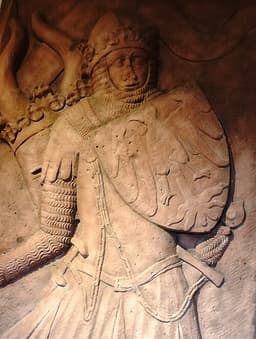
Louis IV the Bavarian
Emperor · Medieval
58.3Total

Napoleon Bonaparte
General · Modern
70.9Total
Basic Information
Born
1282
1769
Died
1347
1821
Era
Medieval
Modern
Nationality
Holy Roman Empire
France
Occupation
Emperor
General
Civilization
Western
Western
Score Comparison
Military (10%)
47.5
94.0
Political (20%)
68.0
72.0
Influence (20%)
55.7
40.0
Legacy (20%)
49.2
80.0
Leadership (15%)
74.0
78.0
Strategy (15%)
60.0
90.0
TOTAL
58.3
70.9
Louis IV the Bavarian — Complete Timeline
1314 AD
Election as King of GermanyPolitical Action◆ Major
Louis, Duke of Bavaria, was elected King of Germany by a faction of electors, while Frederick the Fair of Habsburg was elected by another faction. This led to a double election and civil war.
Double ElectionCivil War
Impact: national
1322 AD
Battle of MühldorfWar
Louis IV decisively defeated his rival Frederick the Fair at the Battle of M
BattleCivil War Victory
Impact: national
1324 AD
Conflict with the PapacyPolitical Action◆ Major
Pope John XXII excommunicated Louis IV for exercising imperial authority without papal approval. Louis responded by declaring the pope a heretic and invading Italy, leading to a prolonged conflict between empire and papacy.
ExcommunicationImperial-Papal Conflict
Impact: globaldestructive
1338 AD
Promulgation of the Declaration of RhensePolitical Action
Louis IV issued the Declaration of Rhense, asserting that the German king's authority derived from election by the prince-electors, not papal approval. This strengthened the independence of the German monarchy.
DeclarationElectoral Independence
Impact: nationalconstructive
Napoleon Bonaparte — Complete Timeline
1799 AD
Coup of 18 BrumaireOther◆ Major
Napoleon Bonaparte, with support from his brother Lucien and key political figures, overthrew the Directory in a bloodless coup. He established the Consulate with himself as First Consul, effectively becoming the ruler of France. This event ended the French Revolution's most unstable period.
French RevolutionCoupRise to Power
Impact: regional
1804 AD
Promulgation of the Napoleonic CodeOther◆ Major
Napoleon enacted the Civil Code of the French, known as the Napoleonic Code, a comprehensive set of laws that replaced the fragmented feudal legal systems. The code established legal equality, protected property rights, and secularized law. It became the basis for legal systems in many European and world countries.
Legal ReformNapoleonic CodeCivil Law
Impact: globalconstructive
1805 AD
Battle of AusterlitzWar◆ Major
Napoleon's Grande Arm
Napoleonic WarsBattleDecisive Victory
Impact: global
1812 AD
Invasion of RussiaWar◆ Major
Napoleon led the Grande Arm
Napoleonic WarsInvasionDisaster
Impact: globaldestructive
1815 AD
Battle of WaterlooWar◆ Major
Napoleon's French army was defeated by the combined forces of the Duke of Wellington's Anglo-Allied army and Gebhard Leberecht von Bl
Napoleonic WarsBattleFinal Defeat
Impact: globaldestructive
Expert Analysis
louis-iv-the-bavarian-vs-napoleon-bonaparte
# The Emperor and the Bavarian: Two Paths to Power in a Divided Europe
On a crisp October morning in 1815, Napoleon Bonaparte stood on the deck of HMS *Northumberland*, watching the coast of France disappear into the Atlantic mist. He was bound for Saint Helena, a volcanic speck in the South Atlantic, where he would spend his final six years in exile. Less than five centuries earlier, another emperor faced a very different kind of isolation: Louis IV the Bavarian, excommunicated by a pope who denied his very right to rule, yet remained in the heart of Europe, defiant and unbowed. Both men claimed the mantle of empire, but their journeys—and their ends—could not have been more different. Why did one conquer a continent only to lose everything, while the other fought a pope and secured his dynasty’s future?
Origins
Napoleon was born in 1769 on the island of Corsica, a Mediterranean backwater that had only recently become French. His family was minor nobility, but his father’s death left him to climb the military ladder on merit alone. The French Revolution of 1789 had shattered the old order, creating a world where a young artillery officer could rise faster than any nobleman. Napoleon’s era was one of upheaval, nationalism, and the birth of modern warfare—cannon fire, mass conscription, and the dream of a unified Europe under French law.
Louis IV, born in 1282, emerged from a very different world: the Holy Roman Empire, a patchwork of principalities, bishoprics, and free cities that stretched from the Baltic to the Mediterranean. He was a Wittelsbach, a Bavarian duke by birth, and his world was defined not by revolution but by tradition—by feudal oaths, papal authority, and the endless struggle between emperors and popes for supremacy. Where Napoleon’s France was centralized and ambitious, Louis’s Germany was fragmented and cautious.
Rise to Power
Napoleon’s ascent was meteoric. In 1796, at age 27, he took command of the French army in Italy and within a year had crushed the Austrians, forcing them to sign the Treaty of Campo Formio. By 1799, he had staged a coup and made himself First Consul; by 1804, he crowned himself Emperor. His rise was a product of war—each victory, from Austerlitz in 1805 to Jena in 1806, added territory and prestige. He was a master of speed, deception, and the decisive blow.
Louis IV’s path was slower and more precarious. In 1314, he was elected King of Germany by a faction of electors, but his rival Frederick the Fair of Habsburg was also crowned. For eight years, Germany simmered with civil war. Then, in 1322, at the Battle of Mühldorf, Louis captured Frederick and ended the conflict. But unlike Napoleon’s swift consolidation of power, Louis faced a deeper enemy: Pope John XXII, who refused to recognize his election and in 1324 excommunicated him. Louis’s rise was not a conquest but a legal and spiritual struggle—a battle for legitimacy against a pope who claimed the right to crown—or uncrown—emperors.
Leadership & Governance
Napoleon ruled through force and reform. His military genius—scored at 94 for military and 93 for strategy—was unmatched in his age. He reorganized the French army, introduced the corps system, and won battles through rapid marches and overwhelming artillery. But he was also a political visionary: his Napoleonic Code standardized law across Europe, abolished feudalism, and established merit-based bureaucracy. He was a dictator, but a modernizing one, who believed that order and efficiency could replace the chaos of revolution.
Louis IV governed through negotiation and defiance. His military score of 36.1 reflects a leader who fought few major battles after Mühldorf, but his political score of 68.4 and leadership score of 88.1 reveal a different kind of strength. He understood that the emperor’s power lay not in armies alone but in the support of the German princes. In 1338, he issued the Declaration of Rhense, asserting that the German king’s authority came from election by the princes—not from the pope. This was a political masterstroke, a declaration of independence that weakened papal influence for generations. Where Napoleon imposed unity through conquest, Louis built consensus through law.
Triumph & Tragedy
Napoleon’s greatest triumph was Austerlitz, where he destroyed a combined Russian and Austrian army in December 1805. His empire stretched from Spain to Poland, and he seemed invincible. But his tragedy was hubris: the invasion of Russia in 1812 cost him half a million men, and his defeat at Waterloo in 1815 ended his reign. His downfall was a story of overreach—a man who could not stop conquering.
Louis IV’s triumph was the Declaration of Rhense, which shifted the balance of power in the Empire. His tragedy was more subtle: he spent his reign fighting papal excommunication and never fully unified Germany. He died in 1347, still under the papal ban, but his dynasty—the Wittelsbachs—continued to rule Bavaria for centuries. His failure was not military defeat but the limits of medieval power—no emperor could truly conquer the Church.
Character & Destiny
Napoleon was restless, ambitious, and brilliant. He once said, “Power is my mistress,” and he pursued it with relentless energy. His personality drove him to conquer, but also to alienate allies and provoke enemies. He was a man of the Enlightenment who believed in reason, yet he crowned himself emperor and placed his brothers on thrones. His destiny was tied to the revolutionary energy of his age—a force that lifted him up and then consumed him.
Louis IV was stubborn, pragmatic, and patient. He was not a military genius but a political survivor, willing to wait years for victory. His excommunication isolated him, but he used that isolation to build alliances with German princes who resented papal interference. His destiny was shaped by the medieval world—a world where power was fragmented, where a pope could curse an emperor, and where the slow work of law and diplomacy mattered more than battlefield glory.
Legacy
Napoleon left a legacy that reshaped Europe. The Napoleonic Code influenced legal systems from Latin America to Japan. His conquests sparked nationalism in Germany and Italy, and his defeat led to the Congress of Vienna, which redrew the map of Europe. He is remembered as a genius and a tyrant, a man who brought both progress and war.
Louis IV left a quieter but enduring legacy. The Declaration of Rhense became a cornerstone of German constitutional law, asserting that imperial authority came from the electors, not the pope. This principle would echo through the centuries, influencing the Reformation and the rise of sovereign states. He is remembered not as a conqueror but as a defender of imperial independence—a Bavarian who stood up to Rome.
Conclusion
One emperor conquered a continent and lost it all; the other fought a pope and secured his dynasty. Napoleon’s story is a tragedy of ambition, a warning about the limits of power. Louis IV’s story is a triumph of patience, a reminder that sometimes the greatest victories are not won on battlefields but in the quiet halls of law and politics. Both men shaped their worlds, but in opposite ways: Napoleon through force, Louis through principle. As we look back, we see that the emperor who ruled by the sword died in exile, while the emperor who ruled by the pen—and the declaration—lives on in the foundations of modern Europe.
Rankings
🥇
Napoleon BonaparteLeader
Mil: 94.0Pol: 72.0Inf: 40.0
70.9
🥈
Louis IV the Bavarian
Mil: 47.5Pol: 68.0Inf: 55.7
58.3
+12.6 behind
How This Comparison Works
Algorithm
Each figure is scored on 6 dimensions (0—100 scale) based on structured historical data: Military (10%), Political (20%), Influence (20%), Legacy (20%), Leadership (15%), Strategy (15%). The weighted total produces the final ranking.
Data Sources
Scores are computed from structured sub-indicators in the database. Scale factors adjust for era (Ancient ×0.85, Modern ×1.0) and civilization size (Eastern ×1.05, Other ×0.80) to account for differences in population and military scale.
Maximum 3 Figures
Comparisons are limited to 2—3 figures to ensure readability and statistical meaningfulness.
Error Margins
±5 points per dimension — Sub-scores are derived from historical records with inherent uncertainty. Two figures within 5 points on a dimension should be considered roughly equivalent in that area.
Total Score Accuracy
±3 points overall — The weighted combination of 6 dimensions produces a total score with approximately ±3 points of uncertainty. Differences of less than 3 points are not statistically significant— the figures are effectively tied.
Known Limitations
- Historical records are incomplete and uneven across civilizations
- Figures from oral-tradition societies may be underrepresented
- Occupation labels can misclassify multi-role figures
- Scores measure capability and impact, not moral character
- Quantitative scoring is a comparison tool, not absolute truth
Capability Radar
Military (10%) — Battles & Warfare
Battles
55
95
Win Rate
50
90
Expansion
50
95
Political (20%) — Governance & Reform
Reform
50
95
Diplomacy
60
80
Economy
40
85
Influence (20%) — Cultural & Global Reach
Cultural
40
85
Global
35
90
Legacy (20%) — Historical Impact
Historical
55
95
Longevity
40
90
Leadership (15%) — Power & Stability
Tenure
65
85
Stability
45
70
Strategy (15%) — Tactics & Innovation
Strategy
45
95
Tactics
40
98
Reform
30
92
Similar Comparisons
Comments & Discussion
IronLegion6/17/2026
Military history tells a simple tale: Napoleon lost because he won too many battles. By 1812 he had 600,000 men in Russia, most dying from cold and dysentery, not bullets. Louis IV never needed such suicidal marches—he outlasted the Pope by staying local and playing German princes against each other. Napoleon's genius was tactical but strategically hollow; Louis understood that endurance beats flash every time. One built a house of cards, the other a foundation built on dirt and patience.
数字幽灵6/17/2026
数据没说谎:拿破仑麾下50万大军进军俄国时,后勤线拉得比法国香肠还长,补给损耗超60%。路易四世呢?靠巴伐利亚那点破地皮,硬撑了30年,兵源和粮食全是家门口的。你说谁更会算账?拿破仑赢在面子,路易赢在里子。数字专家告诉你:战线短、消耗少、活得久,才是硬道理。
Classicursus6/17/2026
As a classics scholar, I see Napoleon as a failed Roman, Louis as a successful medieval pragmatist. Napoleon imitated Caesar's conquests but ignored his diplomacy—Caesar pardoned enemies, Napoleon exiled or shot them. Louis, excommunicated in 1324, simply ignored the Pope's spiritual sword and let time heal wounds. The difference? Napoleon read Plutarch too romantically, Louis read reality. One chased glory, the other secured legitimacy. In the end, a pope’s curse meant less than an island's pri
汉史眼6/17/2026
你拿神圣罗马帝国的巴伐利亚佬比拿破仑?这不公平。拿破仑统治的时代,法国人口2900万,能征50万兵;路易四世那会儿,巴伐利亚不过百万人口,能拉出三万骑士就烧高香了。拿破仑输在野心太大,路易四世赢在资源太少——他根本没资本玩吞并欧洲的疯梦。所以别扯什么韬略高下,资源决定论才是真相。一个是巨人的陨落,一个是矮子的苟活,没法同秤称。
RevisionistScribe6/17/2026
Let's be honest: the myth of Napoleon as a military god is just that, a myth. He lost his empire in three disastrous campaigns—Russia, Germany, Waterloo—each caused by his own overreach. Louis IV, though less flashy, played the long game: he died in 1347 while still emperor, having outmaneuvered both pope and rival kings without a single great defeat. Revisionism demands we stop romanticizing losers who burned millions for ego. Louis’s 'boring' success beats Napoleon’s tragic melodrama any day.