Loading...
This comparison has not been analyzed yet.
One-time AI generation (~1 minute). Scores and timeline are already available below.
Luis Alberto Lacalle vs Shankar Dayal Sharma
Shankar Dayal Sharma leads by 7.8 pts · 2 figures compared
…
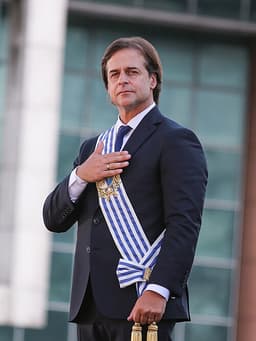
Luis Alberto Lacalle
Politician · Modern
50.7Total

Shankar Dayal Sharma
Politician · Modern
58.5Total
Basic Information
Born
1941
1918
Died
—
1999
Era
Modern
Modern
Nationality
Uruguay
India
Occupation
Politician
Politician
Civilization
Western
Indian
Score Comparison
Military (10%)
50.0
51.4
Political (20%)
68.0
68.0
Influence (20%)
55.7
55.7
Legacy (20%)
45.0
45.0
Leadership (15%)
40.0
80.0
Strategy (15%)
42.9
60.0
TOTAL
50.7
58.5
Luis Alberto Lacalle — Complete Timeline
1989 AD
Elected President of UruguayPolitical Action◆ Major
Luis Alberto Lacalle was elected president of Uruguay in the 1989 general election as the National Party candidate, defeating the Colorado Party. His victory ended 122 years of Colorado Party dominance in the presidency.
ElectionNational PartyEnd of Colorado Dominance
Impact: nationalconstructive
1990 AD
Implemented Neoliberal Economic ReformsReform◆ Major
Lacalle implemented a series of neoliberal reforms, including trade liberalization, deregulation, and privatization of state-owned enterprises. The reforms aimed to modernize the economy but faced opposition from labor unions and led to increased unemployment.
Economic ReformNeoliberalismPrivatization
Impact: nationalconstructive
1991 AD
Signed the Treaty of AsunciónPolitical Action◆ Major
Lacalle signed the Treaty of Asunci
Regional IntegrationTrade BlocMercosur
Impact: regionalconstructive
1992 AD
Faced Referendum on State ReformsPolitical Action
Lacalle's government faced a referendum in December 1992 on several state reform laws, including privatization of state enterprises. Voters rejected the reforms, dealing a political setback to Lacalle's agenda.
ReferendumPrivatizationPolitical Setback
Impact: nationaldestructive
Shankar Dayal Sharma — Complete Timeline
1952 AD
Elected Chief Minister of Madhya PradeshPolitical Action◆ Major
Shankar Dayal Sharma was elected as the Chief Minister of Madhya Pradesh, serving from 1952 to 1956. He was one of the youngest chief ministers in India at the time, overseeing the state's early development.
Chief MinisterMadhya PradeshCongress
Impact: regionalconstructive
1984 AD
Appointed Governor of Andhra PradeshPolitical Action
Shankar Dayal Sharma was appointed as the Governor of Andhra Pradesh, serving from 1984 to 1985. He later served as Governor of Punjab and Maharashtra, handling political crises in those states.
GovernorAndhra PradeshConstitutional
Impact: regionalconstructive
1987 AD
Elected Vice President of IndiaPolitical Action◆ Major
Shankar Dayal Sharma was elected as the Vice President of India, serving from 1987 to 1992. He also served as Chairman of the Rajya Sabha, presiding over the upper house.
Vice PresidentRajya SabhaConstitutional
Impact: nationalconstructive
1992 AD
Elected President of IndiaPolitical Action◆ Major
Shankar Dayal Sharma was elected as the 9th President of India, serving from 1992 to 1997. His presidency saw the rise of coalition politics and the demolition of the Babri Masjid.
PresidencyElectionCoalition
Impact: national
Presided over Babri Masjid demolition aftermathPolitical Action◆ Major
President Shankar Dayal Sharma was in office when the Babri Masjid was demolished on December 6, 1992. He played a constitutional role in the subsequent political crisis, including the dismissal of state governments.
Babri MasjidCrisisConstitutional
Impact: nationaltragic
This comparison has not been analyzed yet.
One-time AI generation (~1 minute). Scores and timeline are already available below.
Rankings
🥇
Shankar Dayal SharmaLeader
Mil: 51.4Pol: 68.0Inf: 55.7
58.5
🥈
Luis Alberto Lacalle
Mil: 50.0Pol: 68.0Inf: 55.7
50.7
+7.8 behind
How This Comparison Works
Algorithm
Each figure is scored on 6 dimensions (0—100 scale) based on structured historical data: Military (10%), Political (20%), Influence (20%), Legacy (20%), Leadership (15%), Strategy (15%). The weighted total produces the final ranking.
Data Sources
Scores are computed from structured sub-indicators in the database. Scale factors adjust for era (Ancient ×0.85, Modern ×1.0) and civilization size (Eastern ×1.05, Other ×0.80) to account for differences in population and military scale.
Maximum 3 Figures
Comparisons are limited to 2—3 figures to ensure readability and statistical meaningfulness.
Error Margins
±5 points per dimension — Sub-scores are derived from historical records with inherent uncertainty. Two figures within 5 points on a dimension should be considered roughly equivalent in that area.
Total Score Accuracy
±3 points overall — The weighted combination of 6 dimensions produces a total score with approximately ±3 points of uncertainty. Differences of less than 3 points are not statistically significant— the figures are effectively tied.
Known Limitations
- Historical records are incomplete and uneven across civilizations
- Figures from oral-tradition societies may be underrepresented
- Occupation labels can misclassify multi-role figures
- Scores measure capability and impact, not moral character
- Quantitative scoring is a comparison tool, not absolute truth
Capability Radar
Military (10%) — Battles & Warfare
Battles
26
41
Win Rate
32
46
Expansion
34
50
Political (20%) — Governance & Reform
Reform
45
55
Diplomacy
60
60
Economy
50
50
Influence (20%) — Cultural & Global Reach
Cultural
30
30
Global
45
35
Legacy (20%) — Historical Impact
Historical
40
40
Longevity
30
30
Leadership (15%) — Power & Stability
Tenure
55
70
Stability
40
65
Strategy (15%) — Tactics & Innovation
Strategy
40
53
Tactics
40
53
Reform
43
60
Similar Comparisons
Comments & Discussion
No comments yet. Be the first to share your thoughts!