Loading...
Macbeth of Scotland vs Napoleon Bonaparte
Napoleon Bonaparte leads by 22.3 pts · 2 figures compared
…
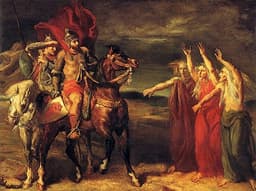
Macbeth of Scotland
Emperor · Medieval
48.6Total

Napoleon Bonaparte
General · Modern
70.9Total
Basic Information
Born
1005
1769
Died
1057
1821
Era
Medieval
Modern
Nationality
Scotland
France
Occupation
Emperor
General
Civilization
Western
Western
Score Comparison
Military (10%)
55.0
94.0
Political (20%)
26.4
72.0
Influence (20%)
55.0
40.0
Legacy (20%)
55.0
80.0
Leadership (15%)
48.4
78.0
Strategy (15%)
43.7
90.0
TOTAL
48.6
70.9
Macbeth of Scotland — Complete Timeline
1040 AD
Battle of PitgavenyWar
Macbeth defeated and killed King Duncan I in battle at Pitgaveny near Elgin. Macbeth then claimed the Scottish throne, becoming King of Scots. This event is the basis for Shakespeare's play, though the historical circumstances differ from the fictional account.
BattleSuccessionDuncan
Impact: national
1050 AD
Pilgrimage to RomeCultural◆ Major
Macbeth made a pilgrimage to Rome, where he was received by Pope Leo IX and distributed alms to the poor. This was a significant act of piety and diplomacy, demonstrating Macbeth's legitimacy as a Christian king and his connections to the wider European church.
PilgrimageRomePiety
Impact: regionalconstructive
1054 AD
Battle of DunsinaneWar◆ Major
Macbeth was defeated at the Battle of Dunsinane by an army led by Siward, Earl of Northumbria, acting on behalf of Malcolm Canmore. The defeat weakened Macbeth's position but did not immediately end his reign, as he continued to rule for three more years.
BattleNorthumbriaMalcolm
Impact: regional
1057 AD
Battle of LumphananWar◆ Major
Macbeth was killed at the Battle of Lumphanan in Aberdeenshire, fighting against Malcolm Canmore's forces. His death ended his 17-year reign and allowed Malcolm to claim the throne. Macbeth's stepson Lulach succeeded briefly before being killed by Malcolm.
BattleDeathSuccession
Impact: national
Napoleon Bonaparte — Complete Timeline
1799 AD
Coup of 18 BrumaireOther◆ Major
Napoleon Bonaparte, with support from his brother Lucien and key political figures, overthrew the Directory in a bloodless coup. He established the Consulate with himself as First Consul, effectively becoming the ruler of France. This event ended the French Revolution's most unstable period.
French RevolutionCoupRise to Power
Impact: regional
1804 AD
Promulgation of the Napoleonic CodeOther◆ Major
Napoleon enacted the Civil Code of the French, known as the Napoleonic Code, a comprehensive set of laws that replaced the fragmented feudal legal systems. The code established legal equality, protected property rights, and secularized law. It became the basis for legal systems in many European and world countries.
Legal ReformNapoleonic CodeCivil Law
Impact: globalconstructive
1805 AD
Battle of AusterlitzWar◆ Major
Napoleon's Grande Arm
Napoleonic WarsBattleDecisive Victory
Impact: global
1812 AD
Invasion of RussiaWar◆ Major
Napoleon led the Grande Arm
Napoleonic WarsInvasionDisaster
Impact: globaldestructive
1815 AD
Battle of WaterlooWar◆ Major
Napoleon's French army was defeated by the combined forces of the Duke of Wellington's Anglo-Allied army and Gebhard Leberecht von Bl
Napoleonic WarsBattleFinal Defeat
Impact: globaldestructive
Expert Analysis
macbeth-of-scotland-vs-napoleon-bonaparte
# The Conqueror and the King: Napoleon and Macbeth — Two Men Who Seized a Crown
On a May morning in 1804, Napoleon Bonaparte stood in the cathedral of Notre-Dame, turned his back on the Pope, and placed the crown of France upon his own head. The gesture was deliberate, defiant, and utterly modern. Seven and a half centuries earlier, on a windswept battlefield near Elgin in northern Scotland, a thane named Macbeth drove his sword into King Duncan I and took a crown by blood. Both men seized power through violence. Both ruled for roughly a decade and a half. One reshaped a continent; the other became the stuff of legend. Why did their paths diverge so radically? The answer lies not just in their talents, but in the worlds that shaped them.
Origins
Napoleon was born in 1769 on the Mediterranean island of Corsica, a place recently annexed by France. His family was minor nobility, but his father’s connections secured him a place at a French military academy. He was an outsider — short, intense, speaking French with a thick Italian accent — and he burned with ambition. The French Revolution had shattered the old order, creating opportunities unknown in the ancien régime. A young artillery officer could rise on merit, and Napoleon did so with breathtaking speed.
Macbeth was born around 1005 into the royal bloodline of Scotland. His mother was a daughter of Malcolm II, and his father was the ruler of Moray. In early medieval Scotland, kingship was not a matter of primogeniture but of strength and blood. The throne passed among the powerful, and murder was a common career tool. Macbeth grew up in a world where loyalty was local, power was personal, and the Church was the only institution that stretched beyond the clan. When he killed Duncan in 1040 at the Battle of Pitgaveny, he was not committing an act of monstrous evil by the standards of his time — he was claiming what he believed was his.
Rise to Power
Napoleon’s ascent was a masterpiece of timing and talent. He first distinguished himself at the Siege of Toulon in 1793, where his artillery plan drove the British from the harbor. By 1796, at age 26, he commanded the Army of Italy. He won a dozen battles in a year, forcing Austria to the negotiating table. His secret was speed: he marched his armies faster than his enemies expected, concentrated his forces at the decisive point, and struck before the enemy could react. In 1799, he returned from a disastrous Egyptian campaign to find the French Directory in chaos. With the support of soldiers and politicians, he staged a coup d’état and made himself First Consul. By 1804, he was Emperor.
Macbeth’s rise was simpler and more brutal. He had already proven himself a capable military commander under Duncan, but when Duncan led a campaign into Moray in 1040, Macbeth met him at Pitgaveny and killed him. He was crowned at Scone, the ancient seat of Scottish kings. Unlike Napoleon, he did not need to reshape the state to take power — he simply needed to eliminate the man who held it. His reign lasted 17 years, a remarkable span in a kingdom where violence was the norm.
Leadership & Governance
Napoleon’s genius was organizational as much as military. He reformed the French legal system into the Napoleonic Code, a clear, rational set of laws that swept away feudal privileges and established equality before the law. He created a centralized bureaucracy, a national education system, and a bank that stabilized the currency. He promoted officers based on merit, not birth. His armies were the most efficient in Europe, and he commanded them with a combination of charisma, tactical brilliance, and relentless energy. He won his greatest victory at Austerlitz in 1805, where he crushed the combined armies of Russia and Austria. His military score of 94 reflects a commander who dominated the battlefield for a decade.
Macbeth ruled differently. He was, by the standards of his time, a successful king. He maintained peace within Scotland for most of his reign. In 1050, he made a pilgrimage to Rome, where Pope Leo IX received him — a sign that he was recognized as a legitimate Christian monarch. He distributed alms to the poor, a gesture that suggests a ruler who understood the spiritual and social duties of kingship. But Scotland in the 11th century was not France in the 19th. There was no bureaucracy, no standing army, no unified legal system. Macbeth ruled through personal relationships, alliances with powerful earls, and the threat of force. His leadership score of 78.9 is respectable, but his political score of 47.2 reveals the limits of his power.
Triumph & Tragedy
Napoleon’s greatest triumph was Austerlitz, where he destroyed a larger coalition army and forced the Holy Roman Empire to dissolve. His greatest tragedy was the invasion of Russia in 1812. He marched 600,000 men into the vastness of the Russian winter. He won every battle, but the Russians simply retreated, burning their own land. When he reached Moscow, the city was abandoned and set ablaze. He had no choice but to retreat. The cold, hunger, and Russian cavalry destroyed his army. Only about 100,000 men returned. It was a catastrophe from which his empire never recovered. He was exiled to Elba in 1814, escaped in 1815, and met final defeat at Waterloo — a battle he might have won if his subordinates had arrived on time.
Macbeth’s triumph was simply surviving for 17 years in a violent age. His tragedy came in 1054, when Siward, Earl of Northumbria, invaded Scotland on behalf of Malcolm Canmore, Duncan’s son. At the Battle of Dunsinane, Macbeth was defeated. He held on for three more years, but in 1057, at the Battle of Lumphanan in Aberdeenshire, he was killed. His death ended his line, and Malcolm Canmore took the throne. Unlike Napoleon, Macbeth did not die in exile, remembered as a genius who fell from grace. He died in battle, as a medieval king might expect.
Character & Destiny
Napoleon was driven by an insatiable hunger for glory. “I live only for posterity,” he once said. He believed that he could shape history through sheer will and intelligence. But his ambition became his flaw. He could not stop. After Austerlitz, he could have made peace with Europe, but he pushed on — into Spain, into Austria again, into Russia. His character was a paradox: a brilliant administrator who could not govern his own ambition, a military genius who could not recognize the limits of force.
Macbeth was, by the accounts we have, a competent and perhaps even pious ruler. Shakespeare turned him into a tragic figure tormented by guilt and prophecy, but the historical Macbeth was more pragmatic. He killed Duncan not because witches told him to, but because it was the way to power in his world. His tragedy was not psychological but structural: he ruled a poor, fragmented kingdom that could not resist the pressure of a better-organized invader. His influence score of 77.9 is inflated by Shakespeare’s play; his legacy score of 67.0 is more accurate for the historical figure.
Legacy
Napoleon’s legacy is enormous. The Napoleonic Code influenced legal systems across Europe and the world. His campaigns revolutionized warfare. He destroyed the Holy Roman Empire and helped create the modern nation-state. Even his enemies adopted his methods. He is remembered as both a liberator and a tyrant, a man who spread revolutionary ideals while crushing them under his own ambition. His total score of 82.4 reflects a figure of the first rank.
Macbeth’s legacy is complicated by fiction. The historical Macbeth is barely remembered outside of Scotland. His reign was unremarkable in the annals of medieval kings. But Shakespeare’s play made him one of the most famous rulers in history — a symbol of ambition, guilt, and fate. The real Macbeth was a minor figure who stumbled into immortality through the genius of a playwright.
Conclusion
Napoleon and Macbeth both seized thrones by violence, but they inhabited different worlds. Napoleon lived in an age of revolution, where a man of talent could reshape the world. Macbeth lived in an age of blood and iron, where kingship was a prize won by the sword and held by the strong. Napoleon’s failure came from overreach; Macbeth’s came from the limits of his world. One is remembered for what he did, the other for what he became in the imagination of a poet. In the end, both stories remind us that the crown is always heavy — and history writes the final judgment.
Rankings
🥇
Napoleon BonaparteLeader
Mil: 94.0Pol: 72.0Inf: 40.0
70.9
🥈
Macbeth of Scotland
Mil: 55.0Pol: 26.4Inf: 55.0
48.6
+22.3 behind
How This Comparison Works
Algorithm
Each figure is scored on 6 dimensions (0—100 scale) based on structured historical data: Military (10%), Political (20%), Influence (20%), Legacy (20%), Leadership (15%), Strategy (15%). The weighted total produces the final ranking.
Data Sources
Scores are computed from structured sub-indicators in the database. Scale factors adjust for era (Ancient ×0.85, Modern ×1.0) and civilization size (Eastern ×1.05, Other ×0.80) to account for differences in population and military scale.
Maximum 3 Figures
Comparisons are limited to 2—3 figures to ensure readability and statistical meaningfulness.
Error Margins
±5 points per dimension — Sub-scores are derived from historical records with inherent uncertainty. Two figures within 5 points on a dimension should be considered roughly equivalent in that area.
Total Score Accuracy
±3 points overall — The weighted combination of 6 dimensions produces a total score with approximately ±3 points of uncertainty. Differences of less than 3 points are not statistically significant— the figures are effectively tied.
Known Limitations
- Historical records are incomplete and uneven across civilizations
- Figures from oral-tradition societies may be underrepresented
- Occupation labels can misclassify multi-role figures
- Scores measure capability and impact, not moral character
- Quantitative scoring is a comparison tool, not absolute truth
Capability Radar
Military (10%) — Battles & Warfare
Battles
30
95
Win Rate
35
90
Expansion
25
95
Political (20%) — Governance & Reform
Reform
15
95
Diplomacy
20
80
Economy
15
85
Influence (20%) — Cultural & Global Reach
Cultural
70
85
Global
60
90
Legacy (20%) — Historical Impact
Historical
65
95
Longevity
75
90
Leadership (15%) — Power & Stability
Tenure
40
85
Stability
20
70
Strategy (15%) — Tactics & Innovation
Strategy
20
95
Tactics
25
98
Reform
10
92
Similar Comparisons
Comments & Discussion
CROWNSNATCHER6/17/2026
Look, Napoleon actually *earned* his crown through military genius and institutional reform. Macbeth just stabbed a sleeping king in a feudal power play. Napoleon's self-coronation at Notre-Dame was a PR masterstroke against the Church; Macbeth's murder of Duncan was a PR disaster that made him a bogeyman for centuries. One man built a meritocracy, the other just wanted his family's bloodline on top. Not the same thing.
兵棋推演师6/17/2026
拿破仑在奥斯特里茨战役里用佯退和集中突破的战术,一个下午就粉碎了俄奥联军。麦克白呢?历史记载里他就打了几场边境部落械斗,连正规军队都没有。拿破仑是真正改变战争形态的军事革命者,麦克白充其量是个成功的部落酋长。拿炮兵战术和石斧砍杀比?这不是一个量级。
SANGUINARYSTATS6/17/2026
The numbers tell a brutal story: Napoleon's wars killed 3-6 million people across Europe. Macbeth's reign saw maybe 10,000 deaths max by medieval Scottish standards. Napoleon was a continent-scale catastrophe; Macbeth was a local political scandal inflated by Shakespeare's pen. If we're measuring by body count and systemic impact, Napoleon dwarfs Macbeth in every measurable category. History rightly prioritizes the bigger destroyer.
古本猎手6/17/2026
你们都被莎士比亚骗了。真实的麦克白统治了十七年,农业丰收、宗教稳定,还把王国南境推到了洛锡安。邓肯一世不过是个暴虐的幼王,被杀后国家反而安定。拿破仑的民法典再伟大,也是建立在大半个欧洲的累累白骨上。麦克白以一人之血换一国太平,拿破仑用千万人血染红了他的鹰旗。
REVISIONISTGLAZE6/17/2026
Oh please, the "meritocracy" myth for Napoleon is pure propaganda. He restored slavery in 1802, crowned himself emperor in 1804, and stuffed his incompetent relatives on every European throne. Macbeth at least didn't pretend his power grab was enlightened. Both were ambitious murderers who seized power unconstitutionally. The real difference? Napoleon had better press agents and bigger cannons. Prince of liars meets thane of blood.