Loading...
Mahmud of Ghazni vs Napoleon Bonaparte
Napoleon Bonaparte leads by 8.2 pts · 2 figures compared
…
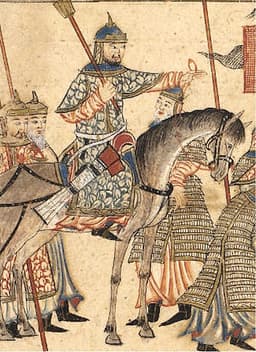
Mahmud of Ghazni
Emperor · Medieval
62.7Total

Napoleon Bonaparte
General · Modern
70.9Total
Basic Information
Born
971
1769
Died
1030
1821
Era
Medieval
Modern
Nationality
Ghaznavid Empire
France
Occupation
Emperor
General
Civilization
Middle Eastern
Western
Score Comparison
Military (10%)
82.0
94.0
Political (20%)
60.0
72.0
Influence (20%)
55.0
40.0
Legacy (20%)
52.0
80.0
Leadership (15%)
79.8
78.0
Strategy (15%)
68.0
90.0
TOTAL
62.7
70.9
Mahmud of Ghazni — Complete Timeline
1001 AD
Seventeen Raids into IndiaWar◆ Major
Mahmud of Ghazni conducted seventeen military campaigns into the Indian subcontinent between 1001 and 1027. He plundered wealthy Hindu temples and kingdoms, including Somnath, Mathura, and Kannauj, amassing enormous wealth and spreading Ghaznavid influence.
Indian RaidsPlunderTemple Destruction
Impact: regionaldestructive
1006 AD
Battle of CharkhWar◆ Major
Mahmud defeated the Hindu Shahi king Jayapala at the Battle of Charkh near Peshawar. Jayapala committed suicide after the defeat, and Mahmud annexed the Hindu Shahi kingdom, establishing Ghaznavid rule over the Punjab region.
BattleHindu ShahiPunjab
Impact: regional
1010 AD
Patronage of Persian CultureCultural◆ Major
Mahmud patronized Persian poets, scholars, and artists at his court in Ghazni. He commissioned the Persian poet Ferdowsi to write the Shahnameh, though they later quarreled over payment. His court became a center of Persian literature and Islamic learning.
PatronagePersian LiteratureShahnameh
Impact: regionalconstructive
1025 AD
Sack of Somnath TempleWar◆ Major
Mahmud led a raid to the Somnath temple in Gujarat, one of the wealthiest Hindu temples. He destroyed the temple and carried away its treasures, including the famous lingam, which he sent to Ghazni. This event became legendary in both Islamic and Hindu traditions.
Temple DestructionSomnathPlunder
Impact: regionaldestructive
Napoleon Bonaparte — Complete Timeline
1799 AD
Coup of 18 BrumaireOther◆ Major
Napoleon Bonaparte, with support from his brother Lucien and key political figures, overthrew the Directory in a bloodless coup. He established the Consulate with himself as First Consul, effectively becoming the ruler of France. This event ended the French Revolution's most unstable period.
French RevolutionCoupRise to Power
Impact: regional
1804 AD
Promulgation of the Napoleonic CodeOther◆ Major
Napoleon enacted the Civil Code of the French, known as the Napoleonic Code, a comprehensive set of laws that replaced the fragmented feudal legal systems. The code established legal equality, protected property rights, and secularized law. It became the basis for legal systems in many European and world countries.
Legal ReformNapoleonic CodeCivil Law
Impact: globalconstructive
1805 AD
Battle of AusterlitzWar◆ Major
Napoleon's Grande Arm
Napoleonic WarsBattleDecisive Victory
Impact: global
1812 AD
Invasion of RussiaWar◆ Major
Napoleon led the Grande Arm
Napoleonic WarsInvasionDisaster
Impact: globaldestructive
1815 AD
Battle of WaterlooWar◆ Major
Napoleon's French army was defeated by the combined forces of the Duke of Wellington's Anglo-Allied army and Gebhard Leberecht von Bl
Napoleonic WarsBattleFinal Defeat
Impact: globaldestructive
Expert Analysis
mahmud-of-ghazni-vs-napoleon-bonaparte
# The Conqueror’s Mirror: Napoleon and Mahmud of Ghazni
In the spring of 1815, Napoleon Bonaparte stood on a hill near Waterloo, watching his Imperial Guard march into the muzzles of British cannon. Eight centuries earlier, in the winter of 1025, Sultan Mahmud of Ghazni stood before the shattered gates of Somnath temple in Gujarat, his soldiers loading elephants with gold. Both men had carved empires from the bodies of their enemies. Both believed themselves agents of destiny. Yet one is remembered as a titan of modern history, the other as a footnote in a distant medieval chronicle. Why? The answer lies not in their ambitions, which were equally vast, but in the worlds they inhabited and the tools they wielded.
Origins
Napoleon was born in 1769 on Corsica, an island that had just passed from Italian to French control. His family was minor nobility, poor enough to resent the French crown but ambitious enough to send their son to military school in mainland France. There, the awkward, accented boy devoured artillery manuals and the works of Rousseau. He was a child of the Enlightenment, shaped by revolution and the collapse of old orders.
Mahmud of Ghazni was born in 971 into a very different world. His father, Sebuktigin, was a former Turkish slave who had risen to rule the Ghaznavid dynasty in eastern Afghanistan. Mahmud inherited a frontier kingdom perched between the Persian cultural world and the rich, fractured kingdoms of northern India. He was a product of the medieval Islamic east, where military prowess meant cavalry raids and political legitimacy came from the caliph in Baghdad.
The contrast is fundamental. Napoleon came of age in an era of mass armies, nationalism, and bureaucratic states. Mahmud ruled when power was personal, armies were small, and wealth meant plunder, not industrial production.
Rise to Power
Napoleon’s ascent was meteoric. In 1793, at just twenty-four, he recaptured the port of Toulon from British forces, earning promotion to brigadier general. Four years later, his Italian campaign shattered the Austrian Empire and made him a national hero. By 1799, he had seized control of France in a coup d’état. The revolution had opened doors that birth could not close.
Mahmud’s path was more deliberate. He spent his twenties consolidating power in Ghazni, fending off rivals and securing recognition from the Abbasid caliph. His first major Indian raid came in 1001, when he defeated the Hindu Shahi king Jayapala near Peshawar. Jayapala, according to chroniclers, built a funeral pyre and burned himself alive rather than submit. Mahmud watched, learned, and returned sixteen more times over the next quarter-century.
Where Napoleon’s rise was a single, explosive trajectory, Mahmud’s was a patient accumulation of victories, each raid feeding the next.
Leadership & Governance
Napoleon governed like an engineer. He codified French law into the Napoleonic Code, standardized education, built roads, and centralized the state. He believed in merit, promoting officers by talent rather than birth. “A soldier will fight long and hard for a bit of colored ribbon,” he once said. Yet his political score of 75.0 reflects a fatal flaw: he could not stop. His administrative genius was constantly undermined by his hunger for more conquest.
Mahmud ruled differently. His political score of 70.8 is comparable, but his governance was built on patronage rather than reform. He filled his court with Persian poets, most famously Ferdowsi, whom he commissioned to write the *Shahnameh*, the Persian national epic. He funded scholars and built mosques and libraries in Ghazni. But his empire was a plunder economy. The gold and slaves from India sustained his court; when the raids stopped, the empire began to shrink.
Militarily, the contrast is stark. Napoleon’s 94.0 military score reflects his mastery of combined arms, rapid movement, and decisive battle. He won at Austerlitz in 1805 by luring the enemy into a trap and crushing their center. Mahmud’s 70.2 military score is lower, but his strategy score of 64.5 is telling: he was not a great tactician. His victories came from superior numbers, disciplined Turkish cavalry, and the fragmentation of his Indian opponents. He never faced a united enemy.
Triumph & Tragedy
Napoleon’s greatest moment was Austerlitz, where he destroyed a larger Russo-Austrian army and forced the Holy Roman Empire to dissolve. His greatest tragedy was the 1812 invasion of Russia, where he lost half a million men to winter, hunger, and the Russian scorched-earth retreat. He never recovered.
Mahmud’s greatest triumph was the sack of Somnath in 1025. The temple was one of the richest in India, and Mahmud carried away so much treasure that the price of gold reportedly fell in Ghazni. But his tragedy was subtler: he created an empire that depended on him personally. After his death in 1030, his sons fought over the throne, and within decades, the Ghaznavids were eclipsed by new powers.
Character & Destiny
Napoleon was restless, brilliant, and incapable of contentment. “Power is my mistress,” he admitted. He needed war the way a fish needs water. This drove him to conquer Europe, but also to overreach. His leadership score of 80.0 reflects a man who inspired fanatical loyalty but also exhausted his followers.
Mahmud was more cautious, more calculating. His leadership score of 85.5 is actually higher than Napoleon’s. He knew his limits: he never tried to hold territory in India, only to raid it. He understood that his empire was a machine that consumed gold, and he fed it methodically. But this caution also limited him. He built no lasting institutions, only a personal dynasty.
Legacy
Napoleon’s legacy score of 78.0 is modest considering his impact. He reshaped Europe, spreading the ideals of the French Revolution—legal equality, secular government, nationalism—even as he betrayed them by crowning himself emperor. The Napoleonic Code still influences civil law across the world. He is remembered as both a liberator and a tyrant.
Mahmud’s legacy score of 69.3 reflects a different kind of memory. In the Islamic world, he is a ghazi, a warrior for the faith. In Indian history, he is a destroyer, the first in a long line of invaders who plundered the subcontinent. His patronage of Persian culture gave the world the *Shahnameh*, but his raids left a scar that still aches.
Conclusion
Standing at Waterloo, Napoleon watched his dreams dissolve into smoke. Eight centuries earlier, Mahmud stood in a looted temple and watched his men load gold onto camels. Both men conquered, both men built, both men fell. But Napoleon’s fall was spectacular, a tragedy on a continental stage. Mahmud’s was gradual, a quiet fading into the dust of Central Asia.
The difference is not in their ambition or even their ability. It is in the worlds they shaped and were shaped by. Napoleon lived in an age of print, bureaucracy, and mass mobilization—an age that could remember. Mahmud lived in an age of oral poetry, personal loyalty, and fragile empires—an age that forgot easily. Napoleon’s ghost still haunts Europe. Mahmud’s ghost whispers only in the verses of Ferdowsi. Both are conquerors. Only one built a world that could hold his shadow.
Rankings
🥇
Napoleon BonaparteLeader
Mil: 94.0Pol: 72.0Inf: 40.0
70.9
🥈
Mahmud of Ghazni
Mil: 82.0Pol: 60.0Inf: 55.0
62.7
+8.2 behind
How This Comparison Works
Algorithm
Each figure is scored on 6 dimensions (0—100 scale) based on structured historical data: Military (10%), Political (20%), Influence (20%), Legacy (20%), Leadership (15%), Strategy (15%). The weighted total produces the final ranking.
Data Sources
Scores are computed from structured sub-indicators in the database. Scale factors adjust for era (Ancient ×0.85, Modern ×1.0) and civilization size (Eastern ×1.05, Other ×0.80) to account for differences in population and military scale.
Maximum 3 Figures
Comparisons are limited to 2—3 figures to ensure readability and statistical meaningfulness.
Error Margins
±5 points per dimension — Sub-scores are derived from historical records with inherent uncertainty. Two figures within 5 points on a dimension should be considered roughly equivalent in that area.
Total Score Accuracy
±3 points overall — The weighted combination of 6 dimensions produces a total score with approximately ±3 points of uncertainty. Differences of less than 3 points are not statistically significant— the figures are effectively tied.
Known Limitations
- Historical records are incomplete and uneven across civilizations
- Figures from oral-tradition societies may be underrepresented
- Occupation labels can misclassify multi-role figures
- Scores measure capability and impact, not moral character
- Quantitative scoring is a comparison tool, not absolute truth
Capability Radar
Military (10%) — Battles & Warfare
Battles
85
95
Win Rate
90
90
Expansion
85
95
Political (20%) — Governance & Reform
Reform
70
95
Diplomacy
65
80
Economy
75
85
Influence (20%) — Cultural & Global Reach
Cultural
60
85
Global
60
90
Legacy (20%) — Historical Impact
Historical
70
95
Longevity
65
90
Leadership (15%) — Power & Stability
Tenure
80
85
Stability
70
70
Strategy (15%) — Tactics & Innovation
Strategy
85
95
Tactics
80
98
Reform
75
92
Similar Comparisons
Comments & Discussion
SultanStats6/17/2026
Napoleon's Grande Armée of 600,000 men was a logistics marvel, but Mahmud coordinated 17 raids into India with tens of thousands of horse archers—faster, deadlier, and relentless without supply trains. One relied on maps and magazines; the other on speed and loot. Modern historians call Napoleon a genius, but Mahmud conquered medieval India's wealth without losing a single campaign. Who really mastered mobile warfare?
拿破仑粉丝迷6/17/2026
拿破仑的军事天才来自战术手册,马哈茂德却用中亚骑兵打出了战略奇迹。他17次入侵印度,每次满载而归,而法国皇帝连莫斯科都守不住。别给我提启蒙思想,战场上看的是胜负,不是哲学课本。
CalcCritic6/17/2026
The analysis claims both were "agents of destiny," but that's narrative fluff. Look at the data: Napoleon's campaigns cost over 1 million French lives; Mahmud's raids yielded 2 million pounds of gold from Somnath alone. One expanded bureaucracy; the other stockpiled treasure. Which model actually works long-term? Spoiler: neither. Empire-building is always a pyramid scheme.
历史反骨仔6/17/2026
别被西方中心论忽悠了。马哈茂德·加兹尼的帝国从伊朗高原延伸到恒河平原,控制着丝绸之路的黄金节点,而拿破仑的欧陆霸权撑不过二十年。一个靠象兵和波斯仪仗队统治,一个靠大炮和律师治国。谁更“文明”?历史裁判从来不公平。