Loading...
Manik Sarkar vs Napoleon Bonaparte
Napoleon Bonaparte leads by 20.2 pts · 2 figures compared
…
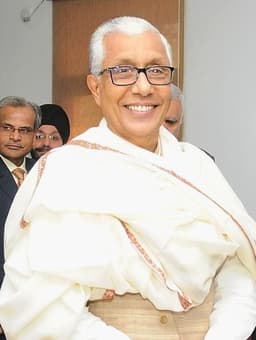
Manik Sarkar
Politician · Modern
50.7Total

Napoleon Bonaparte
General · Modern
70.9Total
Basic Information
Born
1949
1769
Died
—
1821
Era
Modern
Modern
Nationality
India
France
Occupation
Politician
General
Civilization
Indian
Western
Score Comparison
Military (10%)
37.6
94.0
Political (20%)
46.6
72.0
Influence (20%)
47.9
40.0
Legacy (20%)
40.0
80.0
Leadership (15%)
79.8
78.0
Strategy (15%)
60.0
90.0
TOTAL
50.7
70.9
Manik Sarkar — Complete Timeline
1998 AD
Became Chief Minister of TripuraPolitical Action
Manik Sarkar became Chief Minister of Tripura for the first time, leading a Left Front government. He would go on to serve four consecutive terms, making him one of India's longest-serving chief ministers.
Chief MinisterTripuraLeft Front
Impact: regionalconstructive
Known for frugal lifestyleOther
Throughout his tenure, Sarkar was noted for his simple and frugal lifestyle, living in a modest government quarter and driving an old car. This earned him a reputation as an honest and accessible leader.
LifestyleHonestyTripura
Impact: regionalconstructive
2013 AD
Won 2013 Tripura Assembly electionPolitical Action◆ Major
Sarkar led the CPI(M)-led Left Front to victory in the Tripura assembly election, winning 49 of 60 seats. This was his fourth consecutive term as chief minister.
ElectionTripuraLeft Front
Impact: regionalconstructive
2018 AD
Lost 2018 Tripura Assembly electionPolitical Action
Sarkar's Left Front government was defeated by the BJP-IPFT alliance, winning only 16 seats. This ended his 20-year tenure as chief minister, marking a major political shift in the state.
ElectionTripuraDefeat
Impact: regionaltragic
Napoleon Bonaparte — Complete Timeline
1799 AD
Coup of 18 BrumaireOther◆ Major
Napoleon Bonaparte, with support from his brother Lucien and key political figures, overthrew the Directory in a bloodless coup. He established the Consulate with himself as First Consul, effectively becoming the ruler of France. This event ended the French Revolution's most unstable period.
French RevolutionCoupRise to Power
Impact: regional
1804 AD
Promulgation of the Napoleonic CodeOther◆ Major
Napoleon enacted the Civil Code of the French, known as the Napoleonic Code, a comprehensive set of laws that replaced the fragmented feudal legal systems. The code established legal equality, protected property rights, and secularized law. It became the basis for legal systems in many European and world countries.
Legal ReformNapoleonic CodeCivil Law
Impact: globalconstructive
1805 AD
Battle of AusterlitzWar◆ Major
Napoleon's Grande Arm
Napoleonic WarsBattleDecisive Victory
Impact: global
1812 AD
Invasion of RussiaWar◆ Major
Napoleon led the Grande Arm
Napoleonic WarsInvasionDisaster
Impact: globaldestructive
1815 AD
Battle of WaterlooWar◆ Major
Napoleon's French army was defeated by the combined forces of the Duke of Wellington's Anglo-Allied army and Gebhard Leberecht von Bl
Napoleonic WarsBattleFinal Defeat
Impact: globaldestructive
Expert Analysis
manik-sarkar-vs-napoleon-bonaparte
# The Emperor and the Ascetic
On a June morning in 1815, Napoleon Bonaparte watched the sun rise over the fields of Waterloo, his grand army arrayed for a battle that would decide the fate of Europe. Two centuries later and half a world away, Manik Sarkar would begin his day in a modest government quarter in Agartala, wearing a simple cotton shirt and sipping tea from a steel cup, preparing to govern one of India’s smallest states. What could possibly connect these two men—one a conqueror who redrew the map of Europe, the other a communist chief minister who never owned a car? Their lives, separated by time and scale, reveal the profound ways in which ambition and humility shape power, and how the same historical stage can produce radically different destinies.
Origins
Napoleon Bonaparte was born in 1769 on the island of Corsica, a place that had only recently become French. His family was minor nobility, but their poverty was real. He spoke Italian before French and carried the insecurities of an outsider into the heart of a nation that would one day worship him. The French Revolution, erupting when he was twenty, tore down the old order and opened paths that had been closed for centuries. A young artillery officer with a gift for mathematics and a hunger for glory, Napoleon seized the moment.
Manik Sarkar was born in 1949 in Tripura, a princely state that had just been absorbed into independent India. His family was not wealthy, but his father was a schoolteacher who valued education. The world he entered was one of postcolonial poverty, ethnic diversity, and simmering insurgencies. While Napoleon read military treatises at the Brienne military academy, Sarkar was drawn to Marxist literature and student politics. The era shaped them both: Napoleon’s France was a volcano of revolution; Sarkar’s India was a democracy struggling to hold together its many fragments.
Rise to Power
Napoleon’s ascent was meteoric. At twenty-four, he drove the British out of Toulon. At twenty-six, he crushed a royalist uprising in Paris with a “whiff of grapeshot.” By thirty, he had conquered Italy and Egypt, and by thirty-five, he had crowned himself Emperor of the French. Each victory fed the next, and his ambition grew with his success. He understood that in a revolutionary age, merit could outrank birth, and he exploited this truth ruthlessly.
Manik Sarkar’s rise was slower, quieter, and far less dramatic. He joined the Communist Party of India (Marxist) as a young man and worked his way through the ranks of Tripura’s turbulent politics. In 1998, at the age of forty-nine, he became Chief Minister. There was no coup, no grand battle—only patient organizing, coalition-building, and the grinding work of winning elections in a state where tribal loyalties and leftist ideology often clashed. His turning point came not with a cannonade but with a ballot box.
Leadership & Governance
Napoleon governed like a storm. He centralized the French state, reorganized the bureaucracy, and created the Napoleonic Code—a legal framework that influenced civil law across Europe and beyond. He built roads, schools, and a modern banking system. But he also suppressed dissent, censored the press, and subordinated every institution to his personal will. His military genius was undeniable: at Austerlitz in 1805, with a score of 93 for strategy, he destroyed a combined Russian and Austrian army in one of history’s most brilliant battles. Yet his political wisdom, with a score of 75, was ultimately undermined by his own ambition.
Manik Sarkar governed like a monk. He lived in a three-room government quarter, wore simple clothes, and refused bodyguards. His administration was known for its fiscal discipline and low corruption—rare achievements in Indian state politics. He focused on infrastructure, education, and rural development. Tripura, once a violent hotspot of insurgency, saw relative peace under his tenure. But his political score of 62.9 reflects a narrower vision. He did not seek to conquer new territories or reshape the world. He sought only to govern well, within the limits of a small state, according to the principles of his party.
Triumph & Tragedy
Napoleon’s greatest triumph was his empire at its height in 1811—a domain stretching from Spain to Poland, with puppet states and allied kingdoms across the continent. His greatest tragedy was the invasion of Russia in 1812. Half a million men marched east; fewer than a hundred thousand returned. The disaster broke his aura of invincibility, and within two years he was exiled to Elba. He escaped, returned, and was defeated again at Waterloo in 1815. His final exile on Saint Helena was a slow death by boredom and cancer.
Manik Sarkar’s triumph was his longevity. He won four consecutive elections, serving as Chief Minister for twenty years—a record in Tripura. His tragedy was the election of 2018. The Left Front, which had governed for decades, collapsed to just sixteen seats. The BJP-IPFT alliance swept to power, ending his tenure. There was no dramatic exile, no grand defeat on a battlefield. He simply lost an election. The quietness of his fall matched the quietness of his rule.
Character & Destiny
Napoleon’s character was a furnace of ambition. He once said, “Power is my mistress. I have worked too hard at her conquest to allow anyone to take her from me.” His destiny was shaped by this hunger. He could not stop. Every victory demanded another, and every conquest created new enemies. His personality drove him to overreach, and his overreach destroyed him.
Manik Sarkar’s character was defined by restraint. He was known for his frugality and humility—traits that earned him respect but also limited his reach. He did not seek fame or fortune. He governed a small state with quiet competence and then left. His destiny was to be remembered not as a world-historical figure but as a decent administrator. The difference between the two men is the difference between a comet and a candle.
Legacy
Napoleon left behind a transformed Europe. The Napoleonic Code, the metric system, the reorganization of German states, the spread of nationalism—his shadow stretches into the present. He is remembered as a military genius, a tyrant, a reformer, and a romantic figure. His legacy score of 78 reflects this complexity.
Manik Sarkar left behind a more peaceful Tripura. His legacy is local, not global. He is remembered as an honest man who governed without corruption—a rare thing in Indian politics. His legacy score of 53.5 reflects the modesty of his ambitions. He did not seek to change the world, and so the world has largely forgotten him.
Conclusion
Standing at the end of their stories, we see two men who used power in opposite ways. Napoleon grasped at the entire world and lost everything; Manik Sarkar held only a small state and kept his integrity. Which was the wiser? The emperor’s ambition gave us laws and wars that still echo. The ascetic’s humility gave his people two decades of stable, honest governance. Perhaps the real lesson is that history has room for both—the conqueror and the caretaker—and that each, in his own way, illuminates the strange, contradictory nature of human leadership.
Rankings
🥇
Napoleon BonaparteLeader
Mil: 94.0Pol: 72.0Inf: 40.0
70.9
🥈
Manik Sarkar
Mil: 37.6Pol: 46.6Inf: 47.9
50.7
+20.2 behind
How This Comparison Works
Algorithm
Each figure is scored on 6 dimensions (0—100 scale) based on structured historical data: Military (10%), Political (20%), Influence (20%), Legacy (20%), Leadership (15%), Strategy (15%). The weighted total produces the final ranking.
Data Sources
Scores are computed from structured sub-indicators in the database. Scale factors adjust for era (Ancient ×0.85, Modern ×1.0) and civilization size (Eastern ×1.05, Other ×0.80) to account for differences in population and military scale.
Maximum 3 Figures
Comparisons are limited to 2—3 figures to ensure readability and statistical meaningfulness.
Error Margins
±5 points per dimension — Sub-scores are derived from historical records with inherent uncertainty. Two figures within 5 points on a dimension should be considered roughly equivalent in that area.
Total Score Accuracy
±3 points overall — The weighted combination of 6 dimensions produces a total score with approximately ±3 points of uncertainty. Differences of less than 3 points are not statistically significant— the figures are effectively tied.
Known Limitations
- Historical records are incomplete and uneven across civilizations
- Figures from oral-tradition societies may be underrepresented
- Occupation labels can misclassify multi-role figures
- Scores measure capability and impact, not moral character
- Quantitative scoring is a comparison tool, not absolute truth
Capability Radar
Military (10%) — Battles & Warfare
Battles
46
95
Win Rate
47
90
Expansion
48
95
Political (20%) — Governance & Reform
Reform
40
95
Diplomacy
45
80
Economy
30
85
Influence (20%) — Cultural & Global Reach
Cultural
15
85
Global
10
90
Legacy (20%) — Historical Impact
Historical
20
95
Longevity
20
90
Leadership (15%) — Power & Stability
Tenure
70
85
Stability
60
70
Strategy (15%) — Tactics & Innovation
Strategy
51
95
Tactics
56
98
Reform
58
92
Similar Comparisons
Comments & Discussion
CORSICAN THUNDER6/17/2026
Comparing Napoleon to a provincial chief minister is like comparing a hurricane to a drizzle. Sure, both move water, but one reshapes continents. Manik Sarkar may be honest and humble, but he governed a state smaller than Corsica. Napoleon marched armies across Europe, rewired legal systems with the Code, and made kings tremble. Humility is fine for saints; history remembers those who set the world on fire. Give me ambition that dares—not a man who never bought a car.
反叛的炮兵6/17/2026
说真的,把拿破仑和曼尼克·萨卡尔放一起比?一个重组了整个欧洲,另一个只是穷省里的老好人。萨卡尔清廉得连车都不买,可他的“成就”不过是让特里普拉安安静静。拿破仑输了滑铁卢,但赢了一百场战役。你们老拿“简朴”说事,可历史记得是谁改变了法律、决定了战争。我只想问:萨卡尔敢不敢像拿破仑那样,对世界叫一声“别挡我的路”?
OSCAR WILDE'S GHOST6/17/2026
Here's the real joke: we compare a man who slept in silk tents with one who drank from steel cups, yet both are equally obsessed with control. Napoleon codified laws to bind a continent; Sarkar nationalized buses to bind a state. The scale differs, but the impulse is identical—petty tyranny dressed in different uniforms. One wore epaulets, the other khadi. Both told their subjects, "This is good for you." I'd rather take my chances with chaos than either man's order.
沉默的档案员6/17/2026
数据不会骗人。拿破仑统治下的法国,战争伤亡超过一百万;萨卡尔执政二十多年,特里普拉没发生一场重大冲突。你们歌颂拿破仑的“伟大”,却忘了那是尸山血海。萨卡尔的GDP增长慢得像蜗牛,但暴力犯罪率几乎为零。拿破仑留下凯旋门,萨卡尔留下一个平静的省。你说哪个更文明?我更愿意住在没人会冻死在街头的阿加尔塔拉,而不是走在巴黎的泥泞里。
Historian9916/17/2026
What fascinates me is not their power but their loneliness. Napoleon on St. Helena, dictating memoirs to a ghost audience, still believing he was saving the world. Sarkar in a two-room apartment, with no family to speak of, giving speeches to empty chairs after elections. Both were married to an idea—one to destiny, the other to duty. The Emperor died with his legacy written by enemies; the Ascetic will die with his legacy unwritten. There's a tragic poetry in both endings.