Loading...
Manishtushu vs Napoleon Bonaparte
Napoleon Bonaparte leads by 30.0 pts · 2 figures compared
…
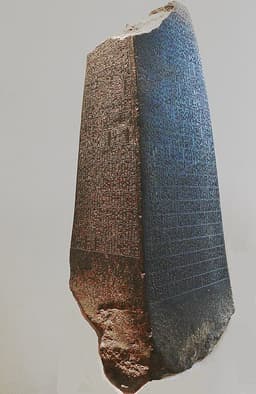
Manishtushu
Emperor · Ancient
40.9Total

Napoleon Bonaparte
General · Modern
70.9Total
Basic Information
Born
-2269
1769
Died
-2255
1821
Era
Ancient
Modern
Nationality
Akkadian Empire
France
Occupation
Emperor
General
Civilization
Middle Eastern
Western
Score Comparison
Military (10%)
38.3
94.0
Political (20%)
36.5
72.0
Influence (20%)
47.1
40.0
Legacy (20%)
36.7
80.0
Leadership (15%)
45.0
78.0
Strategy (15%)
38.6
90.0
TOTAL
40.9
70.9
Manishtushu — Complete Timeline
2269 BC
Trade Expedition to Magan and MeluhhaCultural◆ Major
Manishtushu, king of the Akkadian Empire, sent a trade expedition to Magan (Oman) and Meluhha (Indus Valley). Inscriptions record the acquisition of diorite stone for statues and other goods. This trade network connected Mesopotamia with distant regions, demonstrating the empire's reach.
TradeMaganMeluhha
Impact: globalconstructive
2265 BC
Construction of the Manishtushu ObeliskCultural
Manishtushu erected a large diorite obelisk recording land purchases in the city of Kish. The obelisk lists the fields bought, their prices, and the names of the sellers. It is a key source for understanding land ownership and economic practices in the Akkadian period.
ObeliskLand PurchaseKish
Impact: regional
2260 BC
Campaign against the LullubiWar
Manishtushu led a military campaign against the Lullubi, a mountain people in the Zagros. He defeated them and erected a victory stele. This campaign secured the northeastern frontier of the Akkadian Empire and is recorded in inscriptions found at Susa.
Military CampaignLullubiZagros
Impact: regional
Napoleon Bonaparte — Complete Timeline
1799 AD
Coup of 18 BrumaireOther◆ Major
Napoleon Bonaparte, with support from his brother Lucien and key political figures, overthrew the Directory in a bloodless coup. He established the Consulate with himself as First Consul, effectively becoming the ruler of France. This event ended the French Revolution's most unstable period.
French RevolutionCoupRise to Power
Impact: regional
1804 AD
Promulgation of the Napoleonic CodeOther◆ Major
Napoleon enacted the Civil Code of the French, known as the Napoleonic Code, a comprehensive set of laws that replaced the fragmented feudal legal systems. The code established legal equality, protected property rights, and secularized law. It became the basis for legal systems in many European and world countries.
Legal ReformNapoleonic CodeCivil Law
Impact: globalconstructive
1805 AD
Battle of AusterlitzWar◆ Major
Napoleon's Grande Arm
Napoleonic WarsBattleDecisive Victory
Impact: global
1812 AD
Invasion of RussiaWar◆ Major
Napoleon led the Grande Arm
Napoleonic WarsInvasionDisaster
Impact: globaldestructive
1815 AD
Battle of WaterlooWar◆ Major
Napoleon's French army was defeated by the combined forces of the Duke of Wellington's Anglo-Allied army and Gebhard Leberecht von Bl
Napoleonic WarsBattleFinal Defeat
Impact: globaldestructive
Expert Analysis
manishtushu-vs-napoleon-bonaparte
# The Emperor and the Obelisk
On a June morning in 1815, Napoleon Bonaparte stood on a muddy field near Waterloo, watching his Imperial Guard march into certain death. Thirty kilometers away, in the Belgian village of Genappe, his abandoned carriage would soon be looted, its contents scattered across a road that led nowhere. Four thousand years earlier, another ruler had carved his name into diorite, recording land purchases in the city of Kish, never imagining that his obelisk would outlast his empire. What separates a man who reshaped the world from one who merely left a mark? The answer lies not in the century of their birth, but in the fire that burned within.
Origins
Napoleon Bonaparte was born in 1769 on the island of Corsica, a place that had become French only months before his birth. His family was minor nobility, poor enough to feel the sting of hunger but proud enough to despise the French who now ruled them. He learned French as a second language, speaking it with an Italian accent that would never quite disappear. At nine, he entered a military academy in mainland France, where his classmates mocked his accent and his poverty. The humiliation forged something hard in him—a determination to prove that the outsider could become the master.
Manishtushu, by contrast, was born into power. His father was Sargon of Akkad, the first empire-builder in history, a man who had conquered from the Persian Gulf to the Mediterranean. The son inherited a world already conquered, a bureaucracy already built, and a military already feared. He never had to fight for respect; it came with his blood. His challenge was not to rise, but to hold.
Rise to Power
Napoleon’s ascent was a masterpiece of audacity. In 1795, at twenty-six, he scattered royalist insurgents with a "whiff of grapeshot" in the streets of Paris. Two years later, he led a ragged army across the Alps into Italy, winning battles that seemed impossible against Austrian forces that outnumbered him. Each victory was a gamble, each campaign a calculated risk. He understood that in revolutionary France, merit mattered more than birth—and he had merit to spare.
Manishtushu’s path was different. He became king around 2269 BCE, inheriting an empire that stretched from the Mediterranean to the Persian Gulf. His father Sargon had established the Akkadian dynasty through conquest; Manishtushu’s task was consolidation. He did not storm into history; he stepped into it, taking his place in a line of succession that demanded little more than competence.
Leadership & Governance
Napoleon ruled France with a combination of brilliance and brutality. He reformed the legal system through the Napoleonic Code, establishing principles of equality before the law that would influence legal systems across Europe and beyond. He centralized administration, created the Bank of France, and built a network of roads and schools. But he also suppressed dissent, censored newspapers, and crowned himself emperor in 1804, turning a revolution into a monarchy. His military genius was undeniable—he won sixty of seventy battles—but his political wisdom was compromised by ambition.
Manishtushu governed differently. He built no grand legal code, reformed no bureaucracy. Instead, he engaged in trade, sending expeditions as far as Magan (modern Oman) and Meluhha (the Indus Valley). The Manishtushu Obelisk, erected around 2265 BCE, records land purchases in Kish—not conquests, but transactions. This was a ruler who understood that an empire could be sustained by commerce as much as by swords. His military campaign against the Lullubi, a mountain people in the Zagros, was a minor affair, a border skirmish rather than a war of conquest.
Triumph & Tragedy
Napoleon’s greatest triumph was the Battle of Austerlitz in 1805, where he crushed the combined armies of Russia and Austria, destroying a coalition that had seemed invincible. His greatest tragedy was the invasion of Russia in 1812, where he lost half a million men to the Russian winter and his own hubris. He was exiled to Elba in 1814, escaped in 1815, and was defeated at Waterloo—a final gamble that failed.
Manishtushu’s triumphs were quieter. He maintained an empire that his father had built, kept trade routes open, and left monuments that would survive for millennia. His tragedy was that we know so little about him. His obelisk stands, but his story is fragmentary, pieced together from inscriptions and archaeological guesses. He ruled for fourteen years, then vanished from the historical record, remembered only as Sargon’s son.
Character & Destiny
Napoleon was driven by an insatiable hunger for glory. "Impossible is a word to be found only in the dictionary of fools," he once said. He believed that history would judge him by his achievements, and he was right—but the judgment is mixed. His personality, forged in the fires of childhood humiliation, pushed him to conquer, but also to overreach. He could not stop, because stopping meant returning to the obscurity he had escaped.
Manishtushu seems to have been content with order. He did not attempt to surpass his father’s conquests; he did not try to conquer Egypt or Anatolia. He built, traded, and maintained. His personality, shaped by privilege rather than struggle, produced stability rather than glory. He was a steward, not a shaper.
Legacy
Napoleon’s legacy is everywhere. The Napoleonic Code influences legal systems from Louisiana to Lebanon. His military tactics are still studied at war colleges. His name is synonymous with ambition, genius, and disaster. He is remembered as a force of nature, a man who changed the course of history.
Manishtushu’s legacy is the obelisk that bears his name, a black diorite monument that sits in the Louvre, its inscriptions still legible after four thousand years. It records land purchases, and it reminds us that some rulers leave their mark not through conquest, but through commerce. He is remembered, but barely—a footnote in the history of an empire that collapsed within a century of his death.
Conclusion
The difference between Napoleon and Manishtushu is not a matter of talent, but of circumstance and hunger. Napoleon was born poor and ambitious; he had everything to prove and nothing to lose. Manishtushu was born rich and secure; he had everything to preserve and nothing to gain. One reshaped the world; the other maintained it. Both left their mark, but only one left a scar. In the end, history remembers the fire more than the foundation.
Rankings
🥇
Napoleon BonaparteLeader
Mil: 94.0Pol: 72.0Inf: 40.0
70.9
🥈
Manishtushu
Mil: 38.3Pol: 36.5Inf: 47.1
40.9
+30.0 behind
How This Comparison Works
Algorithm
Each figure is scored on 6 dimensions (0—100 scale) based on structured historical data: Military (10%), Political (20%), Influence (20%), Legacy (20%), Leadership (15%), Strategy (15%). The weighted total produces the final ranking.
Data Sources
Scores are computed from structured sub-indicators in the database. Scale factors adjust for era (Ancient ×0.85, Modern ×1.0) and civilization size (Eastern ×1.05, Other ×0.80) to account for differences in population and military scale.
Maximum 3 Figures
Comparisons are limited to 2—3 figures to ensure readability and statistical meaningfulness.
Error Margins
±5 points per dimension — Sub-scores are derived from historical records with inherent uncertainty. Two figures within 5 points on a dimension should be considered roughly equivalent in that area.
Total Score Accuracy
±3 points overall — The weighted combination of 6 dimensions produces a total score with approximately ±3 points of uncertainty. Differences of less than 3 points are not statistically significant— the figures are effectively tied.
Known Limitations
- Historical records are incomplete and uneven across civilizations
- Figures from oral-tradition societies may be underrepresented
- Occupation labels can misclassify multi-role figures
- Scores measure capability and impact, not moral character
- Quantitative scoring is a comparison tool, not absolute truth
Capability Radar
Military (10%) — Battles & Warfare
Battles
25
95
Win Rate
30
90
Expansion
35
95
Political (20%) — Governance & Reform
Reform
20
95
Diplomacy
35
80
Economy
40
85
Influence (20%) — Cultural & Global Reach
Cultural
20
85
Global
20
90
Legacy (20%) — Historical Impact
Historical
25
95
Longevity
15
90
Leadership (15%) — Power & Stability
Tenure
30
85
Stability
25
70
Strategy (15%) — Tactics & Innovation
Strategy
25
95
Tactics
20
98
Reform
15
92
Similar Comparisons
Comments & Discussion
QUIRINUS_THE_SKEPTIC6/17/2026
Let's not pretend these two belong in the same conversation. Napoleon changed the legal and political fabric of Europe—his Civil Code still shapes half the world. Manishtushu left us a four-foot pillar of rock recording some real estate deals. That's it. A land registry, not a legacy. One man codified rights; the other haggled over barley fields. Comparing them is like putting the Rosetta Stone next to a grocery list.
玉玺守护者6/17/2026
拿皇一个炮兵少尉出身,二十岁打下半壁江山。曼尼什图苏呢?爹是萨尔贡,帝国是现成的,他不过是在遗产上刻了个名字。拿破仑的滑铁卢至少是史诗级的悲剧,曼尼什图苏的失败连个像样的记录都没有——连怎么死的都不清楚!一个活成了神话,一个活成了脚注。别拿世袭的跟白手起家的比,侮辱人了。