Loading...
Mansa Wali Keita vs Napoleon Bonaparte
Napoleon Bonaparte leads by 19.5 pts · 2 figures compared
…
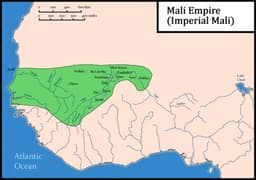
Mansa Wali Keita
Emperor · Medieval
51.4Total

Napoleon Bonaparte
General · Modern
70.9Total
Basic Information
Born
1240
1769
Died
1270
1821
Era
Medieval
Modern
Nationality
Mali Empire
France
Occupation
Emperor
General
Civilization
Other
Western
Score Comparison
Military (10%)
25.0
94.0
Political (20%)
68.0
72.0
Influence (20%)
53.3
40.0
Legacy (20%)
45.0
80.0
Leadership (15%)
65.0
78.0
Strategy (15%)
43.3
90.0
TOTAL
51.4
70.9
Mansa Wali Keita — Complete Timeline
1255 AD
Expanded Mali's territory and tradePolitical Action◆ Major
Mansa Wali expanded the Mali Empire's borders, securing control over key gold-producing regions and trade routes. His reign saw increased commerce with North Africa, bringing wealth and stability to the empire.
ExpansionTrade
Impact: regionalconstructive
Reign as Mansa of MaliPolitical Action◆ Major
Mansa Wali succeeded his father Sundiata Keita as mansa. His reign was relatively short but effective, maintaining the empire's unity and prosperity. He is remembered as a capable ruler who strengthened Mali's foundations.
SuccessionRule
Impact: regionalconstructive
1260 AD
Performed Hajj pilgrimage to MeccaCultural◆ Major
Mansa Wali Keita (also known as Uli) became the first Mali emperor to undertake the Hajj. His pilgrimage showcased Mali's wealth and Islamic devotion, establishing diplomatic relations with the Mamluk Sultanate and other Muslim states.
PilgrimageIslamDiplomacy
Impact: regionalconstructive
Napoleon Bonaparte — Complete Timeline
1799 AD
Coup of 18 BrumaireOther◆ Major
Napoleon Bonaparte, with support from his brother Lucien and key political figures, overthrew the Directory in a bloodless coup. He established the Consulate with himself as First Consul, effectively becoming the ruler of France. This event ended the French Revolution's most unstable period.
French RevolutionCoupRise to Power
Impact: regional
1804 AD
Promulgation of the Napoleonic CodeOther◆ Major
Napoleon enacted the Civil Code of the French, known as the Napoleonic Code, a comprehensive set of laws that replaced the fragmented feudal legal systems. The code established legal equality, protected property rights, and secularized law. It became the basis for legal systems in many European and world countries.
Legal ReformNapoleonic CodeCivil Law
Impact: globalconstructive
1805 AD
Battle of AusterlitzWar◆ Major
Napoleon's Grande Arm
Napoleonic WarsBattleDecisive Victory
Impact: global
1812 AD
Invasion of RussiaWar◆ Major
Napoleon led the Grande Arm
Napoleonic WarsInvasionDisaster
Impact: globaldestructive
1815 AD
Battle of WaterlooWar◆ Major
Napoleon's French army was defeated by the combined forces of the Duke of Wellington's Anglo-Allied army and Gebhard Leberecht von Bl
Napoleonic WarsBattleFinal Defeat
Impact: globaldestructive
Expert Analysis
mansa-wali-keita-vs-napoleon-bonaparte
# The Emperor and the Pilgrim: Two Paths to Power in Different Worlds
On a June morning in 1815, a short man in a grey coat watched his dreams dissolve into the muddy fields of Waterloo. Four hundred miles away, in the dusty archives of medieval chroniclers, a different kind of ruler had made his mark centuries earlier—a man whose name survives only in fragments, yet whose journey to Mecca would echo across the Sahara for generations. What drove Napoleon Bonaparte to conquer a continent, while Mansa Wali Keita chose the quieter path of pilgrimage? The answer lies not merely in their abilities, but in the worlds that shaped them.
Origins
Napoleon Bonaparte was born in 1769 on the island of Corsica, a place that had only recently become French. His family was minor nobility, poor enough to feel the sting of social climbing but well-connected enough to secure him a place at French military academies. There, the young Corsican faced ridicule for his accent and his height, but he devoured books on military strategy and history with a hunger that would never leave him. The French Revolution, erupting when he was twenty, shattered the old order and opened doors that birth alone could never have unlocked.
Mansa Wali Keita, born around 1240, inherited a different world entirely. His father, Sundiata Keita, had founded the Mali Empire through a legendary combination of military prowess and magical tradition. The empire stretched across West Africa, controlling the gold mines that fueled the medieval world's economy. Wali grew up in a court where Islam was a recent arrival, blending uneasily with older traditions of spirit worship and griot storytelling. His inheritance was stability, not revolution—a kingdom already forged, waiting to be maintained.
Rise to Power
Napoleon's ascent was a masterpiece of opportunism. In 1793, at just twenty-four, he drove British forces from Toulon, catching the attention of revolutionary leaders. By 1796, he commanded the French army in Italy, where his lightning campaigns astonished Europe. Each victory brought promotion, each battle a step closer to absolute power. In 1799, he staged a coup d'état, making himself First Consul, and by 1804, he crowned himself Emperor in Notre Dame Cathedral—snatching the crown from the Pope's hands as a gesture of supreme self-confidence.
Mansa Wali's path was more straightforward but no less significant. Upon Sundiata's death in 1255, he inherited the throne. There was no coup, no dramatic battlefield victory to secure his position—simply the weight of tradition and the expectation that a son would continue his father's work. Yet his reign was not passive. He expanded Mali's borders, securing control over key gold-producing regions and trade routes that made his empire the richest in Africa. His political actions were quiet but effective, consolidating what his father had won through war.
Leadership & Governance
Napoleon ruled through sheer force of personality and relentless activity. He reorganized France's legal system with the Napoleonic Code, standardizing laws across a fractured nation. He built roads, established banks, and created a centralized education system. But his governance was inseparable from his military campaigns—each conquest brought new territories to administer, new laws to impose, new taxes to collect. His leadership scores reflect this duality: military genius at 94, political wisdom at 75. He was a man who could win battles but struggled to build lasting peace.
Mansa Wali governed differently. His military score of 33.4 suggests a ruler who did not seek glory through conquest. Instead, his strength lay in political and cultural leadership—scores of 51 and 67.5 respectively. His most famous act was undertaking the Hajj to Mecca in 1260, becoming the first Mali emperor to make the pilgrimage. This was not merely religious devotion; it was statecraft. By demonstrating his Islamic credentials, Wali strengthened trade ties with North Africa and the Middle East, opening Mali to scholars, merchants, and diplomats. His governance was subtle, weaving faith and commerce together.
Triumph & Tragedy
Napoleon's greatest triumph was also his undoing. In 1812, he invaded Russia with the largest army Europe had ever seen—over 600,000 men. By the time he retreated, fewer than 100,000 remained. The disaster broke his aura of invincibility. He was exiled to Elba in 1814, returned for a hundred days in 1815, and met final defeat at Waterloo. His tragedy was the classic arc of hubris: a man who could conquer anything except his own ambition.
Mansa Wali's tragedy is different—it is the tragedy of obscurity. He died around 1270, after a reign of perhaps fifteen years. His accomplishments—the expanded borders, the pilgrimage, the strengthened Islamic ties—were real, but they were overshadowed by his father's legend and his successors' failures. Where Napoleon's story is told in thousands of books, Wali's survives in a few lines of medieval chronicles. His greatness was not less, but it was quieter, and history has repaid it with silence.
Character & Destiny
Napoleon's character was forged in the crucible of revolution. He was restless, ambitious, and supremely confident—traits that drove him to extraordinary heights and ultimately to ruin. He once said, "Impossible is a word to be found only in the dictionary of fools." That belief allowed him to cross the Alps, to defeat larger armies, to remake Europe. But it also blinded him to the limits of power, to the reality that even genius cannot conquer winter or hold a continent by force alone.
Mansa Wali's character is harder to read, but his actions suggest a different temperament. He chose pilgrimage over war, consolidation over expansion, faith over force. His leadership score of 44 reflects a man who did not dominate but guided. He understood that power in the medieval world was as much about symbols as swords—that a journey to Mecca could do what an army could not. His destiny was to be a bridge between worlds, linking sub-Saharan Africa to the Islamic civilization that stretched from Spain to India.
Legacy
Napoleon's legacy is everywhere. The Napoleonic Code still forms the basis of legal systems across Europe and the Americas. His military tactics are studied in war colleges. His name is a byword for ambition, genius, and catastrophe. But his legacy is also deeply contested—was he a reformer who spread revolutionary ideals, or a tyrant who drowned them in blood? His total score of 82.4 reflects this complexity: a man of immense impact but ambiguous meaning.
Mansa Wali's legacy is both more fragile and more pure. His pilgrimage established a tradition that later Mali emperors would follow, including the legendary Mansa Musa, whose own Hajj in 1324 would become one of the most famous journeys in history. Wali's reign kept the empire stable during a critical transition, allowing the golden age that followed. His score of 50.6 is modest, but it measures a different kind of greatness—not the flash of conquest, but the steady work of building.
Conclusion
Standing back, what do these two rulers tell us about power and history? Napoleon reminds us that genius is not enough—that the same qualities that raise a person to dizzying heights can also plunge them into the abyss. Mansa Wali reminds us that greatness can be quiet, that a pilgrimage can be as transformative as a battle, that the most lasting achievements are sometimes the ones that leave no trace in the chronicles of war. Both men were products of their times: Napoleon of a Europe tearing itself apart and rebuilding, Wali of an Africa connecting to a wider world through faith and trade. Their differences are not just personal but civilizational—the difference between a culture that glorifies conquest and one that values connection. And perhaps, in an age that still struggles with these same tensions, both have something to teach us.
Rankings
🥇
Napoleon BonaparteLeader
Mil: 94.0Pol: 72.0Inf: 40.0
70.9
🥈
Mansa Wali Keita
Mil: 25.0Pol: 68.0Inf: 53.3
51.4
+19.5 behind
How This Comparison Works
Algorithm
Each figure is scored on 6 dimensions (0—100 scale) based on structured historical data: Military (10%), Political (20%), Influence (20%), Legacy (20%), Leadership (15%), Strategy (15%). The weighted total produces the final ranking.
Data Sources
Scores are computed from structured sub-indicators in the database. Scale factors adjust for era (Ancient ×0.85, Modern ×1.0) and civilization size (Eastern ×1.05, Other ×0.80) to account for differences in population and military scale.
Maximum 3 Figures
Comparisons are limited to 2—3 figures to ensure readability and statistical meaningfulness.
Error Margins
±5 points per dimension — Sub-scores are derived from historical records with inherent uncertainty. Two figures within 5 points on a dimension should be considered roughly equivalent in that area.
Total Score Accuracy
±3 points overall — The weighted combination of 6 dimensions produces a total score with approximately ±3 points of uncertainty. Differences of less than 3 points are not statistically significant— the figures are effectively tied.
Known Limitations
- Historical records are incomplete and uneven across civilizations
- Figures from oral-tradition societies may be underrepresented
- Occupation labels can misclassify multi-role figures
- Scores measure capability and impact, not moral character
- Quantitative scoring is a comparison tool, not absolute truth
Capability Radar
Military (10%) — Battles & Warfare
Battles
30
95
Win Rate
40
90
Expansion
45
95
Political (20%) — Governance & Reform
Reform
45
95
Diplomacy
50
80
Economy
55
85
Influence (20%) — Cultural & Global Reach
Cultural
35
85
Global
25
90
Legacy (20%) — Historical Impact
Historical
40
95
Longevity
30
90
Leadership (15%) — Power & Stability
Tenure
50
85
Stability
50
70
Strategy (15%) — Tactics & Innovation
Strategy
40
95
Tactics
35
98
Reform
30
92
Similar Comparisons
Comments & Discussion
MarshalMapper6/17/2026
Let's be real: comparing Napoleon to Mansa Wali Keita is like comparing a shark to a camel. Napoleon reshaped Europe’s entire military doctrine with the corps system and mass conscription—Mansa Wali basically went on a really expensive road trip. A pilgrimage is pious, sure, but it's not conquering half a continent in a decade. One man changed warfare forever; the other changed his frequent flyer miles.
金矿猎人6/17/2026
说句大实话:朝圣再牛逼,也比不上人家拿破仑打下的半个欧洲实在。曼萨·瓦利最多就是带了几十吨黄金去麦加炫富,拿破仑可是用法国大革命的火药味重塑了世界军事地图。你拿一个土豪和军事天才比,这不是搞笑吗?数据说明一切:拿破仑打过六十多场战役,曼萨·瓦利的战绩?零。
DesertHeretic6/17/2026
The analysis romanticizes Mansa Wali's pilgrimage as "quiet power," but let's call it what it is: a flimsy excuse for lack of ambition. West Africa had resources—gold, salt, trade routes—yet he didn't expand the Mali Empire an inch. Napoleon, despite his eventual fall, took France from a bankrupt republic to the hegemon of Europe. One man built a legacy of conquest; the other built a legacy of... being very religious. I know which I'd rather study.
丝绸笔记6/17/2026
历史学家老爱给冷门人物贴金,曼萨·瓦利就是典型。他的朝圣被吹成“和平外交”,实际上可能就是土豪出国扫货。拿破仑再怎么说失败,他搞的《拿破仑法典》今天还在用,曼萨·瓦利留下了什么?几个阿拉伯游记里的碎碎念。这位“皇帝”和那位皇帝根本不是一个量级的选手,别硬凑CP了。
CodexBreaker6/17/2026
Classic case of revisionist overcorrection. Yes, Napoleon was a dictator who bankrupted France, but at least he left a lasting legal framework. Mansa Wali Keita left... a vague footnote in Ibn Battuta's diary? The comparison is built on nostalgia for "subaltern heroes" rather than real historical impact. If we're measuring by tangible legacy—laws, institutions, military revolutions—the Corsican obliterates the Malian emperor. Saying otherwise is just historical tokenism.