Loading...
Manuel II Palaiologos vs Napoleon Bonaparte
Napoleon Bonaparte leads by 30.9 pts · 2 figures compared
…
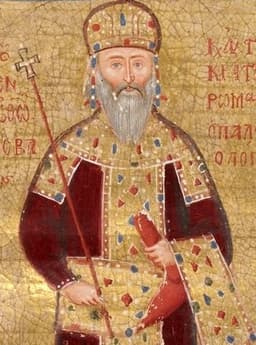
Manuel II Palaiologos
Emperor · Medieval
40.0Total

Napoleon Bonaparte
General · Modern
70.9Total
Basic Information
Born
1350
1769
Died
1425
1821
Era
Medieval
Modern
Nationality
Byzantine Empire
France
Occupation
Emperor
General
Civilization
Western
Western
Score Comparison
Military (10%)
10.2
94.0
Political (20%)
33.6
72.0
Influence (20%)
53.3
40.0
Legacy (20%)
43.3
80.0
Leadership (15%)
45.0
78.0
Strategy (15%)
30.3
90.0
TOTAL
40.0
70.9
Manuel II Palaiologos — Complete Timeline
1394 AD
Defense of Constantinople during the Ottoman siegeWar◆ Major
Manuel II oversaw the defense of Constantinople during a prolonged Ottoman blockade by Sultan Bayezid I. The city held out until the Ottoman defeat at the Battle of Ankara in 1402 temporarily relieved pressure.
SiegeOttoman WarsByzantine Empire
Impact: regional
1399 AD
Travel to Western Europe to seek aid against the Ottoman EmpirePolitical Action◆ Major
Manuel II Palaiologos traveled to the courts of Western Europe, including England, France, and the Holy Roman Empire, to request military assistance against the Ottoman siege of Constantinople. He met with King Henry IV of England and King Charles VI of France, but secured no substantial military aid.
DiplomacyOttoman WarsByzantine Empire
Impact: regional
1400 AD
Writing of religious dialogues and theological worksCultural
Manuel II composed several theological works, including dialogues on Christianity and Islam, and letters. His writings reflect his intellectual engagement with religious issues during the decline of the Byzantine Empire.
TheologyLiteratureByzantine Culture
Napoleon Bonaparte — Complete Timeline
1799 AD
Coup of 18 BrumaireOther◆ Major
Napoleon Bonaparte, with support from his brother Lucien and key political figures, overthrew the Directory in a bloodless coup. He established the Consulate with himself as First Consul, effectively becoming the ruler of France. This event ended the French Revolution's most unstable period.
French RevolutionCoupRise to Power
Impact: regional
1804 AD
Promulgation of the Napoleonic CodeOther◆ Major
Napoleon enacted the Civil Code of the French, known as the Napoleonic Code, a comprehensive set of laws that replaced the fragmented feudal legal systems. The code established legal equality, protected property rights, and secularized law. It became the basis for legal systems in many European and world countries.
Legal ReformNapoleonic CodeCivil Law
Impact: globalconstructive
1805 AD
Battle of AusterlitzWar◆ Major
Napoleon's Grande Arm
Napoleonic WarsBattleDecisive Victory
Impact: global
1812 AD
Invasion of RussiaWar◆ Major
Napoleon led the Grande Arm
Napoleonic WarsInvasionDisaster
Impact: globaldestructive
1815 AD
Battle of WaterlooWar◆ Major
Napoleon's French army was defeated by the combined forces of the Duke of Wellington's Anglo-Allied army and Gebhard Leberecht von Bl
Napoleonic WarsBattleFinal Defeat
Impact: globaldestructive
Expert Analysis
manuel-ii-palaiologos-vs-napoleon-bonaparte
# The Emperor Who Fell and the Emperor Who Endured
In the winter of 1399, a Byzantine emperor knelt before the King of England, begging for soldiers he would never receive. Four hundred years later, in the spring of 1815, a French emperor returned from exile and raised an army that nearly conquered Europe again. Manuel II Palaiologos and Napoleon Bonaparte never met, never shared a language, never fought on the same battlefield. Yet their lives pose a question that haunts history: Why do some leaders rise like meteors while others endure like candles in a storm?
Origins
Napoleon Bonaparte was born in 1769 on the island of Corsica, a place that had just become French by treaty. His family was minor nobility, poor enough to need scholarships, proud enough to hate their new masters. He spoke Italian before French, and his accent would always mark him as an outsider. But the French Revolution, which began when he was twenty, shattered the old rules of advancement. In the chaos, talent mattered more than birth, and Napoleon had talent to burn.
Manuel II Palaiologos was born in 1350 into a world that was already dying. The Byzantine Empire, once the Roman Empire's eastern heir, had shrunk to little more than Constantinople itself, plus a few scattered territories. His father, John V, had been captured, ransomed, and humiliated by the Ottomans. Manuel grew up watching his empire bleed territory, treasure, and hope. He learned Greek, Latin, and theology, but he also learned that the Christian kings of the West would rather fight each other than save Byzantium.
Their eras shaped them like rivers shape stone. Napoleon came of age when everything was possible. Manuel came of age when almost nothing was.
Rise to Power
Napoleon's ascent was a cannonball shot. In 1793, at twenty-four, he drove the British out of Toulon and became a brigadier general. In 1796, he took command of a starving, unpaid army in Italy and turned it into a weapon that destroyed Austria's power in two campaigns. By 1799, he was First Consul of France. By 1804, Emperor. Each step was earned by victory, and each victory made the next step possible.
Manuel's rise was a slow climb through a collapsing structure. He became co-emperor with his father in 1373, then sole emperor in 1391. He spent his early reign managing a crisis that never ended. In 1394, Sultan Bayezid I launched a prolonged blockade of Constantinople. Manuel oversaw the defense—a war of patience more than glory. The city held, but it held by a thread. There would be no lightning campaigns, no triumphal entries into captured capitals. Survival was his victory.
Leadership & Governance
Compare their ruling styles, and you see two philosophies of power. Napoleon governed through the Napoleonic Code—a legal system that enshrined equality before the law, protected property, and centralized the state. He built schools, roads, and banks. He made peace with the Catholic Church while keeping it under state control. He was a modernizer who believed that order and efficiency could remake society. His military genius—scored at 94.0—was matched by a political skill scored at 75.0. He could win battles, but he struggled to secure the peace that followed.
Manuel governed through theology and diplomacy. He wrote religious dialogues defending Christianity against Islam, composed letters that sought to unite the Eastern and Western churches, and traveled across Europe from 1399 to 1403 to beg for military aid. His leadership score of 74.6 reflects a ruler who held his empire together through persuasion rather than force. His military score of 43.3 tells a different story: he was no general. He could not conquer, only negotiate. And negotiation, when you have nothing to offer, is a weak weapon.
Triumph & Tragedy
Napoleon's greatest moment was Austerlitz in 1805, where he destroyed the combined armies of Austria and Russia. His worst was Waterloo in 1815, where he lost everything in a single day. Between these two battles, he conquered most of Europe, installed his brothers on thrones, and then lost it all through overreach. The invasion of Russia in 1812 killed half a million men. The exile to Elba, the Hundred Days, the final exile to Saint Helena—his life became a tragedy of ambition without limit.
Manuel's greatest moment was the defense of Constantinople in 1394, when he held the city against Bayezid's blockade. His worst came earlier, in 1376, when he was imprisoned by his own brother Andronikos IV for three years. His tragedy was not a single battle but a slow decline. He saw the Ottoman Empire grow stronger while his own empire grew weaker. He died in 1425, a monk in a monastery, knowing that his son would likely be the last emperor. Twenty-eight years later, Constantinople fell.
Character & Destiny
Napoleon was restless, brilliant, and incapable of stopping. He once said, "Power is my mistress." He believed that will could overcome any obstacle, and for a while, it did. But his personality drove him to take risks that destroyed him. He could not share power, could not accept limits, could not learn from defeat. His strategy score of 93.0 was a weapon that turned on its owner.
Manuel was patient, learned, and realistic. He wrote that "a wise man adapts himself to circumstances, as water shapes itself to the vessel containing it." He accepted that he could not defeat the Ottomans, only delay them. His personality drove him to preserve rather than expand, to endure rather than conquer. He held his empire together for thirty-four years, but holding together was the best he could do.
Legacy
Napoleon's legacy is everywhere. The Napoleonic Code shapes legal systems across Europe and the Americas. His military tactics are still studied. His name is synonymous with ambition, genius, and catastrophe. His legacy score of 78.0 and influence score of 82.0 reflect a man who changed the world, even if he could not keep his empire.
Manuel's legacy is quieter. His theological dialogues are read by scholars. His desperate journey across Europe is remembered as a symbol of Byzantium's final years. His legacy score of 57.3 reflects a ruler who delayed the end but could not prevent it. Yet there is a dignity in his endurance that Napoleon never achieved. Napoleon died alone on an island, blaming others. Manuel died in a monastery, having done everything he could.
Conclusion
We remember Napoleon because he soared. We remember Manuel because he held. One changed the world through conquest, the other through resistance. One built an empire that collapsed under its own weight. One preserved a city that fell only after he was gone. Both were failures in the end—Napoleon lost his throne, Manuel lost his empire. But failure is not the same as meaning. Napoleon shows us what happens when ambition has no limits. Manuel shows us what happens when courage has no hope. Both are worth remembering, but for very different reasons.
Rankings
🥇
Napoleon BonaparteLeader
Mil: 94.0Pol: 72.0Inf: 40.0
70.9
🥈
Manuel II Palaiologos
Mil: 10.2Pol: 33.6Inf: 53.3
40.0
+30.9 behind
How This Comparison Works
Algorithm
Each figure is scored on 6 dimensions (0—100 scale) based on structured historical data: Military (10%), Political (20%), Influence (20%), Legacy (20%), Leadership (15%), Strategy (15%). The weighted total produces the final ranking.
Data Sources
Scores are computed from structured sub-indicators in the database. Scale factors adjust for era (Ancient ×0.85, Modern ×1.0) and civilization size (Eastern ×1.05, Other ×0.80) to account for differences in population and military scale.
Maximum 3 Figures
Comparisons are limited to 2—3 figures to ensure readability and statistical meaningfulness.
Error Margins
±5 points per dimension — Sub-scores are derived from historical records with inherent uncertainty. Two figures within 5 points on a dimension should be considered roughly equivalent in that area.
Total Score Accuracy
±3 points overall — The weighted combination of 6 dimensions produces a total score with approximately ±3 points of uncertainty. Differences of less than 3 points are not statistically significant— the figures are effectively tied.
Known Limitations
- Historical records are incomplete and uneven across civilizations
- Figures from oral-tradition societies may be underrepresented
- Occupation labels can misclassify multi-role figures
- Scores measure capability and impact, not moral character
- Quantitative scoring is a comparison tool, not absolute truth
Capability Radar
Military (10%) — Battles & Warfare
Battles
10
95
Win Rate
10
90
Expansion
5
95
Political (20%) — Governance & Reform
Reform
15
95
Diplomacy
60
80
Economy
10
85
Influence (20%) — Cultural & Global Reach
Cultural
30
85
Global
20
90
Legacy (20%) — Historical Impact
Historical
35
95
Longevity
25
90
Leadership (15%) — Power & Stability
Tenure
40
85
Stability
15
70
Strategy (15%) — Tactics & Innovation
Strategy
20
95
Tactics
15
98
Reform
5
92
Similar Comparisons
Comments & Discussion
数据控御史6/17/2026
从数据看,拿破仑的军事胜利基于规模:他征召了约250万人,而曼努埃尔二世连维持1万守军都困难。拿破仑在奥斯特里茨以6.8万对9万俄奥联军,战术完胜,但资源量级完全不同。曼努埃尔二世的“乞讨外交”本质是零GDP帝国的挣扎。别拿烛火比流星,这不是勇气问题,是后勤的降维打击。
Alaric's Quill6/17/2026
As a classics scholar, I'd argue Manuel II deserves credit for cultural resilience. While Napoleon rewrote laws and redrew maps, Manuel wrote theological treatises and preserved ancient texts at a time when his capital was crumbling. His correspondence with the Abbasid Caliph shows intellectual ambition beyond survival. Napoleon's legacy is flashes of genius in bronze and blood; Manuel's is a quiet defiance of extinction. One shaped history through conquest, the other through conversation.
历史的剥洋葱6/17/2026
修正主义视角:别把拿破仑神化成天才,他的崛起靠的是大革命后的权力真空和社会流动性,不是个人全能的魔法。曼努埃尔二世面对的是奥斯曼这个当时的世界级帝国,而拿破仑的对手多是僵化的旧君主制国家。曼努埃尔二世在1399年向英格兰乞援时,英法还在百年战争中内耗,欧洲根本无力东顾。他不是软弱,是困于结构性无人救援的困局。
Candle in the Storm6/17/2026
History buff here—this comparison actually reveals a shared truth: both men fought impossible odds with what they had. Napoleon at Waterloo faced a coalition of 200,000; Manuel held Constantinople against Bayezid's first blockade in 1394-1402. Napoleon lost and was exiled; Manuel survived because of Timur's invasion, pure luck. The difference isn't character but the clock—Napoleon's hour ran out in a sweep of battles, Manuel's in decades of erosion. Both were prisoners of their era's momentum.
Chronicler59266/17/2026
As a military historian, I see this as a mismatch of context over character. Napoleon commanded armies of hundreds of thousands with logistics, artillery, and conscription—tools of total war. Manuel II had maybe 5,000 men at best, holding a city that was economically and strategically doomed. Napoleon’s rise was possible only because Revolutionary France gave him manpower and resources; Manuel’s endurance was forced by desperation. Calling this a 'comparison' ignores that one had a nation behind