Loading...
Maravarman Kulasekara vs Napoleon Bonaparte
Napoleon Bonaparte leads by 10.9 pts · 2 figures compared
…
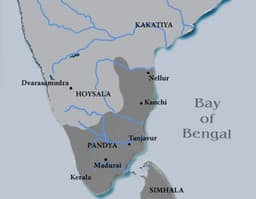
Maravarman Kulasekara
Emperor · Medieval
60.0Total

Napoleon Bonaparte
General · Modern
70.9Total
Basic Information
Born
1268
1769
Died
1310
1821
Era
Medieval
Modern
Nationality
India
France
Occupation
Emperor
General
Civilization
Indian
Western
Score Comparison
Military (10%)
74.7
94.0
Political (20%)
53.8
72.0
Influence (20%)
60.0
40.0
Legacy (20%)
54.0
80.0
Leadership (15%)
68.0
78.0
Strategy (15%)
58.0
90.0
TOTAL
60.0
70.9
Maravarman Kulasekara — Complete Timeline
1268 AD
Accession as Pandya emperorPolitical Action◆ Major
Maravarman Kulasekara succeeded Jatavarman Sundara Pandya as the Pandya emperor. He inherited a powerful empire but faced challenges from the Hoysalas and the Delhi Sultanate.
PandyaSuccessionEmpire
Impact: regional
1275 AD
War with the Hoysala kingdomWar
Maravarman Kulasekara fought a war against the Hoysala king Narasimha III. The conflict was inconclusive, but it drained Pandya resources and weakened the empire.
PandyaHoysalaWar
Impact: regional
1310 AD
Invasion by Malik KafurWar
Malik Kafur, a general of the Delhi Sultanate, invaded the Pandya kingdom. Maravarman Kulasekara was killed in the battle, and the Pandya capital Madurai was sacked, ending the Pandya empire.
Delhi SultanateInvasionDeath
Impact: regionaltragic
Napoleon Bonaparte — Complete Timeline
1799 AD
Coup of 18 BrumaireOther◆ Major
Napoleon Bonaparte, with support from his brother Lucien and key political figures, overthrew the Directory in a bloodless coup. He established the Consulate with himself as First Consul, effectively becoming the ruler of France. This event ended the French Revolution's most unstable period.
French RevolutionCoupRise to Power
Impact: regional
1804 AD
Promulgation of the Napoleonic CodeOther◆ Major
Napoleon enacted the Civil Code of the French, known as the Napoleonic Code, a comprehensive set of laws that replaced the fragmented feudal legal systems. The code established legal equality, protected property rights, and secularized law. It became the basis for legal systems in many European and world countries.
Legal ReformNapoleonic CodeCivil Law
Impact: globalconstructive
1805 AD
Battle of AusterlitzWar◆ Major
Napoleon's Grande Arm
Napoleonic WarsBattleDecisive Victory
Impact: global
1812 AD
Invasion of RussiaWar◆ Major
Napoleon led the Grande Arm
Napoleonic WarsInvasionDisaster
Impact: globaldestructive
1815 AD
Battle of WaterlooWar◆ Major
Napoleon's French army was defeated by the combined forces of the Duke of Wellington's Anglo-Allied army and Gebhard Leberecht von Bl
Napoleonic WarsBattleFinal Defeat
Impact: globaldestructive
Expert Analysis
maravarman-kulasekara-vs-napoleon-bonaparte
# The Emperor and the King: Two Paths to Glory and Ruin
On a June morning in 1815, Napoleon Bonaparte watched his Imperial Guard march into the cannon fire of Wellington’s squares at Waterloo. Twenty years earlier, he had been an obscure artillery officer from Corsica. Now, he was about to lose everything. Five centuries before, on the other side of the world, Maravarman Kulasekara faced a different kind of end. In 1310, the aging Pandya king stood against the horsemen of Malik Kafur, a slave-general from the Delhi Sultanate who had crossed the Vindhya mountains with fire and sword. Both men died defeated. But why did one become a name that still echoes in every corner of the world, while the other faded into the footnotes of history?
Origins
Napoleon was born in 1769 on Corsica, an island that had just become French. His family was minor nobility, poor enough to feel the sting of hunger but proud enough to resent the French who ruled them. He spoke Italian before he learned French, and his accent would mark him as an outsider his entire life. Yet France’s revolutionary turmoil gave him something priceless: a world in chaos, where talent mattered more than birth.
Maravarman Kulasekara was born into a different world entirely. The Pandya dynasty had ruled the southern tip of India for centuries, their power rooted in the pearl fisheries of the Gulf of Mannar and the trade routes that brought Roman gold and Chinese silk to Madurai. When he ascended to the throne in 1268, succeeding Jatavarman Sundara Pandya, he inherited an empire at its peak. The temples of Madurai gleamed with new towers. The armies were seasoned. The treasury was full. He had every advantage Napoleon lacked—and every disadvantage that came with them.
Rise to Power
Napoleon’s rise was a ladder of fire. He was a captain at 24, a general at 26, and by 30 he had conquered Italy. The Siege of Toulon in 1793 had made his name; the Italian campaign of 1796 made his legend. He understood that in revolutionary France, the old rules were dead. A man who could win battles and manage politics could go anywhere. He cultivated journalists, married Josephine, and positioned himself as the man who could save the Republic from itself.
Maravarman Kulasekara never had to rise. He was born at the top. But maintaining power in medieval India was no easier than seizing it in revolutionary France. In 1275, he fought a war against the Hoysala king Narasimha III. The conflict was inconclusive, but it drained resources that might have been used elsewhere. Unlike Napoleon, who could always find another battle to win, another enemy to crush, Kulasekara faced a problem the Corsican never knew: the limits of geography and logistics in a land where the monsoon dictated the campaigning season.
Leadership & Governance
Napoleon was a military genius in the classical sense. His scores of 94 in military skill and 93 in strategy reflect a mind that could calculate artillery trajectories and army movements with terrifying precision. But he was also a political reformer, scoring 75 in that domain. The Napoleonic Code, which he imposed across Europe, standardized laws, abolished feudal privileges, and established the principle that justice should be equal for all men—at least in theory. He built roads, founded banks, and created a centralized state that France had never known.
Maravarman Kulasekara governed as a traditional Hindu king. His leadership score of 72.4 and political score of 62.2 suggest competence without brilliance. He patronized temples, maintained the caste order, and collected taxes from the fertile Kaveri delta. But he did not reform. He did not innovate. The Pandya kingdom, for all its wealth, remained a medieval state built on personal loyalty and ritual obligation. When the storm came, that foundation would crack.
Triumph & Tragedy
Napoleon’s greatest moment was Austerlitz in 1805, where he destroyed the combined armies of Russia and Austria in a single day. His empire stretched from Madrid to Warsaw. He crowned himself Emperor, placed his brothers on thrones, and seemed to have bent history to his will. His tragedy was the invasion of Russia in 1812—600,000 men marched east, fewer than 40,000 returned. He never recovered.
Maravarman Kulasekara’s triumph was simply holding his empire together for over four decades in a world of constant warfare. His tragedy came in 1310, when Malik Kafur’s army appeared at the gates of Madurai. The Pandya king fought and died. His kingdom was sacked, its treasures carried north to Delhi. The great Pandya dynasty, which had ruled for centuries, collapsed into irrelevance.
Character & Destiny
Napoleon was driven by an insatiable hunger. He once said, “Glory is fleeting, but obscurity is forever.” He could not stop. Every victory demanded another. Every throne required another war. His personality—brilliant, arrogant, restless—shaped his decisions until the end. He chose to fight at Waterloo when he might have negotiated. He chose exile on St. Helena when he might have escaped.
Maravarman Kulasekara was a traditional king in a traditional world. He did not seek to conquer the unknown. He sought to preserve what he had. His personality was shaped by duty, not ambition. He defended his kingdom because that was what kings did. When the enemy came, he fought and died—not as a revolutionary, but as a guardian of an ancient order.
Legacy
Napoleon’s legacy score of 78 reflects a man who reshaped Europe permanently. The Napoleonic Code influences legal systems from France to Louisiana. His military tactics are still studied at West Point and Sandhurst. He is remembered as both tyrant and reformer, conqueror and lawgiver.
Maravarman Kulasekara’s legacy score of 68 is lower, but not because he was a lesser man. It is because he belonged to a civilization that was about to be overwhelmed. The Pandya kingdom fell, and with it, a whole way of life. Today, he is remembered mainly in Tamil Nadu, where his name appears in temple inscriptions and local histories. He did not change the world. He simply held it together for a time.
Conclusion
The difference between these two men is not merely a matter of talent or luck. It is a matter of context. Napoleon was born into a world that was breaking apart, where a man of genius could remake reality. Maravarman Kulasekara was born into a world that was stable, ancient, and doomed. One man’s ambition destroyed him; the other’s duty destroyed him. Both fell. But Napoleon fell from a height that still makes us gasp, while Kulasekara fell from a peak that history has long since forgotten. The question is not who was greater. The question is what we choose to remember—and why.
Rankings
🥇
Napoleon BonaparteLeader
Mil: 94.0Pol: 72.0Inf: 40.0
70.9
🥈
Maravarman Kulasekara
Mil: 74.7Pol: 53.8Inf: 60.0
60.0
+10.9 behind
How This Comparison Works
Algorithm
Each figure is scored on 6 dimensions (0—100 scale) based on structured historical data: Military (10%), Political (20%), Influence (20%), Legacy (20%), Leadership (15%), Strategy (15%). The weighted total produces the final ranking.
Data Sources
Scores are computed from structured sub-indicators in the database. Scale factors adjust for era (Ancient ×0.85, Modern ×1.0) and civilization size (Eastern ×1.05, Other ×0.80) to account for differences in population and military scale.
Maximum 3 Figures
Comparisons are limited to 2—3 figures to ensure readability and statistical meaningfulness.
Error Margins
±5 points per dimension — Sub-scores are derived from historical records with inherent uncertainty. Two figures within 5 points on a dimension should be considered roughly equivalent in that area.
Total Score Accuracy
±3 points overall — The weighted combination of 6 dimensions produces a total score with approximately ±3 points of uncertainty. Differences of less than 3 points are not statistically significant— the figures are effectively tied.
Known Limitations
- Historical records are incomplete and uneven across civilizations
- Figures from oral-tradition societies may be underrepresented
- Occupation labels can misclassify multi-role figures
- Scores measure capability and impact, not moral character
- Quantitative scoring is a comparison tool, not absolute truth
Capability Radar
Military (10%) — Battles & Warfare
Battles
75
95
Win Rate
70
90
Expansion
75
95
Political (20%) — Governance & Reform
Reform
65
95
Diplomacy
60
80
Economy
65
85
Influence (20%) — Cultural & Global Reach
Cultural
60
85
Global
40
90
Legacy (20%) — Historical Impact
Historical
65
95
Longevity
50
90
Leadership (15%) — Power & Stability
Tenure
70
85
Stability
55
70
Strategy (15%) — Tactics & Innovation
Strategy
70
95
Tactics
65
98
Reform
60
92
Similar Comparisons
Comments & Discussion
The Corsican Ghost6/17/2026
Waterloo comparisons get lazy, but here’s the real edge: Napoleon never had to fight a slave-general from halfway across a subcontinent while his own vassals switched sides mid-campaign. Maravarman Kulasekara faced Malik Kafur’s lightning raids in 1310 with a feudal levy that literally melted away because local chieftains preferred Delhi’s plunder promises. Napoleon’s Grande Armée at least died loyal. That tells you everything about institutional versus personal loyalty systems.
数据捕手6/17/2026
说拿破仑“天才”很容易,但请看看数字:他统治欧洲时,控制约7000万人口,军队峰值近60万。而Maravarman Kulasekara统治的潘地亚王国顶多300万人口,能动员的兵力不到3万。这不是同级别的游戏,是重量级对羽量级。把两者对比,本身就含有对印度历史的系统轻视——因为后者的“失败”更多是资源极度不对称的结果,而非能力差距。
Sanskrit Script Sleuth6/17/2026
少谈战略,多谈文本:马拉瓦尔曼·库拉塞卡拉在1310年面对德里苏丹国入侵时,还留下了一座至今屹立的湿婆神庙建筑群——唐加武尔神庙。而拿破仑除了军事官僚和法律体系,几乎没留下任何严肃的宗教或文化纪念碑。历史记住谁,往往取决于他们写了什么、建了什么,而非他们打了多少胜仗。一个在史诗中被吟唱,一个在教材中被背诵——这是文明记忆的选择,不是绝对实力。
History’s Footnote Fisherman6/17/2026
The real difference isn’t talent—it’s the audience. Napoleon was a product of print culture: pamphlets, bulletins, memoirs. Every victory got exaggerated in broadsheets read from Paris to Warsaw. Maravarman’s victories (and he had many against the Hoysalas and Cholas) were recorded in copperplate grants and temple inscriptions in Tamil and Sanskrit, read by maybe a few hundred Brahmins and officials. One man built a myth for the ages because he had the press. The other built a kingdom that crumb
喀拉拉铁狮子6/17/2026
站在印度视角,这个对比根本是殖民史观的陷阱。马拉瓦尔曼·库拉塞卡拉不是“失败者”,他是印度抵抗伊斯兰征服的最后堡垒之一,他战死后不到二十年,整个南印度就落入德里苏丹的阴影。而拿破仑的失败只是法国霸权的终结,欧洲主权国家体系从未崩溃。把两人的败亡并列看似公平,实则忽略了亚洲文明面临的是彻底的文明替代威胁——欧洲的战争,永远是换了主人的同一场游戏。