Loading...
Maravarman Kulasekara vs Philip II Augustus
Philip II Augustus leads by 3.9 pts · 2 figures compared
…
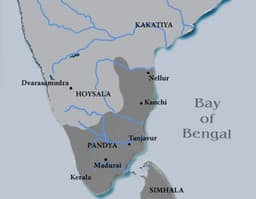
Maravarman Kulasekara
Emperor · Medieval
60.0Total

Philip II Augustus
Emperor · Medieval
63.9Total
Basic Information
Born
1268
1165
Died
1310
1223
Era
Medieval
Medieval
Nationality
India
France
Occupation
Emperor
Emperor
Civilization
Indian
Western
Score Comparison
Military (10%)
74.7
76.0
Political (20%)
53.8
70.0
Influence (20%)
60.0
55.0
Legacy (20%)
54.0
55.0
Leadership (15%)
68.0
78.0
Strategy (15%)
58.0
66.3
TOTAL
60.0
63.9
Maravarman Kulasekara — Complete Timeline
1268 AD
Accession as Pandya emperorPolitical Action◆ Major
Maravarman Kulasekara succeeded Jatavarman Sundara Pandya as the Pandya emperor. He inherited a powerful empire but faced challenges from the Hoysalas and the Delhi Sultanate.
PandyaSuccessionEmpire
Impact: regional
1275 AD
War with the Hoysala kingdomWar
Maravarman Kulasekara fought a war against the Hoysala king Narasimha III. The conflict was inconclusive, but it drained Pandya resources and weakened the empire.
PandyaHoysalaWar
Impact: regional
1310 AD
Invasion by Malik KafurWar
Malik Kafur, a general of the Delhi Sultanate, invaded the Pandya kingdom. Maravarman Kulasekara was killed in the battle, and the Pandya capital Madurai was sacked, ending the Pandya empire.
Delhi SultanateInvasionDeath
Impact: regionaltragic
Philip II Augustus — Complete Timeline
1180 AD
Granting of Charters to TownsReform
Philip II Augustus granted charters to many towns in the royal domain, granting them self-governance and privileges. This policy encouraged urban growth and trade. It also strengthened the monarchy by gaining the support of the bourgeoisie.
ChartersUrbanizationReform
Impact: regionalconstructive
1182 AD
Expulsion of the Jews from FrancePolitical Action◆ Major
Philip II Augustus expelled the Jews from the French royal domain and confiscated their property. The expulsion was motivated by religious and financial reasons. It was a harsh measure that disrupted Jewish communities and set a precedent for later persecutions.
ExpulsionJewsPersecution
Impact: regionaldestructive
1190 AD
Construction of the Louvre FortressCultural
Philip II Augustus ordered the construction of the Louvre Fortress in Paris. The fortress was built to defend the city from English attacks. It later became the Louvre Palace and eventually the Louvre Museum, a symbol of French culture.
ArchitectureParisFortification
constructive
1204 AD
Conquest of NormandyWar◆ Major
Philip II Augustus conquered Normandy from King John of England. He captured the castle of Ch
ConquestNormandyFrance
Impact: regionalconstructive
1214 AD
Battle of BouvinesWar◆ Major
Philip II Augustus defeated a coalition of English, Flemish, and German forces at the Battle of Bouvines. This victory secured French control over the territories of Normandy, Anjou, and Maine. It also strengthened the French monarchy and weakened the Angevin Empire.
BattleFranceAngevin Empire
Impact: regionalconstructive
Expert Analysis
Origins
Maravarman Kulasekara was born around 1260 CE into the Pandya dynasty of southern India. He succeeded his father Jatavarman Sundara Pandya, inheriting a kingdom that controlled the Tamil country and parts of Kerala. The Pandyas were ancient rulers, but internal strife and external threats from the Hoysalas and the Delhi Sultanate loomed. Kulasekara received a traditional Hindu education focused on administration and warfare, but his reign was marked by continuous conflict.
Philip II Augustus was born on 21 August 1165 in Paris, son of King Louis VII and Adèle of Champagne. He was crowned at age 15 in 1180, inheriting a small royal domain around Paris. His father had strengthened the monarchy, but the real power lay with the Plantagenets of England, who controlled Normandy, Anjou, and Aquitaine. Philip was educated in Latin, law, and military strategy, and from his youth displayed a calculating, ambitious nature.
Rise to Power
Kulasekara ascended the Pandya throne around 1300 CE, during a period of declining power. The Hoysala king Narasimha III invaded the Pandya kingdom, and Kulasekara fought an inconclusive war that drained resources. In 1311, Malik Kafur, general of the Delhi Sultanate under Alauddin Khalji, launched a lightning campaign into the Deccan and South India. Kafur's army captured the Pandya capital Madurai, and Kulasekara was killed in battle, ending the Pandya imperial line. His rise was brief and reactive, unable to stem the tide of northern invasion.
Philip II rose through careful diplomacy and military campaigns. He first allied with Henry II of England's rebellious sons, then turned against them. In 1202, he declared John Lackland's French fiefs forfeit and invaded Normandy. Over the next two years, he captured Château Gaillard and Rouen, conquering Normandy by 1204. He also annexed Anjou, Maine, and Touraine. His greatest triumph came in 1214 at the Battle of Bouvines, where he defeated a coalition of John, Otto IV, and Flanders. This victory secured his conquests and established French supremacy.
Leadership & Governance
Kulasekara's leadership was traditional and reactive. He relied on feudal levies and local chieftains, but failed to modernize his army or forge strong alliances. His governance was centered on the temple city of Madurai, with limited administrative reach. He scored 68.0 in leadership and 58.0 in strategy, reflecting his inability to adapt to new threats. In contrast, Philip II scored 78.0 in leadership and 66.3 in strategy. He centralized French government, appointing bailiffs and seneschals to enforce royal justice. He granted charters to towns, fostering urban growth and loyalty. He also ordered the construction of the Louvre fortress to defend Paris. His governance built the foundations of the French state.
Triumph & Tragedy
Kulasekara's greatest success was maintaining Pandya independence against the Hoysalas, but his reign ended in catastrophe: invasion by Malik Kafur and his own death. The Pandya kingdom was sacked, and Madurai fell under Delhi's influence. His total score of 60.0 reflects his limited impact. Philip II's triumphs include the conquest of Normandy (doubling royal domains), victory at Bouvines (securing French borders), and the construction of the Louvre. However, he also faced failures: his expulsion of Jews in 1182 was a moral blemish, and his conflict with the Church over marriage issues damaged his reputation. Overall, his triumphs far outweighed his tragedies.
Character & Destiny
Kulasekara was a proud and traditional ruler, but he underestimated the threat from the north. His character was shaped by the declining Pandya power, and he lacked the strategic foresight to unite southern kingdoms against Delhi. His destiny was sealed by Malik Kafur's superior military tactics. Philip II was pragmatic, ruthless, and visionary. He exploited the weaknesses of his enemies, broke alliances when convenient, and built a centralized state. His character drove him to expand royal power at all costs, and his destiny was to become the most powerful king in Europe by his death in 1223.
Legacy
Kulasekara's legacy is that of the last great Pandya emperor. After his death, the Pandya kingdom fragmented and fell under the Delhi Sultanate and later the Vijayanagara Empire. His name is remembered in Tamil literature, but his political impact was short-lived. His legacy score is 54.0. Philip II's legacy is immense. He transformed France from a feudal patchwork into a strong monarchy. The conquests of Normandy and Bouvines laid the groundwork for French dominance in the later Middle Ages. His administrative reforms influenced French government for centuries. His legacy score is 55.0, but his impact was far greater and more enduring.
Conclusion
Comparing a medieval Indian king with a French monarch reveals stark differences in context and outcome. Kulasekara (total 60.0) faced a superior invading force and failed to adapt, while Philip II (total 63.9) capitalized on his opportunities and built a lasting state. The score gap of 3.9 points understates the difference in impact. Philip II's conquests and reforms reshaped Europe, while Kulasekara's reign ended in ruin. Therefore, Philip II Augustus had the greater historical impact, as his achievements endured and set the stage for the French nation.
Rankings
🥇
Philip II AugustusLeader
Mil: 76.0Pol: 70.0Inf: 55.0
63.9
🥈
Maravarman Kulasekara
Mil: 74.7Pol: 53.8Inf: 60.0
60.0
+3.9 behind
How This Comparison Works
Algorithm
Each figure is scored on 6 dimensions (0—100 scale) based on structured historical data: Military (10%), Political (20%), Influence (20%), Legacy (20%), Leadership (15%), Strategy (15%). The weighted total produces the final ranking.
Data Sources
Scores are computed from structured sub-indicators in the database. Scale factors adjust for era (Ancient ×0.85, Modern ×1.0) and civilization size (Eastern ×1.05, Other ×0.80) to account for differences in population and military scale.
Maximum 3 Figures
Comparisons are limited to 2—3 figures to ensure readability and statistical meaningfulness.
Error Margins
±5 points per dimension — Sub-scores are derived from historical records with inherent uncertainty. Two figures within 5 points on a dimension should be considered roughly equivalent in that area.
Total Score Accuracy
±3 points overall — The weighted combination of 6 dimensions produces a total score with approximately ±3 points of uncertainty. Differences of less than 3 points are not statistically significant— the figures are effectively tied.
Known Limitations
- Historical records are incomplete and uneven across civilizations
- Figures from oral-tradition societies may be underrepresented
- Occupation labels can misclassify multi-role figures
- Scores measure capability and impact, not moral character
- Quantitative scoring is a comparison tool, not absolute truth
Capability Radar
Military (10%) — Battles & Warfare
Battles
75
75
Win Rate
70
80
Expansion
75
85
Political (20%) — Governance & Reform
Reform
65
80
Diplomacy
60
85
Economy
65
70
Influence (20%) — Cultural & Global Reach
Cultural
60
60
Global
40
60
Legacy (20%) — Historical Impact
Historical
65
75
Longevity
50
70
Leadership (15%) — Power & Stability
Tenure
70
85
Stability
55
75
Strategy (15%) — Tactics & Innovation
Strategy
70
85
Tactics
65
70
Reform
60
60
Similar Comparisons
Comments & Discussion
No comments yet. Be the first to share your thoughts!