Loading...
Ly Thai To vs Philip II Augustus
Philip II Augustus leads by 9.3 pts · 2 figures compared
…
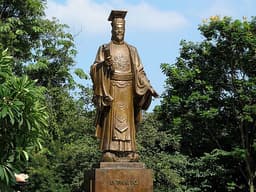
Ly Thai To
Emperor · Medieval
54.6Total

Philip II Augustus
Emperor · Medieval
63.9Total
Basic Information
Born
974
1165
Died
1028
1223
Era
Medieval
Medieval
Nationality
Vietnam
France
Occupation
Emperor
Emperor
Civilization
Eastern
Western
Score Comparison
Military (10%)
45.0
76.0
Political (20%)
68.0
70.0
Influence (20%)
61.0
55.0
Legacy (20%)
58.0
55.0
Leadership (15%)
40.0
78.0
Strategy (15%)
41.7
66.3
TOTAL
54.6
63.9
Ly Thai To — Complete Timeline
1009 AD
Foundation of the Ly DynastyPolitical Action
Ly Cong Uan, later known as Ly Thai To, was proclaimed emperor after the death of the last Le dynasty ruler. He founded the Ly dynasty, which would rule Vietnam for over 200 years. His accession was supported by Buddhist monks and the court.
Dynasty FoundingLy DynastyBuddhist Influence
Impact: nationalconstructive
1010 AD
Move of the Capital to Thang Long (Hanoi)Political Action
Ly Thai To moved the capital from Hoa Lu to Dai La, renaming it Thang Long (Rising Dragon), now Hanoi. The move was intended to centralize power and promote economic development. Thang Long became the political and cultural center of Vietnam for centuries.
Capital MoveThang LongHanoi
Impact: nationalconstructive
Promotion of Buddhism and EducationCultural◆ Major
Ly Thai To promoted Buddhism as the state religion and built many pagodas and temples. He also established the first Vietnamese university, the Quoc Tu Giam, to educate scholars in Confucian classics. These policies laid the foundation for Vietnamese culture and governance.
BuddhismEducationCultural Development
Impact: nationalconstructive
Philip II Augustus — Complete Timeline
1180 AD
Granting of Charters to TownsReform
Philip II Augustus granted charters to many towns in the royal domain, granting them self-governance and privileges. This policy encouraged urban growth and trade. It also strengthened the monarchy by gaining the support of the bourgeoisie.
ChartersUrbanizationReform
Impact: regionalconstructive
1182 AD
Expulsion of the Jews from FrancePolitical Action◆ Major
Philip II Augustus expelled the Jews from the French royal domain and confiscated their property. The expulsion was motivated by religious and financial reasons. It was a harsh measure that disrupted Jewish communities and set a precedent for later persecutions.
ExpulsionJewsPersecution
Impact: regionaldestructive
1190 AD
Construction of the Louvre FortressCultural
Philip II Augustus ordered the construction of the Louvre Fortress in Paris. The fortress was built to defend the city from English attacks. It later became the Louvre Palace and eventually the Louvre Museum, a symbol of French culture.
ArchitectureParisFortification
constructive
1204 AD
Conquest of NormandyWar◆ Major
Philip II Augustus conquered Normandy from King John of England. He captured the castle of Ch
ConquestNormandyFrance
Impact: regionalconstructive
1214 AD
Battle of BouvinesWar◆ Major
Philip II Augustus defeated a coalition of English, Flemish, and German forces at the Battle of Bouvines. This victory secured French control over the territories of Normandy, Anjou, and Maine. It also strengthened the French monarchy and weakened the Angevin Empire.
BattleFranceAngevin Empire
Impact: regionalconstructive
Expert Analysis
Origins
Ly Thai To, born Ly Cong Uan in 974 in Co Phap village (now Bac Ninh province), was raised in a Buddhist pagoda after his mother's death. He became a temple orphan, later rising to become a palace guard commander under the Le dynasty. His humble origins and monastic education shaped his spiritual and administrative outlook. In contrast, Philip II Augustus was born in 1165 in Paris, the posthumous son of King Louis VII of France and Adela of Champagne. As a Capetian heir, he was groomed for kingship from birth, receiving military and political training. While Ly Thai To's early life was marked by obscurity and religious devotion, Philip's was defined by dynastic expectation and feudal politics.
Rise to Power
Ly Thai To's rise came in 1009 when the childless Emperor Le Ngoa Trieu was deposed by the court. Ly Cong Uan, then commander of the palace guard, was elected emperor by the mandarins, reportedly due to his virtue and administrative skills. He took the era name Thuan Thien ("Following Heaven") and founded the Ly dynasty. Philip II ascended at age 14 in 1180 after his father's death. His early reign was challenged by powerful nobles like the Counts of Flanders and Champagne. He skillfully played factions against each other, annulling his marriage to Isabelle of Hainaut to avoid her family's influence, and later remarried to secure alliances. By 1186, he had consolidated royal authority, a contrast to Ly Thai To's smooth ascension.
Leadership & Governance
Ly Thai To's governance focused on centralization and cultural unification. In 1010, he moved the capital from Hoa Lu to Dai La, renaming it Thang Long ("Rising Dragon"), now Hanoi. This strategic relocation shifted power from the mountainous north to the Red River Delta, facilitating trade and administration. He promoted Buddhism as the state religion, building pagodas and temples, and established the Quoc Tu Giam, Vietnam's first national university, in 1076 (though initiated by his successors, his patronage set the foundation). His administrative reforms included a codified legal system and tax collection based on land surveys. Philip II, by contrast, expanded royal domains through conquest and diplomacy. He doubled the size of the French crown lands by seizing Normandy, Anjou, Maine, and Touraine from King John of England between 1202 and 1204. He granted charters to towns, fostering urban growth and creating a loyal bourgeoisie counterweight to nobles. His construction of the Louvre Fortress in Paris symbolized royal power. While Ly Thai To's leadership was more cultural and spiritual, Philip's was pragmatic and expansionist. Ly Thai To scored 40.0 in leadership, Philip 78.0, reflecting the latter's more assertive style.
Triumph & Tragedy
Ly Thai To's greatest triumph was founding a dynasty that ruled Vietnam for 216 years, stabilizing the country after the tumultuous Le dynasty. His capital move to Thang Long created a political and cultural heart that endures today. However, his reliance on Buddhism and neglect of Confucian administration led to later power struggles with temple hierarchies. He also failed to secure succession effectively, as his son Ly Thai Tong faced rebellions. Philip II's triumph was the Battle of Bouvines in 1214, where he defeated a coalition of England, Flanders, and the Holy Roman Empire, solidifying French supremacy. His conquest of Normandy doubled royal revenues. Yet his expulsion of Jews from the royal domain in 1182, motivated by debt cancellation and religious zeal, was a moral failure that deprived France of economic talent. He also had strained relations with the Church, excommunicated briefly for his marriage policies. Philip's political score of 70.0 reflects his successes, but his legacy is tarnished by such actions.
Character & Destiny
Ly Thai To was described as benevolent and pious, with a calm demeanor that earned him respect. His decision to move the capital showed strategic vision but also a desire to break from the past. His Buddhist faith influenced his governance, emphasizing moral rule over coercion. Philip II was shrewd, calculating, and relentless. Known as "Augustus" for his expansion, he was a master of feudal politics, often using marriage and legal claims to seize lands. His character was less spiritual and more Machiavellian; he rarely forgave enemies. Ly Thai To's destiny was to create a stable foundation for Vietnam, while Philip's was to forge a unified France. Their scores in strategy (Ly Thai To 41.7, Philip 66.3) align with Philip's more aggressive and successful military campaigns.
Legacy
Ly Thai To's legacy is monumental in Vietnam. The Ly dynasty's cultural and administrative reforms shaped Vietnamese identity, and Thang Long remains the capital. He is revered as a founding father, with temples and streets named after him. His total score of 54.6 reflects his enduring but localized impact. Philip II's legacy is equally significant in France. He transformed the Capetian monarchy from a weak title to a dominant force, laying the groundwork for the French nation-state. The Louvre, originally his fortress, became a symbol of royal power. His scores total 63.9, higher in military and leadership. Globally, Philip's influence is more recognized due to France's central role in European history.
Conclusion
While both rulers were foundational, Philip II Augustus had greater impact due to his military conquests and state-building that directly shaped modern France. Ly Thai To's cultural and spiritual contributions were vital for Vietnam, but his influence remained regional. Philip's score of 63.9 versus Ly Thai To's 54.6 underscores his higher effectiveness in military and leadership. The Battle of Bouvines and the conquest of Normandy were events of European significance, whereas Ly Thai To's capital move, though important, did not alter continental power balances. Therefore, Philip II Augustus emerges as the more impactful historical figure.
Rankings
🥇
Philip II AugustusLeader
Mil: 76.0Pol: 70.0Inf: 55.0
63.9
🥈
Ly Thai To
Mil: 45.0Pol: 68.0Inf: 61.0
54.6
+9.3 behind
How This Comparison Works
Algorithm
Each figure is scored on 6 dimensions (0—100 scale) based on structured historical data: Military (10%), Political (20%), Influence (20%), Legacy (20%), Leadership (15%), Strategy (15%). The weighted total produces the final ranking.
Data Sources
Scores are computed from structured sub-indicators in the database. Scale factors adjust for era (Ancient ×0.85, Modern ×1.0) and civilization size (Eastern ×1.05, Other ×0.80) to account for differences in population and military scale.
Maximum 3 Figures
Comparisons are limited to 2—3 figures to ensure readability and statistical meaningfulness.
Error Margins
±5 points per dimension — Sub-scores are derived from historical records with inherent uncertainty. Two figures within 5 points on a dimension should be considered roughly equivalent in that area.
Total Score Accuracy
±3 points overall — The weighted combination of 6 dimensions produces a total score with approximately ±3 points of uncertainty. Differences of less than 3 points are not statistically significant— the figures are effectively tied.
Known Limitations
- Historical records are incomplete and uneven across civilizations
- Figures from oral-tradition societies may be underrepresented
- Occupation labels can misclassify multi-role figures
- Scores measure capability and impact, not moral character
- Quantitative scoring is a comparison tool, not absolute truth
Capability Radar
Military (10%) — Battles & Warfare
Battles
20
75
Win Rate
25
80
Expansion
30
85
Political (20%) — Governance & Reform
Reform
60
80
Diplomacy
50
85
Economy
55
70
Influence (20%) — Cultural & Global Reach
Cultural
55
60
Global
30
60
Legacy (20%) — Historical Impact
Historical
60
75
Longevity
55
70
Leadership (15%) — Power & Stability
Tenure
55
85
Stability
60
75
Strategy (15%) — Tactics & Innovation
Strategy
25
85
Tactics
20
70
Reform
30
60
Similar Comparisons
Comments & Discussion
No comments yet. Be the first to share your thoughts!