Loading...
Marc Ravalomanana vs Nursultan Nazarbayev
Nursultan Nazarbayev leads by 7.3 pts · 2 figures compared
…

Marc Ravalomanana
Politician · Modern
49.9Total
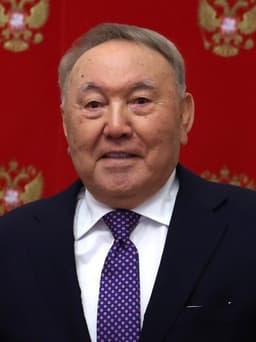
Nursultan Nazarbayev
Politician · Modern
57.2Total
Basic Information
Born
1949
1940
Died
—
—
Era
Modern
Modern
Nationality
Madagascar
Kazakhstan
Occupation
Politician
Politician
Civilization
Other
Eastern
Score Comparison
Military (10%)
36.6
10.0
Political (20%)
53.8
78.0
Influence (20%)
52.5
62.0
Legacy (20%)
41.7
54.0
Leadership (15%)
62.2
78.0
Strategy (15%)
53.0
38.3
TOTAL
49.9
57.2
Marc Ravalomanana — Complete Timeline
2002 AD
Implemented Economic ReformsReform◆ Major
Ravalomanana pursued free-market economic reforms, privatizing state-owned enterprises and encouraging foreign investment. His policies led to rapid economic growth, but also increased inequality and poverty.
MadagascarEconomic ReformPrivatization
Impact: nationalconstructive
Elected President of MadagascarPolitical Action◆ Major
Marc Ravalomanana won the presidential election against Didier Ratsiraka, but the results were disputed. After a political crisis and military support, Ravalomanana assumed power, ending Ratsiraka's rule.
MadagascarElectionPolitical Crisis
Impact: nationalconstructive
2006 AD
Reelected PresidentPolitical Action
Ravalomanana won a second term in the presidential election with 54.8% of the vote. His victory was seen as a mandate for his economic policies, but opposition grew over his authoritarian tendencies.
MadagascarElectionSecond Term
Impact: national
2009 AD
Overthrown by Andry RajoelinaPolitical Action◆ Major
Ravalomanana was overthrown in a coup led by Andry Rajoelina, the mayor of Antananarivo. The coup followed months of protests and political crisis, and Ravalomanana went into exile in South Africa.
MadagascarCoupExile
Impact: nationaltragic
Nursultan Nazarbayev — Complete Timeline
1991 AD
Became First President of KazakhstanPolitical Action◆ Major
Nursultan Nazarbayev was elected as the first president of independent Kazakhstan following the dissolution of the Soviet Union. He had previously served as the head of the Kazakh Soviet Socialist Republic. His presidency focused on nation-building, economic reform, and maintaining stability.
IndependenceNation-BuildingPost-Soviet Transition
Impact: nationalconstructive
1993 AD
Introduced Market ReformsReform◆ Major
Nazarbayev implemented a series of market-oriented economic reforms, including privatization of state enterprises and price liberalization. These reforms attracted foreign investment, particularly in the oil and gas sector, and helped stabilize the economy after the Soviet collapse.
Economic ReformPrivatizationForeign Investment
Impact: nationalconstructive
1997 AD
Moved Capital to AstanaPolitical Action◆ Major
Nazarbayev ordered the relocation of the capital from Almaty to the northern city of Akmola, renamed Astana (now Nur-Sultan). The move was intended to develop the underpopulated north and assert sovereignty over the region. The new capital was built with ambitious architecture and foreign investment.
Capital RelocationUrban DevelopmentNational Identity
Impact: nationalconstructive
2019 AD
Resigned as PresidentPolitical Action◆ Major
Nazarbayev unexpectedly resigned as President of Kazakhstan after nearly 30 years in power. He was succeeded by Kassym-Jomart Tokayev, a loyalist. Nazarbayev retained significant influence as head of the Security Council and as 'Elbasy' (Leader of the Nation), a title granted by parliament.
ResignationPower TransitionPolitical Legacy
Impact: national
2022 AD
Suppressed January 2022 ProtestsPolitical Action◆ Major
Following a violent uprising in January 2022, Nazarbayev was removed from his position as head of the Security Council. The protests, initially over fuel prices, turned into a broader challenge to the regime. Tokayev ordered a crackdown with CSTO support, and Nazarbayev's influence waned.
Protest SuppressionPower StruggleCSTO Intervention
Impact: nationaldestructive
Expert Analysis
Origins
**Marc Ravalomanana** was born on December 12, 1949, in Imerinkasinina, Madagascar, into a modest family. He started a small business selling yogurt, which grew into the Tiko Group, a major dairy and food conglomerate. His entrepreneurial success gave him a platform but no formal political background.
**Nursultan Nazarbayev** was born on July 6, 1940, in Chemolgan, Kazakh SSR, into a peasant family. He worked in a steel plant and joined the Communist Party, rising through the ranks. He became First Secretary of the Communist Party of Kazakhstan in 1989, before the Soviet collapse.
Rise to Power
Ravalomanana entered politics as a reformist outsider. In 2001, he ran for president against longtime leader Didier Ratsiraka. The election was disputed; Ravalomanana claimed victory, and after a six-month crisis and military defections, he assumed power in 2002. His rise was marked by popular support but fragile institutions.
Nazarbayev became the first president of independent Kazakhstan in 1991, following the dissolution of the USSR. He had already consolidated power as party leader. In 1995, he extended his term via a referendum, and later elections were criticized as neither free nor fair. His rise was methodical, leveraging Soviet-era networks.
Leadership & Governance
Ravalomanana pursued aggressive free-market reforms: privatizing state enterprises, cutting tariffs, and encouraging foreign investment. GDP growth averaged 5-6% annually from 2002-2008. However, his governance was criticized as autocratic—he cracked down on opposition media and jailed rivals. His leadership score is 62.2.
Nazarbayev adopted a gradual market transition, privatizing key industries while maintaining control over oil and gas. He moved the capital to Astana (now Nur-Sultan) to assert authority over the north. His rule was authoritarian: he suppressed dissent, but maintained stability and economic growth, with GDP per capita rising from $1,500 in 1991 to over $9,000 by 2019. His leadership score is 78.0.
Triumph & Tragedy
Ravalomanana's triumph was his economic turnaround: Madagascar's growth hit 6.2% in 2008. His tragedy was his overthrow in 2009 by Andry Rajoelina after months of protests. He mishandled the crisis by vacillating between concession and repression, and he fled into exile. His political score is 53.8.
Nazarbayev's triumph was creating a stable, energy-rich nation from Soviet ruins. He secured Kazakhstan's borders and attracted massive foreign investment. His tragedy was the violent January 2022 protests, sparked by fuel price hikes, which forced him to cede his Security Council post. His reputation was tarnished by corruption and cronyism. His political score is 78.0.
Character & Destiny
Ravalomanana was a businessman who believed in efficiency and markets, but lacked political finesse. He underestimated his opponents and failed to build durable alliances. His destiny was cut short by a coup he might have prevented with better coalition-building.
Nazarbayev was a pragmatic autocrat who prioritized stability. He cultivated a personality cult and managed elites through patronage. His destiny was to remain in power for three decades, but his legacy was marred by the eventual uprising. His strategy score is 38.3, reflecting a lack of a succession plan.
Legacy
Ravalomanana's legacy is mixed: he is remembered for economic reforms that lifted growth but also for authoritarian tendencies. His fall demonstrated the fragility of African democracies. His influence score is 52.5.
Nazarbayev's legacy is more durable: he shaped Kazakhstan's borders, economy, and political system. The capital bears his name, and his policies still guide the country. But his authoritarian model proved unsustainable. His legacy score is 54.0.
Conclusion
Nazarbayev had greater impact. His total score of 57.2 vs Ravalomanana's 49.9 reflects his longer tenure, larger economy, and geopolitical significance. While Ravalomanana's reforms were bold, Nazarbayev's nation-building was more consequential. Nazarbayev's Kazakhstan is a middle-income energy power; Ravalomanana's Madagascar remains poor and unstable. The data supports Nazarbayev's edge.
Rankings
🥇
Nursultan NazarbayevLeader
Mil: 10.0Pol: 78.0Inf: 62.0
57.2
🥈
Marc Ravalomanana
Mil: 36.6Pol: 53.8Inf: 52.5
49.9
+7.3 behind
How This Comparison Works
Algorithm
Each figure is scored on 6 dimensions (0—100 scale) based on structured historical data: Military (10%), Political (20%), Influence (20%), Legacy (20%), Leadership (15%), Strategy (15%). The weighted total produces the final ranking.
Data Sources
Scores are computed from structured sub-indicators in the database. Scale factors adjust for era (Ancient ×0.85, Modern ×1.0) and civilization size (Eastern ×1.05, Other ×0.80) to account for differences in population and military scale.
Maximum 3 Figures
Comparisons are limited to 2—3 figures to ensure readability and statistical meaningfulness.
Error Margins
±5 points per dimension — Sub-scores are derived from historical records with inherent uncertainty. Two figures within 5 points on a dimension should be considered roughly equivalent in that area.
Total Score Accuracy
±3 points overall — The weighted combination of 6 dimensions produces a total score with approximately ±3 points of uncertainty. Differences of less than 3 points are not statistically significant— the figures are effectively tied.
Known Limitations
- Historical records are incomplete and uneven across civilizations
- Figures from oral-tradition societies may be underrepresented
- Occupation labels can misclassify multi-role figures
- Scores measure capability and impact, not moral character
- Quantitative scoring is a comparison tool, not absolute truth
Capability Radar
Military (10%) — Battles & Warfare
Battles
5
0
Win Rate
5
0
Expansion
5
0
Political (20%) — Governance & Reform
Reform
60
75
Diplomacy
50
80
Economy
65
75
Influence (20%) — Cultural & Global Reach
Cultural
30
50
Global
25
60
Legacy (20%) — Historical Impact
Historical
30
60
Longevity
20
55
Leadership (15%) — Power & Stability
Tenure
40
90
Stability
20
70
Strategy (15%) — Tactics & Innovation
Strategy
5
0
Tactics
5
0
Reform
10
10
Similar Comparisons
Comments & Discussion
No comments yet. Be the first to share your thoughts!