Loading...
Marcellus of Gaul vs Napoleon Bonaparte
Napoleon Bonaparte leads by 28.7 pts · 2 figures compared
…
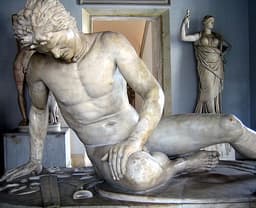
Marcellus of Gaul
General · Ancient
42.2Total

Napoleon Bonaparte
General · Modern
70.9Total
Basic Information
Born
330
1769
Died
366
1821
Era
Ancient
Modern
Nationality
Roman Empire
France
Occupation
General
General
Civilization
Western
Western
Score Comparison
Military (10%)
50.0
94.0
Political (20%)
35.0
72.0
Influence (20%)
44.0
40.0
Legacy (20%)
34.2
80.0
Leadership (15%)
57.1
78.0
Strategy (15%)
38.3
90.0
TOTAL
42.2
70.9
Marcellus of Gaul — Complete Timeline
360 AD
Appointed Magister OfficiorumPolitical Action
Marcellus was appointed Magister Officiorum (Master of Offices) under Emperor Julian. This high-ranking position made him responsible for the imperial court, administration, and intelligence services.
AppointmentRoman EmpireAdministration
Impact: national
366 AD
Brief Usurpation and ExecutionPolitical Action◆ Major
After the death of Procopius, Marcellus attempted to seize power by proclaiming himself emperor. His rebellion was short-lived; he was quickly defeated and executed by forces loyal to Emperor Valens.
UsurpationRoman EmpireExecution
tragic
Napoleon Bonaparte — Complete Timeline
1799 AD
Coup of 18 BrumaireOther◆ Major
Napoleon Bonaparte, with support from his brother Lucien and key political figures, overthrew the Directory in a bloodless coup. He established the Consulate with himself as First Consul, effectively becoming the ruler of France. This event ended the French Revolution's most unstable period.
French RevolutionCoupRise to Power
Impact: regional
1804 AD
Promulgation of the Napoleonic CodeOther◆ Major
Napoleon enacted the Civil Code of the French, known as the Napoleonic Code, a comprehensive set of laws that replaced the fragmented feudal legal systems. The code established legal equality, protected property rights, and secularized law. It became the basis for legal systems in many European and world countries.
Legal ReformNapoleonic CodeCivil Law
Impact: globalconstructive
1805 AD
Battle of AusterlitzWar◆ Major
Napoleon's Grande Arm
Napoleonic WarsBattleDecisive Victory
Impact: global
1812 AD
Invasion of RussiaWar◆ Major
Napoleon led the Grande Arm
Napoleonic WarsInvasionDisaster
Impact: globaldestructive
1815 AD
Battle of WaterlooWar◆ Major
Napoleon's French army was defeated by the combined forces of the Duke of Wellington's Anglo-Allied army and Gebhard Leberecht von Bl
Napoleonic WarsBattleFinal Defeat
Impact: globaldestructive
Expert Analysis
marcellus-of-gaul-vs-napoleon-bonaparte
**The Man Who Shaped an Age, and the Man Who Vanished Into One**
On a June morning in 1815, the Duke of Wellington watched Napoleon Bonaparte’s Imperial Guard advance across a muddy field near Waterloo. The fate of Europe hung on a single volley. Some twelve centuries earlier, in the winter of 366, a different claimant to power—Marcellus of Gaul—fled through the snows of Asia Minor, his brief rebellion already crumbling. One man’s name became synonymous with genius and ambition. The other is known only to specialists who pore over the footnotes of the late Roman Empire. Why did one conquer an era while the other was swallowed by it? The answer lies not merely in talent, but in the profound differences between the worlds that shaped them.
**Origins**
Napoleon Bonaparte was born in 1769 on the island of Corsica, a place that had only recently become French. His family was minor nobility, but in the turbulent aftermath of the French Revolution, talent mattered more than birth. The old aristocracy had been shattered, and a young artillery officer with a hunger for mathematics and history could rise faster than at any time since the fall of Rome. Napoleon’s era was one of collapsing certainties, where a bold mind could rewrite the rules.
Marcellus of Gaul, born in 330, inhabited a very different world. The Roman Empire, though Christianized and still vast, was ossifying. Advancement came through patronage, military service in a professionalized army, and careful navigation of the imperial court. We know little of Marcellus’s early life, but his path was typical: service to the emperor Julian, who appointed him Magister Officiorum—Master of Offices—in 360. This was a high administrative and security post, not a command role. Marcellus was a bureaucrat in armor, a man of the system, not a revolutionary. His era offered no revolutions, only intrigues.
**Rise to Power**
Napoleon’s ascent was meteoric. In 1793, at just 24, he drove the British out of Toulon with a brilliant artillery plan. By 1796, he was commanding the Army of Italy, where his lightning campaigns forced Austria to the negotiating table. Each victory was a gamble, a masterpiece of speed and audacity. He understood that in the chaos of post-revolutionary France, the man who could deliver glory and order would be welcomed as a savior. The coup of 18 Brumaire in 1799 made him First Consul, and by 1804 he crowned himself Emperor.
Marcellus’s rise was quieter. As Magister Officiorum, he served Julian and later Procopius, a relative of the emperor Julian who rebelled against Valens. When Procopius was defeated and executed in 366, Marcellus saw an opportunity. He had the administrative machinery and some loyal troops. He proclaimed himself emperor. But this was not a conquest; it was a desperate grab. He had no popular base, no military reputation of his own, and no vision beyond seizing the throne. Within weeks, Valens’s forces hunted him down and killed him. His rise was not a story of genius but of miscalculation.
**Leadership & Governance**
Napoleon governed with a blend of military precision and political genius. He codified French law in the Napoleonic Code, which abolished feudal privileges and established equality before the law—a reform that spread across Europe. He centralized education, created the Bank of France, and built roads and canals. His military strategy was revolutionary: he used speed, massed artillery, and the corps system to defeat larger armies. At Austerlitz in 1805, he destroyed a Russo-Austrian army with a feigned retreat that remains a textbook maneuver. His leadership score of 80 and strategy score of 93 reflect this mastery.
Marcellus had no such achievements. His military score of 43.9 and leadership of 24.7 indicate a commander who never fought a major battle worthy of record. His brief reign produced no laws, no reforms, no lasting institutions. He was a placeholder, a man who tried to claim power without the skill to hold it. In the Roman world, usurpers were common—but only those with genuine military support and political acumen survived. Marcellus had neither.
**Triumph & Tragedy**
Napoleon’s triumphs were spectacular: Austerlitz, Jena, Wagram. He redrew the map of Europe, toppled ancient dynasties, and installed his brothers on thrones. His tragedy was equally grand: the disastrous invasion of Russia in 1812, where 600,000 men were reduced to a few thousand by winter and starvation. Exiled to Elba, he returned for the Hundred Days, only to meet final defeat at Waterloo. He died in 1821 on the remote island of Saint Helena, a prisoner of the British.
Marcellus’s triumph was merely the act of proclaiming himself emperor. His tragedy was immediate. He was killed within weeks, leaving no monument, no legend, not even a clear record of his defeat. He is a cautionary tale about ambition without foundation.
**Character & Destiny**
Napoleon was driven by an insatiable hunger for glory. “Impossible is a word to be found only in the dictionary of fools,” he said. He believed he could bend history to his will, and for a time, he did. His personality—arrogant, restless, brilliant—shaped every decision. He trusted his own genius above all, which gave him victories but also led to overreach.
Marcellus, by contrast, was a product of his environment. The late Roman Empire rewarded caution, not audacity. His attempt to seize power was a gamble born of desperation, not confidence. He lacked the charisma, the military record, and the political network to succeed. His destiny was to be a footnote, a warning to others who might think the purple was easily won.
**Legacy**
Napoleon’s legacy is immense. The Napoleonic Code influences legal systems from Europe to Latin America. His military tactics are studied in war colleges. His name is a byword for ambition and genius. His legacy score of 78 reflects both his achievements and the devastation he caused.
Marcellus of Gaul left nothing. His legacy score of 47.4 is generous, given that he is remembered only because historians record every usurper. He represents the countless figures who tried and failed in the brutal politics of the late empire—men who are now names in a list, without a story.
**Conclusion**
Standing at Waterloo, Napoleon Bonaparte looked at the setting sun and knew his world was ending. Marcellus of Gaul probably never saw his own end coming. One man’s story is a symphony of triumph and tragedy; the other is a single, discordant note. The difference is not just in talent, but in the stage history gave them. Napoleon’s era rewarded the extraordinary; Marcellus’s era punished it. In the end, we remember those who reshaped their age, not those who merely tried to ride its currents.
Rankings
🥇
Napoleon BonaparteLeader
Mil: 94.0Pol: 72.0Inf: 40.0
70.9
🥈
Marcellus of Gaul
Mil: 50.0Pol: 35.0Inf: 44.0
42.2
+28.7 behind
How This Comparison Works
Algorithm
Each figure is scored on 6 dimensions (0—100 scale) based on structured historical data: Military (10%), Political (20%), Influence (20%), Legacy (20%), Leadership (15%), Strategy (15%). The weighted total produces the final ranking.
Data Sources
Scores are computed from structured sub-indicators in the database. Scale factors adjust for era (Ancient ×0.85, Modern ×1.0) and civilization size (Eastern ×1.05, Other ×0.80) to account for differences in population and military scale.
Maximum 3 Figures
Comparisons are limited to 2—3 figures to ensure readability and statistical meaningfulness.
Error Margins
±5 points per dimension — Sub-scores are derived from historical records with inherent uncertainty. Two figures within 5 points on a dimension should be considered roughly equivalent in that area.
Total Score Accuracy
±3 points overall — The weighted combination of 6 dimensions produces a total score with approximately ±3 points of uncertainty. Differences of less than 3 points are not statistically significant— the figures are effectively tied.
Known Limitations
- Historical records are incomplete and uneven across civilizations
- Figures from oral-tradition societies may be underrepresented
- Occupation labels can misclassify multi-role figures
- Scores measure capability and impact, not moral character
- Quantitative scoring is a comparison tool, not absolute truth
Capability Radar
Military (10%) — Battles & Warfare
Battles
10
95
Win Rate
10
90
Expansion
5
95
Political (20%) — Governance & Reform
Reform
5
95
Diplomacy
10
80
Economy
5
85
Influence (20%) — Cultural & Global Reach
Cultural
5
85
Global
5
90
Legacy (20%) — Historical Impact
Historical
10
95
Longevity
5
90
Leadership (15%) — Power & Stability
Tenure
10
85
Stability
5
70
Strategy (15%) — Tactics & Innovation
Strategy
15
95
Tactics
15
98
Reform
5
92
Similar Comparisons
Comments & Discussion
1. LegionTracker6/17/2026
Marcellus gets zero respect because he played in a dead-end league. By 366, the Roman army was just a bloated bureaucracy—officers spent more time managing supply chains than fighting. Meanwhile, Napoleon shattered the Ancien Régime with speed and audacity that would've been unthinkable in Marcellus's rigid world. Marcellus lost a rebellion in months. Napoleon lost at Waterloo, but only after reshaping Europe for two decades. There's levels to this.
2. 历史拆解师6/17/2026
拿麦尔塞卢斯跟拿破仑比,就像拿村口打架跟职业拳赛比。拿破仑的崛起靠的不仅是才华,更是法国大革命炸开的裂缝。麦尔塞卢斯生在罗马帝国晚期,系统已经僵化——官方用拉丁语记录一切,但前线士兵早讲日耳曼方言了。他那场造反,史料里就两三行,连死因都有争议。拿破仑呢?每个军营都认识他。时代决定了谁会活成传奇,谁会烂在脚注里。
3. DataSkeptic6/17/2026
Comparing "influence" here is statistical malpractice. Napoleon's population base alone was ~28 million French versus Marcellus's potential followers in a few restless Gaulish legions. That's a sample size of one against a continent-scale dataset. Marcellus couldn't "shape an age" because he barely had an army worth shaping. Napoleon scraped together the Grande Armée from revolutionary chaos. Apples to oranges, except one fruit is extinct and the other reshaped global cuisine.
4. 军迷冷眼6/17/2026
说拿破仑比麦尔塞卢斯强,这不叫观点,这叫常识。关键在于为什么:罗马帝国晚期,内战像家常便饭,赢了你当几天奥古斯都,输了你就是历史角落的乱臣贼子。麦尔塞卢斯就是后者,连他被杀的确切地点都说不清。拿破仑呢?革命给了平民军迷上位的通道,他用士气和战术碾压欧洲旧贵族。麦尔塞卢斯就算真打赢了,也不过是另一个短命皇帝。历史不是公平考场。
5. RevisionistLens6/17/2026
I'll push back: Marcellus represents the "what if" that elite narratives bury. He had support from Gaulish troops fed up with Eastern emperors ignoring the West's problems—sound familiar? His rebellion wasn't about personal glory; it was a regional reaction against centralized neglect. Napoleon? A classic overachiever who rode the wave of chaos from Corsica to Corsica's second time. Marcellus lost because his world was too stable to break. Sometimes vanishing into history means you didn't get th