Loading...
Mariano Rajoy Brey vs Napoleon Bonaparte
Napoleon Bonaparte leads by 19.1 pts · 2 figures compared
…
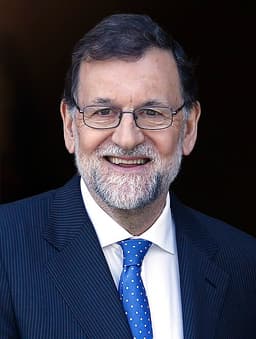
Mariano Rajoy Brey
Politician · Modern
51.8Total

Napoleon Bonaparte
General · Modern
70.9Total
Basic Information
Born
1955
1769
Died
—
1821
Era
Modern
Modern
Nationality
Spain
France
Occupation
Politician
General
Civilization
Western
Western
Score Comparison
Military (10%)
50.0
94.0
Political (20%)
68.0
72.0
Influence (20%)
50.2
40.0
Legacy (20%)
40.0
80.0
Leadership (15%)
66.0
78.0
Strategy (15%)
41.6
90.0
TOTAL
51.8
70.9
Mariano Rajoy Brey — Complete Timeline
2011 AD
Elected Prime Minister of SpainPolitical Action
Rajoy led the People's Party (PP) to a landslide victory in the general election, becoming Prime Minister. His government implemented austerity measures to address the economic crisis.
Spanish PoliticsPPElection
Impact: national
2012 AD
Implemented austerity measuresReform◆ Major
Rajoy's government passed a series of austerity measures, including spending cuts and tax increases, to reduce the budget deficit and meet EU requirements. These measures were widely protested.
AusterityEconomic CrisisReform
Impact: nationaldestructive
2017 AD
Refused to hold a legal referendum on Catalan independencePolitical Action◆ Major
Rajoy's government opposed the Catalan independence referendum, declaring it illegal. He invoked Article 155 of the Constitution to impose direct rule on Catalonia after the referendum was held.
Catalan IndependenceArticle 155Constitutional Crisis
Impact: national
2018 AD
Ousted in no-confidence votePolitical Action
Rajoy lost a no-confidence motion in the Spanish Congress of Deputies, triggered by a corruption scandal involving the PP. He was replaced by Socialist leader Pedro S
No-confidenceCorruptionPP
Impact: nationaldestructive
Napoleon Bonaparte — Complete Timeline
1799 AD
Coup of 18 BrumaireOther◆ Major
Napoleon Bonaparte, with support from his brother Lucien and key political figures, overthrew the Directory in a bloodless coup. He established the Consulate with himself as First Consul, effectively becoming the ruler of France. This event ended the French Revolution's most unstable period.
French RevolutionCoupRise to Power
Impact: regional
1804 AD
Promulgation of the Napoleonic CodeOther◆ Major
Napoleon enacted the Civil Code of the French, known as the Napoleonic Code, a comprehensive set of laws that replaced the fragmented feudal legal systems. The code established legal equality, protected property rights, and secularized law. It became the basis for legal systems in many European and world countries.
Legal ReformNapoleonic CodeCivil Law
Impact: globalconstructive
1805 AD
Battle of AusterlitzWar◆ Major
Napoleon's Grande Arm
Napoleonic WarsBattleDecisive Victory
Impact: global
1812 AD
Invasion of RussiaWar◆ Major
Napoleon led the Grande Arm
Napoleonic WarsInvasionDisaster
Impact: globaldestructive
1815 AD
Battle of WaterlooWar◆ Major
Napoleon's French army was defeated by the combined forces of the Duke of Wellington's Anglo-Allied army and Gebhard Leberecht von Bl
Napoleonic WarsBattleFinal Defeat
Impact: globaldestructive
Expert Analysis
mariano-rajoy-brey-vs-napoleon-bonaparte
# The Emperor and the Bureaucrat
In the spring of 1815, Napoleon Bonaparte stood before his Grande Armée for the last time, a man who had reshaped Europe through sheer will and military genius. Two centuries later, in June 2018, Mariano Rajoy Brey gathered his belongings in the Moncloa Palace, a bearded Galician who had governed Spain through crisis and scandal, only to be toppled by a no-confidence vote. One ended his career in exile on a remote Atlantic island; the other returned to his home in Pontevedra. What separates a titan of history from a footnote? The answer lies not merely in the scale of their ambitions, but in the worlds they inhabited—and the choices they made within them.
Origins
Napoleon was born in 1769 on Corsica, an island that had only become French the year before. His family were minor nobles of Italian origin, and young Napoleone Buonaparte grew up speaking Corsican, not French—an outsider in the nation he would one day rule. The French Revolution, erupting when he was twenty, shattered the old order and created opportunities unimaginable under the Bourbon monarchy. A gifted artillery officer could rise not by birth but by talent and courage. The era rewarded audacity.
Mariano Rajoy was born in 1955 in Santiago de Compostela, the son of a provincial judge. Galicia, in Spain’s rainy northwest, is a land of cautious people, known for their reserve and patience. Rajoy came of age under Franco’s dictatorship, but his political career began in the democratic transition. He was a product of the Spanish People’s Party, a conservative institution built on stability and incrementalism. His world was one of committees, parliamentary procedures, and coalition-building—not battlefields.
Rise to Power
Napoleon’s ascent was meteoric. At age twenty-four, he drove the British out of Toulon and was promoted to brigadier general. In 1796, at twenty-six, he took command of the French army in Italy and won a series of stunning victories against the Austrians. By 1799, he had seized power in a coup, becoming First Consul. He was crowned Emperor in 1804 at age thirty-four. Each step was a gamble, each victory a foundation for the next.
Rajoy’s rise was methodical. He entered politics in the 1980s, holding various ministerial posts under José María Aznar: public administration, education, interior, and eventually vice president. He was known as a loyalist and a pragmatist, not a visionary. In 2011, as Spain reeled from the financial crisis, his People’s Party won a landslide victory—not because Rajoy inspired passion, but because he promised stability. He became Prime Minister at age fifty-six, having spent decades in the corridors of power.
Leadership & Governance
Napoleon governed as a conqueror and reformer. His Napoleonic Code, enacted in 1804, standardized French law across Europe, enshrining principles of meritocracy, property rights, and secular administration. He built roads, schools, and a centralized bureaucracy. But his rule was also autocratic: he censored the press, suppressed dissent, and crowned himself emperor. His military strategy was revolutionary—rapid marches, decisive battles, and the use of artillery as a shock weapon. At Austerlitz in 1805, he destroyed a combined Russian-Austrian army, cementing his reputation as the age’s greatest commander.
Rajoy governed as a crisis manager. His signature achievement was steering Spain through the eurozone debt crisis. In 2012, he implemented harsh austerity measures: spending cuts, tax increases, and labor reforms. The economy stabilized, but unemployment remained above twenty percent. His leadership style was reactive, not visionary. When Catalonia held an illegal independence referendum in 2017, Rajoy invoked Article 155 of the Spanish Constitution, suspending Catalan autonomy and calling new elections. It was a constitutional solution, not a political one—legal but divisive.
Triumph & Tragedy
Napoleon’s greatest triumph was the Empire of 1810–1812, when he controlled most of continental Europe. His greatest tragedy was the invasion of Russia in 1812. He marched 600,000 men into the vastness of Russia; fewer than 100,000 returned. The Grande Armée was destroyed, and the other European powers sensed weakness. By 1814, Paris had fallen, and Napoleon was exiled to Elba. He escaped in 1815, raised another army, and met his final defeat at Waterloo on June 18, 1815. He died in 1821 on Saint Helena, a British prisoner.
Rajoy’s triumph was surviving the financial crisis. Spain avoided a full bailout, and by 2017 the economy was growing again. His tragedy was the corruption scandal that destroyed his government. In 2018, a court convicted former PP officials in the Gürtel case, a bribery scheme that had operated for years. Rajoy himself was not implicated, but the scandal tainted his party. In June 2018, he lost a no-confidence vote by 180 to 169, becoming the first Spanish prime minister to be ousted in this way. He left office quietly, without drama.
Character & Destiny
Napoleon was driven by ambition, energy, and a belief in his own destiny. “Impossible is a word to be found only in the dictionary of fools,” he once said. He trusted his instincts, took enormous risks, and demanded absolute loyalty. His personality shaped his decisions: the Russian campaign was a gamble too far, driven by hubris. Yet his reforms outlasted his empire—the Napoleonic Code remains the basis of law in much of Europe.
Rajoy was cautious, patient, and averse to conflict. He was known for his dry wit and his ability to wait out crises. “It is not a question of being optimistic or pessimistic,” he once said. “It is a question of being realistic.” His personality made him a steady hand during a financial storm, but it also made him appear passive and disconnected when scandal struck. He never commanded armies or rewrote constitutions; he managed decline and avoided collapse.
Legacy
Napoleon is remembered as one of history’s most transformative figures. His scores—Military: 94, Political: 75, Influence: 82—reflect a man who changed the course of Europe. He is studied in military academies worldwide, his code enshrined in legal systems, his legend alive in art and literature.
Rajoy is remembered as a competent but unremarkable prime minister. His scores—Military: 37.5, Political: 74.4, Influence: 69.3—place him as a competent bureaucrat in a complex era. He stabilized Spain but failed to inspire. He is unlikely to appear in many history books beyond footnotes.
Conclusion
Napoleon and Rajoy lived in different centuries, but the deeper difference is not time—it is the relationship between the individual and history. Napoleon believed he could bend the world to his will; Rajoy believed he could only manage it. One expanded the boundaries of human ambition; the other held the line against chaos. Both were necessary in their eras, but only one left a mark that still burns. In the end, history rewards not just competence, but audacity.
Rankings
🥇
Napoleon BonaparteLeader
Mil: 94.0Pol: 72.0Inf: 40.0
70.9
🥈
Mariano Rajoy Brey
Mil: 50.0Pol: 68.0Inf: 50.2
51.8
+19.1 behind
How This Comparison Works
Algorithm
Each figure is scored on 6 dimensions (0—100 scale) based on structured historical data: Military (10%), Political (20%), Influence (20%), Legacy (20%), Leadership (15%), Strategy (15%). The weighted total produces the final ranking.
Data Sources
Scores are computed from structured sub-indicators in the database. Scale factors adjust for era (Ancient ×0.85, Modern ×1.0) and civilization size (Eastern ×1.05, Other ×0.80) to account for differences in population and military scale.
Maximum 3 Figures
Comparisons are limited to 2—3 figures to ensure readability and statistical meaningfulness.
Error Margins
±5 points per dimension — Sub-scores are derived from historical records with inherent uncertainty. Two figures within 5 points on a dimension should be considered roughly equivalent in that area.
Total Score Accuracy
±3 points overall — The weighted combination of 6 dimensions produces a total score with approximately ±3 points of uncertainty. Differences of less than 3 points are not statistically significant— the figures are effectively tied.
Known Limitations
- Historical records are incomplete and uneven across civilizations
- Figures from oral-tradition societies may be underrepresented
- Occupation labels can misclassify multi-role figures
- Scores measure capability and impact, not moral character
- Quantitative scoring is a comparison tool, not absolute truth
Capability Radar
Military (10%) — Battles & Warfare
Battles
26
95
Win Rate
30
90
Expansion
34
95
Political (20%) — Governance & Reform
Reform
40
95
Diplomacy
55
80
Economy
45
85
Influence (20%) — Cultural & Global Reach
Cultural
20
85
Global
20
90
Legacy (20%) — Historical Impact
Historical
25
95
Longevity
15
90
Leadership (15%) — Power & Stability
Tenure
65
85
Stability
50
70
Strategy (15%) — Tactics & Innovation
Strategy
38
95
Tactics
40
98
Reform
43
92
Similar Comparisons
Comments & Discussion
Napoleon'sGhost6/17/2026
Comparing Rajoy to Napoleon is like comparing a puddle to the Pacific. Napoleon rewrote Europe's map in blood and glory, winning 60 battles and codifying laws that still govern. Rajoy's legacy? Austerity cuts and a botched Catalonia response. One reshaped civilization; the other barely held Spain together for six years. This isn't a comparison—it's a category error.
历史刻度尺6/17/2026
拿破仑打了一辈子仗,滑铁卢之后还能让整个欧洲发抖。拉霍伊呢?2018年不信任案一过,直接坐火车回老家。没有大军、没有法典、没有流放海岛,连个像样的政敌都没有。这不是历史人物对比,这是拿泰坦尼克号比浴缸里的橡皮鸭。一个改变世界,一个只是按时下班。
SkepticalSusan6/17/2026
The analysis romanticizes Napoleon's "choice" and ignores Rajoy's institutional constraints. Napoleon ruled with emergency powers at swordpoint; Rajoy had to navigate a constitutional monarchy, EU bailouts, and 17 autonomous regions. Different arenas, different rules. Rajoy didn't choose to be a footnote—he operated in a system designed to prevent any single person from becoming a titan. Context matters more than hero worship.
制度之眼6/17/2026
拿1815年的欧洲和2018年的西班牙比,本身就是历史错位。拿破仑面对的是旧制度的废墟,他可以是孤胆英雄。拉霍伊面对的是完整的民主制度、媒体监督、政党博弈,他每走一步都要过议会。把两人的不同简单归结为“勇气大小”,是忽视了制度对人的塑造。君权神授的时代早就死了,拉霍伊只是在一个系统里打工而已。