Loading...
Martin Vizcarra vs Napoleon Bonaparte
Napoleon Bonaparte leads by 18.8 pts · 2 figures compared
…
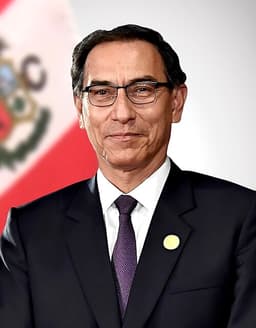
Martin Vizcarra
Politician · Modern
52.1Total

Napoleon Bonaparte
General · Modern
70.9Total
Basic Information
Born
1963
1769
Died
—
1821
Era
Modern
Modern
Nationality
Peru
France
Occupation
Politician
General
Civilization
Western
Western
Score Comparison
Military (10%)
50.0
94.0
Political (20%)
68.0
72.0
Influence (20%)
51.0
40.0
Legacy (20%)
40.8
80.0
Leadership (15%)
64.0
78.0
Strategy (15%)
43.7
90.0
TOTAL
52.1
70.9
Martin Vizcarra — Complete Timeline
2018 AD
Succeeded Pedro Pablo Kuczynski as PresidentPolitical Action◆ Major
Martín Vizcarra, then First Vice President, succeeded to the presidency after the resignation of Pedro Pablo Kuczynski. His ascension was seen as a chance to restore public trust in government amid widespread corruption.
SuccessionPresidency
Impact: nationalconstructive
2019 AD
Dissolved Congress in 2019Political Action
President Vizcarra dissolved the Peruvian Congress after it refused to hold a vote of confidence on his anti-corruption reforms. This triggered a constitutional crisis, but Vizcarra called for new legislative elections, which were held in 2020.
Constitutional CrisisCongressReform
Impact: national
2020 AD
Impeached and removed from officePolitical Action
Vizcarra was impeached by the new Congress on charges of corruption and moral incapacity, and removed from office. His removal was highly controversial, with many seeing it as a political maneuver by the opposition, and it sparked widespread protests.
ImpeachmentRemovalProtest
Impact: nationaldestructive
Napoleon Bonaparte — Complete Timeline
1799 AD
Coup of 18 BrumaireOther◆ Major
Napoleon Bonaparte, with support from his brother Lucien and key political figures, overthrew the Directory in a bloodless coup. He established the Consulate with himself as First Consul, effectively becoming the ruler of France. This event ended the French Revolution's most unstable period.
French RevolutionCoupRise to Power
Impact: regional
1804 AD
Promulgation of the Napoleonic CodeOther◆ Major
Napoleon enacted the Civil Code of the French, known as the Napoleonic Code, a comprehensive set of laws that replaced the fragmented feudal legal systems. The code established legal equality, protected property rights, and secularized law. It became the basis for legal systems in many European and world countries.
Legal ReformNapoleonic CodeCivil Law
Impact: globalconstructive
1805 AD
Battle of AusterlitzWar◆ Major
Napoleon's Grande Arm
Napoleonic WarsBattleDecisive Victory
Impact: global
1812 AD
Invasion of RussiaWar◆ Major
Napoleon led the Grande Arm
Napoleonic WarsInvasionDisaster
Impact: globaldestructive
1815 AD
Battle of WaterlooWar◆ Major
Napoleon's French army was defeated by the combined forces of the Duke of Wellington's Anglo-Allied army and Gebhard Leberecht von Bl
Napoleonic WarsBattleFinal Defeat
Impact: globaldestructive
Expert Analysis
martin-vizcarra-vs-napoleon-bonaparte
# The Conqueror and the Reformer: Two Paths of Power in Turbulent Times
On a windswept field in Belgium, June 18, 1815, Napoleon Bonaparte watched his empire crumble as Prussian reinforcements sealed his fate at Waterloo. Two centuries later, in the sterile corridors of Lima’s Congress, Martín Vizcarra sat alone as lawmakers voted to strip him of the presidency, his anti-corruption crusade ending not with cannon fire but with the quiet rustle of ballots. One man commanded armies across continents; the other commanded a fractured legislature. Yet both rose from obscurity to reshape their nations—and both fell when the forces they sought to control turned against them. What drove such different outcomes? The answer lies not in the scale of their ambitions, but in the nature of the worlds they inhabited.
Origins
Napoleon was born in 1769 on the rugged island of Corsica, a land of fierce independence recently annexed by France. His family were minor nobles of Italian descent, scraping by on modest estates. The young Bonaparte arrived at military school as an outsider—short, poor, and speaking French with a thick accent that invited ridicule. He devoured books on military history and Enlightenment philosophy, absorbing Voltaire’s skepticism and Rousseau’s belief in the power of will. The French Revolution erupted when he was twenty, shattering the old order and opening paths that birth could never have granted.
Martín Vizcarra entered the world in 1963 in Lima, Peru, the son of a politician father who served as a congressman and later as mayor. He grew up in the shadow of a nation torn by the Shining Path insurgency, hyperinflation, and military dictatorships. Unlike Napoleon, he studied civil engineering at university, then climbed the ladder of public administration—first as a regional governor, then as minister of transport, then as vice president. His rise was methodical, a product of bureaucratic competence rather than revolutionary upheaval. The French Revolution made Napoleon possible; the slow decay of Peruvian institutions made Vizcarra necessary.
Rise to Power
Napoleon’s ascent was a lightning strike. In 1793, at age twenty-four, he drove British forces from the port of Toulon with a daring artillery assault. By 1796, he commanded the Army of Italy, leading ragged soldiers across the Alps to crush Austrian armies in a series of masterful campaigns. “I am of the race that founds empires,” he wrote to his wife Joséphine. In 1799, he seized power in a coup d’état, becoming First Consul of France. Five years later, he crowned himself Emperor. Each step was forged in battle, each victory a lever to pry open the next door.
Vizcarra’s path was quieter but no less dramatic. In 2018, President Pedro Pablo Kuczynski resigned amid corruption scandals, and Vizcarra, as first vice president, succeeded him. He had not sought the presidency; it was thrust upon him. But he seized the moment. In 2019, when Congress refused to hold a vote of confidence on his anti-corruption reforms, he dissolved the legislature—a constitutional maneuver that stunned the nation. “The people are tired of corruption,” he declared. For a year, he ruled by decree, pushing through measures to ban convicted officials from office and reform campaign finance. His power came not from armies but from public anger.
Leadership & Governance
Napoleon governed as he fought: with relentless energy and total centralization. He reformed French law through the Napoleonic Code, standardizing legal principles across a continent still tangled in feudal customs. He established the Bank of France, stabilized the currency, and built roads and canals that connected his empire. Yet his genius was also his curse—he trusted no one but himself, appointing family members to thrones and demanding absolute loyalty. His military strategy, rated at 93 out of 100 by historians, relied on speed, deception, and the crushing weight of massed artillery. But political wisdom scored lower, at 75; he could win battles but could not secure lasting peace.
Vizcarra’s governance was the opposite: cautious, institutional, and reactive. His leadership score of 77 reflects a man who governed through persuasion rather than force. He could not command armies; he could only appeal to public opinion and constitutional rules. His anti-corruption drive won him widespread support, but his political score of 72 reveals the limits of his approach. He dissolved Congress in 2019, but the new Congress elected in 2020 was dominated by his enemies. His strategy score of 35—the lowest in this comparison—shows a leader who understood the problem but not the chessboard.
Triumph & Tragedy
Napoleon’s greatest moment came in 1805 at Austerlitz, where he destroyed a combined Russian and Austrian army, securing his dominance over Europe. His tragedy unfolded in 1812, when he invaded Russia with 600,000 men and returned with fewer than 100,000. The frozen plains swallowed his army whole. He was exiled to Elba in 1814, escaped in 1815, and fell forever at Waterloo. “There is but one step from the sublime to the ridiculous,” he later said—and he had taken it.
Vizcarra’s triumph was quieter: he dissolved a corrupt Congress and forced through reforms that no previous president had dared attempt. His tragedy came during the COVID-19 pandemic, when Peru suffered one of the world’s highest death rates. The new Congress, elected in 2020, impeached him on charges of corruption—allegations he denied—and removed him from office in November 2020. He left not in chains but in a helicopter, waving to supporters from the presidential palace garden.
Character & Destiny
Napoleon was driven by an insatiable hunger for glory. “Impossible is a word to be found only in the dictionary of fools,” he said. His personality—arrogant, brilliant, paranoid—shaped every decision. He could not stop conquering because he could not imagine a world where he did not dominate. That hubris built an empire and then destroyed it.
Vizcarra was driven by a quieter conviction: that institutions could be reformed from within. He was not a visionary but a technician, not a conqueror but a cleaner. His personality—methodical, stubborn, moralistic—led him to challenge a system that eventually swallowed him. He could not imagine a world where corruption won, but it did.
Legacy
Napoleon left behind the Napoleonic Code, which still shapes legal systems from France to Brazil, and a legend that haunts European memory. His legacy score of 78 reflects a man who changed the world, for better and worse. Vizcarra’s legacy score of 56 is more modest. He is remembered as a reformer who failed, a president who tried to clean a stable that was too dirty. Yet in Peru, his name is still spoken with respect by those who believe that democracy can be saved.
Conclusion
One man conquered Europe; the other tried to conquer corruption. Napoleon’s fall was spectacular, a thunderclap that echoed across centuries. Vizcarra’s fall was quiet, a door closing in a forgotten corridor of power. Yet both stories ask the same question: What happens when a leader’s ambition exceeds the limits of his age? Napoleon learned that even genius cannot defeat winter. Vizcarra learned that even courage cannot defeat a broken system. In the end, they remind us that history is not written by the strongest or the smartest, but by those who understand the currents of their time—and those who do not are swept away.
Rankings
🥇
Napoleon BonaparteLeader
Mil: 94.0Pol: 72.0Inf: 40.0
70.9
🥈
Martin Vizcarra
Mil: 50.0Pol: 68.0Inf: 51.0
52.1
+18.8 behind
How This Comparison Works
Algorithm
Each figure is scored on 6 dimensions (0—100 scale) based on structured historical data: Military (10%), Political (20%), Influence (20%), Legacy (20%), Leadership (15%), Strategy (15%). The weighted total produces the final ranking.
Data Sources
Scores are computed from structured sub-indicators in the database. Scale factors adjust for era (Ancient ×0.85, Modern ×1.0) and civilization size (Eastern ×1.05, Other ×0.80) to account for differences in population and military scale.
Maximum 3 Figures
Comparisons are limited to 2—3 figures to ensure readability and statistical meaningfulness.
Error Margins
±5 points per dimension — Sub-scores are derived from historical records with inherent uncertainty. Two figures within 5 points on a dimension should be considered roughly equivalent in that area.
Total Score Accuracy
±3 points overall — The weighted combination of 6 dimensions produces a total score with approximately ±3 points of uncertainty. Differences of less than 3 points are not statistically significant— the figures are effectively tied.
Known Limitations
- Historical records are incomplete and uneven across civilizations
- Figures from oral-tradition societies may be underrepresented
- Occupation labels can misclassify multi-role figures
- Scores measure capability and impact, not moral character
- Quantitative scoring is a comparison tool, not absolute truth
Capability Radar
Military (10%) — Battles & Warfare
Battles
29
95
Win Rate
30
90
Expansion
33
95
Political (20%) — Governance & Reform
Reform
65
95
Diplomacy
50
80
Economy
40
85
Influence (20%) — Cultural & Global Reach
Cultural
20
85
Global
25
90
Legacy (20%) — Historical Impact
Historical
30
95
Longevity
15
90
Leadership (15%) — Power & Stability
Tenure
55
85
Stability
20
70
Strategy (15%) — Tactics & Innovation
Strategy
39
95
Tactics
41
98
Reform
46
92
Similar Comparisons
Comments & Discussion
WaterlooWonk6/17/2026
Comparing a career military genius to a populist engineer is like comparing storm clouds to a leaky faucet. Napoleon actually conquered his parliament - the Coup of 18 Brumaire. Vizcarra couldn't even hold his coalition together for one term. One reshaped Europe's legal code, the other couldn't pass basic anti-corruption laws. Let's stop pretending temporary occupancy of a presidential palace equals empire-building.
史海沉舟6/17/2026
拿破仑在埃及时带着科学家测量狮身人面像,而比斯卡拉连利马的排水系统都没修好。说真的,一个因法律失败倒台,一个因军事失误溃败——但拿破仑输给的是整个欧洲联军,比斯卡拉输给的是弹劾传票。把土木工程师和军事战略家放在一起,简直就是侮辱了滑铁卢的战场。
SkepticalSally6/17/2026
The analysis keeps saying "both rose from obscurity" - how obscurity? Napoleon went to one of France's best military academies on scholarship. Vizcarra was born into a wealthy construction family dynasty. These are privileged obscurity narratives. Let's call it what it is: two elite men fell from power because they overestimated their mandate and underestimated their institutional enemies.
考据狂人6/17/2026
这个比较漏了一个关键点:拿破仑1815年面对的是一群君主国组成的第七次反法同盟,而比斯卡拉的对手只是几个腐败政党。但看看结局——拿破仑用老近卫军最后一次冲锋,输了但保持荣誉;比斯卡拉被民调只有7%支持的国会赶下台。国际名声和战略眼光,根本不在一个量级。
ReformistRuckus6/17/2026
Everyone's ignoring the fundamental difference: Napoleon created the Napoleonic Code that still shapes modern law. Vizcarra's big achievement? Dissolving a congress that hated him. One man's legacy is civil law across Europe; the other's is a footnote in Peru's endless cycle of presidents getting impeached. The comparison fails because one built systems, the other just fought them.