Loading...
Matthias Corvinus vs Napoleon Bonaparte
Napoleon Bonaparte leads by 10.2 pts · 2 figures compared
…
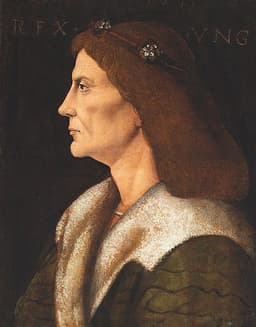
Matthias Corvinus
Emperor · Medieval
60.7Total

Napoleon Bonaparte
General · Modern
70.9Total
Basic Information
Born
1443
1769
Died
1490
1821
Era
Medieval
Modern
Nationality
Hungary
France
Occupation
Emperor
General
Civilization
Western
Western
Score Comparison
Military (10%)
80.0
94.0
Political (20%)
59.3
72.0
Influence (20%)
55.0
40.0
Legacy (20%)
52.0
80.0
Leadership (15%)
66.0
78.0
Strategy (15%)
72.0
90.0
TOTAL
60.7
70.9
Matthias Corvinus — Complete Timeline
1458 AD
Coronation as King of HungaryPolitical Action◆ Major
Matthias Corvinus was elected and crowned King of Hungary at the age of 14, following the death of his father John Hunyadi. His coronation was supported by the Hungarian nobility, who expected him to be a figurehead.
CoronationHungaryHunyadi
Impact: nationalconstructive
1460 AD
Establishment of the Black ArmyReform◆ Major
Matthias created a professional standing army, the Black Army, composed of mercenaries and paid soldiers. This force became one of the most effective in Europe, enabling his military campaigns and reducing reliance on feudal levies.
Military ReformBlack ArmyMercenaries
Impact: regionalconstructive
1470 AD
Foundation of the Bibliotheca CorvinianaCultural◆ Major
Matthias established one of the largest and most renowned libraries in Renaissance Europe, the Bibliotheca Corviniana in Buda. The library housed thousands of manuscripts and printed books, attracting scholars from across Europe.
LibraryRenaissanceCulture
Impact: regionalconstructive
1477 AD
War with Frederick III of HabsburgWar◆ Major
Matthias waged a war against Holy Roman Emperor Frederick III over claims to the Hungarian throne and Austrian territories. The conflict ended with the Peace of Pressburg, which recognized Matthias's conquests but failed to secure the imperial crown.
WarHabsburgAustria
Impact: regional
1485 AD
Conquest of ViennaWar◆ Major
Matthias captured Vienna after a prolonged siege, making it his new capital. This conquest marked the peak of Hungarian power, extending his rule over much of Austria and challenging the Habsburgs.
ConquestViennaHabsburg
Impact: regional
Napoleon Bonaparte — Complete Timeline
1799 AD
Coup of 18 BrumaireOther◆ Major
Napoleon Bonaparte, with support from his brother Lucien and key political figures, overthrew the Directory in a bloodless coup. He established the Consulate with himself as First Consul, effectively becoming the ruler of France. This event ended the French Revolution's most unstable period.
French RevolutionCoupRise to Power
Impact: regional
1804 AD
Promulgation of the Napoleonic CodeOther◆ Major
Napoleon enacted the Civil Code of the French, known as the Napoleonic Code, a comprehensive set of laws that replaced the fragmented feudal legal systems. The code established legal equality, protected property rights, and secularized law. It became the basis for legal systems in many European and world countries.
Legal ReformNapoleonic CodeCivil Law
Impact: globalconstructive
1805 AD
Battle of AusterlitzWar◆ Major
Napoleon's Grande Arm
Napoleonic WarsBattleDecisive Victory
Impact: global
1812 AD
Invasion of RussiaWar◆ Major
Napoleon led the Grande Arm
Napoleonic WarsInvasionDisaster
Impact: globaldestructive
1815 AD
Battle of WaterlooWar◆ Major
Napoleon's French army was defeated by the combined forces of the Duke of Wellington's Anglo-Allied army and Gebhard Leberecht von Bl
Napoleonic WarsBattleFinal Defeat
Impact: globaldestructive
Expert Analysis
Origins
Matthias Corvinus was born in 1443 in Kolozsvár, Kingdom of Hungary, the second son of John Hunyadi, a leading military commander. His father died in 1456, and Matthias was elected king at age 14 in 1458, following the death of Ladislaus V. His early years were shaped by the Ottoman threat and internal noble factions. Napoleon Bonaparte was born in 1769 in Ajaccio, Corsica, to a minor noble family. He studied at military schools in Brienne and Paris, graduating in 1785 as a second lieutenant. The French Revolution opened opportunities for rapid advancement.
Rise to Power
Matthias consolidated power by defeating rival nobles, notably the Garai family, and securing support from the lesser nobility. He was crowned in 1458 but faced opposition from Emperor Frederick III, who claimed the Hungarian throne. In 1464, Matthias captured the Holy Crown from Frederick, solidifying his legitimacy. His rise was marked by military campaigns against the Ottomans and his Habsburg rival. Napoleon rose through the ranks during the Revolutionary Wars. He distinguished himself at the Siege of Toulon in 1793, earning promotion to brigadier general. In 1795, he suppressed a royalist revolt in Paris. His Italian campaign of 1796-1797 made him a national hero. The Coup of 18 Brumaire in 1799 overthrew the Directory, making him First Consul. He crowned himself Emperor in 1804.
Leadership & Governance
Matthias ruled as a Renaissance prince, centralizing authority and reducing the power of the barons. He reformed the judicial system, established a royal court, and promoted culture. He created the Black Army, a professional force of up to 30,000 men, funded by heavy taxation. His governance was pragmatic, balancing nobility and church. Napoleon centralized the French state, creating the Napoleonic Code in 1804, which standardized laws across France. He established the Bank of France, reformed education, and created a merit-based bureaucracy. His governance was authoritarian, with limited freedoms. While Matthias scored 72.0 in political score, Napoleon scored 75.0, reflecting his more systematic reforms.
Triumph & Tragedy
Matthias's greatest triumph was the capture of Vienna in 1485, making it his capital and extending Hungarian power into Austria. His Bibliotheca Corviniana housed over 2,000 manuscripts, a Renaissance treasure. However, his heavy taxation and centralization alienated nobles, and his empire crumbled after his death in 1490. The Black Army was disbanded, and the library was destroyed by the Ottomans. Napoleon's triumph was the Battle of Austerlitz in 1805, where he defeated a larger Russo-Austrian army. His Napoleonic Code influenced legal systems worldwide. His tragedy was the invasion of Russia in 1812, where his Grande Armée of over 600,000 men was destroyed by winter and scorched-earth tactics. He was exiled to Elba in 1814, returned briefly, but was defeated at Waterloo in 1815 and exiled to Saint Helena. Napoleon scored 94.0 in military, Matthias 65.4, reflecting Napoleon's larger scale of conquest.
Character & Destiny
Matthias was pragmatic, cultured, and ambitious, but his reliance on mercenaries and heavy taxes sowed seeds of instability. He was a patron of learning but also a ruthless ruler. His destiny was to be a great but temporary king: his achievements did not outlive him. Napoleon was charismatic, brilliant, and overconfident. His ambition led him to conquer Europe but also to overreach. He once said, "Power is my mistress." His character combined strategic genius with a fatal inability to compromise. His destiny was to reshape Europe but ultimately fall due to his own hubris. Historian Paul Johnson noted Napoleon's "inability to stop." Matthias's leadership score is 72.0, Napoleon's 80.0.
Legacy
Matthias's legacy is mixed: he is remembered as a Renaissance king, but his empire vanished quickly. The Bibliotheca Corviniana symbolizes his cultural impact, but few works survive. His military innovations influenced later Hungarian armies. Napoleon's legacy is immense: he redrew Europe's map, spread nationalist ideas, and his code civil remains a foundation of civil law in many countries. His military tactics are studied worldwide. He scored 78.0 in legacy, Matthias 66.9. Napoleon's influence score is 82.0, Matthias 77.9.
Conclusion
Napoleon Bonaparte had a greater impact than Matthias Corvinus. With a total score of 82.4 vs 71.8, Napoleon's military conquests, legal reforms, and lasting influence on modern statecraft surpass Matthias's more localized achievements. While Matthias was a remarkable Renaissance ruler, his empire collapsed immediately. Napoleon reshaped Europe permanently, and his Napoleonic Code endures. The score gap of 10.6 points reflects this disparity.
Rankings
🥇
Napoleon BonaparteLeader
Mil: 94.0Pol: 72.0Inf: 40.0
70.9
🥈
Matthias Corvinus
Mil: 80.0Pol: 59.3Inf: 55.0
60.7
+10.2 behind
How This Comparison Works
Algorithm
Each figure is scored on 6 dimensions (0—100 scale) based on structured historical data: Military (10%), Political (20%), Influence (20%), Legacy (20%), Leadership (15%), Strategy (15%). The weighted total produces the final ranking.
Data Sources
Scores are computed from structured sub-indicators in the database. Scale factors adjust for era (Ancient ×0.85, Modern ×1.0) and civilization size (Eastern ×1.05, Other ×0.80) to account for differences in population and military scale.
Maximum 3 Figures
Comparisons are limited to 2—3 figures to ensure readability and statistical meaningfulness.
Error Margins
±5 points per dimension — Sub-scores are derived from historical records with inherent uncertainty. Two figures within 5 points on a dimension should be considered roughly equivalent in that area.
Total Score Accuracy
±3 points overall — The weighted combination of 6 dimensions produces a total score with approximately ±3 points of uncertainty. Differences of less than 3 points are not statistically significant— the figures are effectively tied.
Known Limitations
- Historical records are incomplete and uneven across civilizations
- Figures from oral-tradition societies may be underrepresented
- Occupation labels can misclassify multi-role figures
- Scores measure capability and impact, not moral character
- Quantitative scoring is a comparison tool, not absolute truth
Capability Radar
Military (10%) — Battles & Warfare
Battles
75
95
Win Rate
80
90
Expansion
75
95
Political (20%) — Governance & Reform
Reform
80
95
Diplomacy
70
80
Economy
75
85
Influence (20%) — Cultural & Global Reach
Cultural
75
85
Global
55
90
Legacy (20%) — Historical Impact
Historical
70
95
Longevity
60
90
Leadership (15%) — Power & Stability
Tenure
70
85
Stability
65
70
Strategy (15%) — Tactics & Innovation
Strategy
80
95
Tactics
85
98
Reform
85
92
Similar Comparisons
Comments & Discussion
No comments yet. Be the first to share your thoughts!