Loading...
This comparison has not been analyzed yet.
One-time AI generation (~1 minute). Scores and timeline are already available below.
Mbandzeni vs Umberto II of Italy
Mbandzeni leads by 7.5 pts · 2 figures compared
…

Mbandzeni
Emperor · Modern
48.7Total
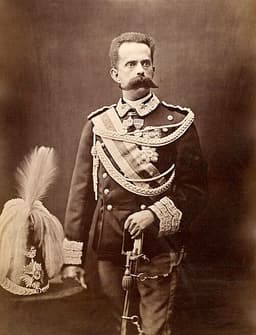
Umberto II of Italy
Emperor · Modern
41.2Total
Basic Information
Born
1855
1904
Died
1889
1983
Era
Modern
Modern
Nationality
Eswatini
Italy
Occupation
Emperor
Emperor
Civilization
Other
Western
Score Comparison
Military (10%)
20.0
46.1
Political (20%)
54.7
45.1
Influence (20%)
51.8
45.5
Legacy (20%)
43.3
35.8
Leadership (15%)
62.2
33.6
Strategy (15%)
54.3
45.0
TOTAL
48.7
41.2
Mbandzeni — Complete Timeline
1880 AD
Granting of Land Concessions to EuropeansPolitical Action◆ Major
Mbandzeni issued numerous land concessions to European settlers, miners, and traders, granting rights to vast areas of Swazi territory. By 1889, nearly all Swazi land was claimed by foreigners, undermining traditional land tenure.
Land ConcessionsColonial EncroachmentEconomic Change
Impact: nationaldestructive
1881 AD
Signing of the First Swazi ConventionPolitical Action◆ Major
Mbandzeni signed a convention with the British and Transvaal governments that defined Swaziland's borders and recognized its independence. However, the agreement failed to protect Swazi sovereignty from increasing European pressure.
TreatyBorder DefinitionDiplomacy
Impact: regional
1888 AD
Establishment of the Swaziland Concessions CommissionPolitical Action
Mbandzeni agreed to the creation of a commission to adjudicate land disputes between Swazis and European concessionaires. This body later became a tool for colonial control, as it often ruled in favor of settlers.
Land DisputesColonial AdministrationLegal System
Impact: nationaldestructive
Umberto II of Italy — Complete Timeline
1946 AD
Accession to the ThronePolitical Action◆ Major
Umberto II became King of Italy upon his father Victor Emmanuel III's abdication. His reign lasted only 34 days, from May 9 to June 12, 1946, during the constitutional referendum on the monarchy.
MonarchySuccession
Impact: national
1946 Italian Institutional ReferendumPolitical Action
Umberto II accepted the results of the referendum that abolished the monarchy in favor of a republic. He went into exile in Portugal, never returning to Italy, ending the Savoy dynasty's rule.
ReferendumRepublicExile
Impact: national
Exile in CascaisPolitical Action
Umberto II settled in Cascais, Portugal, after the monarchy was abolished. He lived there for the rest of his life, never abdicating his claim to the throne, and became a symbolic figure for Italian monarchists.
ExileMonarchy
Impact: national
This comparison has not been analyzed yet.
One-time AI generation (~1 minute). Scores and timeline are already available below.
Rankings
🥇
MbandzeniLeader
Mil: 20.0Pol: 54.7Inf: 51.8
48.7
🥈
Umberto II of Italy
Mil: 46.1Pol: 45.1Inf: 45.5
41.2
+7.5 behind
How This Comparison Works
Algorithm
Each figure is scored on 6 dimensions (0—100 scale) based on structured historical data: Military (10%), Political (20%), Influence (20%), Legacy (20%), Leadership (15%), Strategy (15%). The weighted total produces the final ranking.
Data Sources
Scores are computed from structured sub-indicators in the database. Scale factors adjust for era (Ancient ×0.85, Modern ×1.0) and civilization size (Eastern ×1.05, Other ×0.80) to account for differences in population and military scale.
Maximum 3 Figures
Comparisons are limited to 2—3 figures to ensure readability and statistical meaningfulness.
Error Margins
±5 points per dimension — Sub-scores are derived from historical records with inherent uncertainty. Two figures within 5 points on a dimension should be considered roughly equivalent in that area.
Total Score Accuracy
±3 points overall — The weighted combination of 6 dimensions produces a total score with approximately ±3 points of uncertainty. Differences of less than 3 points are not statistically significant— the figures are effectively tied.
Known Limitations
- Historical records are incomplete and uneven across civilizations
- Figures from oral-tradition societies may be underrepresented
- Occupation labels can misclassify multi-role figures
- Scores measure capability and impact, not moral character
- Quantitative scoring is a comparison tool, not absolute truth
Capability Radar
Military (10%) — Battles & Warfare
Battles
5
23
Win Rate
5
28
Expansion
5
33
Political (20%) — Governance & Reform
Reform
30
0
Diplomacy
50
10
Economy
30
0
Influence (20%) — Cultural & Global Reach
Cultural
30
5
Global
20
5
Legacy (20%) — Historical Impact
Historical
40
10
Longevity
30
5
Leadership (15%) — Power & Stability
Tenure
40
5
Stability
20
5
Strategy (15%) — Tactics & Innovation
Strategy
5
32
Tactics
5
34
Reform
5
36
Similar Comparisons
Comments & Discussion
No comments yet. Be the first to share your thoughts!