Loading...
Mehmed Emin Rauf Pasha vs Napoleon Bonaparte
Napoleon Bonaparte leads by 21.0 pts · 2 figures compared
…
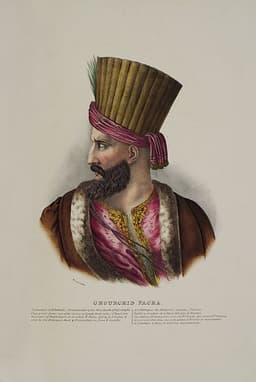
Mehmed Emin Rauf Pasha
Politician · Modern
49.9Total

Napoleon Bonaparte
General · Modern
70.9Total
Basic Information
Born
1780
1769
Died
1859
1821
Era
Modern
Modern
Nationality
Ottoman Empire
France
Occupation
Politician
General
Civilization
Middle Eastern
Western
Score Comparison
Military (10%)
36.6
94.0
Political (20%)
68.0
72.0
Influence (20%)
49.4
40.0
Legacy (20%)
41.7
80.0
Leadership (15%)
53.2
78.0
Strategy (15%)
53.0
90.0
TOTAL
49.9
70.9
Mehmed Emin Rauf Pasha — Complete Timeline
1839 AD
Tanzimat Reforms ImplementationReform◆ Major
Mehmed Emin Rauf Pasha served as grand vizier during the early Tanzimat period, implementing reforms that modernized the Ottoman legal and administrative systems. His tenure saw the proclamation of the Edict of G
TanzimatReformModernization
Impact: nationalconstructive
1853 AD
Crimean War DiplomacyPolitical Action◆ Major
During the Crimean War, Mehmed Emin Rauf Pasha managed Ottoman diplomacy, balancing relations with Britain and France against Russia. His efforts helped secure allied support, though the war exposed Ottoman military weaknesses.
Crimean WarDiplomacyAlliance
Impact: global
1859 AD
Five-Time Grand VizierPolitical Action◆ Major
Mehmed Emin Rauf Pasha served as grand vizier five times between 1833 and 1859, a record for the Tanzimat era. His repeated appointments reflected his political skill and the volatile nature of Ottoman politics.
AppointmentPolitical LongevityTanzimat
Impact: national
Napoleon Bonaparte — Complete Timeline
1799 AD
Coup of 18 BrumaireOther◆ Major
Napoleon Bonaparte, with support from his brother Lucien and key political figures, overthrew the Directory in a bloodless coup. He established the Consulate with himself as First Consul, effectively becoming the ruler of France. This event ended the French Revolution's most unstable period.
French RevolutionCoupRise to Power
Impact: regional
1804 AD
Promulgation of the Napoleonic CodeOther◆ Major
Napoleon enacted the Civil Code of the French, known as the Napoleonic Code, a comprehensive set of laws that replaced the fragmented feudal legal systems. The code established legal equality, protected property rights, and secularized law. It became the basis for legal systems in many European and world countries.
Legal ReformNapoleonic CodeCivil Law
Impact: globalconstructive
1805 AD
Battle of AusterlitzWar◆ Major
Napoleon's Grande Arm
Napoleonic WarsBattleDecisive Victory
Impact: global
1812 AD
Invasion of RussiaWar◆ Major
Napoleon led the Grande Arm
Napoleonic WarsInvasionDisaster
Impact: globaldestructive
1815 AD
Battle of WaterlooWar◆ Major
Napoleon's French army was defeated by the combined forces of the Duke of Wellington's Anglo-Allied army and Gebhard Leberecht von Bl
Napoleonic WarsBattleFinal Defeat
Impact: globaldestructive
Expert Analysis
mehmed-emin-rauf-pasha-vs-napoleon-bonaparte
# The Emperor and the Bureaucrat: Two Paths Through the Storm of Modernity
In the winter of 1815, as Napoleon Bonaparte paced the deck of the *Northumberland* bound for St. Helena, a boy of five was growing up in Istanbul who would never command an army, never conquer a capital, never see his name carved into the Arc de Triomphe. Yet Mehmed Emin Rauf Pasha would outlast Napoleon by nearly four decades, serving five times as grand vizier of an empire the French emperor had once threatened to dismantle. One man changed the map of Europe; the other held together the fraying threads of a dying empire. What drove these two men, born only eleven years apart, to such radically different destinies?
Origins
Napoleon Bonaparte was born in 1769 on Corsica, an island that had become French property only months before his birth. His family was minor nobility, but poor—his father, Carlo, was a lawyer who ingratiated himself with the French occupiers. Napoleon grew up speaking Italian, not French, and carried a lifelong chip on his shoulder about his outsider status. The French Revolution, which erupted when he was twenty, shattered the old order and opened a path for ambitious young men of talent. Napoleon seized it with both hands.
Mehmed Emin Rauf Pasha, born in 1780 in Istanbul, came from a world that seemed immutable. The Ottoman Empire had ruled for centuries, its sultans commanding the loyalty of Muslims from the Balkans to Arabia. Rauf Pasha was a product of the Ottoman bureaucratic class—educated in the palace school, trained in the arts of administration and diplomacy. Unlike Napoleon, he did not need to storm a Bastille to find opportunity; the Ottoman system rewarded loyal service within its ancient hierarchies. But that system was under siege, and Rauf Pasha would spend his entire career trying to patch its cracks.
Rise to Power
Napoleon’s ascent was meteoric and violent. In 1793, at twenty-four, he drove British forces from Toulon and was promoted to brigadier general. By 1796, he commanded the Army of Italy and won a series of stunning victories that made him a national hero. In 1799, he returned from an Egyptian campaign to stage a coup d’état, becoming First Consul. Five years later, he crowned himself Emperor of the French. Each step was a gamble, each victory a stepping stone to the next—and each defeat, as he would learn, could send him tumbling back.
Rauf Pasha’s rise was slower, steadier, and far less dramatic. He entered the imperial bureaucracy as a young clerk, rising through the ranks of the Sublime Porte. His first appointment as grand vizier came in 1833, when he was fifty-three—an age at which Napoleon had already conquered Europe and been exiled twice. Rauf Pasha’s path was not one of battlefield glory but of administrative competence, of being the man the sultan could trust to manage the empire’s chaotic finances and navigate its treacherous diplomacy.
Leadership & Governance
Napoleon governed as he fought: with speed, decisiveness, and a ruthless focus on results. He centralized the French state, reorganized the legal system into the Napoleonic Code (which abolished feudal privileges and established equality before the law), and created a meritocratic bureaucracy. He was a military genius—his campaigns at Austerlitz in 1805 and Jena in 1806 remain textbook examples of strategic brilliance—but his political wisdom was limited to his own ambition. He could not share power, could not delegate effectively, and could not recognize when his empire had grown too large to control.
Rauf Pasha governed as a healer of wounds. The Tanzimat Reforms, which began in 1839 during his first term as grand vizier, were a deliberate effort to modernize the Ottoman Empire from within—to grant legal equality to all subjects, reform the tax system, and create a modern army. It was a slow, painful process, resisted by conservatives and criticized by reformers as too timid. Rauf Pasha was not a visionary; he was a pragmatist, a man who believed that the empire could survive only by adapting, but who knew that change had to be managed carefully to avoid collapse.
Triumph & Tragedy
Napoleon’s greatest triumph was his empire—at its height in 1812, he controlled most of Europe from Spain to Poland. His greatest tragedy was the invasion of Russia that same year. The Grande Armée of 600,000 men marched into a frozen wasteland and emerged with fewer than 100,000. It was a catastrophic miscalculation born of hubris, the belief that he could bend nature and geography to his will. He never fully recovered.
Rauf Pasha’s triumphs were quiet ones: the implementation of the Tanzimat, the successful navigation of Ottoman diplomacy during the Crimean War in 1853, the fact that he served as grand vizier five times—a record for the Tanzimat era. His tragedy was that none of it was enough. The Ottoman Empire was bleeding territory and legitimacy, and no reform, however well-intentioned, could stop the hemorrhage. He died in 1859, the year the empire’s decline became irreversible.
Character & Destiny
Napoleon was driven by an insatiable hunger for glory. “I am not a man, but a thing,” he once said, meaning that he had become a force of history, a figure who could not stop because to stop was to cease to exist. His personality—brilliant, arrogant, paranoid, and endlessly energetic—shaped every decision. He trusted no one, forgave no one, and ultimately destroyed himself by refusing to accept limits.
Rauf Pasha was driven by duty. He served five different sultans, each with his own agenda, and managed to survive the purges and intrigues that destroyed so many of his contemporaries. He was not a genius, but he was patient, adaptable, and deeply loyal to the empire he served. His destiny was not to conquer but to endure—to be the man who kept the machinery of state running while the world changed around him.
Legacy
Napoleon’s legacy is written in stone and law. The Napoleonic Code influenced legal systems across Europe and the Americas. His military campaigns are studied in war colleges to this day. He is remembered as a titan, a man who remade the world in his image—and then saw it slip away.
Rauf Pasha’s legacy is more modest, but no less real. The Tanzimat Reforms, however incomplete, laid the groundwork for modern Turkey. His career demonstrated that the Ottoman Empire could produce capable, loyal administrators who understood the need for change. He is not a household name, but he is remembered by historians as a symbol of the empire’s struggle to adapt.
Conclusion
Standing side by side, these two men seem to belong to different species—one a comet that blazed across the sky, the other a candle that burned steadily through the night. But both were products of their time, responding to the same fundamental challenge: how to govern in an age of revolution and empire. Napoleon chose conquest; Rauf Pasha chose reform. One ended his life in exile, the other in office. One is remembered for his glory, the other for his service. Both stories remind us that history is not only made by those who take by force, but by those who hold on with patience.
Rankings
🥇
Napoleon BonaparteLeader
Mil: 94.0Pol: 72.0Inf: 40.0
70.9
🥈
Mehmed Emin Rauf Pasha
Mil: 36.6Pol: 68.0Inf: 49.4
49.9
+21.0 behind
How This Comparison Works
Algorithm
Each figure is scored on 6 dimensions (0—100 scale) based on structured historical data: Military (10%), Political (20%), Influence (20%), Legacy (20%), Leadership (15%), Strategy (15%). The weighted total produces the final ranking.
Data Sources
Scores are computed from structured sub-indicators in the database. Scale factors adjust for era (Ancient ×0.85, Modern ×1.0) and civilization size (Eastern ×1.05, Other ×0.80) to account for differences in population and military scale.
Maximum 3 Figures
Comparisons are limited to 2—3 figures to ensure readability and statistical meaningfulness.
Error Margins
±5 points per dimension — Sub-scores are derived from historical records with inherent uncertainty. Two figures within 5 points on a dimension should be considered roughly equivalent in that area.
Total Score Accuracy
±3 points overall — The weighted combination of 6 dimensions produces a total score with approximately ±3 points of uncertainty. Differences of less than 3 points are not statistically significant— the figures are effectively tied.
Known Limitations
- Historical records are incomplete and uneven across civilizations
- Figures from oral-tradition societies may be underrepresented
- Occupation labels can misclassify multi-role figures
- Scores measure capability and impact, not moral character
- Quantitative scoring is a comparison tool, not absolute truth
Capability Radar
Military (10%) — Battles & Warfare
Battles
5
95
Win Rate
5
90
Expansion
5
95
Political (20%) — Governance & Reform
Reform
55
95
Diplomacy
50
80
Economy
45
85
Influence (20%) — Cultural & Global Reach
Cultural
20
85
Global
15
90
Legacy (20%) — Historical Impact
Historical
30
95
Longevity
20
90
Leadership (15%) — Power & Stability
Tenure
60
85
Stability
40
70
Strategy (15%) — Tactics & Innovation
Strategy
5
95
Tactics
5
98
Reform
10
92
Similar Comparisons
Comments & Discussion
CorsicaSlasher6/17/2026
Rauf Pasha was the Ottoman equivalent of a master plumber plugging leaks in a sinking ship, while Napoleon was an arsonist who burned down the neighborhood to build his own palace. Napoleon conquered Europe in a decade; Rauf Pasha held his crumbling empire together through the Greek War of Independence and the Muhammad Ali crisis. One rewrote laws, the other just enforced them. Give me the visionary over the caretaker any day.
安卡拉的算盘6/17/2026
别被拿破仑的军装骗了——他靠的是运气和地图上的错误,而拉乌夫帕夏靠的是预算表和外交辞令。拿破仑在埃及输给了英军和瘟疫,拉乌夫却在同一时期(1808-1837)稳定了奥斯曼财政,甚至没让帝国破产。数据不会撒谎:拿破仑的战争让法国负债累累,拉乌夫的节俭治国让伊斯坦布尔还能给官员发工资。谁更持久?看看结局就知道了。