Loading...
Mehmed II vs Napoleon Bonaparte
Napoleon Bonaparte leads by 4.1 pts · 2 figures compared
…
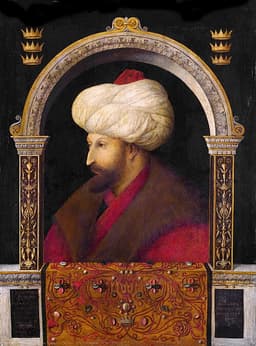
Mehmed II
Emperor · Medieval
66.8Total

Napoleon Bonaparte
General · Modern
70.9Total
Basic Information
Born
1432
1769
Died
1481
1821
Era
Medieval
Modern
Nationality
Ottoman Empire
France
Occupation
Emperor
General
Civilization
Middle Eastern
Western
Score Comparison
Military (10%)
77.5
94.0
Political (20%)
70.3
72.0
Influence (20%)
40.0
40.0
Legacy (20%)
75.0
80.0
Leadership (15%)
78.0
78.0
Strategy (15%)
80.3
90.0
TOTAL
66.8
70.9
Mehmed II — Complete Timeline
1453 AD
Siege of ConstantinopleWar
Mehmed II led the Ottoman army in a 53-day siege of Constantinople, the capital of the Byzantine Empire. The city fell on May 29, 1453, after Ottoman forces breached the walls. This conquest ended the Byzantine Empire and established Constantinople as the Ottoman capital, later renamed Istanbul.
ConquestByzantine EmpireOttoman Expansion
Impact: global
1456 AD
Siege of BelgradeWar◆ Major
Mehmed II led a large Ottoman army to besiege Belgrade, a key Hungarian fortress. The siege was broken by a Christian relief force led by John Hunyadi. The Ottoman army suffered heavy losses and was forced to retreat. This defeat halted Ottoman expansion into Hungary for decades.
SiegeDefeatHungary
Impact: regional
1461 AD
Conquest of the Empire of TrebizondWar◆ Major
Mehmed II led a military campaign against the Empire of Trebizond, the last major Byzantine Greek successor state. After a siege of the capital, Emperor David Megas Komnenos surrendered. This conquest eliminated the final remnant of Byzantine authority in Anatolia.
ConquestAnatoliaByzantine Successor
Impact: regional
1478 AD
Codification of Ottoman Law (Kanunname)Reform◆ Major
Mehmed II issued the Kanunname, a comprehensive legal code that systematized Ottoman criminal, administrative, and land law. This code defined the powers of the sultan, the structure of the bureaucracy, and the rights of subjects. It provided a legal framework for the expanding empire.
Legal ReformOttoman LawAdministration
Impact: nationalconstructive
1480 AD
Invasion of OtrantoWar
Mehmed II ordered an Ottoman fleet to invade the Italian city of Otranto. Ottoman forces captured the city and massacred many inhabitants. This invasion established a temporary Ottoman foothold in Italy, causing alarm among Italian states. The occupation ended after Mehmed's death.
InvasionItalyOttoman Expansion
Impact: regionaldestructive
Napoleon Bonaparte — Complete Timeline
1799 AD
Coup of 18 BrumaireOther◆ Major
Napoleon Bonaparte, with support from his brother Lucien and key political figures, overthrew the Directory in a bloodless coup. He established the Consulate with himself as First Consul, effectively becoming the ruler of France. This event ended the French Revolution's most unstable period.
French RevolutionCoupRise to Power
Impact: regional
1804 AD
Promulgation of the Napoleonic CodeOther◆ Major
Napoleon enacted the Civil Code of the French, known as the Napoleonic Code, a comprehensive set of laws that replaced the fragmented feudal legal systems. The code established legal equality, protected property rights, and secularized law. It became the basis for legal systems in many European and world countries.
Legal ReformNapoleonic CodeCivil Law
Impact: globalconstructive
1805 AD
Battle of AusterlitzWar◆ Major
Napoleon's Grande Arm
Napoleonic WarsBattleDecisive Victory
Impact: global
1812 AD
Invasion of RussiaWar◆ Major
Napoleon led the Grande Arm
Napoleonic WarsInvasionDisaster
Impact: globaldestructive
1815 AD
Battle of WaterlooWar◆ Major
Napoleon's French army was defeated by the combined forces of the Duke of Wellington's Anglo-Allied army and Gebhard Leberecht von Bl
Napoleonic WarsBattleFinal Defeat
Impact: globaldestructive
Expert Analysis
mehmed-ii-vs-napoleon-bonaparte
### Two Titans of Conquest: Napoleon and Mehmed II
In the spring of 1453, a twenty-one-year-old sultan watched his cannons breach the ancient walls of Constantinople, a city that had stood impregnable for a thousand years. Three and a half centuries later, another young general, just twenty-seven, stood before the pyramids of Egypt, telling his 40,000 troops that forty centuries looked down upon them. Both men, born into worlds apart, would bend history to their will. Yet their paths, so similar in ambition, diverged so sharply in outcome that they raise a haunting question: what separates a conqueror who builds an empire from one who loses it?
**Origins**
Mehmed II entered the world in 1432 in Edirne, the Ottoman capital, as the fourth son of Sultan Murad II. His mother was a slave concubine, likely of Christian origin, a fact that placed him low in the succession. But Mehmed was a scholar’s child. He studied philosophy, science, and military theory under the finest tutors of the Islamic world, and could read Greek, Latin, Arabic, and Persian. His father, sensing his brilliance, had him enthroned at twelve, then deposed him at fourteen when the boy’s arrogance alienated the court. This early taste of power and loss forged a ruthlessness that would define his reign.
Napoleon Bonaparte was born in 1769 on the Mediterranean island of Corsica, a year after France purchased it from Genoa. His family were minor Italian nobility, but they lived in a backwater, speaking a dialect that French aristocrats mocked. Napoleon was sent to military school in mainland France at nine, where classmates taunted him for his accent and poverty. He devoured history and strategy, but he never forgot the sting of being an outsider. Where Mehmed inherited a stable, expanding empire, Napoleon inherited a revolution.
**Rise to Power**
Mehmed’s second accession in 1451 was a masterstroke of calculation. He had spent his years out of power studying, plotting, and building alliances with the Janissaries—the elite slave-soldiers who had become kingmakers in Ottoman politics. He bribed them, promised them glory, and crushed all rivals, including his own infant half-brother, whom he had strangled in the bath. By the time he marched on Constantinople in 1453, he commanded an army of perhaps 80,000 men and a fleet of 320 ships. The siege, lasting fifty-three days, was a symphony of innovation: he dragged ships overland to bypass the Byzantine boom, and his Hungarian engineer Urban cast the largest cannon ever built, a bronze monster that fired 1,200-pound stone balls.
Napoleon’s rise was a staircase of victories. In 1793, at twenty-four, he drove the British out of Toulon with a daring artillery plan. By 1796, he commanded the French army in Italy, where he defeated larger Austrian forces in a lightning campaign that made him a national hero. In 1799, he returned from Egypt to stage a coup, becoming First Consul of France at thirty. By 1804, he crowned himself Emperor in Notre Dame, taking the crown from the Pope’s hands and placing it on his own head. His path was built on merit, not birth—a product of the Revolution that had shattered the old order.
**Leadership & Governance**
Mehmed ruled as an absolute monarch with a genius for institutional design. After conquering Constantinople, he repopulated it by forcibly relocating Muslims, Christians, and Jews from across his empire, creating a cosmopolitan capital. He issued the Kanunname in 1478, a comprehensive legal code that systematized everything from criminal justice to land tenure, blending Islamic sharia with secular imperial law. He was a patron of science and art, inviting the Italian painter Gentile Bellini to his court. Yet his military strategy was methodical, not flashy: he besieged Belgrade in 1456 but failed when a Christian relief army broke his lines; he conquered Trebizond in 1461 through a combination of siege and negotiation. He was a builder, not a gambler.
Napoleon governed with a different philosophy: total rationalization. The Napoleonic Code of 1804 standardized French law, abolishing feudal privileges and establishing equality before the law. He reformed education, built roads, and created the Bank of France. But his military style was all speed and shock. He won the Battle of Austerlitz in 1805 by luring the Russians and Austrians into a trap, then crushing their center. He defeated Prussia in 1806 at Jena in a single day. Yet his conquests were unsustainable: he installed brothers and marshals as puppet kings, looted treasuries, and forced conscription, breeding resentment across Europe.
**Triumph & Tragedy**
Mehmed’s greatest triumph was Constantinople, but his tragedy was the Siege of Belgrade. In 1456, he led a massive army to take the Hungarian fortress, only to be defeated by a peasant crusade led by John Hunyadi. The failure stopped Ottoman expansion into Hungary for a generation. Yet Mehmed learned from it: he never again underestimated his enemies, and he spent the rest of his reign consolidating, not overreaching. He died in 1481, possibly poisoned, at forty-nine, but his empire was intact and growing.
Napoleon’s triumph was Austerlitz, where he destroyed a coalition army and forced the Holy Roman Empire to dissolve. His tragedy was the invasion of Russia in 1812. He marched 600,000 men into the vastness, won every battle, and captured Moscow—only to find it burning. The retreat killed 500,000 soldiers. He was exiled to Elba in 1814, returned for the Hundred Days, and met his final defeat at Waterloo in 1815, where his cavalry charged into British squares and broke. He died in 1821 on Saint Helena, a prisoner.
**Character & Destiny**
Mehmed was calculating and patient. He studied his enemies, bribed their officials, and waited for the right moment. He was capable of cruelty—he had his brother killed, and after Constantinople fell, he allowed three days of looting—but he also granted religious freedom to his subjects. His personality was that of a builder: he wanted to create an empire that would outlast him.
Napoleon was restless and narcissistic. He believed in his own star, once saying, “Impossible is a word to be found only in the dictionary of fools.” He trusted his genius over logistics, his speed over strategy. He could inspire men to die for him, but he could not stop. His personality was that of a gambler: he kept doubling down until the house took everything.
**Legacy**
Mehmed II is remembered as the Conqueror, the man who ended the Byzantine Empire and made Istanbul a world capital. His Kanunname influenced Ottoman law for centuries. His legacy is stable and honored: Turkey still celebrates the conquest, and the Fatih Sultan Mehmed Bridge spans the Bosphorus.
Napoleon’s legacy is a paradox. He spread the ideals of the French Revolution—nationalism, meritocracy, legal equality—across Europe, but at the cost of millions of lives. The Napoleonic Code is the foundation of civil law in many nations. Yet he is remembered as both a hero and a tyrant, a genius and a cautionary tale.
**Conclusion**
In the end, Mehmed succeeded where Napoleon failed because he understood the limits of power. He conquered a city, not a continent; he built institutions, not just victories. Napoleon conquered everything and held nothing. Both men changed the world, but only one left an empire that outlived him. Perhaps the lesson is this: history rewards those who know when to stop.
Rankings
🥇
Napoleon BonaparteLeader
Mil: 94.0Pol: 72.0Inf: 40.0
70.9
🥈
Mehmed II
Mil: 77.5Pol: 70.3Inf: 40.0
66.8
+4.1 behind
How This Comparison Works
Algorithm
Each figure is scored on 6 dimensions (0—100 scale) based on structured historical data: Military (10%), Political (20%), Influence (20%), Legacy (20%), Leadership (15%), Strategy (15%). The weighted total produces the final ranking.
Data Sources
Scores are computed from structured sub-indicators in the database. Scale factors adjust for era (Ancient ×0.85, Modern ×1.0) and civilization size (Eastern ×1.05, Other ×0.80) to account for differences in population and military scale.
Maximum 3 Figures
Comparisons are limited to 2—3 figures to ensure readability and statistical meaningfulness.
Error Margins
±5 points per dimension — Sub-scores are derived from historical records with inherent uncertainty. Two figures within 5 points on a dimension should be considered roughly equivalent in that area.
Total Score Accuracy
±3 points overall — The weighted combination of 6 dimensions produces a total score with approximately ±3 points of uncertainty. Differences of less than 3 points are not statistically significant— the figures are effectively tied.
Known Limitations
- Historical records are incomplete and uneven across civilizations
- Figures from oral-tradition societies may be underrepresented
- Occupation labels can misclassify multi-role figures
- Scores measure capability and impact, not moral character
- Quantitative scoring is a comparison tool, not absolute truth
Capability Radar
Military (10%) — Battles & Warfare
Battles
95
95
Win Rate
90
90
Expansion
95
95
Political (20%) — Governance & Reform
Reform
90
95
Diplomacy
85
80
Economy
80
85
Influence (20%) — Cultural & Global Reach
Cultural
85
85
Global
90
90
Legacy (20%) — Historical Impact
Historical
95
95
Longevity
90
90
Leadership (15%) — Power & Stability
Tenure
85
85
Stability
75
70
Strategy (15%) — Tactics & Innovation
Strategy
95
95
Tactics
95
98
Reform
85
92
Similar Comparisons
Comments & Discussion
No comments yet. Be the first to share your thoughts!