Loading...
Mevlut Cavusoglu vs Napoleon Bonaparte
Napoleon Bonaparte leads by 24.1 pts · 2 figures compared
…
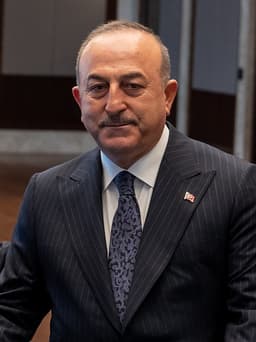
Mevlut Cavusoglu
Politician · Modern
46.8Total

Napoleon Bonaparte
General · Modern
70.9Total
Basic Information
Born
1968
1769
Died
—
1821
Era
Modern
Modern
Nationality
Turkey
France
Occupation
Politician
General
Civilization
Middle Eastern
Western
Score Comparison
Military (10%)
23.5
94.0
Political (20%)
68.0
72.0
Influence (20%)
54.9
40.0
Legacy (20%)
41.7
80.0
Leadership (15%)
40.0
78.0
Strategy (15%)
41.1
90.0
TOTAL
46.8
70.9
Mevlut Cavusoglu — Complete Timeline
2014 AD
Appointed Minister of Foreign AffairsPolitical Action◆ Major
Cavusoglu was appointed Foreign Minister of Turkey on August 29, 2014, serving under President Erdogan. He became one of the longest-serving foreign ministers in Turkish history, overseeing foreign policy during a period of regional turmoil.
Turkish PoliticsForeign PolicyDiplomacy
Impact: national
2016 AD
2016 Turkish coup attempt responsePolitical Action◆ Major
During the July 15, 2016 coup attempt, Cavusoglu was in New York. He coordinated diplomatic efforts to condemn the coup, secured international support for the Turkish government, and later oversaw a purge of foreign ministry personnel linked to the Gulen movement.
Coup AttemptDiplomacyPurge
Impact: national
Syrian conflict diplomacyPolitical Action◆ Major
Cavusoglu played a key role in Turkish foreign policy regarding the Syrian civil war, including the Euphrates Shield operation (2016) and the Idlib ceasefire agreements. He negotiated with Russia and Iran under the Astana process, shaping Turkey's military involvement.
Syrian WarDiplomacyMilitary Intervention
Impact: regional
2020 AD
Eastern Mediterranean tensionsPolitical Action◆ Major
Cavusoglu led Turkey's assertive stance in the Eastern Mediterranean, including disputes over maritime boundaries and energy resources with Greece and Cyprus. He oversaw the deployment of research vessels and diplomatic confrontations with the EU and NATO allies.
Maritime DisputeEnergyNATO
Impact: regional
Napoleon Bonaparte — Complete Timeline
1799 AD
Coup of 18 BrumaireOther◆ Major
Napoleon Bonaparte, with support from his brother Lucien and key political figures, overthrew the Directory in a bloodless coup. He established the Consulate with himself as First Consul, effectively becoming the ruler of France. This event ended the French Revolution's most unstable period.
French RevolutionCoupRise to Power
Impact: regional
1804 AD
Promulgation of the Napoleonic CodeOther◆ Major
Napoleon enacted the Civil Code of the French, known as the Napoleonic Code, a comprehensive set of laws that replaced the fragmented feudal legal systems. The code established legal equality, protected property rights, and secularized law. It became the basis for legal systems in many European and world countries.
Legal ReformNapoleonic CodeCivil Law
Impact: globalconstructive
1805 AD
Battle of AusterlitzWar◆ Major
Napoleon's Grande Arm
Napoleonic WarsBattleDecisive Victory
Impact: global
1812 AD
Invasion of RussiaWar◆ Major
Napoleon led the Grande Arm
Napoleonic WarsInvasionDisaster
Impact: globaldestructive
1815 AD
Battle of WaterlooWar◆ Major
Napoleon's French army was defeated by the combined forces of the Duke of Wellington's Anglo-Allied army and Gebhard Leberecht von Bl
Napoleonic WarsBattleFinal Defeat
Impact: globaldestructive
Expert Analysis
mevlut-cavusoglu-vs-napoleon-bonaparte
# The Emperor and the Diplomat: Two Visions of Power in a Changing World
In the summer of 1815, Napoleon Bonaparte stood on the deck of the *Bellerophon*, watching the coast of France recede into the Atlantic mist. He had conquered an empire from Madrid to Moscow, rewritten the laws of Europe, and now faced exile on a remote volcanic island. Two centuries later, in the summer of 2016, Mevlüt Çavuşoğlu sat in a New York hotel room, his phone buzzing with frantic messages as fighter jets screamed over Ankara. A coup was unfolding in Turkey, and the foreign minister, thousands of miles away, had to hold together a government’s diplomatic legitimacy with nothing but words and a satellite connection. One man commanded armies; the other commanded cables. Both wielded immense power, but their worlds could not have been more different. What drove Napoleon to the edge of the world, and Çavuşoğlu to the center of a shifting geopolitical order? The answer lies not just in their choices, but in the eras that shaped them.
Origins
Napoleon Bonaparte was born in 1769 on the island of Corsica, a year after France purchased the island from Genoa. His family was minor nobility, but they were outsiders in a French world—Corsican by blood, Italian by language, and fiercely ambitious. The French Revolution, which erupted when Napoleon was a twenty-year-old artillery lieutenant, shattered the old order and created a vacuum for talent. He was a child of chaos, raised in a time when a man with a cannon and a mind for mathematics could rise to rule a continent. His education at the military academy of Brienne was harsh, marked by poverty and ridicule from wealthier classmates, but it forged a ruthless pragmatism.
Mevlüt Çavuşoğlu was born in 1968 in Alanya, a coastal town in southern Turkey, into a middle-class family. His father was a customs officer, his mother a housewife. Turkey in the 1960s was a republic still finding its footing—secular, NATO-aligned, but deeply divided between traditionalists and modernizers. Çavuşoğlu studied political science at Ankara University, then earned a master’s in international relations from Long Island University in New York. He was a product of the Cold War’s twilight, fluent in English and comfortable in the corridors of diplomacy. Where Napoleon learned to command through fire and steel, Çavuşoğlu learned to negotiate through memos and press releases.
Rise to Power
Napoleon’s ascent was a series of explosions. At 24, he recaptured the port of Toulon from British forces with a daring artillery plan. At 26, he put down a royalist uprising in Paris with a “whiff of grapeshot”—a volley of cannon fire into the crowd. By 30, he was First Consul of France, having seized power in the coup of 18 Brumaire. His rise was not gradual; it was a cascade of victories that rewrote the map of Europe. The Italian campaign of 1796–1797 made him a legend: he defeated larger Austrian armies through speed, deception, and relentless aggression. He understood that in an age of mass mobilization, a general who could move faster than his enemy could win with fewer men.
Çavuşoğlu’s rise was slower, more procedural. He entered parliament in 2002 as a member of the newly formed Justice and Development Party (AKP), which had swept to power on a wave of economic reform and religious conservatism. He chaired the Council of Europe’s Parliamentary Assembly from 2010 to 2012, a role that required building consensus among 47 member states. When President Recep Tayyip Erdoğan appointed him Foreign Minister in 2014, Çavuşoğlu was 46 years old—older than Napoleon at his coronation. He did not seize power; he was appointed to it, a bureaucrat in a system where the president held the ultimate authority.
Leadership & Governance
Napoleon ruled as an emperor, but he governed as a reformer. His Napoleonic Code, enacted in 1804, standardized French law, abolished feudal privileges, and established principles of equality before the law, property rights, and secular administration. It spread across Europe as his armies marched. He built roads, schools, and a centralized banking system. Yet his governance was authoritarian: he censored the press, suppressed dissent, and crowned himself in Notre-Dame, taking the crown from the pope’s hands to place it on his own head. His military genius was undeniable—he won sixty battles, from Austerlitz in 1805 to Wagram in 1809—but his political wisdom was flawed. He could not stop conquering, even when conquest became unsustainable.
Çavuşoğlu’s leadership was diplomatic, not martial. He managed Turkey’s foreign policy during a period of extraordinary turbulence: the Syrian civil war, the refugee crisis of 2015, tensions with Russia over the downing of a Su-24 jet in 2015, and the confrontation with Greece and Cyprus over energy reserves in the Eastern Mediterranean. His score of 64.5 in political skill reflects a man who operated within constraints, not above them. He could not declare war or command armies; he could only persuade, threaten, and negotiate. During the 2016 coup attempt, he coordinated with foreign leaders from New York, ensuring that no country recognized the coup plotters. He was a voice in a storm, not the storm itself.
Triumph & Tragedy
Napoleon’s greatest moment was Austerlitz, December 2, 1805, where he crushed a combined Russian and Austrian army. It was a masterpiece of deception: he deliberately weakened his right flank to lure the allies into a trap, then struck their center. The battle ended the Third Coalition and cemented his dominance. His greatest tragedy was the invasion of Russia in 1812. He marched 600,000 men into the vastness of the Russian steppe, won the Battle of Borodino, entered Moscow—and found it burning. The retreat through winter killed most of his army. He never recovered. Waterloo in 1815 was the final act: a mud-soaked field, a delayed Prussian arrival, and a broken empire.
Çavuşoğlu’s triumph was subtler. In 2020, he led Turkey’s assertive stance in the Eastern Mediterranean, sending research vessels accompanied by warships into waters claimed by Greece. It was a high-risk gamble that drew condemnation from the European Union, but it secured Turkey’s claims in a region rich with natural gas. His tragedy was Syria. The Euphrates Shield operation in 2016 pushed ISIS from the border, but it also brought Turkey into direct confrontation with Kurdish forces backed by the United States. The war dragged on, creating a refugee crisis and straining relations with NATO allies. Çavuşoğlu could not solve Syria; he could only manage the damage.
Character & Destiny
Napoleon was driven by an insatiable hunger for glory. “Impossible is a word to be found only in the dictionary of fools,” he once said. He believed that destiny was something to be seized, not awaited. This made him brilliant in attack but blind to limits. He could not delegate, could not compromise, could not stop. His personality was a forge that melted all obstacles—and eventually melted him.
Çavuşoğlu, by contrast, was a pragmatist. He did not seek to reshape the world; he sought to navigate it. His 72.0 leadership score reflects a man who was competent, loyal, and durable, but not visionary. He served Erdoğan for nine years, adapting to shifting policies and crises. He was a survivor in a political system that devours the weak. Where Napoleon burned bright and fast, Çavuşoğlu burned steady and long.
Legacy
Napoleon left a Europe remade. The Napoleonic Code influenced civil law in dozens of countries. He destroyed the Holy Roman Empire, sparked nationalism in Germany and Italy, and sold Louisiana to the United States, doubling its size. His legacy score of 78.0 reflects a figure who is both admired and reviled—a genius of war and a tyrant who caused millions of deaths. He is remembered in statues, in the Arc de Triomphe, in the word “Napoleonic.”
Çavuşoğlu’s legacy is more fragile. He served as Turkey’s foreign minister during a period when the country shifted from a NATO loyalist to an assertive, sometimes isolated, power. His legacy score of 54.5 reflects a figure who was effective but not transformative. He will be remembered as a skilled diplomat in a turbulent era, but not as a shaper of history. He did not change the world; he managed its changes.
Conclusion
Napoleon and Çavuşoğlu are separated by two centuries, but they share a truth about power: it is always a gamble. Napoleon bet everything on conquest and lost. Çavuşoğlu bet on diplomacy and survived. One built an empire that crumbled; the other served an empire that was already built. In the end, the difference between them is not just talent or ambition—it is the age they lived in. Napoleon’s world was a battlefield where a single man could rewrite the map. Çavuşoğlu’s world is a network of alliances and treaties where no one can win alone. The emperor died on a lonely island, dreaming of glory. The diplomat retired to a quiet life, having done his duty. History remembers the emperor. But perhaps the diplomat understood the modern world better.
Rankings
🥇
Napoleon BonaparteLeader
Mil: 94.0Pol: 72.0Inf: 40.0
70.9
🥈
Mevlut Cavusoglu
Mil: 23.5Pol: 68.0Inf: 54.9
46.8
+24.1 behind
How This Comparison Works
Algorithm
Each figure is scored on 6 dimensions (0—100 scale) based on structured historical data: Military (10%), Political (20%), Influence (20%), Legacy (20%), Leadership (15%), Strategy (15%). The weighted total produces the final ranking.
Data Sources
Scores are computed from structured sub-indicators in the database. Scale factors adjust for era (Ancient ×0.85, Modern ×1.0) and civilization size (Eastern ×1.05, Other ×0.80) to account for differences in population and military scale.
Maximum 3 Figures
Comparisons are limited to 2—3 figures to ensure readability and statistical meaningfulness.
Error Margins
±5 points per dimension — Sub-scores are derived from historical records with inherent uncertainty. Two figures within 5 points on a dimension should be considered roughly equivalent in that area.
Total Score Accuracy
±3 points overall — The weighted combination of 6 dimensions produces a total score with approximately ±3 points of uncertainty. Differences of less than 3 points are not statistically significant— the figures are effectively tied.
Known Limitations
- Historical records are incomplete and uneven across civilizations
- Figures from oral-tradition societies may be underrepresented
- Occupation labels can misclassify multi-role figures
- Scores measure capability and impact, not moral character
- Quantitative scoring is a comparison tool, not absolute truth
Capability Radar
Military (10%) — Battles & Warfare
Battles
20
95
Win Rate
24
90
Expansion
26
95
Political (20%) — Governance & Reform
Reform
40
95
Diplomacy
70
80
Economy
30
85
Influence (20%) — Cultural & Global Reach
Cultural
20
85
Global
40
90
Legacy (20%) — Historical Impact
Historical
30
95
Longevity
20
90
Leadership (15%) — Power & Stability
Tenure
60
85
Stability
35
70
Strategy (15%) — Tactics & Innovation
Strategy
32
95
Tactics
33
98
Reform
38
92
Similar Comparisons
Comments & Discussion
No comments yet. Be the first to share your thoughts!