Loading...
MHDYS of Aksum vs Napoleon Bonaparte
Napoleon Bonaparte leads by 25.6 pts · 2 figures compared
…
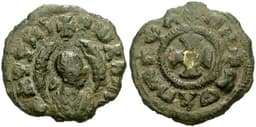
MHDYS of Aksum
Emperor · Ancient
45.3Total

Napoleon Bonaparte
General · Modern
70.9Total
Basic Information
Born
340
1769
Died
360
1821
Era
Ancient
Modern
Nationality
Ethiopia
France
Occupation
Emperor
General
Civilization
Other
Western
Score Comparison
Military (10%)
50.0
94.0
Political (20%)
37.9
72.0
Influence (20%)
51.8
40.0
Legacy (20%)
43.3
80.0
Leadership (15%)
48.4
78.0
Strategy (15%)
35.7
90.0
TOTAL
45.3
70.9
MHDYS of Aksum — Complete Timeline
345 AD
Continued Christianization of AksumCultural◆ Major
MHDYS of Aksum promoted Christianity within the empire, building on the work of Ezana. He issued coins with explicit Christian crosses and likely supported the spread of the religion among the elite and in trade centers.
ChristianizationReligious PolicyAksumite Empire
Impact: nationalconstructive
350 AD
Minted coins with Greek inscriptionsCultural
MHDYS issued gold and silver coins bearing Greek legends, reflecting Aksum's engagement with the Hellenistic world. These coins facilitated trade with Byzantine and Red Sea merchants.
CoinageTradeHellenistic Influence
Impact: regionalconstructive
Napoleon Bonaparte — Complete Timeline
1799 AD
Coup of 18 BrumaireOther◆ Major
Napoleon Bonaparte, with support from his brother Lucien and key political figures, overthrew the Directory in a bloodless coup. He established the Consulate with himself as First Consul, effectively becoming the ruler of France. This event ended the French Revolution's most unstable period.
French RevolutionCoupRise to Power
Impact: regional
1804 AD
Promulgation of the Napoleonic CodeOther◆ Major
Napoleon enacted the Civil Code of the French, known as the Napoleonic Code, a comprehensive set of laws that replaced the fragmented feudal legal systems. The code established legal equality, protected property rights, and secularized law. It became the basis for legal systems in many European and world countries.
Legal ReformNapoleonic CodeCivil Law
Impact: globalconstructive
1805 AD
Battle of AusterlitzWar◆ Major
Napoleon's Grande Arm
Napoleonic WarsBattleDecisive Victory
Impact: global
1812 AD
Invasion of RussiaWar◆ Major
Napoleon led the Grande Arm
Napoleonic WarsInvasionDisaster
Impact: globaldestructive
1815 AD
Battle of WaterlooWar◆ Major
Napoleon's French army was defeated by the combined forces of the Duke of Wellington's Anglo-Allied army and Gebhard Leberecht von Bl
Napoleonic WarsBattleFinal Defeat
Impact: globaldestructive
Expert Analysis
mhdys-of-aksum-vs-napoleon-bonaparte
# The Emperor and the King: Two Paths to Power in a Divided World
On a summer morning in 1815, Napoleon Bonaparte stood on a muddy field in Belgium, watching his Imperial Guard march toward annihilation at Waterloo. Half a world away and fifteen centuries earlier, a king named MHDYS sat on the throne of Aksum, his coins bearing the cross of a faith still young in his realm. One man’s name would echo through every history book in the West; the other’s would survive only on fragments of gold and silver buried in Ethiopian soil. What drove such different outcomes? The answer lies not in destiny, but in the worlds they inherited and the choices they made.
Origins
Napoleon was born in 1769 on the island of Corsica, a territory only recently annexed by France. His family were minor nobility, poor enough to feel the sting of hunger but connected enough to send him to military school. The France of his youth was a powder keg of revolution, and Napoleon absorbed its contradictions: he worshipped order but thrived on chaos, admired the ancien régime but rode the wave of the Revolution. His era was one of upheaval, where a brilliant artillery officer could become emperor in a decade.
MHDYS, by contrast, ruled in a world of stability. The Kingdom of Aksum, in modern-day Ethiopia, had been a major trading power for centuries, controlling the Red Sea routes and minting its own gold coins. MHDYS ascended the throne around 340 CE, inheriting a realm already shaped by his predecessor Ezana, who had adopted Christianity. Where Napoleon faced a fractured continent, MHDYS governed a kingdom whose borders were relatively secure. His challenge was not conquest but consolidation: how to make a foreign faith feel native.
Rise to Power
Napoleon’s ascent was a masterpiece of opportunism. He first gained fame in 1793 by recapturing the port of Toulon from British forces, a victory that made him a brigadier general at twenty-four. In 1796, he took command of the French army in Italy and, within a year, crushed the Austrian Empire, turning a starving, unpaid rabble into a disciplined force. The key turning point came in 1799, when he returned from Egypt to stage a coup d’état, becoming First Consul and, by 1804, Emperor of the French. His path was one of raw ambition, fueled by military genius and a willingness to break every rule.
MHDYS, in contrast, rose through inheritance. As king of Aksum, his authority was unquestioned, but his power was constrained by tradition. He did not conquer his throne; he was born to it. The pivotal moment of his reign came around 345 CE, when he issued coins bearing explicit Christian symbols—the cross and the Chi-Rho monogram. This was a deliberate act of cultural engineering, not a military conquest. Where Napoleon seized power with the sword, MHDYS wielded the subtle influence of currency and faith.
Leadership & Governance
Napoleon’s leadership was a study in contradictions. As a military commander, he was nearly unmatched: his strategy of rapid movement, concentration of force, and decisive battle—scoring a 93 in strategy—brought him victories from Austerlitz in 1805 to Jena in 1806. He reorganized Europe, dismantling the Holy Roman Empire and installing his relatives on thrones. Politically, he was a reformer: the Napoleonic Code standardized French law, abolished feudal privileges, and established merit-based promotion. Yet his governance was also autocratic. He suppressed dissent, censored the press, and treated conquered peoples as subjects, not partners. His political score of 75 reflects this mixed legacy.
MHDYS governed a kingdom where power was diffused among nobles and clergy. His political score of 42.8 suggests limited direct authority, but his influence—69.3—was significant. By minting coins with Greek inscriptions, he connected Aksum to the Hellenistic world, enhancing its prestige. His Christianization efforts were gradual, building on Ezana’s foundation rather than imposing sudden change. This was a leadership of patience and symbolism, not force. His military score of 11.4 indicates that he was no conqueror, but he did not need to be: his kingdom’s strength lay in trade and diplomacy.
Triumph & Tragedy
Napoleon’s greatest triumph was the Empire at its height in 1810, stretching from Spain to Poland. His Napoleonic Code remains a foundation of civil law in much of the world. But his tragedies were monumental: the disastrous invasion of Russia in 1812, where 400,000 men perished in snow and starvation; the defeat at Leipzig in 1813; and finally Waterloo in 1815, where his last gamble failed. He died in exile on Saint Helena in 1821, a prisoner of the British.
MHDYS’s triumphs were quieter. He left no battlefield monuments, but his coins—bearing the cross—survive as evidence of a faith taking root. His tragedy is that we know so little of him. His name, MHDYS, is a cipher; his reign is a gap in the historical record. Where Napoleon’s life is a novel of ambition and downfall, MHDYS’s is a fragment of a lost epic.
Character & Destiny
Napoleon was driven by an insatiable hunger for glory. “I am not an ordinary man,” he once said, and he proved it by reshaping the map of Europe. But his ambition was also his undoing: he could not stop, could not compromise, could not share power. His personality—arrogant, restless, brilliant—propelled him to heights no Corsican could have dreamed of, then dragged him into the abyss.
MHDYS, by contrast, seems to have been a conservative ruler. He did not seek to expand his kingdom or challenge Rome. Instead, he worked within existing structures, using symbols to bind his people to a new faith. His character was likely pragmatic and devout, content to be a steward rather than a conqueror. His destiny was not to be remembered by name, but to be part of a larger story: the Christianization of Ethiopia, a process that would outlast his reign by centuries.
Legacy
Napoleon’s legacy is immense and contested. He is remembered as a military genius, a reformer, and a tyrant. His scores—82 total influence, 78 legacy—reflect a figure who shaped modern Europe’s borders, laws, and nationalisms. But he also left a trail of death and destruction, and his final defeat at Waterloo has become a byword for overreach.
MHDYS’s legacy is narrower but enduring. His total score of 45 masks a profound influence: by minting Christian coins, he helped anchor Christianity in Ethiopia, a faith that remains central to national identity today. He is not a household name, but the cross on his coins is still visible in Ethiopian churches. He represents a different kind of power: the slow, patient work of cultural transformation.
Conclusion
Standing at Waterloo, Napoleon might have thought of empires and immortality. MHDYS, if he ever reflected on his own reign, likely thought of continuity and faith. One man tried to conquer the world and lost; the other helped shape a kingdom that would endure for a millennium. Their stories remind us that greatness is not measured by fame alone. Sometimes the most profound changes are the quietest, etched not in marble and cannon smoke, but in gold and prayer.
Rankings
🥇
Napoleon BonaparteLeader
Mil: 94.0Pol: 72.0Inf: 40.0
70.9
🥈
MHDYS of Aksum
Mil: 50.0Pol: 37.9Inf: 51.8
45.3
+25.6 behind
How This Comparison Works
Algorithm
Each figure is scored on 6 dimensions (0—100 scale) based on structured historical data: Military (10%), Political (20%), Influence (20%), Legacy (20%), Leadership (15%), Strategy (15%). The weighted total produces the final ranking.
Data Sources
Scores are computed from structured sub-indicators in the database. Scale factors adjust for era (Ancient ×0.85, Modern ×1.0) and civilization size (Eastern ×1.05, Other ×0.80) to account for differences in population and military scale.
Maximum 3 Figures
Comparisons are limited to 2—3 figures to ensure readability and statistical meaningfulness.
Error Margins
±5 points per dimension — Sub-scores are derived from historical records with inherent uncertainty. Two figures within 5 points on a dimension should be considered roughly equivalent in that area.
Total Score Accuracy
±3 points overall — The weighted combination of 6 dimensions produces a total score with approximately ±3 points of uncertainty. Differences of less than 3 points are not statistically significant— the figures are effectively tied.
Known Limitations
- Historical records are incomplete and uneven across civilizations
- Figures from oral-tradition societies may be underrepresented
- Occupation labels can misclassify multi-role figures
- Scores measure capability and impact, not moral character
- Quantitative scoring is a comparison tool, not absolute truth
Capability Radar
Military (10%) — Battles & Warfare
Battles
15
95
Win Rate
20
90
Expansion
15
95
Political (20%) — Governance & Reform
Reform
40
95
Diplomacy
35
80
Economy
25
85
Influence (20%) — Cultural & Global Reach
Cultural
40
85
Global
30
90
Legacy (20%) — Historical Impact
Historical
45
95
Longevity
35
90
Leadership (15%) — Power & Stability
Tenure
30
85
Stability
30
70
Strategy (15%) — Tactics & Innovation
Strategy
20
95
Tactics
15
98
Reform
10
92
Similar Comparisons
Comments & Discussion
GeneralBastard6/17/2026
Napoleon didn't just lose at Waterloo—he lost because his marshals were second-rate yes-men, not because the British were better. Ney's suicidal cavalry charges wasted his best troops. Meanwhile, MHDYS was minting Christian gold coins decades before Rome legalized the faith. That's real strategic vision, not just cannonball luck.
铁骑剑客6/17/2026
拿破仑强在陆军,但没海军就注定封不住英国。一场滑铁卢,全欧洲都来踩一脚。而阿克苏姆的王MHDYS根本不靠征服吃饭——人家控制红海贸易,金币上刻十字架,钱就是权。欧洲的皇帝靠打仗,非洲的皇帝靠买卖,谁更聪明?历史已经写了。
DataSkeptic6/17/2026
Show me MHDYS' battle record. You can't, because there isn't one. His entire legacy is a few coins and a mention in a church history. Napoleon fought over sixty battles and rewrote European law. Comparing them is like comparing a rock to a volcano—both are old, but one actually changed the landscape.
华夏青史客6/17/2026
MHDYS那个时代的阿克苏姆,是非洲怎么跟欧洲比的?拿破仑的时代有印刷机、邮政、常备军,MHDYS连本详细史记都没留下。说他是“王”,不如说是部落头人。历史比较不是过家家,别拿一盒金币跟一部法典比。
BronzeCrossChronicler6/17/2026
You're all missing the point. MHDYS didn't need battles because his power was theological gold. His coins were the first Christian currency outside the Roman world—that's soft power on a continental scale. Napoleon conquered Europe with bayonets; MHDYS conquered souls with iconography. Which legacy lasts longer when the empire falls?