Loading...
This comparison has not been analyzed yet.
One-time AI generation (~1 minute). Scores and timeline are already available below.
Mikolaj Potocki vs Ranoji Scindia
Ranoji Scindia leads by 8.6 pts · 2 figures compared
…

Mikolaj Potocki
General · Modern
48.4Total
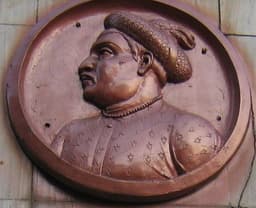
Ranoji Scindia
General · Modern
57.0Total
Basic Information
Born
1595
1700
Died
1651
1745
Era
Modern
Modern
Nationality
Poland-Lithuania
India
Occupation
General
General
Civilization
Western
Indian
Score Comparison
Military (10%)
40.0
50.0
Political (20%)
39.4
54.7
Influence (20%)
51.8
58.0
Legacy (20%)
43.3
54.0
Leadership (15%)
68.0
65.0
Strategy (15%)
45.0
60.0
TOTAL
48.4
57.0
Mikolaj Potocki — Complete Timeline
1646 AD
Appointment as Great Crown HetmanPolitical Action◆ Major
Potocki was appointed Great Crown Hetman, the highest military office in Poland. This position gave him command over Polish forces, but his leadership during the Khmelnytsky Uprising proved disastrous.
AppointmentHetmanPoland
Impact: national
1648 AD
Battle of KorsuńWar◆ Major
Mikolaj Potocki commanded Polish forces against the Cossack uprising led by Bohdan Khmelnytsky at Korsu
Khmelnytsky UprisingBattleDefeatCaptivity
Impact: regionaltragic
Battle of Zhovti VodyWar◆ Major
Potocki sent his son Stefan with a force to confront Khmelnytsky at Zhovti Vody. The Polish force was defeated, and Stefan Potocki was captured and died in Tatar captivity. This defeat preceded the larger disaster at Korsu
Khmelnytsky UprisingBattleDefeat
Impact: regionaltragic
1649 AD
Release from captivityPolitical Action
Potocki was released from Cossack captivity after the Treaty of Zboriv. He returned to Poland but his reputation was damaged by the defeats. He continued to serve as hetman until his death.
CaptivityReleaseTreaty of Zboriv
Impact: national
Ranoji Scindia — Complete Timeline
1726 AD
Appointed Subedar of MalwaPolitical Action◆ Major
Ranoji Scindia was appointed as the Maratha subedar of Malwa by Peshwa Baji Rao I. This gave him control over a large territory and laid the foundation for the Scindia dynasty of Gwalior.
Maratha EmpireMalwaScindia Dynasty
Impact: regionalconstructive
1737 AD
Battle of DelhiWar◆ Major
Ranoji Scindia participated in the Maratha raid on Delhi under Baji Rao I. The attack on the Mughal capital demonstrated Maratha power and led to the extraction of tribute.
Maratha-Mughal WarsDelhiRaid
Impact: national
1739 AD
Battle of VasaiWar
Ranoji Scindia fought alongside Malhar Rao Holkar in the siege of Vasai against the Portuguese. The victory ended Portuguese control in the Konkan region.
Maratha-Portuguese WarsSiegeKonkan
Impact: regional
1740 AD
Founded Gwalior as CapitalPolitical Action◆ Major
Ranoji Scindia established his capital at Gwalior, fortifying the Gwalior Fort and building a palace. This city became the center of Scindia power for over a century.
FoundingGwaliorScindia Dynasty
Impact: regionalconstructive
1745 AD
Death in BattleWar
Ranoji Scindia was killed in a battle against the Nizam of Hyderabad's forces near the Narmada River. His death occurred during a Maratha campaign to expand into the Deccan.
DeathBattleMaratha-Nizam Wars
Impact: regionaltragic
This comparison has not been analyzed yet.
One-time AI generation (~1 minute). Scores and timeline are already available below.
Rankings
🥇
Ranoji ScindiaLeader
Mil: 50.0Pol: 54.7Inf: 58.0
57.0
🥈
Mikolaj Potocki
Mil: 40.0Pol: 39.4Inf: 51.8
48.4
+8.6 behind
How This Comparison Works
Algorithm
Each figure is scored on 6 dimensions (0—100 scale) based on structured historical data: Military (10%), Political (20%), Influence (20%), Legacy (20%), Leadership (15%), Strategy (15%). The weighted total produces the final ranking.
Data Sources
Scores are computed from structured sub-indicators in the database. Scale factors adjust for era (Ancient ×0.85, Modern ×1.0) and civilization size (Eastern ×1.05, Other ×0.80) to account for differences in population and military scale.
Maximum 3 Figures
Comparisons are limited to 2—3 figures to ensure readability and statistical meaningfulness.
Error Margins
±5 points per dimension — Sub-scores are derived from historical records with inherent uncertainty. Two figures within 5 points on a dimension should be considered roughly equivalent in that area.
Total Score Accuracy
±3 points overall — The weighted combination of 6 dimensions produces a total score with approximately ±3 points of uncertainty. Differences of less than 3 points are not statistically significant— the figures are effectively tied.
Known Limitations
- Historical records are incomplete and uneven across civilizations
- Figures from oral-tradition societies may be underrepresented
- Occupation labels can misclassify multi-role figures
- Scores measure capability and impact, not moral character
- Quantitative scoring is a comparison tool, not absolute truth
Capability Radar
Military (10%) — Battles & Warfare
Battles
45
45
Win Rate
30
50
Expansion
25
55
Political (20%) — Governance & Reform
Reform
30
30
Diplomacy
25
45
Economy
20
35
Influence (20%) — Cultural & Global Reach
Cultural
25
30
Global
15
30
Legacy (20%) — Historical Impact
Historical
30
50
Longevity
20
55
Leadership (15%) — Power & Stability
Tenure
55
40
Stability
20
40
Strategy (15%) — Tactics & Innovation
Strategy
30
45
Tactics
35
40
Reform
20
35
Similar Comparisons
Comments & Discussion
No comments yet. Be the first to share your thoughts!