Loading...
Miloš Obilic vs Napoleon Bonaparte
Napoleon Bonaparte leads by 22.5 pts · 2 figures compared
…
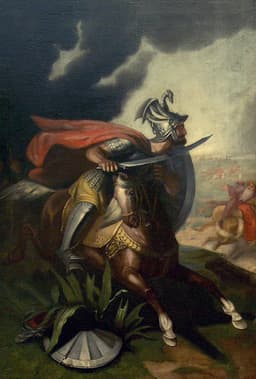
Miloš Obilic
General · Medieval
48.4Total

Napoleon Bonaparte
General · Modern
70.9Total
Basic Information
Born
1350
1769
Died
1389
1821
Era
Medieval
Modern
Nationality
Serbia
France
Occupation
General
General
Civilization
Western
Western
Score Comparison
Military (10%)
38.3
94.0
Political (20%)
51.2
72.0
Influence (20%)
48.6
40.0
Legacy (20%)
44.2
80.0
Leadership (15%)
62.1
78.0
Strategy (15%)
43.3
90.0
TOTAL
48.4
70.9
Miloš Obilic — Complete Timeline
1389 AD
Assassination of Sultan Murad I at KosovoWar◆ Major
According to Serbian epic tradition, Milo
AssassinationBattle of KosovoNational myth
Impact: regional
Death at the Battle of KosovoWar◆ Major
Miloš Obilić died during the Battle of Kosovo, either in combat or executed after his assassination of Murad I. His death, alongside Prince Lazar and many Serbian nobles, became a foundational martyrdom in Serbian epic poetry. The battle's outcome left Serbia under Ottoman suzerainty, but Obilić's act was celebrated as heroic defiance.
MartyrdomEpic heroOttoman conquest
Impact: nationaltragic
Napoleon Bonaparte — Complete Timeline
1799 AD
Coup of 18 BrumaireOther◆ Major
Napoleon Bonaparte, with support from his brother Lucien and key political figures, overthrew the Directory in a bloodless coup. He established the Consulate with himself as First Consul, effectively becoming the ruler of France. This event ended the French Revolution's most unstable period.
French RevolutionCoupRise to Power
Impact: regional
1804 AD
Promulgation of the Napoleonic CodeOther◆ Major
Napoleon enacted the Civil Code of the French, known as the Napoleonic Code, a comprehensive set of laws that replaced the fragmented feudal legal systems. The code established legal equality, protected property rights, and secularized law. It became the basis for legal systems in many European and world countries.
Legal ReformNapoleonic CodeCivil Law
Impact: globalconstructive
1805 AD
Battle of AusterlitzWar◆ Major
Napoleon's Grande Arm
Napoleonic WarsBattleDecisive Victory
Impact: global
1812 AD
Invasion of RussiaWar◆ Major
Napoleon led the Grande Arm
Napoleonic WarsInvasionDisaster
Impact: globaldestructive
1815 AD
Battle of WaterlooWar◆ Major
Napoleon's French army was defeated by the combined forces of the Duke of Wellington's Anglo-Allied army and Gebhard Leberecht von Bl
Napoleonic WarsBattleFinal Defeat
Impact: globaldestructive
Expert Analysis
milo-obilic-vs-napoleon-bonaparte
# The Emperor and the Knight: Two Visions of Heroism
On a June morning in 1815, Napoleon Bonaparte watched his legions march toward the muddy fields of Waterloo, confident that one more victory would cement his dynasty. Four hundred twenty-six years earlier, on a June day in 1389, a Serbian knight named Miloš Obilić rode into the Ottoman camp at Kosovo Field, knowing he would not return. One man commanded hundreds of thousands; the other acted alone. One reshaped the map of Europe; the other left only a story. Yet both have been called heroes, and both met their end in battle. What makes one figure a titan of history and the other a legend of song? The answer lies not in their deeds alone, but in the worlds that shaped them.
Origins
Napoleon Bonaparte was born in 1769 on the island of Corsica, a place that had only recently become French. His family was minor nobility, struggling and ambitious. The son of a lawyer, Napoleon grew up speaking Italian-accented French, an outsider in the elite military schools he attended. The French Revolution of 1789 shattered the old order and opened paths that birth alone could no longer guarantee. For a young artillery officer with genius and hunger, it was the perfect storm.
Miloš Obilić, by contrast, emerged from the mists of Serbian oral tradition. Historical records suggest he was a knight in the service of Prince Lazar Hrebeljanović, who ruled a patchwork of Serbian principalities threatened by the expanding Ottoman Empire. The medieval Balkans were a world of feudal loyalty, religious crusade, and epic poetry—a world where a single act of courage could echo for centuries. Obilić's Serbia was not a modern nation-state but a kingdom fighting for survival, where the line between history and myth blurred with each retelling.
The difference in their eras is fundamental. Napoleon lived in the dawn of modernity, when mass armies, nationalism, and bureaucracy were reshaping power. Obilić lived in the twilight of chivalry, when personal valor and divine mission still defined a warrior's worth.
Rise to Power
Napoleon's ascent was a masterpiece of calculation and opportunity. At age 24, he drove the British from Toulon and was promoted to brigadier general. By 1796, he commanded the Army of Italy, where his lightning campaigns forced Austria to sue for peace. He was 27. The Directory, France's corrupt government, sent him to Egypt to undermine British trade—a strategic failure that Napoleon spun into a propaganda triumph. In 1799, he staged a coup and made himself First Consul. By 1804, he crowned himself Emperor. His rise was not fate; it was a series of gambles, each riskier than the last, each paying off until the last one did not.
Miloš Obilić's rise is almost invisible to history. He appears fully formed in the epic poems of the Kosovo cycle—a knight of great reputation, chosen for a mission of ultimate sacrifice. There is no ladder of promotion, no political maneuvering. He is summoned by Prince Lazar, who warns his knights that whoever kills Sultan Murad I will be remembered forever. Obilić steps forward. In the Serbian tradition, he is not ambitious but chosen, not a strategist but a martyr.
The difference is stark: Napoleon climbed through a system that rewarded talent and ruthlessness. Obilić existed in a world where the only path to greatness was a single, fatal act.
Leadership & Governance
As a military commander, Napoleon was revolutionary. He divided his armies into corps that could operate independently but converge rapidly, used artillery as a mobile shock force, and exploited the speed of the Grande Armée to outflank enemies. His victories at Austerlitz in 1805 and Jena in 1806 were tactical masterpieces. As a ruler, he reformed French law with the Napoleonic Code, standardized education, and built a centralized state. Yet his political score of 75 reflects his fatal flaw: he could conquer but not consolidate. He placed his brothers on thrones across Europe, but they ruled as puppets, not partners. His governance was a one-man show.
Miloš Obilić never governed. He was a knight, not a king. His leadership score of 44 reflects not incompetence but scale—he led no army, reformed no laws, built no institutions. His "leadership" was the example of sacrifice. In the Serbian epic, before battle, Prince Lazar asks his knights to swear loyalty, and Obilić alone refuses, falsely accused of treachery. To prove his loyalty, he rides into the Ottoman camp alone and kills the Sultan. His governance is the governance of myth: it inspires, but it does not administer.
Napoleon's strategy score of 93 speaks to his mind, Obilić's strategy score of 33 to his circumstance. Napoleon planned campaigns across continents; Obilić planned a single, desperate stroke.
Triumph & Tragedy
Napoleon's greatest moment was Austerlitz, where he lured the combined Russian and Austrian armies into a trap and destroyed them. His empire stretched from Spain to Poland. His tragedy was the invasion of Russia in 1812—600,000 men marched east; fewer than 100,000 returned. He was exiled to Elba, returned, and was finally defeated at Waterloo in 1815. He died on Saint Helena in 1821, a prisoner.
Obilić's triumph and tragedy are the same event. At the Battle of Kosovo in 1389, he killed Sultan Murad I—a blow that, in the epic, avenges his honor and strikes at the heart of the enemy. But he was captured and executed, and the Serbian army was shattered. The battle became a national myth of defeat and moral victory. Obilić's death was not the end of a career but the beginning of a legend.
Napoleon's tragedy was hubris—he could not stop. Obilić's tragedy was the fate of his people—he could not save them, only give them a story.
Character & Destiny
Napoleon was restless, brilliant, and insatiable. He once said, "Power is my mistress." His ambition was boundless, his energy inexhaustible, and his ego colossal. He believed in destiny, but he also believed he could shape it. His personality drove him to overreach—to invade Russia, to reject peace terms, to fight one battle too many.
Miloš Obilić, as the epic portrays him, is a figure of honor and silence. He is accused, he does not defend himself with words; he defends himself with action. His personality is not complex—it is archetypal: the loyal knight betrayed, the martyr who redeems his name with blood. He does not shape history in the way Napoleon did; he shapes memory.
Napoleon's destiny was to remake the world and be broken by it. Obilić's destiny was to be remembered, not to rule.
Legacy
Napoleon's legacy is written in law codes, national borders, and military doctrine. The Napoleonic Code influenced civil law across Europe and the Americas. His campaigns are studied in every military academy. His influence score of 82 reflects a man who changed how Europe thought about war, governance, and nationalism. Yet his legacy is contested: he is both a liberator who spread revolutionary ideals and a tyrant who drowned them in blood.
Miloš Obilić's legacy is intangible but powerful. His canonization in Serbian epic tradition—though not official church canon—made him a saint of national identity. He is sung in epic poems, celebrated in folklore, and invoked in moments of national crisis. His legacy score of 58 is low by Napoleon's standards, but it measures a different kind of influence: the power of a story that refuses to die.
Conclusion
We remember Napoleon because he changed the world. We remember Obilić because he gave his people a reason to endure. One was a man of his time—the age of reason, revolution, and empire. The other was a man of his time too—the age of faith, feudalism, and fatalism. Napoleon's total score of 82 dwarfs Obilić's 49, but scores measure only what can be counted. They cannot measure the weight of a name sung for six centuries in a language that survived conquest, occupation, and oblivion.
Napoleon once said, "Glory is fleeting, but obscurity is forever." He was right about himself—his glory has faded into history. But Miloš Obilić, the obscure knight who killed a sultan and died, has achieved a different kind of permanence. He is not history. He is myth. And myth, unlike empire, never falls.
Rankings
🥇
Napoleon BonaparteLeader
Mil: 94.0Pol: 72.0Inf: 40.0
70.9
🥈
Miloš Obilic
Mil: 38.3Pol: 51.2Inf: 48.6
48.4
+22.5 behind
How This Comparison Works
Algorithm
Each figure is scored on 6 dimensions (0—100 scale) based on structured historical data: Military (10%), Political (20%), Influence (20%), Legacy (20%), Leadership (15%), Strategy (15%). The weighted total produces the final ranking.
Data Sources
Scores are computed from structured sub-indicators in the database. Scale factors adjust for era (Ancient ×0.85, Modern ×1.0) and civilization size (Eastern ×1.05, Other ×0.80) to account for differences in population and military scale.
Maximum 3 Figures
Comparisons are limited to 2—3 figures to ensure readability and statistical meaningfulness.
Error Margins
±5 points per dimension — Sub-scores are derived from historical records with inherent uncertainty. Two figures within 5 points on a dimension should be considered roughly equivalent in that area.
Total Score Accuracy
±3 points overall — The weighted combination of 6 dimensions produces a total score with approximately ±3 points of uncertainty. Differences of less than 3 points are not statistically significant— the figures are effectively tied.
Known Limitations
- Historical records are incomplete and uneven across civilizations
- Figures from oral-tradition societies may be underrepresented
- Occupation labels can misclassify multi-role figures
- Scores measure capability and impact, not moral character
- Quantitative scoring is a comparison tool, not absolute truth
Capability Radar
Military (10%) — Battles & Warfare
Battles
10
95
Win Rate
10
90
Expansion
0
95
Political (20%) — Governance & Reform
Reform
50
95
Diplomacy
47
80
Economy
55
85
Influence (20%) — Cultural & Global Reach
Cultural
40
85
Global
20
90
Legacy (20%) — Historical Impact
Historical
45
95
Longevity
40
90
Leadership (15%) — Power & Stability
Tenure
46
85
Stability
59
70
Strategy (15%) — Tactics & Innovation
Strategy
10
95
Tactics
15
98
Reform
0
92
Similar Comparisons
Comments & Discussion
BattlefieldArchitect6/17/2026
Napoleon's artillery at Waterloo fired over 50,000 rounds in a single day—industrialized death on a scale Obilić couldn't imagine. The knight killed one sultan with a dagger; the Emperor broke nations with logistics and gunpowder. Comparing them is like comparing a chess grandmaster to a back-alley brawler. Obilić's story works because it's simple—it's a myth. Napoleon's legacy is complex and brutal, written in census records and ruined cities. Give me the strategist who commanded 500,000 men ov
历史数据控6/17/2026
单从数据看,拿破仑动员了超过60万大军入侵俄国,而米洛什·奥比利奇可能就带了十几个随从。这种对比就像用狙击步枪跟核弹比精度。但有趣的是:奥比利奇的刺杀行动确实让奥斯曼帝国陷入十年内乱,而拿破仑的莫斯科战役输掉了整个帝国。关键不在规模大小,而在实际效果。数据不会撒谎:小行动的投入产出比有时高得吓人。
RhetoricRider6/17/2026
You're all missing the cognitive dissonance here. We romanticize Obilić as this noble martyr, but he was basically a medieval assassin—if we're being honest. And Napoleon? We paint him as a tyrant, yet the guy spread legal codes and meritocracy across Europe. The fact that both are called "heroes" tells you everything about how we cherry-pick historical narratives. Miloš is a symbol of resistance for one ethnic group; Napoleon's a symbol of ambition for half the world. Neither is clean. Neither
古典学迷6/17/2026
把这两个人并列本身就是个哲学命题。奥比利奇体现的是荷马史诗式的个人英雄主义——阿喀琉斯式的单挑决定战局。拿破仑则是修昔底德笔下的权力现实主义者,追求的是制度性的霸权。有趣的是,古代人更崇拜战死沙场的个体勇士,文艺复兴后的欧洲反而崇拜活下来的战略家。这种转变反映了整个西方文明价值观的迁移:从"如何光荣地死"转向"如何更有效率地活"。
CyclopsCritic6/17/2026
Oh great, another whitewashed comparison ignoring that Napoleon reinstated slavery in 1802. Obilić killed one tyrant; Bonaparte killed Haitian independence and enslaved thousands. The "hero" label for Napoleon is pure European exceptionalism. Meanwhile, Obilić's entire legend is built on a single act of defiance against an empire that was also expanding—just non-European. I'm tired of these frameworks that pretend both sides' behaviors are equivalent. Napoleon's body count in Haiti alone probabl