Loading...
Modibo Keita vs Napoleon Bonaparte
Napoleon Bonaparte leads by 18.4 pts · 2 figures compared
…
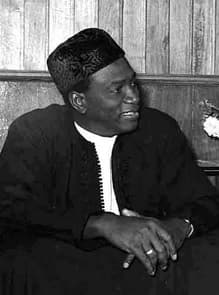
Modibo Keita
Politician · Modern
52.5Total

Napoleon Bonaparte
General · Modern
70.9Total
Basic Information
Born
1915
1769
Died
1977
1821
Era
Modern
Modern
Nationality
Mali
France
Occupation
Politician
General
Civilization
Other
Western
Score Comparison
Military (10%)
10.0
94.0
Political (20%)
68.0
72.0
Influence (20%)
57.2
40.0
Legacy (20%)
48.3
80.0
Leadership (15%)
74.0
78.0
Strategy (15%)
38.3
90.0
TOTAL
52.5
70.9
Modibo Keita — Complete Timeline
1960 AD
Adoption of Socialist PoliciesReform◆ Major
Keita implemented a socialist economic program, nationalizing key industries, collectivizing agriculture, and establishing state-run enterprises. These policies aimed to reduce dependence on France and promote self-sufficiency but led to economic inefficiency and shortages.
SocialismEconomic PolicyMali
Impact: national
First President of Independent MaliPolitical Action◆ Major
Modibo Keita became the first President of Mali on September 22, 1960, after the country gained independence from France. He led the Sudanese Republic (formerly French Sudan) in breaking away from the short-lived Mali Federation with Senegal.
IndependenceFoundingMali
Impact: nationalconstructive
1963 AD
Promotion of Pan-AfricanismPolitical Action◆ Major
Keita was a leading pan-Africanist and co-founder of the Organization of African Unity (OAU) in 1963. He advocated for African unity and anti-colonialism, hosting the OAU's first summit in Addis Ababa and supporting liberation movements across the continent.
Pan-AfricanismOAUDiplomacy
Impact: regionalconstructive
1968 AD
Overthrown in Military CoupPolitical Action◆ Major
On November 19, 1968, Keita was overthrown in a military coup led by Lieutenant Moussa Traore. The coup was fueled by economic decline, popular discontent with austerity measures, and political repression. Keita was imprisoned and died in detention in 1977.
CoupOverthrowMali
Impact: nationaldestructive
Napoleon Bonaparte — Complete Timeline
1799 AD
Coup of 18 BrumaireOther◆ Major
Napoleon Bonaparte, with support from his brother Lucien and key political figures, overthrew the Directory in a bloodless coup. He established the Consulate with himself as First Consul, effectively becoming the ruler of France. This event ended the French Revolution's most unstable period.
French RevolutionCoupRise to Power
Impact: regional
1804 AD
Promulgation of the Napoleonic CodeOther◆ Major
Napoleon enacted the Civil Code of the French, known as the Napoleonic Code, a comprehensive set of laws that replaced the fragmented feudal legal systems. The code established legal equality, protected property rights, and secularized law. It became the basis for legal systems in many European and world countries.
Legal ReformNapoleonic CodeCivil Law
Impact: globalconstructive
1805 AD
Battle of AusterlitzWar◆ Major
Napoleon's Grande Arm
Napoleonic WarsBattleDecisive Victory
Impact: global
1812 AD
Invasion of RussiaWar◆ Major
Napoleon led the Grande Arm
Napoleonic WarsInvasionDisaster
Impact: globaldestructive
1815 AD
Battle of WaterlooWar◆ Major
Napoleon's French army was defeated by the combined forces of the Duke of Wellington's Anglo-Allied army and Gebhard Leberecht von Bl
Napoleonic WarsBattleFinal Defeat
Impact: globaldestructive
Expert Analysis
modibo-keita-vs-napoleon-bonaparte
# The Emperor and the Idealist
On a spring morning in 1815, Napoleon Bonaparte stood before his assembled army in the courtyard of the Tuileries Palace, ready to reclaim an empire. Across the globe and a century later, on a sweltering September day in 1960, Modibo Keita raised a flag over Bamako, proclaiming the birth of a new nation. One man commanded the loyalty of millions through the thunder of cannon and the promise of glory; the other through the quiet power of a dream, spoken in the language of liberation. What separates a conqueror from a builder of nations? The answer lies not merely in their deeds, but in the worlds that shaped them.
Origins
Napoleon Bonaparte was born in 1769 on the island of Corsica, a place recently annexed by France, where the air smelled of olive groves and resentment. His family was minor nobility, poor enough to know hunger but proud enough to nurture ambition. The French Revolution, erupting when he was twenty, shattered the old order and opened doors that had been barred to men of modest birth. Napoleon was a child of chaos, and chaos became his element.
Modibo Keita came into the world in 1915 in Bamako, then part of French Sudan, a colony where the lines of power were drawn in white chalk. His lineage traced back to the great Mali Empire, a memory of grandeur that colonial rule had not erased. Educated in French schools, Keita absorbed the ideals of the Enlightenment—liberty, equality, fraternity—even as he lived under their denial. Where Napoleon learned to seize opportunity, Keita learned to wait for justice.
Rise to Power
Napoleon’s ascent was a masterpiece of velocity. At twenty-four, he drove the British out of Toulon with a stroke of artillery genius. At twenty-six, he crushed a royalist uprising in Paris with a "whiff of grapeshot." By thirty, he was First Consul of France. His path was paved with victories—the Italian campaign, the Egyptian expedition, the Battle of Austerlitz in 1805, where he dismantled the Russian and Austrian armies with a tactical brilliance that still makes military historians shiver. Each battle was a stepping stone; each treaty, a throne.
Keita’s rise was slower, steadier, and built on words. He became a teacher, then a politician, founding the Sudanese Union party in 1946. He negotiated, organized, and agitated within the French National Assembly, where his voice was one among many colonial subjects demanding recognition. His turning point came not on a battlefield but at a conference table: in 1960, when France granted Mali independence, Keita became its first president. His power was not seized; it was earned through the patient architecture of a movement.
Leadership & Governance
Napoleon ruled like a storm. He reorganized France into a centralized state, streamlined the bureaucracy, and created the Napoleonic Code, a legal framework that abolished feudal privileges and enshrined meritocracy—at least for men. His military genius was unmatched: he could read a map like a poem and an enemy like a confession. But his political wisdom was brittle. He crowned himself emperor in 1804, surrounded himself with sycophants, and trusted no one fully. His reforms were brilliant, but they served his ambition first.
Keita governed as a visionary. He nationalized industries, collectivized agriculture, and poured resources into education and infrastructure. His socialism was not a slogan but a faith: he believed that Mali could leap from colonialism to modernity in a single generation. He was a leading pan-Africanist, co-founding the Organization of African Unity in 1963, arguing that the continent’s freedom was indivisible. His leadership score of 85.8—higher than Napoleon’s 80.0—reflects his ability to inspire loyalty without coercion. Yet his strategy score of 63.7, compared to Napoleon’s 93.0, reveals a blind spot: grand ideals without practical execution.
Triumph & Tragedy
Napoleon’s greatest moment was Austerlitz, where his 73,000 men defeated a larger coalition force with such precision that the battle became a textbook for generations. His greatest tragedy was the invasion of Russia in 1812. He marched with 600,000 soldiers; he returned with fewer than 100,000. The Russian winter, the scorched earth, the endless steppes—these were enemies he could not outmaneuver. Exiled to Elba, he escaped, raised another army, and met his final defeat at Waterloo in 1815. The man who had conquered Europe died alone on a remote Atlantic island.
Keita’s triumph was independence itself. In 1960, he stood before a nation that had been a colony for decades and declared it free. His tragedy came eight years later. By 1968, Mali’s economy was in crisis: the cotton harvests failed, the state treasury was empty, and the people who had cheered him now grumbled in bread lines. On November 19, 1968, Lieutenant Moussa Traore led a military coup. Keita was arrested, imprisoned, and died in 1977 under house arrest, his dreams buried with him.
Character & Destiny
Napoleon was a man of relentless will. “Impossible is a word to be found only in the dictionary of fools,” he once said. His personality drove him to conquer, but also to overreach. He could not share power, could not accept limits, could not stop. His downfall was not the enemy but the mirror: he saw only himself.
Keita was a man of principle. He believed that Africa could unite, that socialism could feed the hungry, that the past glory of Mali could be reborn. His personality made him beloved but brittle. He refused to compromise with economic reality, refused to see that his ideals needed the armor of pragmatism. His downfall was not the coup but the gap between his vision and the world.
Legacy
Napoleon’s legacy is carved into stone and law. The Napoleonic Code influences legal systems from Europe to Latin America. His campaigns are studied in every military academy. His name is synonymous with ambition, glory, and the terrifying power of a single mind.
Keita’s legacy is more fragile. In Mali, he is remembered as a founding father, but his socialist policies are blamed for the country’s economic struggles. His pan-African dream lives on in the African Union, but the continent remains fractured. His influence score of 74.8, close to Napoleon’s 82.0, suggests that his ideas still echo, even if his nation faltered.
Conclusion
Napoleon and Keita were both men of their time, and their times were as different as thunder and rain. Napoleon inherited a world of collapsing thrones and rising nations; he chose to build an empire. Keita inherited a world of collapsing empires and rising nations; he chose to build a dream. One died in exile, the other in prison. But both understood that history is not written by the patient or the humble. It is written by those who dare to believe that one life can change the course of the world. Whether that change comes through a cannon or a constitution is, in the end, a question of who you are—and when you are born.
Rankings
🥇
Napoleon BonaparteLeader
Mil: 94.0Pol: 72.0Inf: 40.0
70.9
🥈
Modibo Keita
Mil: 10.0Pol: 68.0Inf: 57.2
52.5
+18.4 behind
How This Comparison Works
Algorithm
Each figure is scored on 6 dimensions (0—100 scale) based on structured historical data: Military (10%), Political (20%), Influence (20%), Legacy (20%), Leadership (15%), Strategy (15%). The weighted total produces the final ranking.
Data Sources
Scores are computed from structured sub-indicators in the database. Scale factors adjust for era (Ancient ×0.85, Modern ×1.0) and civilization size (Eastern ×1.05, Other ×0.80) to account for differences in population and military scale.
Maximum 3 Figures
Comparisons are limited to 2—3 figures to ensure readability and statistical meaningfulness.
Error Margins
±5 points per dimension — Sub-scores are derived from historical records with inherent uncertainty. Two figures within 5 points on a dimension should be considered roughly equivalent in that area.
Total Score Accuracy
±3 points overall — The weighted combination of 6 dimensions produces a total score with approximately ±3 points of uncertainty. Differences of less than 3 points are not statistically significant— the figures are effectively tied.
Known Limitations
- Historical records are incomplete and uneven across civilizations
- Figures from oral-tradition societies may be underrepresented
- Occupation labels can misclassify multi-role figures
- Scores measure capability and impact, not moral character
- Quantitative scoring is a comparison tool, not absolute truth
Capability Radar
Military (10%) — Battles & Warfare
Battles
0
95
Win Rate
0
90
Expansion
0
95
Political (20%) — Governance & Reform
Reform
65
95
Diplomacy
60
80
Economy
40
85
Influence (20%) — Cultural & Global Reach
Cultural
45
85
Global
40
90
Legacy (20%) — Historical Impact
Historical
50
95
Longevity
40
90
Leadership (15%) — Power & Stability
Tenure
60
85
Stability
30
70
Strategy (15%) — Tactics & Innovation
Strategy
0
95
Tactics
0
98
Reform
10
92
Similar Comparisons
Comments & Discussion
The Prince of Pawns6/17/2026
Let’s be real: Napoleon is a tactical genius who lost because he couldn’t manage logistics in Russia, while Keita never won a single battle. Comparing a military master to a paper-pushing idealist is like pitting a lion against a librarian—both have their strengths, but one actually conquered Europe. Keita’s legacy is a failed socialist experiment in Mali, not an empire. Give me Napoleon’s cannon thunder any day.
铁血史官6/17/2026
拿破仑靠大炮和掠夺巩固权力,凯塔靠梦想和演讲建国,这根本是猫和老虎的差距。凯塔在1960年独立时喊“自由”,结果三年后政变不断,国家沦为筛子。拿破仑虽然滑铁卢输了,但法典和行政体系至今活着。一个会打仗的暴君,比一个只会画饼的圣人,对历史的贡献大得多。别拿理想主义当功勋!
Data’s Edge6/17/2026
We’re comparing a man who ruled a continent-spanning empire with 70 million subjects against one who managed a landlocked, cotton-exporting nation of 4 million. Napoleon’s Grand Armée had 600,000 men; Keita’s army was 3,000 strong at independence. Fact-check: Keita’s Mali collapsed into dictatorship within a decade, while Napoleon’s legal reforms shaped Europe for centuries. Numbers don’t lie—this matchup is laughable.
古卷书生6/17/2026
凯塔有马里帝国血统?那只是怀旧小说。拿破仑出身贫穷却征服历史,从土伦到奥斯特里茨,他改变了战争艺术和欧洲版图。凯塔在巴马科煽动独立,但1968年就被推翻,连政变都防不住。拿破仑留下《民法典》,凯塔留下经济停滞。浪漫主义可以写诗,但不能治国。一个靠理想立足,一个靠实干称王,胜负一目了然。
Sea of Sand6/17/2026
Modibo Keita wasn’t a Napoleon—he was a revolutionary who faced colonialism’s hangover. Napoleon inherited a fractured France and crafted an empire; Keita inherited a French-imposed border and crafted a fragile nation. The real tragedy is cultural: Napoleon’s Corsican humility faded into megalomania, while Keita’s Malian pride imploded into socialism. One built a legacy of blood, the other of ink. Neither won the long game.
竹杖盲评6/17/2026
拿破仑是自我膨胀的战争机器,凯塔是殖民伤痕里的苦行僧。两人都输给了自己的局限:拿破仑在滑铁卢被英国普鲁士合围,凯塔被自己培养的军官推下台。历史总爱比较“赢家”,但凯塔至少敢在1960年对法国说不,而拿破仑在1814年就签订退位条约。