Loading...
Muhammad Shah I Bahmani vs Napoleon Bonaparte
Napoleon Bonaparte leads by 16.6 pts · 2 figures compared
…
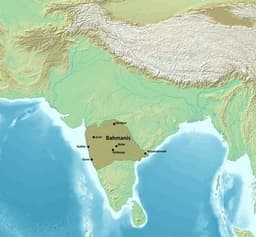
Muhammad Shah I Bahmani
Emperor · Medieval
54.3Total

Napoleon Bonaparte
General · Modern
70.9Total
Basic Information
Born
1358
1769
Died
1375
1821
Era
Medieval
Modern
Nationality
India
France
Occupation
Emperor
General
Civilization
Indian
Western
Score Comparison
Military (10%)
25.0
94.0
Political (20%)
62.7
72.0
Influence (20%)
60.0
40.0
Legacy (20%)
49.2
80.0
Leadership (15%)
66.0
78.0
Strategy (15%)
51.7
90.0
TOTAL
54.3
70.9
Muhammad Shah I Bahmani — Complete Timeline
1360 AD
Reorganization of Bahmani administrationReform◆ Major
Muhammad Shah I Bahmani restructured the Bahmani administration by dividing the sultanate into four provinces (tarafs), each governed by a tarafdar. This system improved tax collection and military organization.
Administrative ReformProvincial System
Impact: regionalconstructive
1365 AD
War with Vijayanagara over Raichur DoabWar◆ Major
Muhammad Shah I Bahmani fought a war against the Vijayanagara Empire for control of the Raichur Doab. The conflict ended with a treaty that temporarily ceded the region to Vijayanagara.
WarVijayanagaraTerritorial Dispute
Impact: regional
1367 AD
Construction of the Jami Masjid at GulbargaCultural
Muhammad Shah I Bahmani commissioned the construction of the Jami Masjid in Gulbarga, a large congregational mosque. The mosque became a center for Islamic worship and learning in the Bahmani capital.
ArchitectureReligion
constructive
1370 AD
Suppression of the rebellion of Bahram KhanPolitical Action
Muhammad Shah I Bahmani crushed a rebellion led by the noble Bahram Khan, who had challenged his authority. The revolt was put down with force, and Bahram Khan was executed.
RebellionInternal Conflict
Impact: nationaldestructive
Napoleon Bonaparte — Complete Timeline
1799 AD
Coup of 18 BrumaireOther◆ Major
Napoleon Bonaparte, with support from his brother Lucien and key political figures, overthrew the Directory in a bloodless coup. He established the Consulate with himself as First Consul, effectively becoming the ruler of France. This event ended the French Revolution's most unstable period.
French RevolutionCoupRise to Power
Impact: regional
1804 AD
Promulgation of the Napoleonic CodeOther◆ Major
Napoleon enacted the Civil Code of the French, known as the Napoleonic Code, a comprehensive set of laws that replaced the fragmented feudal legal systems. The code established legal equality, protected property rights, and secularized law. It became the basis for legal systems in many European and world countries.
Legal ReformNapoleonic CodeCivil Law
Impact: globalconstructive
1805 AD
Battle of AusterlitzWar◆ Major
Napoleon's Grande Arm
Napoleonic WarsBattleDecisive Victory
Impact: global
1812 AD
Invasion of RussiaWar◆ Major
Napoleon led the Grande Arm
Napoleonic WarsInvasionDisaster
Impact: globaldestructive
1815 AD
Battle of WaterlooWar◆ Major
Napoleon's French army was defeated by the combined forces of the Duke of Wellington's Anglo-Allied army and Gebhard Leberecht von Bl
Napoleonic WarsBattleFinal Defeat
Impact: globaldestructive
Expert Analysis
muhammad-shah-i-bahmani-vs-napoleon-bonaparte
### The Emperor and the Sultan: Two Paths to Power in Different Worlds
On a June morning in 1815, Napoleon Bonaparte surveyed a muddy field near Waterloo, his Grande Armée worn but still formidable. Across the Atlantic of time, in 1365, Muhammad Shah I Bahmani watched his forces clash with the Vijayanagara Empire over the arid Raichur Doab, a prize that would define his reign. Both men sought to forge order from chaos, yet their worlds could not have been more different. Napoleon’s ambition would shake Europe to its foundations and end in exile; Muhammad Shah’s quieter consolidation would plant the seeds of a dynasty that lasted two centuries. Why did one man’s story become a symphony of triumph and tragedy, while the other’s remains a footnote in the annals of the Deccan? The answer lies not just in their actions, but in the forces that shaped them.
### Origins
Napoleon was born in 1769 on the island of Corsica, a year after it passed from Genoa to France. His family was minor nobility, but his education at French military schools forged a restless intelligence. The French Revolution had shattered the old order, and a young artillery officer rose on the chaos, his mind a product of Enlightenment ideals and the brutal calculus of war. Muhammad Shah I Bahmani, born in 1358, inherited a different world. The Bahmani Sultanate, carved from the Delhi Sultanate’s southern reaches, was a fragile mosaic of Persian nobles, local Hindu chiefs, and Muslim scholars. He was the son of the founder, Alauddin Bahman Shah, and his upbringing steeped him in the politics of a frontier kingdom, where survival meant balancing faith, force, and administration. Napoleon’s era was one of revolutionary upheaval; Muhammad Shah’s was one of medieval consolidation.
### Rise to Power
Napoleon’s ascent was meteoric. He seized his moment at the Siege of Toulon in 1793, then crushed a royalist uprising in Paris. By 1796, he commanded the Army of Italy, winning victories that stunned Europe. His path was one of personal genius and relentless ambition, crowned by a coup in 1799 that made him First Consul. Muhammad Shah’s rise was quieter. He ascended the throne in 1358, likely in his twenties, following his father’s death. There was no dramatic coup, no battlefield apotheosis. He inherited a kingdom still defining itself, and his challenge was not to conquer a continent but to keep his realm from fracturing. Napoleon’s opportunities came from a world in revolution; Muhammad Shah’s came from the slow, patient work of building a state.
### Leadership & Governance
Napoleon governed with a blend of iron will and visionary reform. He centralized France, created the Napoleonic Code, and reorganized education. His military genius was unmatched—he won battles like Austerlitz in 1805 by outthinking his enemies—but his political wisdom was uneven. He trusted his star too much, appointing family to thrones and ignoring the limits of his empire. Muhammad Shah’s leadership was quieter but no less strategic. In 1360, he restructured the Bahmani administration, dividing the sultanate into four provinces (tarafs) governed by nobles. This was not a revolution but a careful balancing act, designed to control powerful factions while allowing local autonomy. His military score of 32.0 is low, but his political score of 60.4 reflects a ruler who knew that in the Deccan, survival came from negotiation, not conquest. He fought the Vijayanagara war in 1365 over the Raichur Doab, but the conflict ended in a stalemate, not a Napoleonic triumph.
### Triumph & Tragedy
Napoleon’s greatest moment was perhaps the Battle of Austerlitz in 1805, where he destroyed the Russian and Austrian armies. His tragedy was the invasion of Russia in 1812, a catastrophic overreach that bled his army white. He died in 1821 on Saint Helena, a prisoner of the British. Muhammad Shah’s triumphs were more modest. He suppressed the rebellion of Bahram Khan in 1370, crushing a noble who had challenged his authority, and built the Jami Masjid in Gulbarga in 1367, a symbol of Islamic culture in the Deccan. His tragedy was a life cut short—he died in 1375 at around 17 years of rule, leaving a kingdom still fragile. Where Napoleon’s fall was a thunderclap, Muhammad Shah’s end was a quiet passing, his work unfinished.
### Character & Destiny
Napoleon was driven by a titanic ego and a belief that he could shape history. His personality was a double-edged sword: it gave him the will to conquer, but it also blinded him to the limits of power. “Impossible is a word to be found only in the dictionary of fools,” he once said—a motto that led to both glory and ruin. Muhammad Shah, by contrast, appears more cautious, a pragmatist who understood that in the Deccan, a sultan ruled by balancing factions, not crushing them. His suppression of Bahram Khan showed he could be ruthless, but his reforms suggest a mind focused on sustainability, not spectacle. Napoleon’s destiny was to be a titan who fell; Muhammad Shah’s was to be a builder whose foundations outlasted him.
### Legacy
Napoleon’s legacy is vast. His Napoleonic Code influenced legal systems worldwide; his wars reshaped Europe; his memory inspires both admiration and caution. His total score of 82.4 reflects a figure of immense impact. Muhammad Shah’s legacy is more confined. His administrative reforms laid the groundwork for the Bahmani Sultanate’s survival until the early 16th century, and his mosque still stands in Gulbarga. His total score of 62.3 is modest, but it measures a ruler who succeeded in his context. Napoleon changed the world; Muhammad Shah changed a region. Both were products of their time, but the scale of their ambition and the nature of their worlds determined the difference.
### Conclusion
Standing at the edge of history, we see two men who rose to power through different doors. Napoleon Bonaparte was a storm that swept across a continent, leaving both devastation and reform in its wake. Muhammad Shah I Bahmani was a craftsman, shaping a kingdom with patience and pragmatism. One is remembered in every history book; the other is known only to specialists. Yet both faced the same fundamental questions: How do you lead? How do you build? How do you survive? Their answers were shaped by their worlds, and their stories remind us that greatness is not a single standard but a reflection of the stage on which it is performed. The emperor and the sultan—one a comet, the other a steady flame—each illuminated their own sky.
Rankings
🥇
Napoleon BonaparteLeader
Mil: 94.0Pol: 72.0Inf: 40.0
70.9
🥈
Muhammad Shah I Bahmani
Mil: 25.0Pol: 62.7Inf: 60.0
54.3
+16.6 behind
How This Comparison Works
Algorithm
Each figure is scored on 6 dimensions (0—100 scale) based on structured historical data: Military (10%), Political (20%), Influence (20%), Legacy (20%), Leadership (15%), Strategy (15%). The weighted total produces the final ranking.
Data Sources
Scores are computed from structured sub-indicators in the database. Scale factors adjust for era (Ancient ×0.85, Modern ×1.0) and civilization size (Eastern ×1.05, Other ×0.80) to account for differences in population and military scale.
Maximum 3 Figures
Comparisons are limited to 2—3 figures to ensure readability and statistical meaningfulness.
Error Margins
±5 points per dimension — Sub-scores are derived from historical records with inherent uncertainty. Two figures within 5 points on a dimension should be considered roughly equivalent in that area.
Total Score Accuracy
±3 points overall — The weighted combination of 6 dimensions produces a total score with approximately ±3 points of uncertainty. Differences of less than 3 points are not statistically significant— the figures are effectively tied.
Known Limitations
- Historical records are incomplete and uneven across civilizations
- Figures from oral-tradition societies may be underrepresented
- Occupation labels can misclassify multi-role figures
- Scores measure capability and impact, not moral character
- Quantitative scoring is a comparison tool, not absolute truth
Capability Radar
Military (10%) — Battles & Warfare
Battles
45
95
Win Rate
50
90
Expansion
40
95
Political (20%) — Governance & Reform
Reform
65
95
Diplomacy
55
80
Economy
50
85
Influence (20%) — Cultural & Global Reach
Cultural
40
85
Global
30
90
Legacy (20%) — Historical Impact
Historical
45
95
Longevity
40
90
Leadership (15%) — Power & Stability
Tenure
60
85
Stability
55
70
Strategy (15%) — Tactics & Innovation
Strategy
45
95
Tactics
40
98
Reform
55
92
Similar Comparisons
Comments & Discussion
Napoleon'sEcho6/17/2026
Comparing Napoleon to Muhammad Shah is like comparing a supernova to a steady candle. Napoleon revolutionized warfare with the corps system and mass conscription, creating an army that conquered Europe from the Nile to Moscow. Muhammad Shah fought in the Raichur Doab, a regional squabble that barely registers. Waterloo decided Europe's fate; the Deccan campaigns just shuffled local powers. Napoleon's legacy reshaped laws and borders; Muhammad Shah's Bahmani Sultanate crumbled within a century. O
史海冷眼6/17/2026
你们都被拿破仑的光环迷住了,却忘了他的失败有多彻底。滑铁卢后他被流放圣赫勒拿,帝国碎成渣;而穆罕默德沙一世的巴赫曼尼王朝可是实打实撑了两百年。拿破仑的欧陆霸权靠的是枪炮和革命狂热,像是烧得快灭得也快的野火;穆罕默德沙在德干高原的统治却要周旋于波斯贵族、印度教领主和伊斯兰学者之间,这种错综复杂的平衡术才是持久之道——拿破仑根本玩不转。
Corps Critic6/17/2026
From a military data perspective, Napoleon's campaigns are overhyped. He lost 550,000 men in Russia alone, a 90% casualty rate that would end any modern general's career. Muhammad Shah's wars were smaller scale, but his success rate in defending the Raichur Doab against Vijayanagara's massive armies was strategically sound. Napoleon's tactics were brilliant but unsustainable; he bled France white. Muhammad Shah understood that in pre-modern India, attrition defense and fortress diplomacy beat ag
南亚夜航船6/17/2026
作为南亚史爱好者,我看得出写比较的人根本不了解巴赫曼尼王朝的处境。穆罕默德沙一世面对的可不是欧洲那帮互相有亲戚关系的君主,而是维贾亚纳加尔帝国的象兵军团和印度教游击战。他在1365年从维贾亚纳加尔夺回拉伊丘尔两河间地,用的不是拿破仑那种正面冲锋,而是精准的外交手腕:拉拢当地印度教首领、利用波斯移民的军事技术、控制德干高原的贸易路线。拿破仑那套在全欧洲通用,可放到印度季风气候和种姓社会里,三天就完蛋。