Loading...
Muhan Qaghan vs Napoleon Bonaparte
Napoleon Bonaparte leads by 6.0 pts · 2 figures compared
…
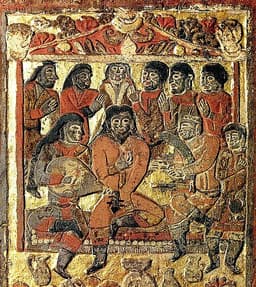
Muhan Qaghan
Emperor · Medieval
64.9Total

Napoleon Bonaparte
General · Modern
70.9Total
Basic Information
Born
540
1769
Died
572
1821
Era
Medieval
Modern
Nationality
Gokturk Khaganate
France
Occupation
Emperor
General
Civilization
Eastern
Western
Score Comparison
Military (10%)
74.0
94.0
Political (20%)
72.0
72.0
Influence (20%)
58.3
40.0
Legacy (20%)
54.0
80.0
Leadership (15%)
79.8
78.0
Strategy (15%)
66.3
90.0
TOTAL
64.9
70.9
Muhan Qaghan — Complete Timeline
557 AD
Conquest of the Hephthalite EmpireWar◆ Major
Muhan Qaghan allied with the Sassanid Persian Empire to defeat the Hephthalite Empire in Central Asia. The Hephthalites were crushed, and their territory was divided between the Turks and Persians, with the Turks gaining the eastern regions.
ConquestHephthalites
Impact: regionaldestructive
560 AD
Expansion of the Turkic Khaganate to its greatest extentWar◆ Major
Muhan Qaghan led campaigns that expanded the Turkic Khaganate to its maximum territorial extent, stretching from the Caspian Sea to the borders of China. He conquered the Hephthalites in Central Asia and subjugated many tribes, making the khaganate a dominant power.
ExpansionTurkic Empire
Impact: regionalconstructive
565 AD
Suppression of internal revoltsWar
Muhan Qaghan faced revolts from subject tribes, including the Tiele and other steppe peoples. He brutally suppressed these uprisings, executing many leaders and forcibly relocating populations to maintain control over the vast khaganate.
Revolt SuppressionInternal Conflict
Impact: regionaldestructive
568 AD
Diplomatic relations with the Byzantine EmpirePolitical Action◆ Major
Muhan Qaghan sent an embassy to the Byzantine Empire, establishing diplomatic and trade relations. This alliance was aimed against the Sassanid Persians, and it opened the Silk Road to Turkic merchants, increasing the khaganate's wealth and influence.
DiplomacyByzantine-Turkic Alliance
Impact: globalconstructive
Napoleon Bonaparte — Complete Timeline
1799 AD
Coup of 18 BrumaireOther◆ Major
Napoleon Bonaparte, with support from his brother Lucien and key political figures, overthrew the Directory in a bloodless coup. He established the Consulate with himself as First Consul, effectively becoming the ruler of France. This event ended the French Revolution's most unstable period.
French RevolutionCoupRise to Power
Impact: regional
1804 AD
Promulgation of the Napoleonic CodeOther◆ Major
Napoleon enacted the Civil Code of the French, known as the Napoleonic Code, a comprehensive set of laws that replaced the fragmented feudal legal systems. The code established legal equality, protected property rights, and secularized law. It became the basis for legal systems in many European and world countries.
Legal ReformNapoleonic CodeCivil Law
Impact: globalconstructive
1805 AD
Battle of AusterlitzWar◆ Major
Napoleon's Grande Arm
Napoleonic WarsBattleDecisive Victory
Impact: global
1812 AD
Invasion of RussiaWar◆ Major
Napoleon led the Grande Arm
Napoleonic WarsInvasionDisaster
Impact: globaldestructive
1815 AD
Battle of WaterlooWar◆ Major
Napoleon's French army was defeated by the combined forces of the Duke of Wellington's Anglo-Allied army and Gebhard Leberecht von Bl
Napoleonic WarsBattleFinal Defeat
Impact: globaldestructive
Expert Analysis
muhan-qaghan-vs-napoleon-bonaparte
# The Eagle and the Wolf: Two Visions of Empire
On a spring morning in 1815, Napoleon Bonaparte stood before his assembled army in the courtyard of the Tuileries Palace, the tricolor snapping in the wind. Half a world away and twelve centuries earlier, a Turkic ruler named Muhan Qaghan gazed across the endless steppes from his felt tent, his horsemen stretching to the horizon. Both men commanded armies that reshaped the known world. Yet one name echoes through every schoolbook, while the other remains a whisper in the pages of specialists. Why does one conqueror become a household legend, while another, who built an empire vaster in its time, fades into obscurity?
Origins
Napoleon was born in 1769 on the Mediterranean island of Corsica, a place recently annexed by France. His family was minor nobility, poor enough to feel the sting of want but proud enough to nurse ambitions. The French Revolution, erupting when he was twenty, shattered the old order and opened paths that birth alone could never have granted. He was a child of chaos, and chaos was his element.
Muhan Qaghan, born around 540, emerged from a very different world. The Göktürks were a confederation of steppe tribes, their lives shaped by the rhythm of horses, the vastness of the Central Asian plains, and the constant pressure of neighboring empires. His grandfather, Bumin Qaghan, had founded the khaganate only decades earlier, throwing off the yoke of the Rouran. Muhan inherited not a revolution but a fragile young state, surrounded by predators: the Hephthalite Empire to the south, the Sassanid Persians to the west, and the ever-present threat of internal rebellion.
Rise to Power
Napoleon’s ascent was meteoric, a story of sheer will. At twenty-four, he drove the British out of Toulon. At twenty-six, he crushed a royalist uprising in Paris with a “whiff of grapeshot.” By thirty, he had conquered Italy and Egypt. His path was paved with victories that dazzled Europe: the Battle of the Pyramids, the crossing of the Alps, Austerlitz. Each triumph was a calculated gamble, a blend of genius and audacity that made him seem touched by fate.
Muhan’s rise was more measured, the work of a builder rather than a gambler. He became qaghan around 553, inheriting a realm still consolidating its power. His great moment came in 557, when he allied with the Sassanid Persian Empire to crush the Hephthalite Empire, the dominant force in Central Asia. This was not a single battle but a campaign of patient diplomacy and coordinated warfare. The Hephthalites, who had terrorized both Persians and Turks for generations, were annihilated. By 560, Muhan’s khaganate stretched from the Caspian Sea to the borders of China, the largest empire the steppes had yet seen.
Leadership & Governance
Napoleon ruled through force of personality and institutional genius. He centralized the French state, created the Napoleonic Code—a legal framework that influenced civil law across Europe—and appointed officials based on merit, not birth. He understood the power of symbols: the Legion of Honor, the imperial coronation, the grand boulevards of Paris. But his governance was a double-edged sword. He demanded total loyalty, crushed dissent, and placed his brothers on thrones they could not hold. His system depended on his own presence; it could not survive his absence.
Muhan ruled through a different logic, that of the steppe confederation. He did not impose a uniform code or build stone cities. Instead, he maintained power by balancing tribes, distributing plunder, and projecting overwhelming force when necessary. In 565, when the Tiele and other subject peoples rose in revolt, he suppressed them with brutal efficiency. But he also knew when to extend the hand of alliance. In 568, he sent an embassy to the Byzantine Empire, proposing a joint campaign against the Sassanids. This was statecraft of a high order—a steppe ruler reaching across continents to reshape the balance of power.
Triumph & Tragedy
Napoleon’s greatest triumph was Austerlitz in 1805, where he destroyed a combined Russian and Austrian army in a battle still studied in military academies. His greatest tragedy was the invasion of Russia in 1812. He marched with half a million men; fewer than a hundred thousand returned. The disaster broke his aura of invincibility. Exiled to Elba, he escaped, raised another army, and met his final defeat at Waterloo in 1815. He died six years later on Saint Helena, a prisoner of the British.
Muhan’s triumph was the conquest of the Hephthalites, which secured the khaganate for generations. His tragedy came not from a single battle but from the nature of his empire. The Göktürks were a nomadic confederation, held together by personal loyalty and success in war. When Muhan died in 572, the khaganate began to fracture. His successors lacked his prestige, and within decades, the empire split into eastern and western halves. The steppe had no room for a legacy that could not be enforced from the saddle.
Character & Destiny
Napoleon was a man of relentless ambition, insatiable energy, and a belief that he could bend history to his will. “Impossible,” he once said, “is a word to be found only in the dictionary of fools.” This conviction drove him to the heights of power—and to the depths of ruin. He could not stop, could not consolidate, could not share power. His destiny was to burn bright and fast.
Muhan was a different kind of ruler: pragmatic, patient, and keenly aware of limits. He did not seek to conquer the world; he sought to secure his people. He built alliances, chose his enemies carefully, and understood that on the steppe, survival was more important than glory. His destiny was to build an empire that lasted, in some form, for centuries—but without the dramatic arc that makes for legend.
Legacy
Napoleon’s legacy is written in the legal codes of Europe, the boundaries of nations, the very concept of modern warfare. He is remembered as a genius and a tyrant, a liberator and a conqueror. His name is a byword for ambition.
Muhan’s legacy is quieter but no less real. The Göktürks he led gave rise to the Turkic peoples who would later create the Seljuk and Ottoman empires. The diplomatic ties he forged with Byzantium echoed through the Middle Ages. But his name is known only to scholars, his empire a footnote in the story of others.
Conclusion
The difference between Napoleon and Muhan is not one of ability but of context. Napoleon conquered a world of writing, printing presses, and national memory. Muhan ruled a world of oral tradition, shifting alliances, and wind-scoured plains. One became a legend because his world was built to remember; the other faded because his world was built to endure, not to record. Both were masters of their age. But the age itself determines who gets to be remembered.
Rankings
🥇
Napoleon BonaparteLeader
Mil: 94.0Pol: 72.0Inf: 40.0
70.9
🥈
Muhan Qaghan
Mil: 74.0Pol: 72.0Inf: 58.3
64.9
+6.0 behind
How This Comparison Works
Algorithm
Each figure is scored on 6 dimensions (0—100 scale) based on structured historical data: Military (10%), Political (20%), Influence (20%), Legacy (20%), Leadership (15%), Strategy (15%). The weighted total produces the final ranking.
Data Sources
Scores are computed from structured sub-indicators in the database. Scale factors adjust for era (Ancient ×0.85, Modern ×1.0) and civilization size (Eastern ×1.05, Other ×0.80) to account for differences in population and military scale.
Maximum 3 Figures
Comparisons are limited to 2—3 figures to ensure readability and statistical meaningfulness.
Error Margins
±5 points per dimension — Sub-scores are derived from historical records with inherent uncertainty. Two figures within 5 points on a dimension should be considered roughly equivalent in that area.
Total Score Accuracy
±3 points overall — The weighted combination of 6 dimensions produces a total score with approximately ±3 points of uncertainty. Differences of less than 3 points are not statistically significant— the figures are effectively tied.
Known Limitations
- Historical records are incomplete and uneven across civilizations
- Figures from oral-tradition societies may be underrepresented
- Occupation labels can misclassify multi-role figures
- Scores measure capability and impact, not moral character
- Quantitative scoring is a comparison tool, not absolute truth
Capability Radar
Military (10%) — Battles & Warfare
Battles
75
95
Win Rate
80
90
Expansion
90
95
Political (20%) — Governance & Reform
Reform
65
95
Diplomacy
75
80
Economy
60
85
Influence (20%) — Cultural & Global Reach
Cultural
55
85
Global
55
90
Legacy (20%) — Historical Impact
Historical
65
95
Longevity
50
90
Leadership (15%) — Power & Stability
Tenure
80
85
Stability
70
70
Strategy (15%) — Tactics & Innovation
Strategy
85
95
Tactics
70
98
Reform
60
92
Similar Comparisons
Comments & Discussion
No comments yet. Be the first to share your thoughts!