Loading...
Murad I vs Napoleon Bonaparte
Napoleon Bonaparte leads by 8.8 pts · 2 figures compared
…
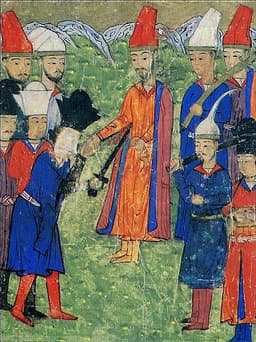
Murad I
Emperor · Medieval
62.1Total

Napoleon Bonaparte
General · Modern
70.9Total
Basic Information
Born
1326
1769
Died
1389
1821
Era
Medieval
Modern
Nationality
Ottoman Empire
France
Occupation
Emperor
General
Civilization
Middle Eastern
Western
Score Comparison
Military (10%)
77.2
94.0
Political (20%)
64.8
72.0
Influence (20%)
56.7
40.0
Legacy (20%)
52.0
80.0
Leadership (15%)
72.0
78.0
Strategy (15%)
67.2
90.0
TOTAL
62.1
70.9
Murad I — Complete Timeline
1362 AD
Accession as Ottoman SultanPolitical Action
Murad I became the third Ottoman ruler after the death of his father, Orhan. He was the first to use the title of Sultan, marking the transition from a beylik to an empire.
SuccessionOttoman Empire
Impact: regionalconstructive
1369 AD
Conquest of AdrianopleWar◆ Major
Murad I captured the city of Adrianople (Edirne) from the Byzantine Empire. He made it the new Ottoman capital, shifting the center of power into Europe.
ConquestCapital Move
Impact: regionalconstructive
1380 AD
Establishment of the devshirme systemReform◆ Major
Murad I institutionalized the devshirme system, recruiting Christian boys from the Balkans to serve as Janissaries and administrators. This created a loyal elite corps and strengthened the Ottoman state.
Military ReformJanissaries
Impact: regionalconstructive
1389 AD
Battle of KosovoWar
Murad I led Ottoman forces against a coalition of Balkan states led by Serbia at the Battle of Kosovo. The battle was a tactical stalemate but resulted in heavy losses for both sides. Murad I was assassinated during or after the battle.
BattleAssassination
Impact: regionaltragic
Napoleon Bonaparte — Complete Timeline
1799 AD
Coup of 18 BrumaireOther◆ Major
Napoleon Bonaparte, with support from his brother Lucien and key political figures, overthrew the Directory in a bloodless coup. He established the Consulate with himself as First Consul, effectively becoming the ruler of France. This event ended the French Revolution's most unstable period.
French RevolutionCoupRise to Power
Impact: regional
1804 AD
Promulgation of the Napoleonic CodeOther◆ Major
Napoleon enacted the Civil Code of the French, known as the Napoleonic Code, a comprehensive set of laws that replaced the fragmented feudal legal systems. The code established legal equality, protected property rights, and secularized law. It became the basis for legal systems in many European and world countries.
Legal ReformNapoleonic CodeCivil Law
Impact: globalconstructive
1805 AD
Battle of AusterlitzWar◆ Major
Napoleon's Grande Arm
Napoleonic WarsBattleDecisive Victory
Impact: global
1812 AD
Invasion of RussiaWar◆ Major
Napoleon led the Grande Arm
Napoleonic WarsInvasionDisaster
Impact: globaldestructive
1815 AD
Battle of WaterlooWar◆ Major
Napoleon's French army was defeated by the combined forces of the Duke of Wellington's Anglo-Allied army and Gebhard Leberecht von Bl
Napoleonic WarsBattleFinal Defeat
Impact: globaldestructive
Expert Analysis
murad-i-vs-napoleon-bonaparte
# The Sultan and the Emperor
On a June morning in 1815, Napoleon Bonaparte watched his Imperial Guard advance across the muddy fields of Waterloo, the last gamble of a man who had once commanded half of Europe. Four centuries earlier, on another battlefield in the Balkans, Sultan Murad I fell to an assassin’s dagger just as his army crushed a coalition of Christian kings. Both men died in war, but their paths to that final moment could not have been more different. Napoleon’s life was a comet—brilliant, swift, and consumed by its own fire. Murad’s was a slow forge, hammering an empire that would outlast him by five hundred years. Why did one become a legend of conquest and collapse, the other a quiet architect of endurance?
Origins
Napoleon was born in 1769 on the island of Corsica, a place of fierce independence recently annexed by France. His family was minor nobility, poor enough to feel the sting of inferiority but proud enough to dream. The son of a lawyer, he spoke French with an Italian accent that aristocrats mocked. This outsider’s hunger drove him. He entered military school at nine, graduated early, and by his early twenties devoured books on artillery, history, and Enlightenment philosophy. The French Revolution shattered the old world, and Napoleon—ambitious, brilliant, ruthless—saw that chaos was opportunity.
Murad I came from a different world entirely. Born in 1326, he was the son of Orhan, the second ruler of a small Turkish beylik in Anatolia. The Ottoman state was a frontier war machine, born from the collapse of the Seljuk Empire and the weakening of Byzantium. Murad grew up in a tent, not a palace. He learned to ride before he could read, to command before he could write. His education was the saddle and the sword. There was no revolution to exploit; there was only the slow, grinding expansion of a tribe into an empire, one raid, one treaty, one marriage at a time.
Rise to Power
Napoleon’s ascent was volcanic. At twenty-four, he drove the British out of Toulon with a brilliant artillery plan. At twenty-six, he crushed a royalist uprising in Paris with a “whiff of grapeshot.” By twenty-seven, he led an army into Italy and defeated the Austrians in a campaign that remains a textbook of speed and deception. In 1799, he seized power in a coup, becoming First Consul of France. He was thirty. Within five years, he crowned himself Emperor in Notre Dame, taking the crown from the Pope’s hands and placing it on his own head.
Murad’s rise was a matter of inheritance and patience. In 1362, at the age of thirty-six, he became sultan after his father’s death. He was the first Ottoman ruler to claim the title formally—a sign that the tribe was becoming a state. His early years were spent not in dazzling campaigns but in consolidating control over Anatolia, crushing rebellions, and buying off rivals. Where Napoleon gambled on glory, Murad gambled on time.
Leadership & Governance
Their styles of rule reflect their worlds. Napoleon was a military genius—scoring a 93 in strategy and 94 in military aptitude, among the highest ever recorded. He reorganized French armies into corps that could march separately and strike together. He used speed to split enemies and artillery to shatter them. His political score of 75 reflects a man who was a brilliant tactician but a flawed statesman. He centralized France, created the Napoleonic Code—a legal system that still influences half the world—but he also suppressed dissent, reinstated slavery, and made peace a prelude to more war.
Murad I, by contrast, scored 86 in politics and 90 in leadership. His genius was not in winning battles but in building institutions. In 1369, he captured Adrianople (modern Edirne) from Byzantium and made it his capital, shifting the Ottoman center of power into Europe itself. Around 1380, he institutionalized the devshirme system—the “boy levy” that took Christian children from the Balkans, converted them to Islam, and trained them as Janissaries and administrators. This was a stroke of political brilliance: it created a loyal elite with no local ties, dependent entirely on the sultan. Napoleon built an empire on his own genius; Murad built an empire that could survive without him.
Triumph & Tragedy
Napoleon’s greatest triumph was Austerlitz in 1805, where he destroyed a combined Russian and Austrian army in a single day. His empire stretched from Spain to Poland. But his tragedies were self-inflicted: the disastrous invasion of Russia in 1812, the brutal occupation of Spain, the final defeat at Waterloo in 1815. Exiled to St. Helena, he died at fifty-one, a prisoner of the British.
Murad’s triumph was the Battle of Kosovo in 1389, where his army defeated a Serbian-led coalition. But he was killed during the battle—stabbed by a Serbian knight pretending to surrender. His tragedy was not defeat but a death that could have undone everything. Yet it did not. His son Bayezid took command, hid the sultan’s death until victory was certain, and continued the expansion. Murad’s death became a foundation myth, not a collapse.
Character & Destiny
Napoleon was driven by an insatiable ego. “I am not a man,” he once said, “but a thing.” He believed in destiny, in his own star. This made him fearless in battle but blind to limits. He could not stop. He invaded Russia because he could not bear not to. He refused peace offers because he thought only of victory. His character was his destiny: a man who conquered the world but could not govern it.
Murad was colder, more calculating. He was a builder, not a destroyer. He did not need to be loved; he needed to be obeyed. He expanded the Ottoman state through marriage, bribery, and careful war. He understood that an empire is not a conquest but a system. Where Napoleon burned bright and fast, Murad burned slow and steady.
Legacy
Napoleon’s legacy is a paradox. He is remembered as a military genius, a reformer, a tyrant. The Napoleonic Code lives on; his battles are studied; his name is synonymous with ambition. But his empire crumbled within a decade of his death. He scored 82 in influence and 78 in legacy—high, but haunted by failure.
Murad I, with a legacy score of 69, is less famous. But the institutions he built—the devshirme, the Janissaries, the capital at Edirne—shaped the Ottoman Empire for centuries. His total score of 76 hides a deeper truth: he created a state that would last until 1922. Napoleon conquered Europe; Murad built a world.
Conclusion
Standing on the fields of Waterloo, Napoleon saw his empire dissolve in a single afternoon. Murad, bleeding on the field of Kosovo, saw his empire rise from his own death. One man’s life was a story of flame; the other’s was a story of foundation. Perhaps the difference is not in brilliance but in purpose. Napoleon wanted to be remembered. Murad wanted to be continued. History, in the end, favors the builders over the burners.
Rankings
🥇
Napoleon BonaparteLeader
Mil: 94.0Pol: 72.0Inf: 40.0
70.9
🥈
Murad I
Mil: 77.2Pol: 64.8Inf: 56.7
62.1
+8.8 behind
How This Comparison Works
Algorithm
Each figure is scored on 6 dimensions (0—100 scale) based on structured historical data: Military (10%), Political (20%), Influence (20%), Legacy (20%), Leadership (15%), Strategy (15%). The weighted total produces the final ranking.
Data Sources
Scores are computed from structured sub-indicators in the database. Scale factors adjust for era (Ancient ×0.85, Modern ×1.0) and civilization size (Eastern ×1.05, Other ×0.80) to account for differences in population and military scale.
Maximum 3 Figures
Comparisons are limited to 2—3 figures to ensure readability and statistical meaningfulness.
Error Margins
±5 points per dimension — Sub-scores are derived from historical records with inherent uncertainty. Two figures within 5 points on a dimension should be considered roughly equivalent in that area.
Total Score Accuracy
±3 points overall — The weighted combination of 6 dimensions produces a total score with approximately ±3 points of uncertainty. Differences of less than 3 points are not statistically significant— the figures are effectively tied.
Known Limitations
- Historical records are incomplete and uneven across civilizations
- Figures from oral-tradition societies may be underrepresented
- Occupation labels can misclassify multi-role figures
- Scores measure capability and impact, not moral character
- Quantitative scoring is a comparison tool, not absolute truth
Capability Radar
Military (10%) — Battles & Warfare
Battles
75
95
Win Rate
80
90
Expansion
82
95
Political (20%) — Governance & Reform
Reform
75
95
Diplomacy
68
80
Economy
65
85
Influence (20%) — Cultural & Global Reach
Cultural
55
85
Global
60
90
Legacy (20%) — Historical Impact
Historical
70
95
Longevity
65
90
Leadership (15%) — Power & Stability
Tenure
70
85
Stability
60
70
Strategy (15%) — Tactics & Innovation
Strategy
78
95
Tactics
70
98
Reform
72
92
Similar Comparisons
Comments & Discussion
No comments yet. Be the first to share your thoughts!